Psychophysics Neuroscience
 Studied by 16 people
 Call Kai
 Learn
Learn Practice Test
 Spaced Repetition
 Match
Match Flashcards
 Knowt Play
1/38

There's no tags or description
Looks like no tags are added yet.
Name | Mastery | Learn | Test | Matching | Spaced | Call with Kai |
|---|
No analytics yet
Send a link to your students to track their progress
39 Terms
How do we measure sensation/perception
Thresholds
Scales
Signal Detection
Cellular/Neuronal Neuroscience
Systems Neuroscience
Systems Neuroscience
Psychophysics
The science of defining quantitative relationships between physical and psychological event
Can control the physical stimuli and then measure how a person responds
Extension from the philosophical ideal of Dualism
Invented by Gustav Fechner
Dualism
The mind exists separately from the material world and thus is not a pure representation of it
Gustav Fechner
1801-1887
Initially damaged his eyesight by staring at the sun doing vision research
Led to one of the earliest experimental psychology fields
Showed that the mind can be studied and quantified
Thresholds
Generally the minimum difference between stimuli (or between a stimulus and baseline) needed to be detected as different
A quantifiable measurement of our perceptual abilities
Two Point Threshold
Within the realm of touch
The minimum distance at which two separate sensations can be distinguished
Just noticeable difference (JND)
The smallest detectable difference between 2 stimuli, or the minimum change in a stimulus that can be correctly judged as different from a reference stimulus
i.e: difference threshold
Absolute threshold
Minimum amount of stimulation necessary for a person to detect a stimulus 50% of the time
Weber’s Law
The principle describing the relationship between stimulus and resulting sensation that says the JND is a constant fraction of the comparison stimulus
Larger stimulus values have larger JNDs and smaller stimulus values have smaller JNDs
Thus, larger amounts of a stimulus in the environment require larger changes for a JND, and in turn smaller stimulus values have smaller JND
“proportional” relationship
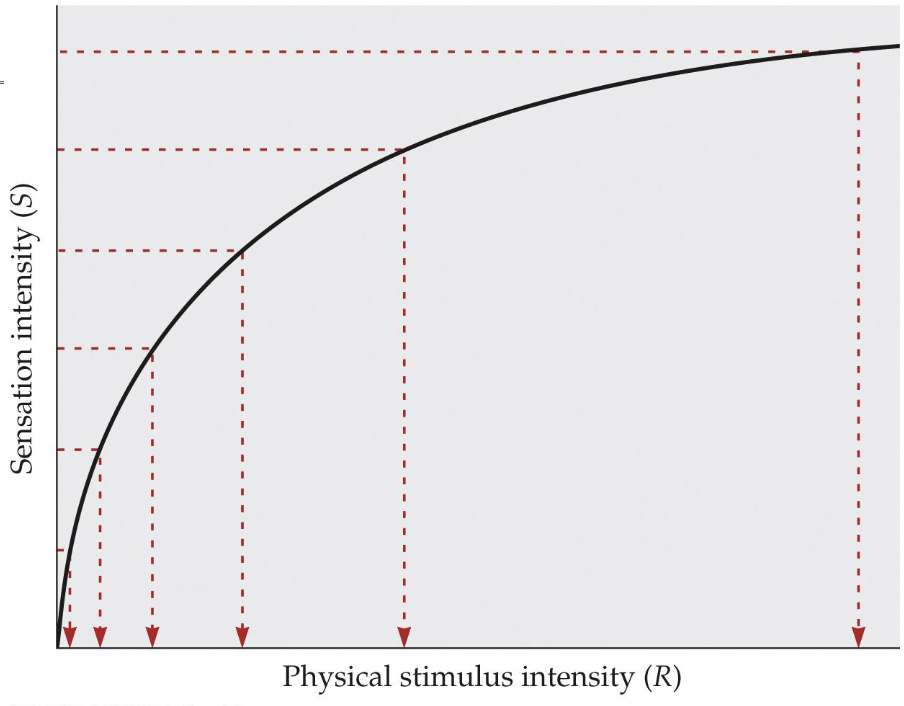
Fechner’s Law
A formalized version of Weber’s Law
A principle describing the relationship between stimulus magnitude and resulting sensation magnitude such that the magnitude of subjective sensation increases proportionally to the logarithm of the stimulus intensity
“logarithmic” relationship
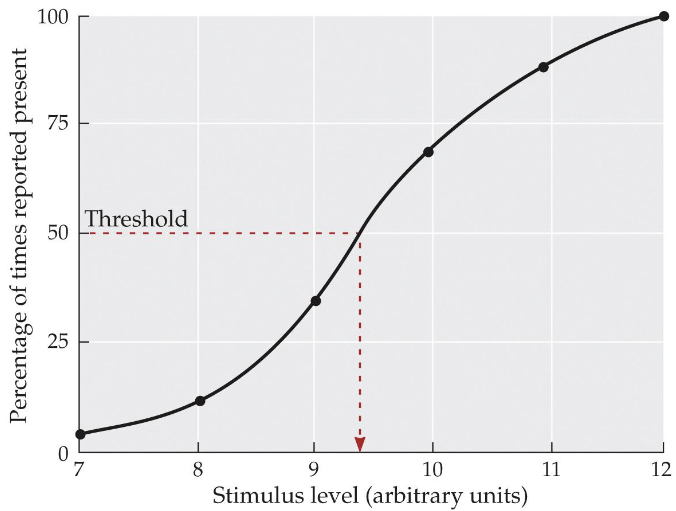
Method of constant stimuli
Test many stimuli, one at a time, across a range including barely perceptible to always perceptible
There is no such thing as “perfect conditions” so it is the point at which you detect it 50% of the time
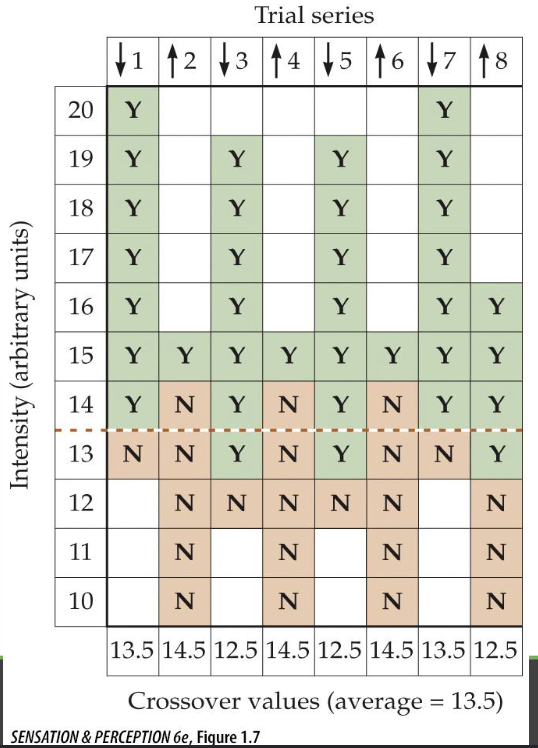
Method of Limits
Vary the magnitude of a stimulus (or difference between two) until participant notices
Scientist adjusts the magnitude change
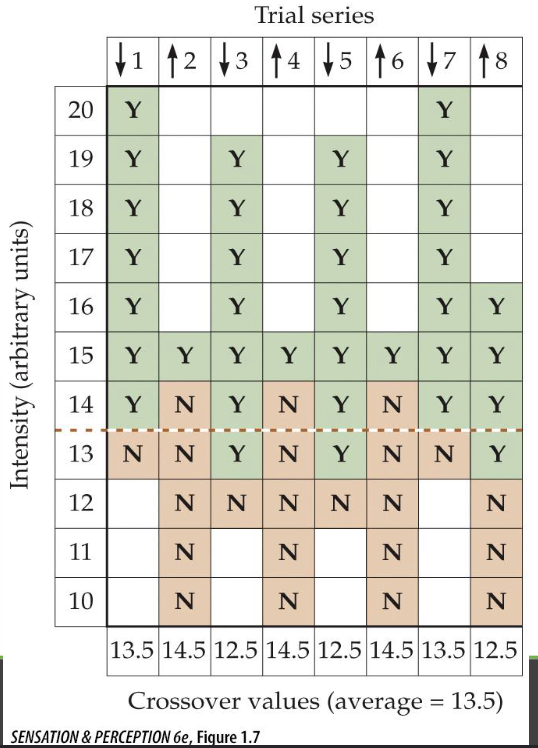
Method of Adjustments
Let participant adjust a stimulus until it matches a target (e.g. color matching)
Participant adjusts the magnitude change
Scaling Methods
Measuring the “strength” of your sensation, rather than threshold of detection
Not all sensations have the same scale, or strength
Can measure this with magnitude estimation
give participants a sensation and have them rate its strength
Can do freeform, or give a starting baseline
Sensations have different scales
Stevens’s Power Law
S=aI^b
S = sensation
I = intensity of stimulus
b = exponent tied to stimulus type
a = constant adjusted to put different scales on the same axis
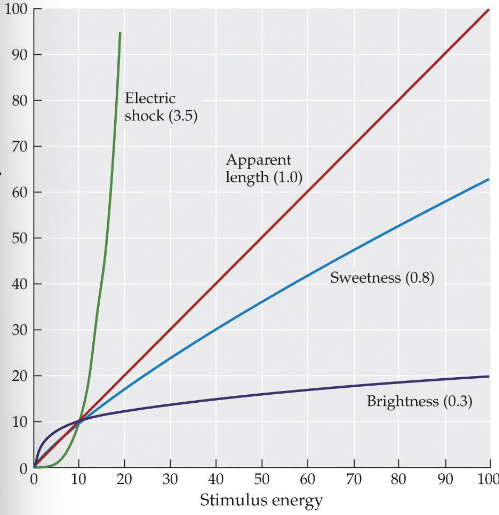
Fechner’s vs Stevens’ “Laws”
Fechner’s is logarithmic whereas Stevens’ is power
Both make broad assumptions about the “fit” of data to their metrics and about the scales they work on
Both are only approximations of data and turn out to not really be “laws”
Both show:
People’s internal perception can be modeled
Sensation is proportional to other parameters
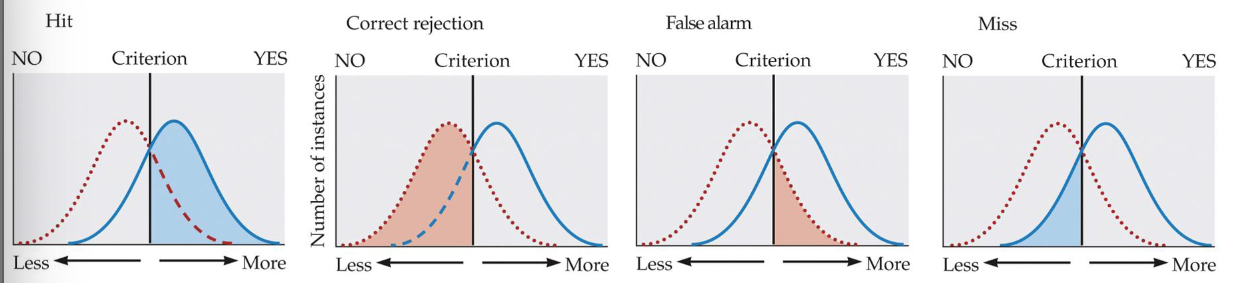
Signal Detection Theory (SDT)
Our ability to detect a signal amongst noise
Accounts for the amount of noise, the discriminability of the signal, and biases in the person’s response patterns
Important to know the signal strength, noise, and criterion, and how they shift
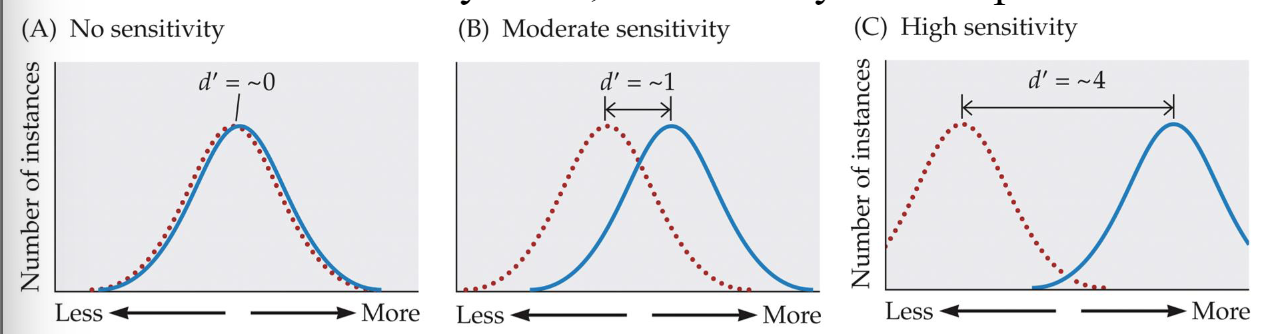
Sensitivity in Signal Detection Theory
How discriminable the target is from the noise can shift results
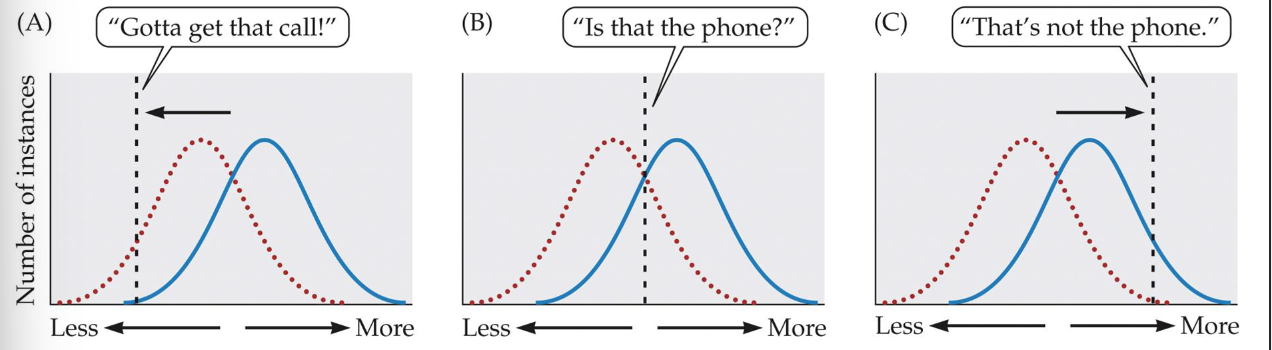
Criterion in Signal Detection Theory
The decision threshold
Can be shifted be the subject
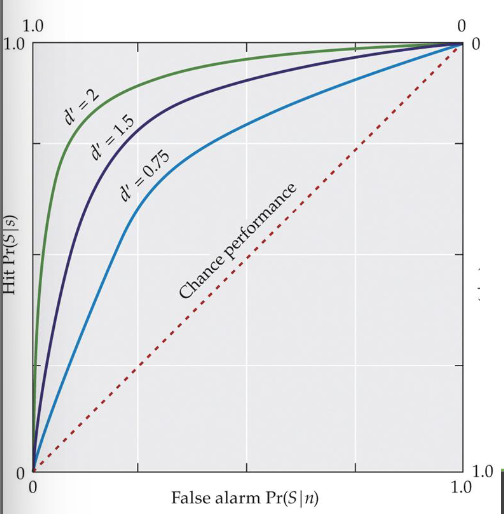
Receiver Operating Characteristic (ROC) Curves
Model of SDT data
Demonstrate both the sensitivity and criterion in one line
With greater sensitivity, curve moves closer to top left corner
Transductions
The translation process that all sensory organ due when they take physical stimuli and convert them to electrical/biochemical signals in our nervous system
The way is occurs is unique to each system, but has same basic tenets
The signal become part of our nervous system’s communication, and then relies on the building blocks of nervous system, neurons and nerves
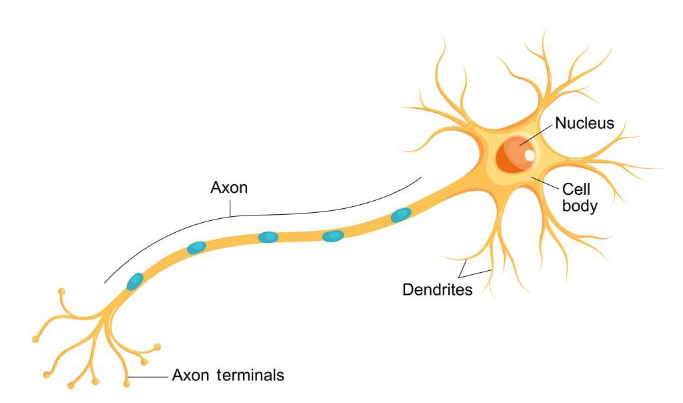
What makes up the neuron
Axon terminals
Axon
Dendrites
Nucleus
Cell Body
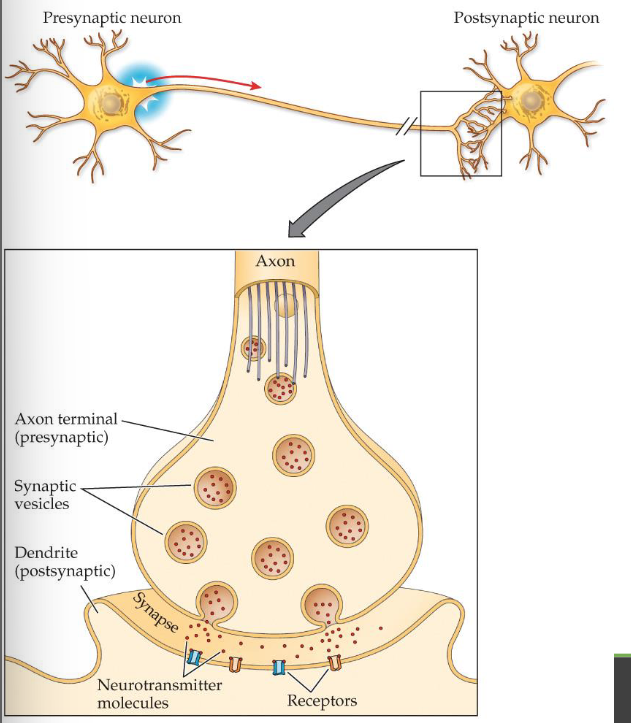
Synapse
The space between 2 neurons
Neuronal Communication - Chemical
Neurons generally transmit signals via neurotransmitters at the synapse
Pre-synaptic neuron releases neurotransmitters into the synapse
Post-synaptic neuron has receptors that are then activated by neurotransmitters
Neurotransmission cues, and is cued by electrochemical action potentials
Neuronal Communication - Electrical
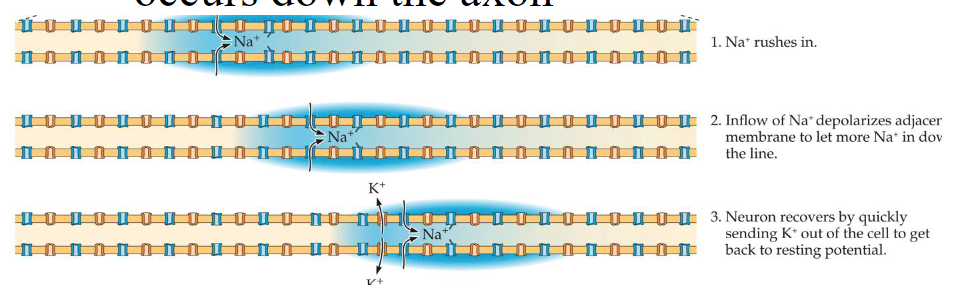
Cells polarized in resting state
When AP threshold reached, depolarization occurs down the axon
Neurotransmitters trigger an electrical shift in the post-synaptic neuron, leading to the neuron “firing” an action potential
Neurons fire in an all-or-none fashion for each action potential, or “spike”
The number of spikes per second indicates how excited the neuron is
Each action potential starts near the cell body of a neuron and propagates down the axon towards the axon terminal
Electrochemical process involves Na+ & K+ ions moving in/out of the neuron
Entire populations of neurons work in concert to process information
Cellular Neuroscience
Neurons themselves still follow the laws of physics
Neuronal signals often compete
Can have excitatory and inhibitory signals
Can research how particular cells function, how they’re organized, what neurotransmitters are involved in particular types of communication, and much more
Nerves
Generally bundles of neurons, typically that extend into the peripheral nervous system
12 Cranial Nerves
Nerves that connect the brain stem to various organs/muscles
Some send information to the brain (afferent; sensory) and some send information from the brain (efferent; motor) and some do a bit of both
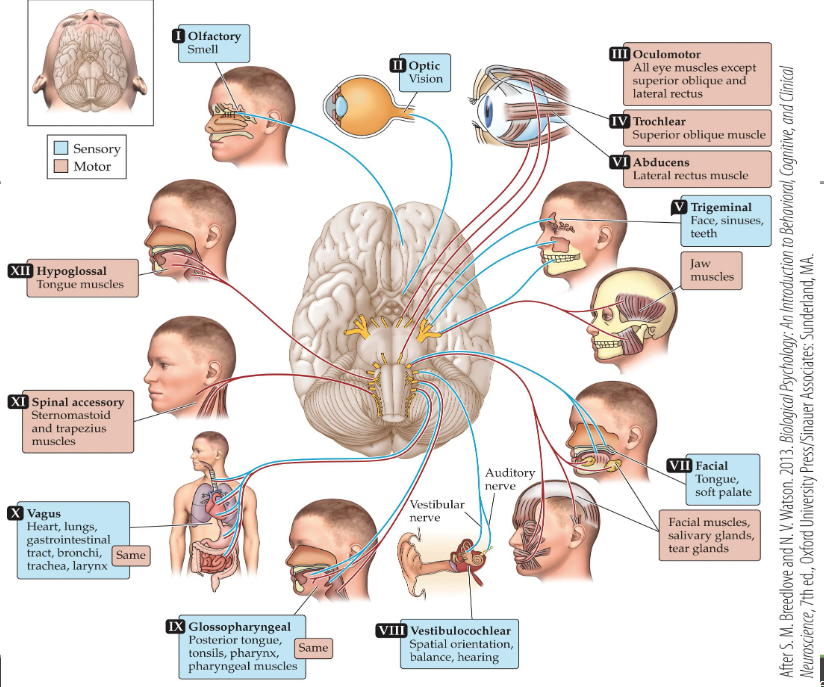
Afferent nerves
Sensory
Send information to the brain
Efferent nerves
Motor
Send information from the brain
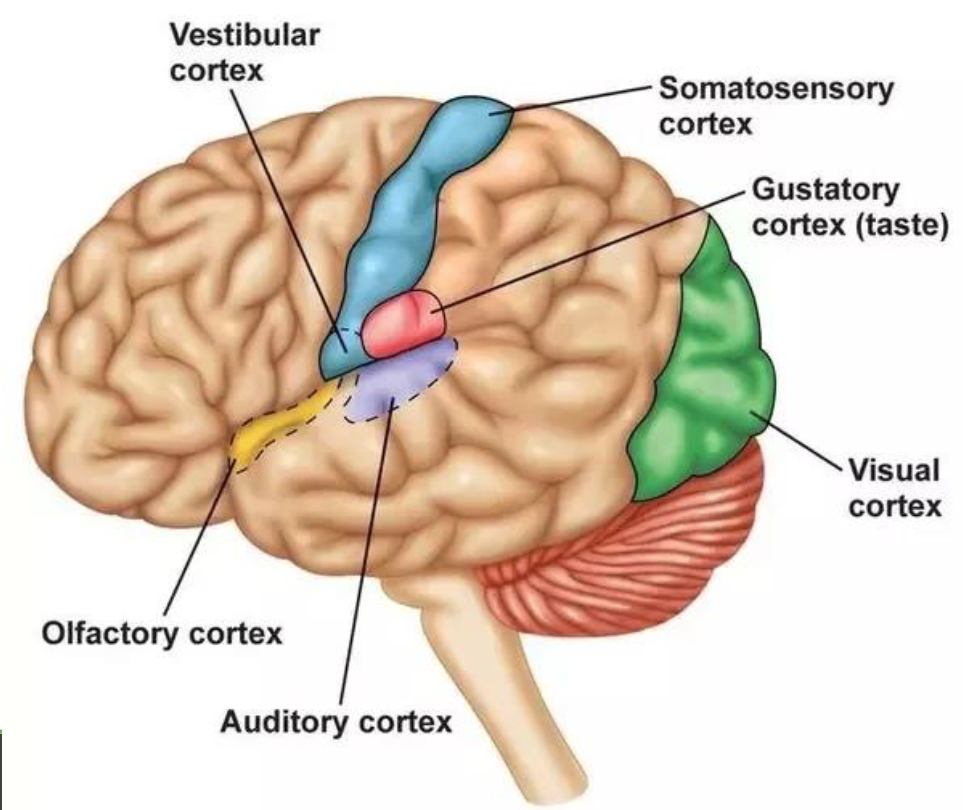
Sensory Cortices
Just as there are different nerves related to different senses, so too are there different parts of the brain that process that information
But this does not mean they never interact
Other regions integrate information between senses
Electroencephalography (EEG)
B placing electrodes on your scalp, we can directly measure the electrical activity generated by neuronal firing, only we’re measuring the firing of large populations of neurons
Can assess Event-Related Potentials (ERP), which are the change in EEG signal as a result of an event, such as a sensation
Need many trials of the event to average across, as the signal is noisy
Excellent temporal resolution (millisecond range), poor spatial resolution
Magnetic Resonance Imaging - Structural
Uses shifts in powerful magnetic fields to asses the atomic structure of tissue
No X-Ray radiation like a CT scan
But magnet dangerous if metals brought in
Magnetic Resonance Imaging - Functional
When neurons fire more, they require more oxygen
fMRI tracks the Blood Oxygen Level Dependent (BOLD) signal, which is the ratio of oxygenated to deoxygenated hemoglobin that shifts in response to neuronal activity
This is an indirect measure of brain activity
Can measure increases and decreases in response to a sensation
Also requires a large # of trials to average
Excellent spatial resolution (millisecond range), poor temporal resolution (1-2s period)
Positron Emission Topography (PET)
Similar resolution to fMRI but based on metabolism of brain cells (requires injection but can track particular neurotransmitters)
Magnetoencephalography (MEG)
Sort of between EEG and fMRI, that measures changes in magnetic activity across populations of many neurons in the brain
Good temporal resolution, and good spatial resolution for at least the surface of the brain
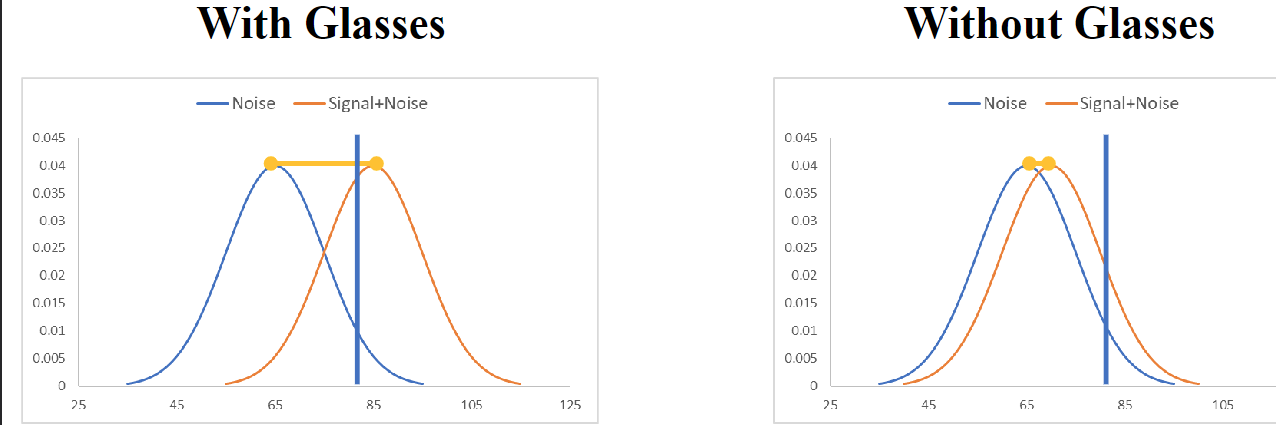
Velma is searching for clues with Scooby and the Gang, when she, as always, breaks her glasses. According to signal detection theory, what MUST have changed with regards to her vision by losing access to her glasses?
A) Her criterion becomes more lax, and she is more likely to accept stimuli as real even if they are not.
B) Her criterion becomes more strict, and she is less likely to accept stimuli as real, even if they really are.
C) Her sensitivity increases, as she is more able to distinguish between signal and noise
D) Her sensitivity decreases, as she is less able to distinguish between signal and noise
D) Her sensitivity decreases, as she is less able to distinguish between signal and noise
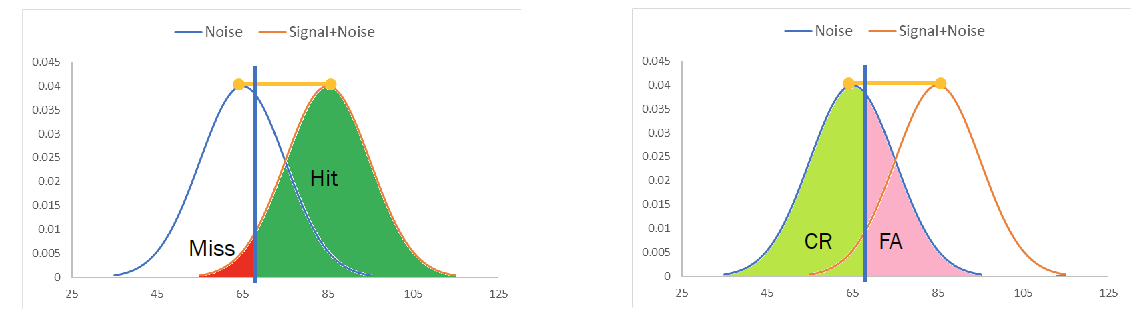
Bjorn is expecting a phone call. After repeatedly accidentally checking his phone, he has started using a stricter criterion, wanting to avoid false alarms. Which of the following statements reflects what may also happen now that he has a stricter criterion?
A) He is more likely to false alarm to noise, accepting as signal.
B) He is less likely to detect a real call, missing it as noise.
C) He is more likely to detect a real call, discriminating it from noise.
D) He is less likely to correctly reject noise, mistaking it as a phone call.
B) He is less likely to detect a real call, missing it as noise.
Which statement is true about EEG:
A) It is a direct measure that has good spatial resolution
B) It is an indirect measure that has good spatial resolution
C) It is a direct measure that has good temporal resolution
D) It is an indirect measure that has good temporal resolution
C) It is a direct measure that has good temporal resolution
 Note
Note  Flashcards (127)