Midterm 1 BIOL 201
 Call Kai
 Learn
Learn Practice Test
 Spaced Repetition
 Match
Match Flashcards
 Knowt Play
1/76

There's no tags or description
Looks like no tags are added yet.
Name | Mastery | Learn | Test | Matching | Spaced | Call with Kai | Chat |
|---|
No analytics yet
Send a link to your students to track their progress
77 Terms
What is the purpose and process of SDS-PAGE?
Purpose:
Identify proteins that are known to have a certain molecular weight
Process:
1. SDS
Negative charged detergent that unfolds proteins at high temps. by breaking non-covalent bonds
Coats denatured protein in negative charges to migrate to positive end of the gel
2. Beta-mercaptoethanol
Break covalent disulfide bonds
3. Put the samples in their lanes with the and compare with the ladder (standard gels)
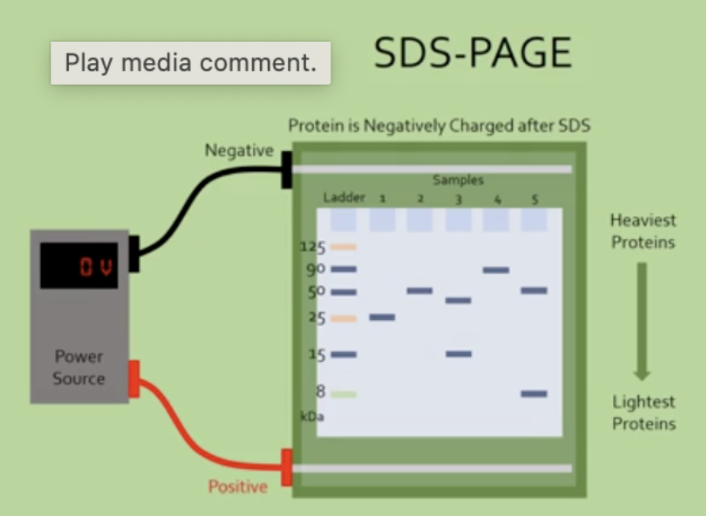
How are proteins separated in SDS-PAGE? What is the order of elution?
Separated:
By mass
Elution:
Top: Heavy proteins / less negative
Bigger/folded proteins move through the small holes of the gel harder and slower
Bottom: Lightest proteins / more negative
Smaller/unfolded proteins move through the small holes of the gel easier and faster
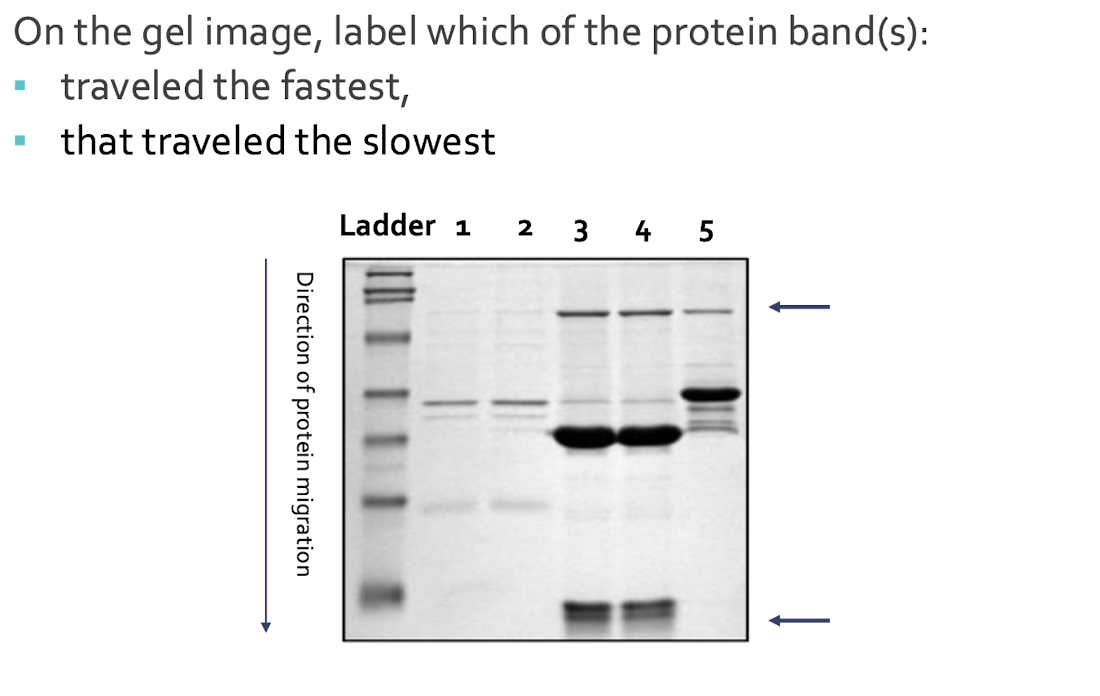
Top arrow: Large proteins
Bottom arrow: Small proteins
Why do you heat the protein sample before loading them onto the gel?
To make sure the protein is deatured
What would happen if you didn’t heat the protein? How would it affect migration of the protein?
the protein will not be fully denatured, resulting in incomplete linearization and failed coating with SDS
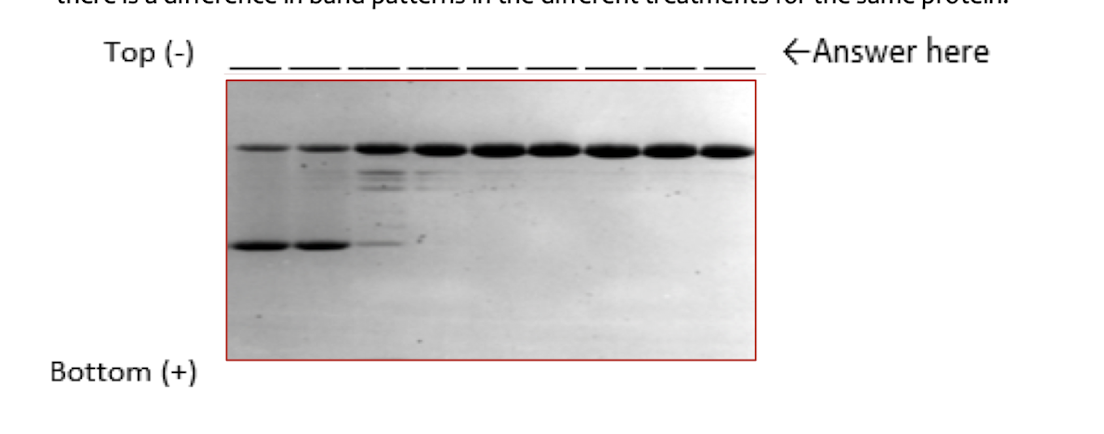
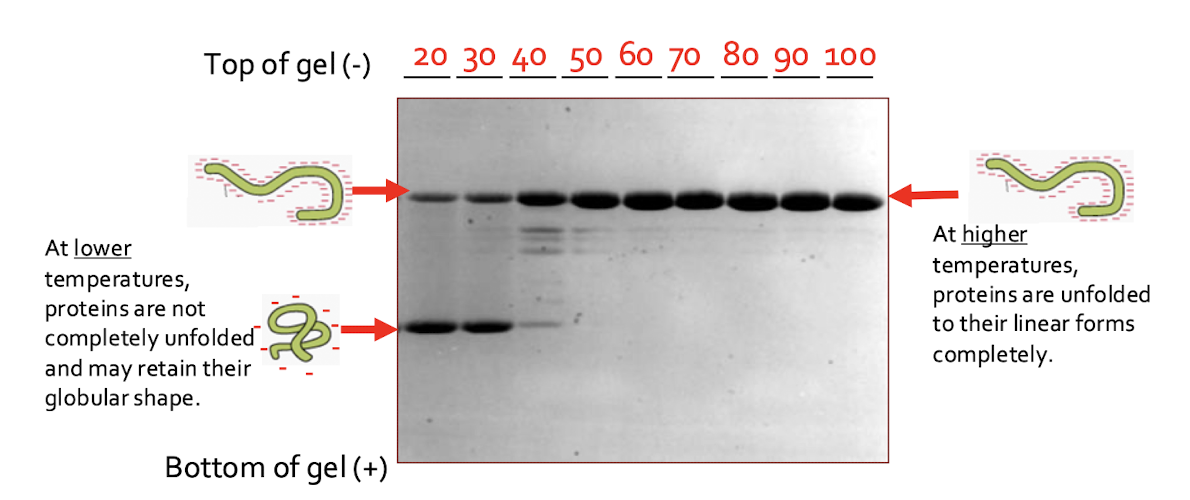
Samples of a monomeric proteins were treated with SDS at different temperatures (20, 30, 40, 50, 60, 70, 80, 90, 100 degrees C). Assign the temperature to the lane and explain why?
Lanes 4-9:
There are no proteins on the bottom, they’re only at the top
Those are all big proteins meaning they are unfolded so they are denatured from the hot temperatures (unfolded is big, folded is small)
Lanes 1-2:
There are only two bands
The top band are large proteins because they are denatured
The bottom band are small proteins that aren’t completely unfolded
Lane 3:
The only lane with a protein gradient
Best temperature for the proteins
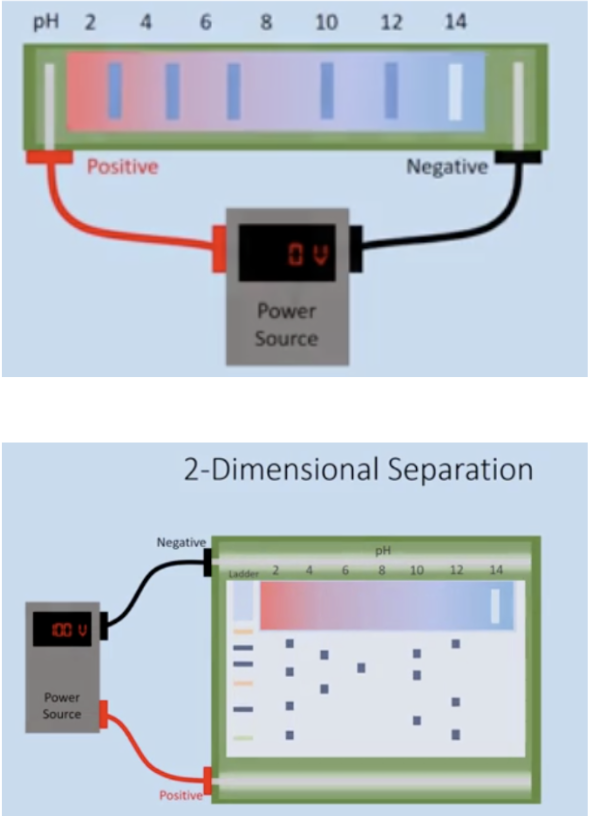
What is the purpose and process for 2D separation?
Purpose:
Separate proteins based on net charge and molecular weight
Process:
1. Isoelectric focusing
Proteins are run through a gel strip with a pH gradient (positive end - 2, 4, 6. 8. 10, 12, 14 - negative end)
The proteins move through the gel when electric current is applied and stop on the gel when they reach a net neutral charge
2. SDS-PAGE
Immobilized protein samples on the pH gradient strip are treated with SDS (denature, break non-covalent bonds at high temp., coat in negative charges), and beta-mercaptoethanol (break covalent disulfide bonds)
Samples are subjected to electrophoresis
How are proteins separated in 2D separation? What is the order of elution?
IEF:
pH = pI
Positive end = low pI
Negative end = high pI
SDS:
Top: Heavy proteins / less negative
Bigger/folded proteins move through the small holes of the gel harder and slower
Bottom: Lightest proteins / more negative
Smaller/unfolded proteins move through the small holes of the gel easier and faster
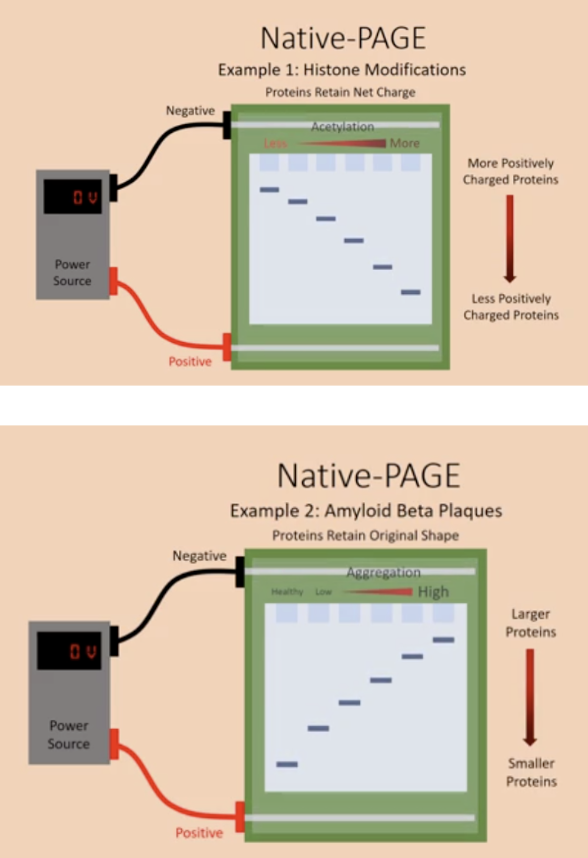
What is the purpose and process for Native-PAGE separation?
Purpose:
Analyze proteins in their folded form
Based on changes in their function
Change in net charge
Protein misfolding and aggregation
Process:
How are proteins separated in Native-PAGE? What is the order of elution?
(Histone acetylation & Amyloid Beta Plaques)
Histone acetylation
Histone acetylation removes the positive charge so the histones are more negative
The more acetylation there is, the more negative histones are, they will be on the bottom where the positive end is
Top: More positive / less acetylation
Bottom: Less positive / more acetylation
Amyloid Beta Plaques
Misfolded amyloid proteins aggregate
Small proteins go through the gel holes easier so they are on the bottom
Top: Big proteins / high aggregation
Bottom: Small proteins / low aggregation
What is the process of size-exclusion chromatography? What are the stationary and mobile phases? What is the order of elution?
Process:
Separate proteins by size and shape
Stationary:
Beads
Mobile:
Liquid solvent
Elution:
Top: Small proteins
Take longer travelling through the beads
Bottom: Big proteins
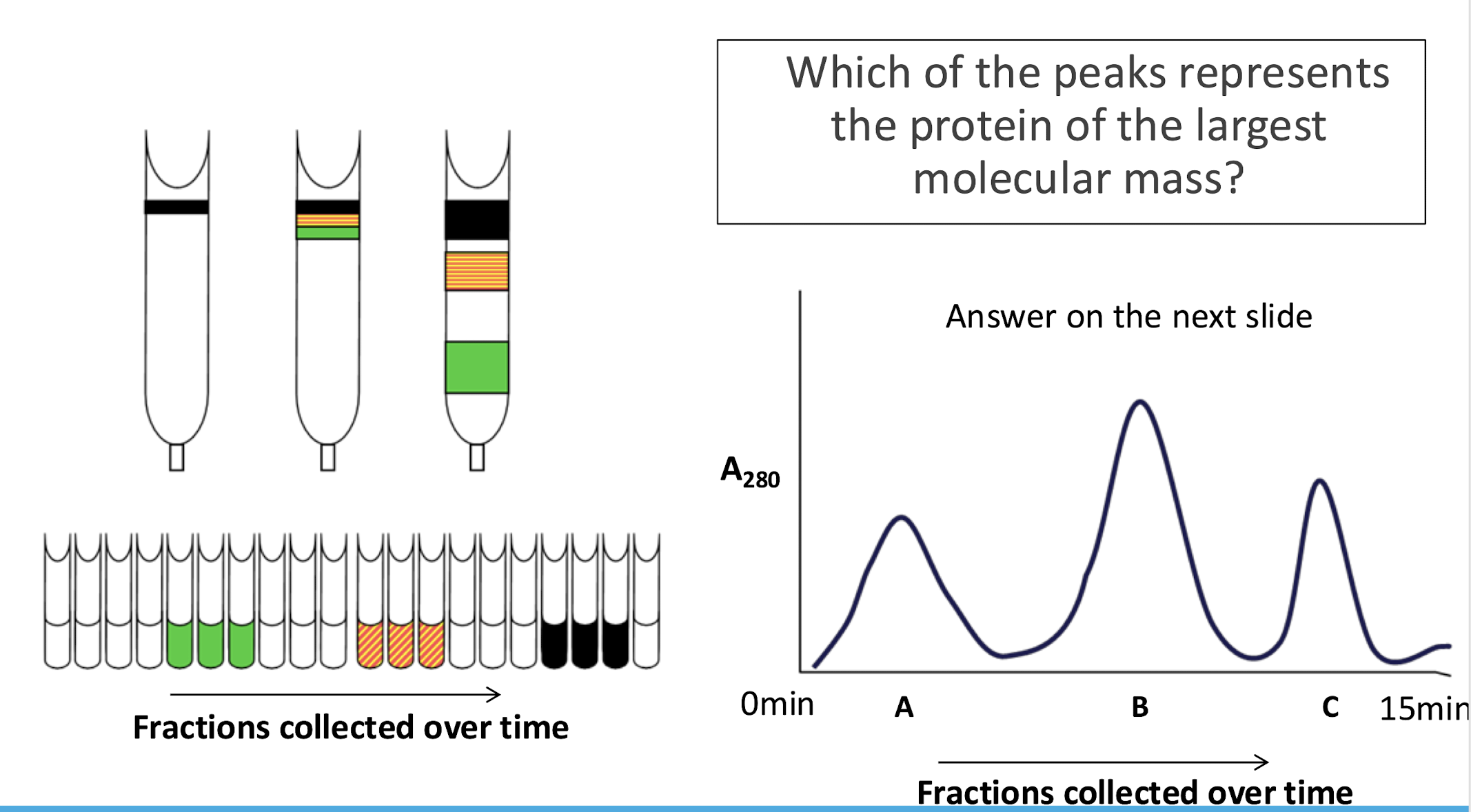
A
Green is on the bottom because those are larger proteins (they elute faster), so they are collected first which is the first peak
What is the process of ion-exchange chromatography? What are the stationary and mobile phases? What is the order of elution?
Process:
Separate based on differences in the sign and magnitude of the net electric charges of a protein at a given pH
Stationary:
Anion exchanger / anion collector: Beads are positive
Cation exchanger / cation collectors: Beads are negative
Mobile:
Positive or negative proteins
Elution:
Depends if anion or cation exchanger
If anion exchanger (collecting negative, stationary is positive):
Top: Positive proteins
Bottom: Negative proteins
How do you release the proteins from the column that have less charges in ion-exchange chromatography?
Use a low-salt elution buffer to neutralize proteins with less charges
How do you release the proteins from the column that have more charges in ion-exchange chromatography?
Use a high-salt elution buffer to neutralize proteins with more charges
How can you change the interaction of ion chromatography?
Change ionic strength or pH
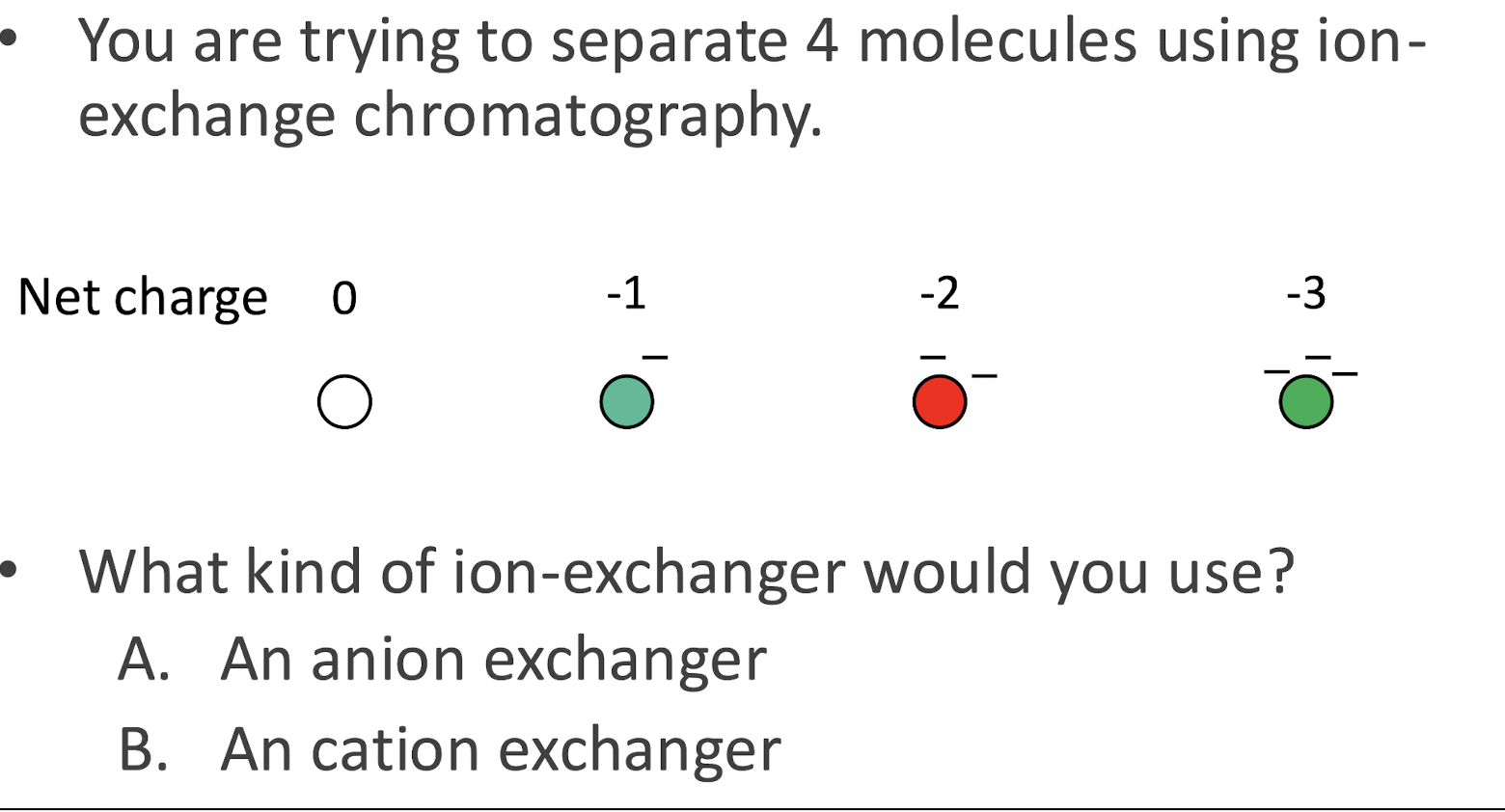
A
You are collecting negative charges so anion exchanger
What is the process of affinity chromatography? What are the stationary and mobile phases? What is the order of elution?
Process:
Protein interacts with the ligand on the bead and is stuck
The rest of the proteins are eluted
“Flush” protein of interest with free ligand, different pH, or a different salt concentration
Stationary:
Beads with ligands
Mobile:
Protein sample
Wash with free ligand, different pH, or a different salt concentration
Elution:
Top: Proteins that are stuck (proteins of interest)
Bottom: Excess proteins
Name examples of ligands
Antibodies
Metal ions
Enzymes
Substrates
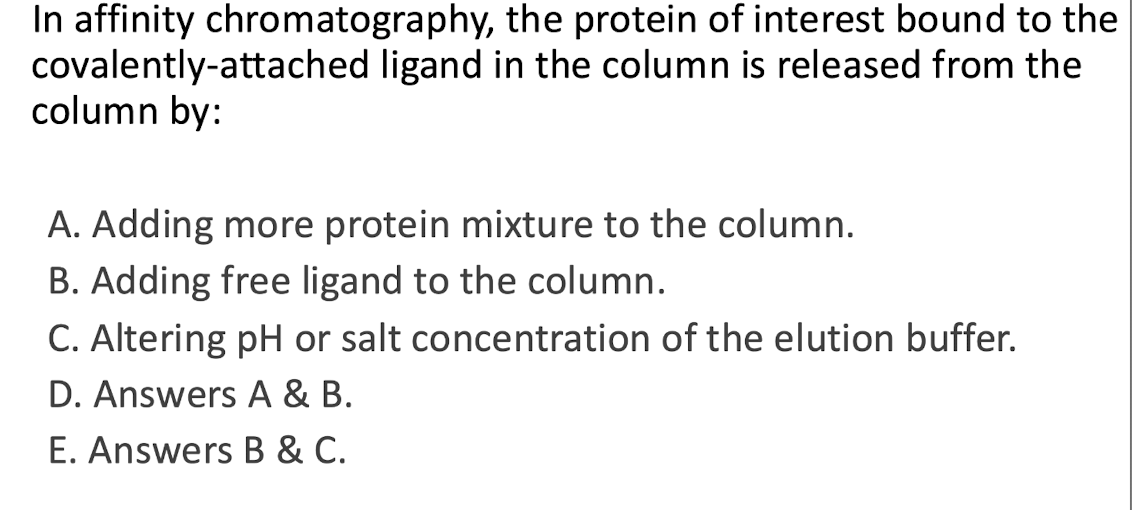
B, C
Free ligands
Alter pH or salt concentration of elution buffer
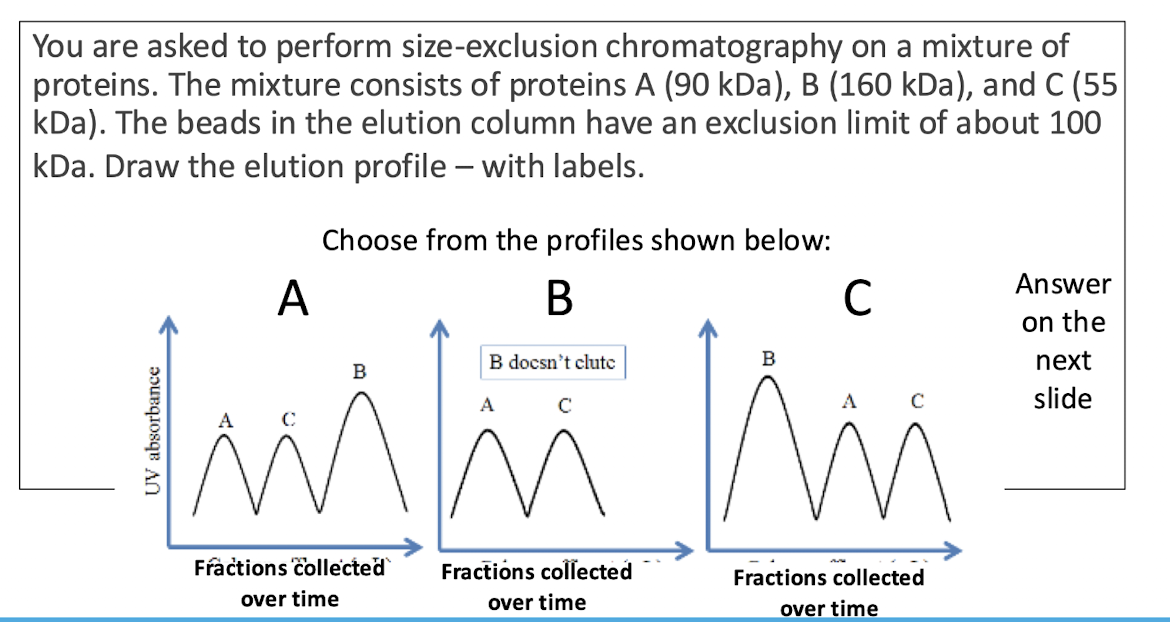
C
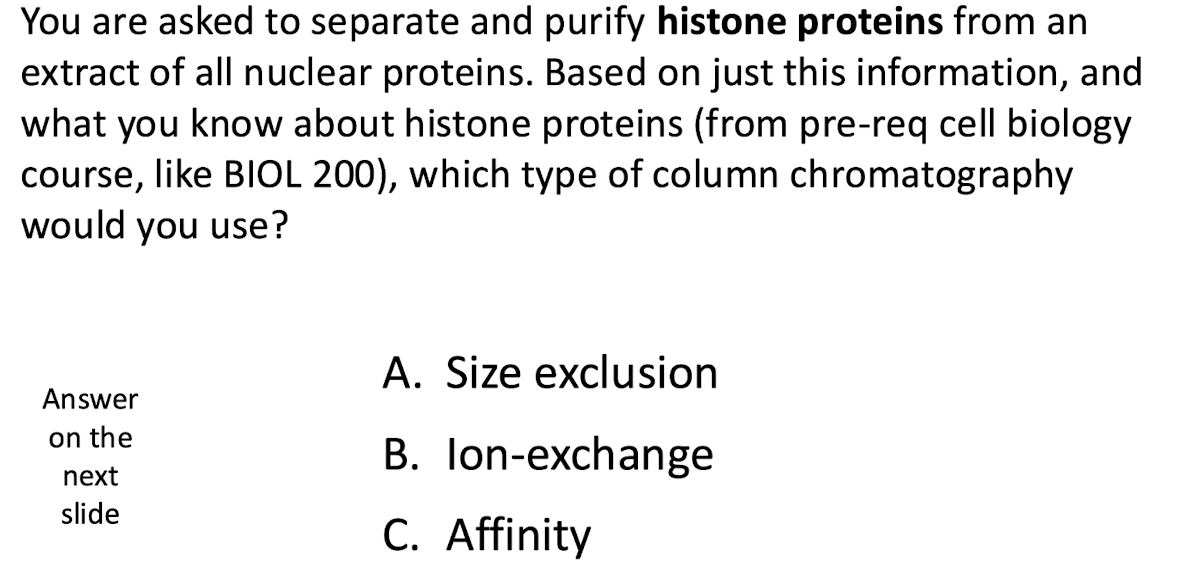
B
Histone acetylation removes their positive charge so the histone is more negative
Usually, the positive end of the gel is on the bottom so the negative histone will be on the bottom
What’s the difference between gel electrophoresis and column chromatography?
Gel electrophoresis:
Separate proteins for detection
Column chromatography:
Separate proteins for purification
Which amino acids have the same skeletal shape?
Asn (N), Asp (D), Leu (L)
Gln (Q), Glu (E)
Cys (C), Ser (S)
Thr (T), Val (V)
Which amino acid has a functional group that ionizes completely in pH 2-9?
Arginine (R)
pH 2-9 < pka 12.5 ∴ protonate N to be positive
Arg has a unit charge so it is ionized completely in the entire pH range
Which amino acid has a functional group that has a unit charge and a fractional charge in pH 2-9?
Aspartate (D)
pH 1.7 - 5.7 ± pka 3.7 ∴ fractional charge
pH 5.8 > pka 3.7 ∴ deprotonate O to be negative
Lysine (K)
pH 8.5 - 12. 5 ± pka 10.5 ∴ fractional charge
pH 2 - 8.4 < pka 10.5 protonate N to be positive
Which amino acid has a functional group that has no charge and a fractional charge in pH 2-9?
Tyrosine (Y)
pH 8.5 - 12.5 ± pka 10.5 ∴ fractional charge
pH 2 - 8.4 < pka 10.5 protonate O to be neutral
Cysteine (C)
pH 6.2 - 10.2 ± pka 8.2 ∴ fractional charge
pH 2 - 6.1 < pka 8.2 protonate S to be neutral
Which amino acid has a functional group that has a unit charge, no charge and a fractional charge in pH 2-9?
Histidine (H)
pH 4 - 8 ± pka 6 ∴ fractional charge
pH 2 - 3.9 < pka 6 protonate N to be positive
pH 8.1 - 9 > pka 6 deprotonate N to be neutral
Glutamate (E)
pH 2.1 - 6.1 ± pka 4.1 ∴ fractional charge
pH 2 < pka 4.1 protonate O to be neutral
pH 6.2 - 9 > pka 4.1 deprotonate O to be negative
Which amino acid has a functional group that has no charge in pH 2-9?
Proline (P)
Doesnt’ have a functional group so it can’t have a charge
Serine (S)
pH 2 - 9 < pka 13.5 protonate O to be neutral
Which amino acids are basic?
Histidine (H)
Arginine (R)
Lysine (K)
Which amino acids are acidic?
Glutamate (E)
Aspartate (D)
What amino acid is prevalent in alpha-helices and why?
Alanine
It’s small and uncharged, it won’t hinder folding
Which amino acids are less common in alpha-helices and why?
Asparagine (N) and Tyrosine (Y)
Side chains are too bulky, it will break the helix
Which amino acids are at the beginning and end of alpha-helices and why?
Glycine
It’s small so it is flexible around its alpha-carbon. If it was in the alpha-helix, it would destabilize it. But it can participate in the turns
What amino acid is the least common in an alpha-helix and why?
Proline
It can’t Hbond because it doesn’t have a hydrogen on its amide nitrogen
It’s side chain links back to the amino group and it’s rigid. This would disrupt right-handed helical conformation
What is the distance of a beta-sheet two residue repeat?
0.7 nm
Which is more stable, antiparallel or parallel beta-strands and why?
Antiparallel is more stable
The Hbonds are straighter because of better alignment of the donor and acceptor atoms
It has shorter loops N → C
What is the problem at the end of alpha-helices? What could be done to prevent this problem?
There are 8 atoms unpaired
The first four N-H groups and last four C=O groups lack intra-helical hydrogen bonds
Make the alpha-helix longer
The longer it is, there are more Hbonds in the middle of the helix to compensate the 4 lost Hbonds
What is the spacing for Hbonds in alpha-helices?
Hbonds form between the carbonyl oxygen (C=O) of one amino acid residue and the amide hydrogen (N−H) of a residue located four units away in the polypeptide chain
Which direction does a right-handed helix and left-handed helix rotate?
Right-handed helix: clockwise
Left-handed helix: counter clockwise
How many residues are there per turn in an alpha-helix?
3.6 residues/turn
What is the problem of the margins of beta-sheets? How can you prevent this?
There are atoms on the margins that aren’t bonded
Make the sheet wider to compensate the atoms that are unbonded
Why do beta-sheets not have a dipole?
The N-H bonds are perpendicular to the strand
They have a local dipole from the N-H bonds but the adjacent residue also has the same N-H bond, but in the opposite direction. So the two dipoles cancel each other out W
Why do alpha-helices have a dipole?
The N-H bonds are parallel along the axis and they point to the same direction
The N-terminal is positive
The C-terminal is negative
Where do they side chains stick out for beta-sheets and alpha-helices?
Beta-sheets: Alternate sticking up and down on the bend
Alpha-helices: Stick out side
Which is more stable, a right or left-handed helix and why?
Right-handed helix is more stable
Left-handed helix is less stable because of steric hinderance of the R-groups
What types of bonds are in a beta-sheet in the x,y,z dimensions?
x: covalent bonds
y: Hbonds
z: IDID interactions
What type of turns do antiparallel and parallel sheets use?
Antiparallel: Tight turns
It bends and has less residues
Parallel: Wide turns
It loops and has many residues
What do turns do and why are they important?
Turns connect alpha-helices and beta-strands. They allow the peptide chain to fold back on itself
Help with the compact 3D shape
How many atoms are in the same plane in an alpha-helix?
6 atoms in the same plane. Those 6 atoms restrict rotation
What is the formula for the number of Hbonds a beta-sheet can form between strands?
#hbonds between strands = # gaps x # aa
What is the formula for the number of Hbonds a beta-sheet can form on the edges of the sheet?
#hbonds on the margins = 2 edges x # aa
Where are loops seen on a folded polypeptide and why?
On the surface since they have hydrophilic residues
How is protein folding spontaneous? Use only Δ fold terms
ΔG fold = (more negative) ΔH fold - (positive)TΔS fold
How is protein folding spontaneous? Use only ΔG terms
ΔG fold = (more negative) ΔG water - (positive) ΔG polypeptide
How is protein folding spontaneous? Use only Δ folding, water, and polypeptide terms
ΔG fold = (negative ΔH water - more negative TΔS water) - (negative ΔH poly. - more positive TΔS poly.)
TΔS poly - TΔS water = TΔS fold
very positive - negative = positive
but now you have to consider ΔH fold which is very negative
ΔH fold - TΔS fold = ΔG fold
very negative - positive = negative
In terms of water, what is ΔS when the protein is unfolded vs. when the protein is folded?
Unfolded:
-ΔS because water shields the non-polar residues so freedom of movement is restricted
Folded:
+ΔS because water is free to move, it’s bulk water
In terms of the polypeptide, what is ΔS when the protein is unfolded vs. when the protein is folded?
Unfolded:
+ΔS because the protein is free to move, it’s floppy
Folded:
-ΔS because the protein is compact, it’s restricted to move
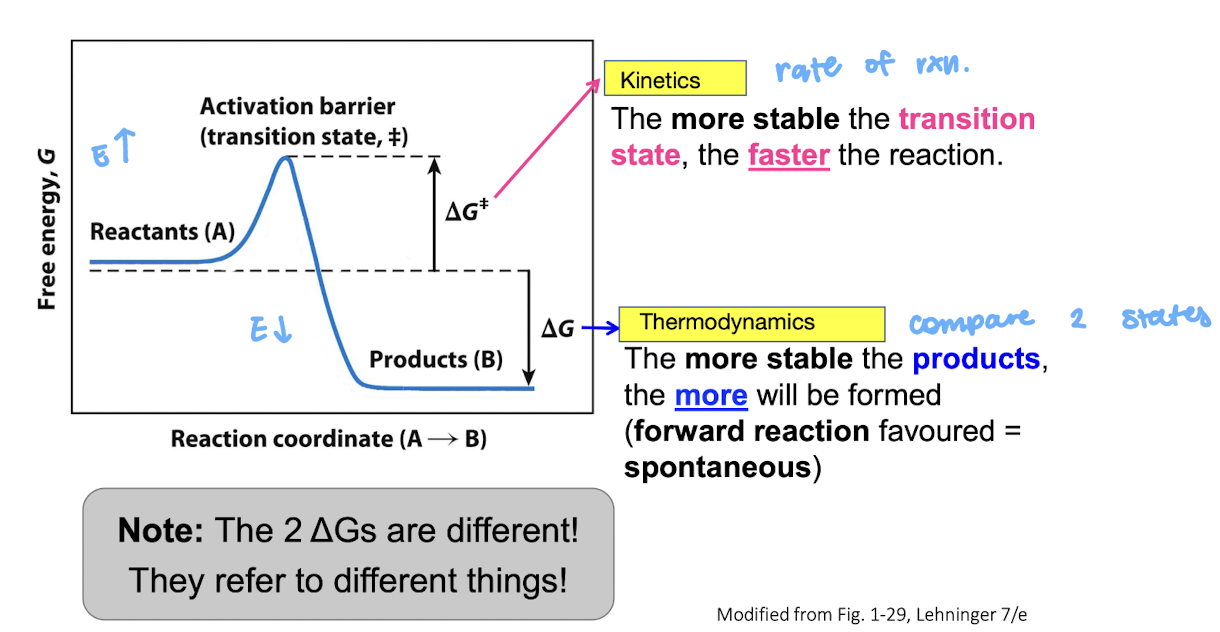
What do catalysts do?
Lower Ea by stabilizing the transition state so reactions can happen faster
Break down reactions into several steps
Does adding a catalyst change delta G?
No, it only lowers the Ea
It doesn’t change the stability of the products
What is the minimum number of steps a reaction can have form a catalyst?
3 steps
Because in a catalytic reaction, there is always an enzyme-substrate complex and an enzyme-product
A 2-step reaction will have how many intermediates and how many transition states?
1 intermediate, 2 transition states
A 3-step reaction will have how many intermediates and how many transition states?
2 intermediate, 3 transition states
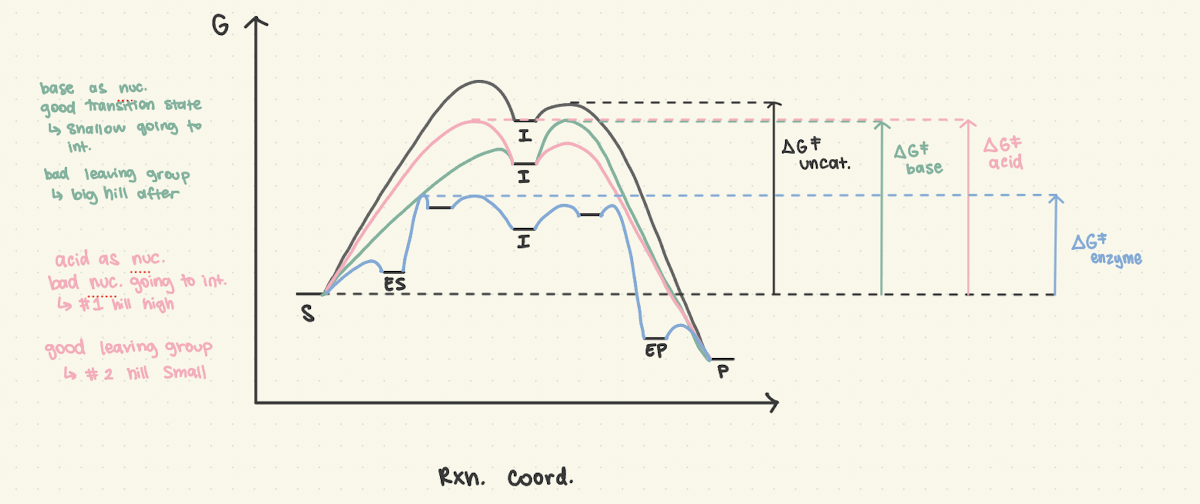
What are the outcomes if you use a base as a nucleophile?
From substrate to intermediate: Good transition state - small hill so it’s not bad
From intermediate to products: Bad leaving group - big hill
Ea is lowered by a little bit
What are the outcomes if you use an acid as a nucleophile?
From substrate to intermediate: Bad transition state - big hill
From intermediate to products: Good leaving group - small hill
Ea is lowered by a little bit
What are the three active site residues aka the catalytic triad?
His-12, Lys-41, His-119
The RNAse acid/base catalysis is a 6 step reaction:
How many transition states are there?
How many intermediates are there?
6 transition states (6 peaks)
5 intermediates (5 low points)
Why are enzymes good catalyts?
Breaks it down into many intermediates
It works on the energy of the central intermediate
It makes it go over small hills on either side of the central intermediate
Draw and compare the delta G double daggar from an uncatalzed, base catalyzed, acid catalyzed, and enzyme catalyzed reaction
Explain the stability for the 5 intermediates
ES (#2, second most stable)
High energy intermediate (#4, least stable)
No resonance stability
More steric hinderance
Accumulation of charges
But Lys-41 does lower the Ea
Central intermediate is more stable (#3 most stable)
Resonance
Less steric hinderacne
Less charges
Ring structure destabilizes because of freedom of motion is restricted
High energy intermediate (#4, least stable)
No resonance stability
More steric hinderance
Accumulation of charges
But Lys-41 does lower the Ea
EP (#1, most stable)
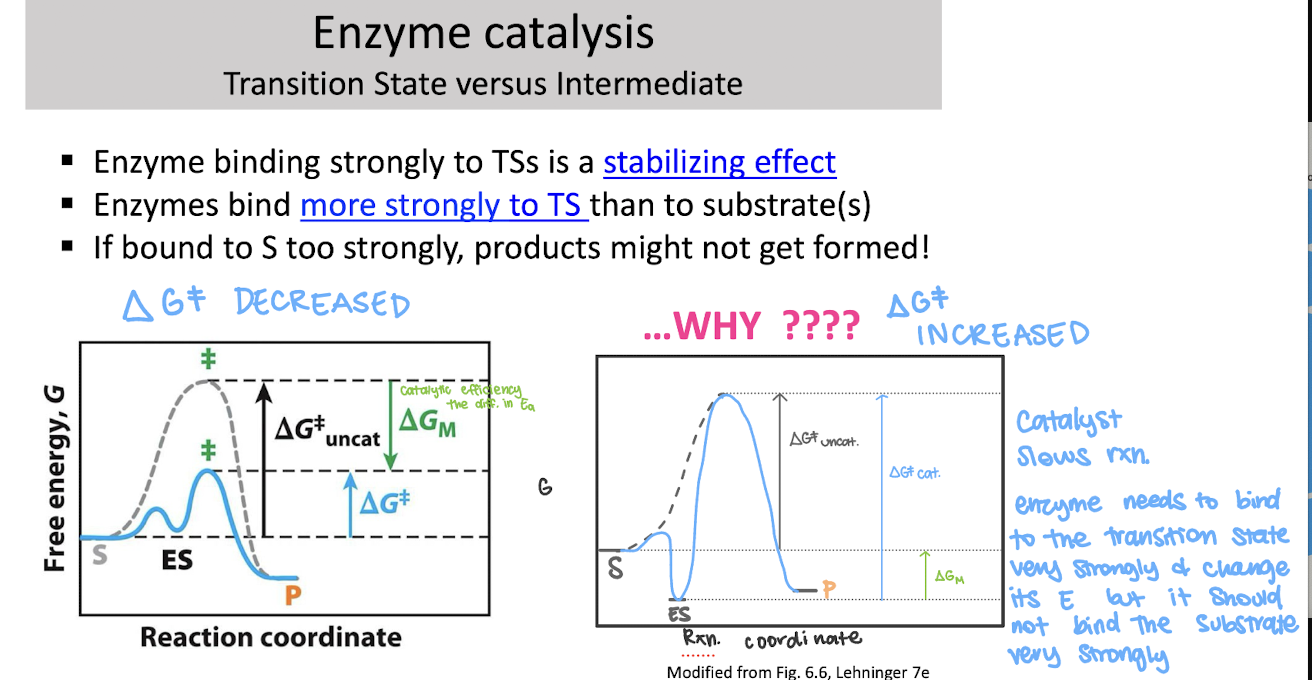
Enzymes need to be careful in binding specific to what? How does the enzyme know?
Binding something specific to the transition state, not to the substrate
So enzymes have a specific geometry to distinguish between transition state and substrate
What would happen if the enzyme binds to the substrate more strongly than binding to the transition state?
It would increase Delta G double daggar so the reaction slows down
Es to Transition state
What does Lys-41 do?
It binds to the high energy intermediates’ transition states to lower the Ea
What does His-12 and His-119 do?
Cyclization step: His-12 acts as a base, His-119 acts as an acid
Hydrolysis step: His-12 acts as an acid, His-119 acts as a base
Summarize the RNAse mechanism
His-12 deprotonates the 2’OH
2’OH nuc attacks phosphate
His-119 protonates phosphate oxygen
5’oxygen gets protonated and makes an alcohol leaving group
Product 1 leaves, water enters
His-119 deprotonates water
Hydroxide anion nuc attack electrophile forming P-O
His-12 protonates 2’oxygen and makes an alcohol leaving group
Product 2 leaves
What are the specificities in the RNase mechanism?
1. Enzyme-substrate binding geometry
Pyrimidine-binding pocket
2. RNA has the 2’-OH group where the oxygen will act as a nucleophile
DNA doesn’t have the oxygen
3. Location of His-12 forms only 3’phosphate products are formed