0.4 Fossils
 Call Kai
 Learn
Learn Practice Test
 Spaced Repetition
 Match
Match Flashcards
 Knowt Play
1/24

There's no tags or description
Looks like no tags are added yet.
Name | Mastery | Learn | Test | Matching | Spaced | Call with Kai | Chat |
|---|
No analytics yet
Send a link to your students to track their progress
25 Terms
Syllabus Point
The fossil record is incomplete and cannot represent the entire biodiversity of a time or a location due to many factors that affect fossil formation, the persistence of fossils and accessibility to fossilised
remains.
What is a fossil
A fossil is any preserved traces footprints, burrows, impressions) or remains of an organism that lived in the past.
Fossils are most commonly found in sedimentary rocks.
Most fossils consist of hard parts (bones, shells or teeth) because soft tissues decompose and the materials are recycled.
Palaeontology is the study of fossils and extinct life forms.
Importance of the fossil record
The fossil record establishes evolutionary links between species by:
Providing evidence of which organisms lived on earth in the past.
Offering examples of organisms which may now be extinct.
Providing examples of transitional organisms between species.
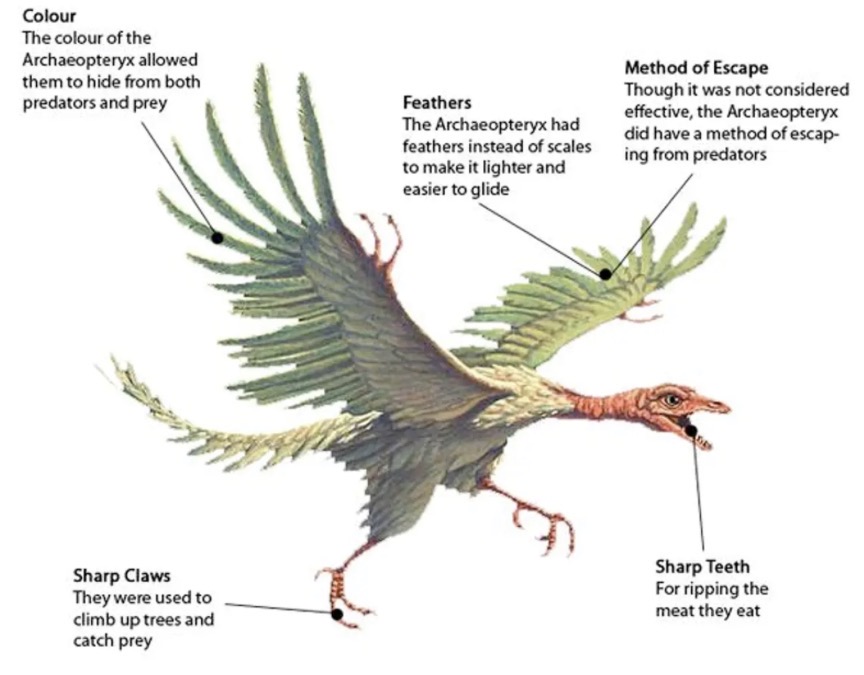
Archaeoptery
earliest bird in the fossil record.
Had features of dinosaurs and birds.
Fossil record example
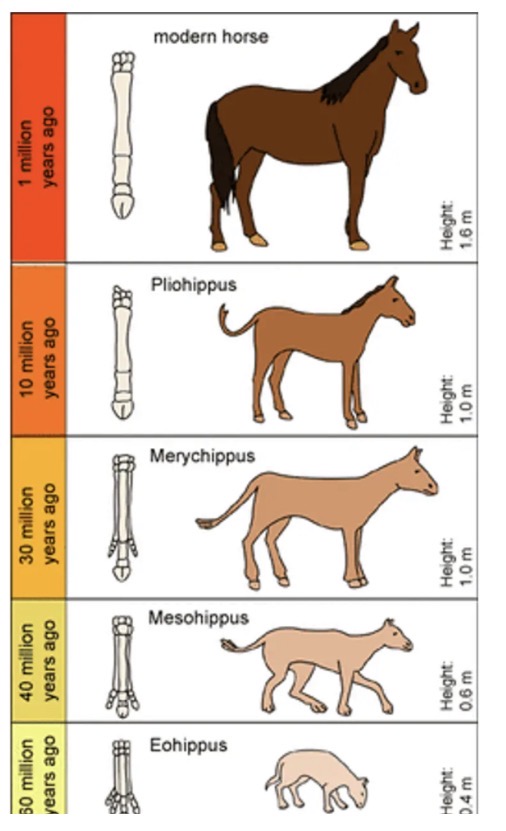
Fossil record of a horse has allowed scientists to build up a sequence of the evolution of a horse.
Is evidence that organisms in the past were not the same as organisms alive today.
Example archaeopteryx
Some fossils are transitional forms i.e. they show characteristics of two different groups
e.g. Archaeopteryx is a transitional form that shows the missing link from reptiles to birds.
6 ways fossils can be formed
shallow lakes, marshes and swamps
Marine habitats
Dry cave deposits
Trapped in ice
In amber or tar
Traces of organisms
Fossils: shallow lakes, marshes and swamps
where the organism is quickly covered by sediment and decay is stopped.
Fossils: marine habitats
Where the organisms are buried and preserved on the ocean floor.
Fossils: Dry cave deposits
Where soft body parts decay leaving hard parts undisturbed.
Fossils: trapped in ice
Low temperatures can stop the decay process and the whole body with soft parts intact can be preserved.
Fossils: in amber or tar
Insects can be trapped in amber and preserved intact.
Organisms can be trapped in tar. The tar soaks into its bones and prevents the bones from decaying.
Fossils: traces of organisms
This includes footprints, tracks, burrows, nests and hardened dung.
Fossilisation
Is the process by which a plant or animal becomes a fossil.
This process is extremely rare and only a small fraction of the plants and animals that have lived in the past 600 million years are preserved as fossils.
Stages of fossilisation
Death and burial:
2. Deposition:
3. Mineral replacement:
4. Erosion / exposure:
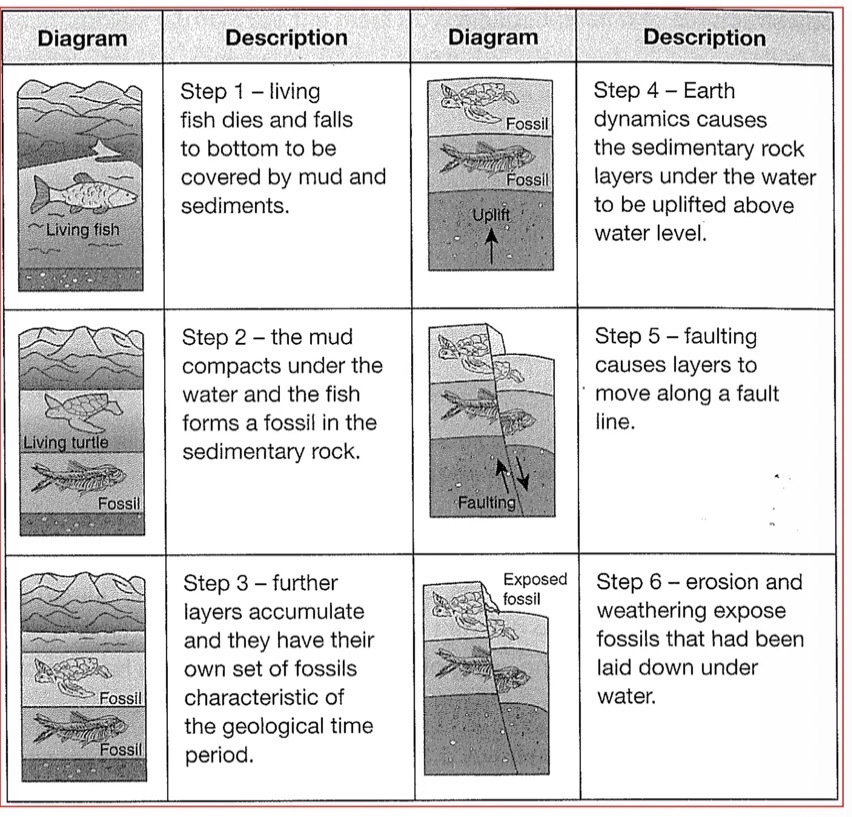
1. Death and burial
The organism dies and is rapidly covered with silt and sand.
Deposition
Over time more layers continue to build and compact the sediment into
rock.
Mineral replacement
Pressure from the covering layers of dirt/rock cause the hard- organic material to be replaced by minerals.
Bones become petrified into rock
Erosion/ exposure
Movement of earth plates may displace the fossil and return it to the surface for discovery.
Layers of rock get worn away by rain, wind and water
Stages of Mineral Replacement
There are varying degrees of mineral
replacement (0-100%).
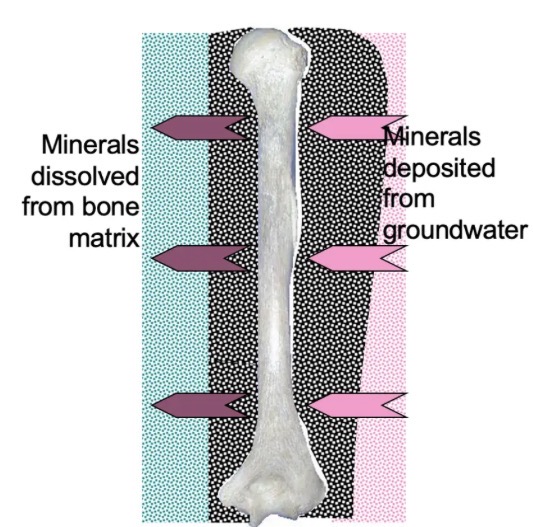
Stage 1 - Minerals from groundwater fill pores in the bone or shell.
Stage 2 - Minerals forming the bone matrix, or shell, are dissolved away and replaced by minerals e.g. iron oxide in the groundwater.
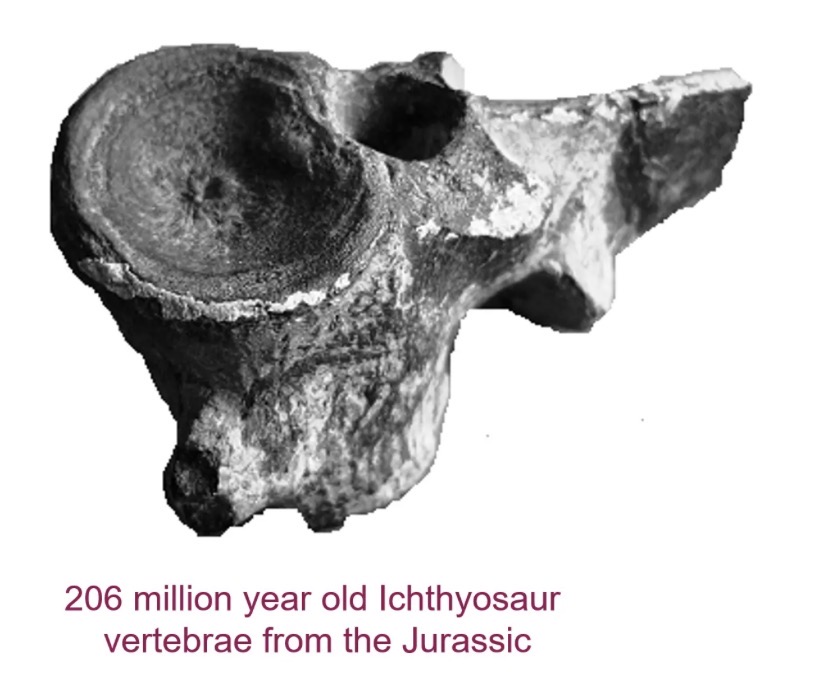
Example of mineral replacement
206 millions year old lchthyosaur vertebrae from the Jurassic
The Taung child
Fossils formed by mineral replacement provide a three-dimensional replica of the original material.
In the fossil opposite, the facial bones (formed by mineral replacement) have broken away to reveal an endocast of the brain - (an endocast is a cast fossil formed when an empty cavity, such as the cranium, is filled with mud).
Conditions required for fossilisation
Needs to protected from decay by microorganisms, decomposers and scavengers.
buried rapidly.
lack of oxygen in sediment.
No/low oxygen and alkaline soil is best for the preservation of bones as there is no acid to dissolve the bones.
Sediment must be left undisturbed for a long period of time.
Why the fossil record is incomplete
Most fossils form from solid body parts and many organisms do not have hard structures.
Not all organisms would be buried rapidly at the time of death.
Specific sediment features are required for fossilisation such as no oxygen and alkaline soil.
Bodies of dead organisms would often be eaten by other organisms before being buried or decayed by microorganisms.
Fossils may be destroyed due to volcanic eruptions, earthquakes, faulting or folding.
Human activity may destroy fossil remains.
Weathering and erosion can destroy fossils.
Fossils may not be recognised and get overlooked.
Some of the challenges that are associated with using the fossil record to interpret the past include:
The poor probability of an organism becoming a fossil means fewer organisms become fossils.
The fossil record is incomplete due to plate tectonics, earth movements and the recycling of rock material, meaning many fossils have been destroyed, yet to be found, or are inaccessible to US.
In studying extinct species, it is difficult to classify them at a species level. The definition of a species 'can breed to produce fertile young,' is difficult to determine from a fossil.
Different scientists can interpret the same evidence in different ways.