Connective Tissue
 Call Kai
 Learn
Learn Practice Test
 Spaced Repetition
 Match
Match Flashcards
 Knowt Play
1/12

There's no tags or description
Looks like no tags are added yet.
Name | Mastery | Learn | Test | Matching | Spaced | Call with Kai | Chat |
|---|
No analytics yet
Send a link to your students to track their progress
13 Terms

Areolar Connective Tissue
Structure
Abundant viscous ground substance; few collagen and elastic fibers; scattered fibroblasts; many blood vessels
Function
Protects tissues and organs; binds skin and some epithelia to deeper tissue
Location
Papillary layer of the dermis (skin); subcutaneous layer (deep to skin); surrounds organs, nerve cells, some muscle cells, and blood vessels
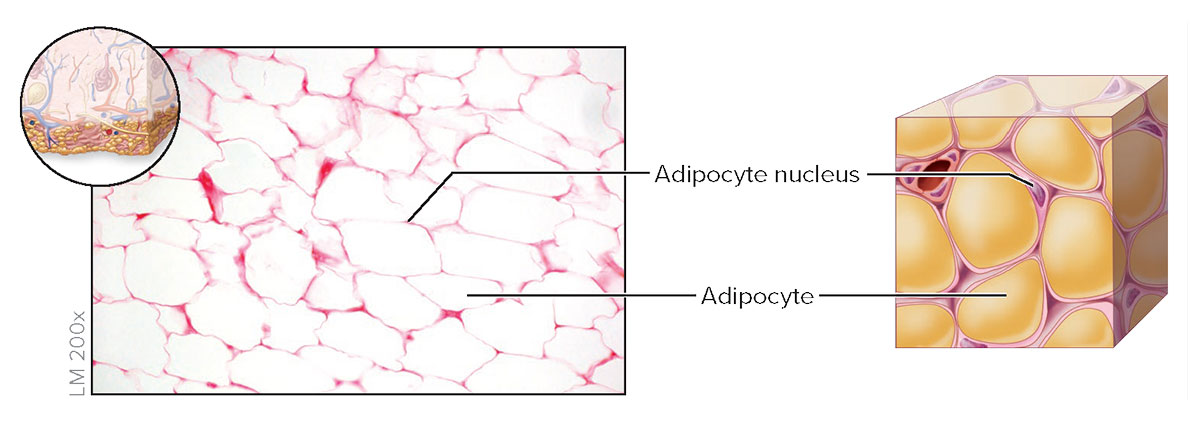
Adipose Connective Tissue
Structure
Closely packed adipocytes; nucleus pushed to edge of cell by large fat droplet; contains many blood vessels
Function
Stores energy; insulates, cushions, and protects
Location
Subcutaneous layer; surrounds and covers some organs

Reticular Connective Tissue
Structure
Viscous ground substance; meshwork of reticular fibers, leukocytes, and some fibroblasts
Function
Provides stroma (supportive framework) to lymphatic organs
Location
Spleen, lymph nodes, and red bone marrow

Dense Regular Connective Tissue
Structure
Densely packed, parallel arrays of collagen fibers; fibroblasts squeezed between layers of fibers; scarce ground substance; limited blood supply
Function
Attaches bone to bone (most ligaments) as well as muscleto bone (tendons); resists stress applied in one direction
Location
Tendons (attach muscle to bone); ligaments (typically attach bone to bone)
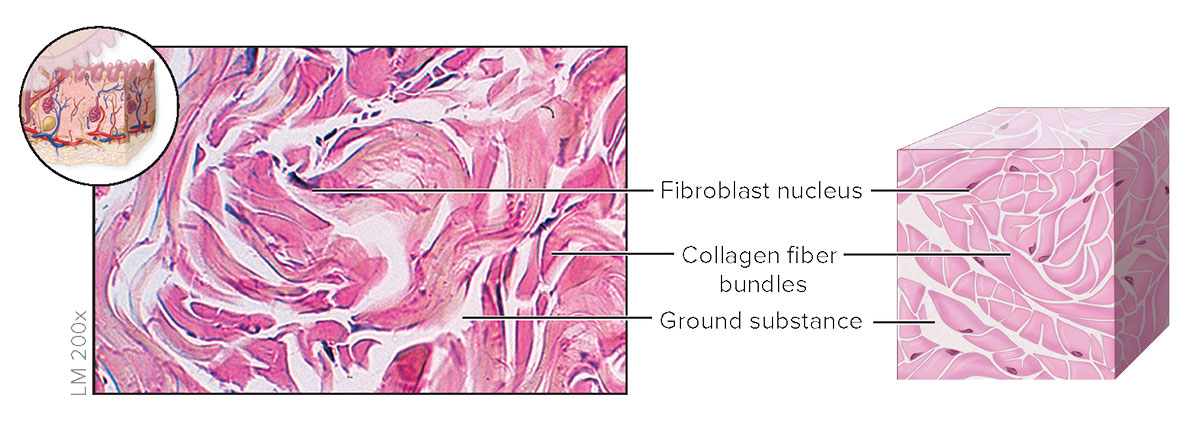
Dense Irregular Connective Tissue
Structure
Collagen fibers randomly arranged and clumped together; fibroblasts in spaces among fibers; more ground substance than in dense regular connective tissue; extensive blood supply
Function
Withstands stresses applied in all directions; durable
Location
Most of dermis of skin; periosteum covering bone; perichondrium covering cartilage, epineurium covering nerves, epimysium covering skeletal muscle, some organ capsules
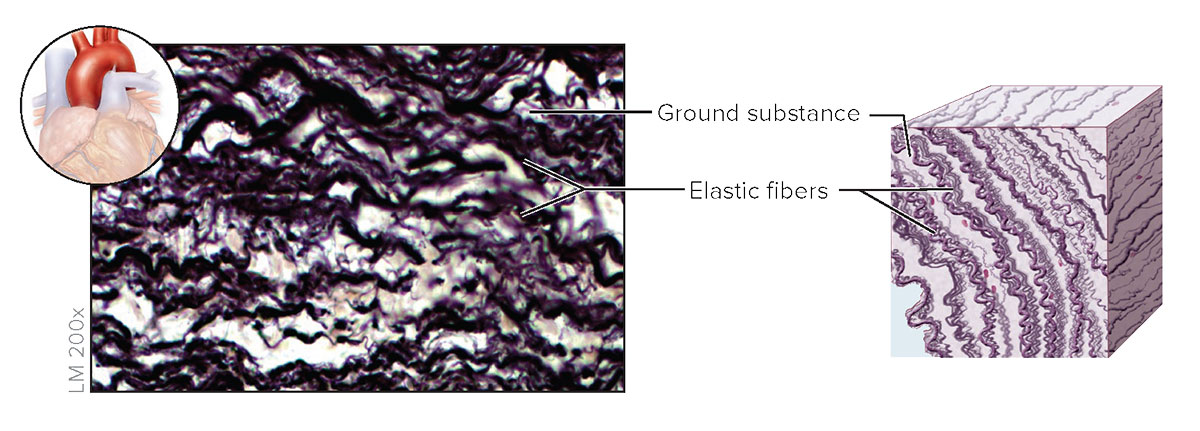
Elastic Connective Tissue
Structure
Predominantly composed of elastic fibers; fibroblasts occupy some spaces between fibers
Function
Allows for stretching and recoil
Location
Walls of elastic arteries (such as the aorta), trachea, vocal cords
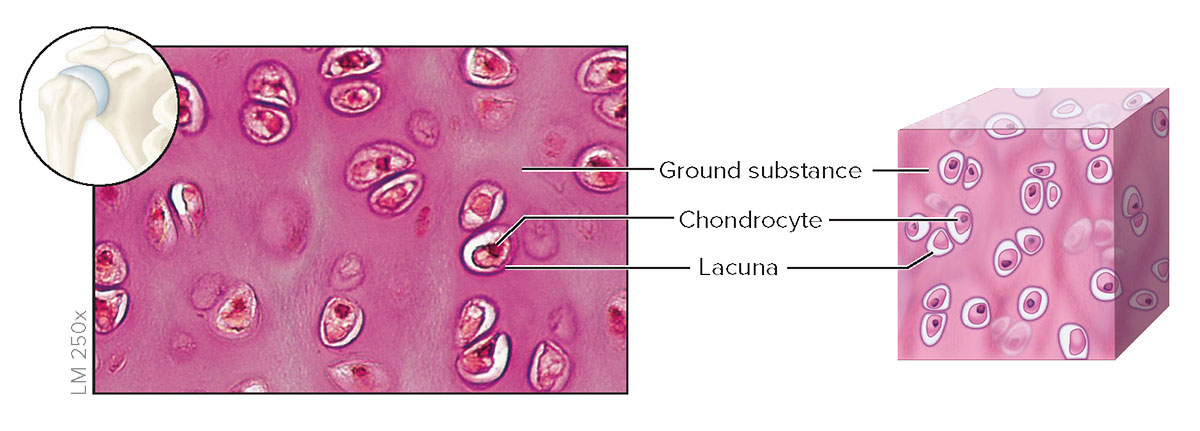
Hyaline Cartilage
Structure
Glassy-appearing matrix; irregularly arranged chondrocytes in lacunae
Function
Provides support; forms most of fetal skeleton
Location
Tip of nose; trachea; most of larynx, costal cartilage; both the epiphyseal (growth) plates and articular ends of long bones; most of fetal skeleton
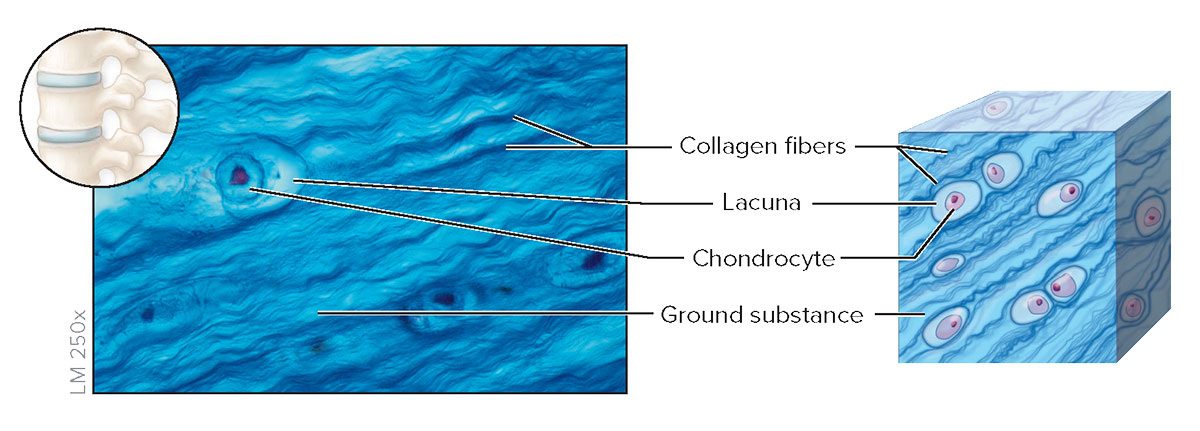
Fibrocartilage
Structure
Readily visible, numerous, parallel collagen fibers with limited ground substance; large chondrocytes in lacunae
Function
Resists compression; acts as shock absorber in some joints
Location
Intervertebral discs; pubic symphysis; menisci of knee joints
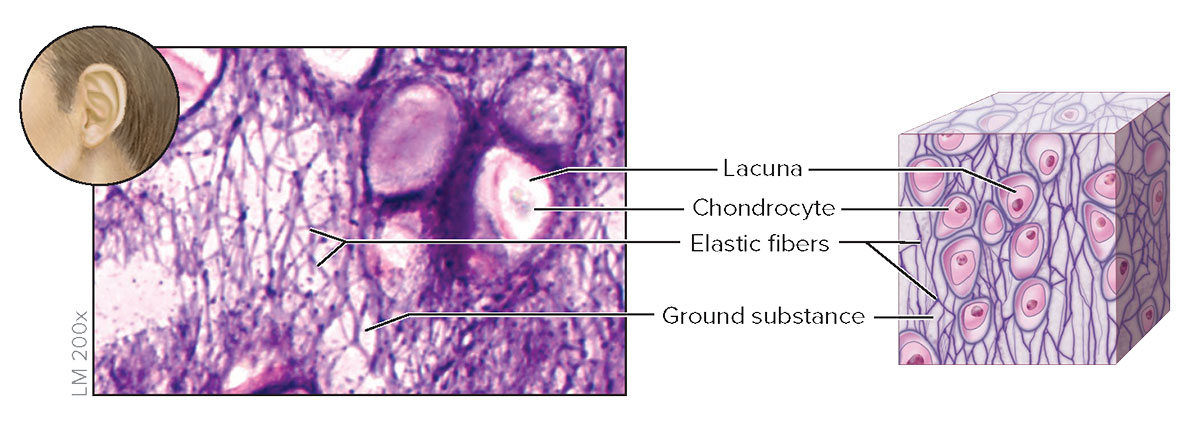
Elastic Cartila
Structure
Abundant elastic fibers that form weblike mesh; closely packed chondrocytes in lacunae
Function
Maintains shape while permitting extensive flexibility
Location
External ear; epiglottis of larynx

Bone
Structure
Calcified extracellular matrix containing osteocytes trapped in lacunae; compact bone organized in osteons (concentric lamellae arranged around a central canal); spongy bone is a meshwork that has a different organization from compact bone; well vascularized
Function
Provides levers for body movement, supports soft structures, protects organs, stores calcium and phosphorus; spongy bone contains hemopoietic tissue and is the site for hemopoiesis
Location
Bones of the body

Blood
Structure
Contains formed elements (erythrocytes, leukocytes, and platelets); dissolved protein within a liquid ground substance called plasma
Function
Erythrocytes transport respiratory gases (oxygen and carbon dioxide); leukocytes help protect the body from infectious agents; and platelets help with blood clotting. Dissolved protein fibers coalesce and assist with blood clotting. Plasma transports nutrients, wastes, and hormones throughout the body.
Location
Primarily within blood vessels and in the heart
Lymph
Lymph fluid is found within lymph vessels and derives from interstitial fluid. It is mostly water and dissolved solutes and typically no cellular components.