Chemical Kinetics
 Call Kai
 Learn
Learn Practice Test
 Spaced Repetition
 Match
Match Flashcards
 Knowt Play
1/63

There's no tags or description
Looks like no tags are added yet.
Name | Mastery | Learn | Test | Matching | Spaced | Call with Kai | Chat |
|---|
No analytics yet
Send a link to your students to track their progress
64 Terms
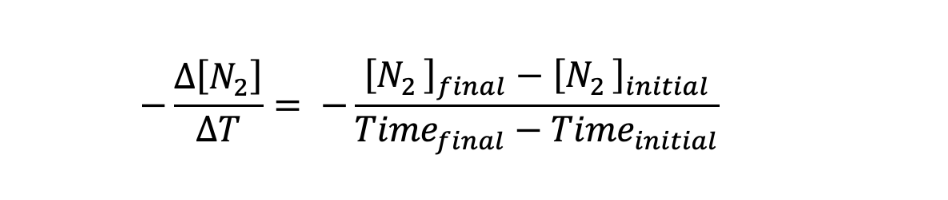
What is chemical kinetics?
The study of how fast chemical reactions happen
What is the rate of a reaction?
A measure of how the reaction progresses over time
What happens as chemical reaction proceed?
The concentrations of products increase
How can you measure the rate of a reaction?
Measured as the change in concentrations of either reactants or products over time
What does the rate expression express?
The change in concentrations of either reactants or products over time
What is the general rate expression for a general chemical equation?
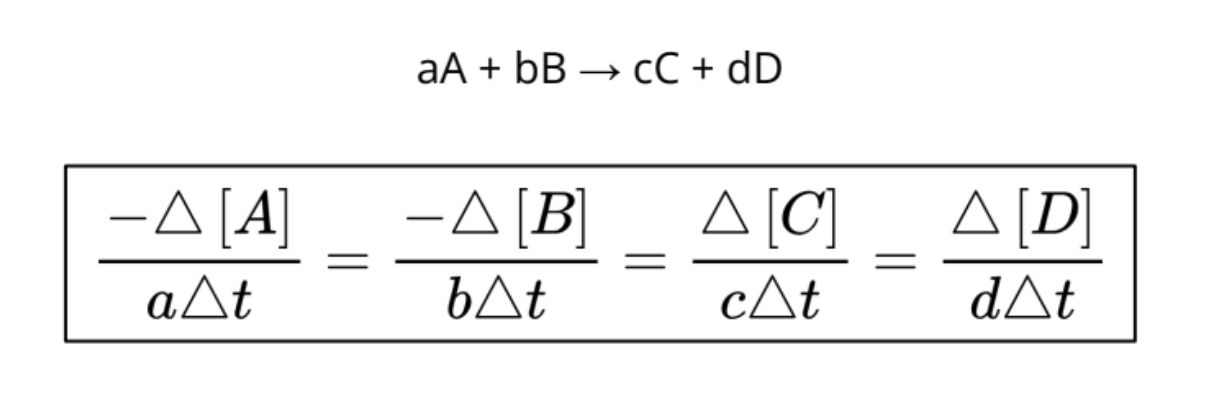
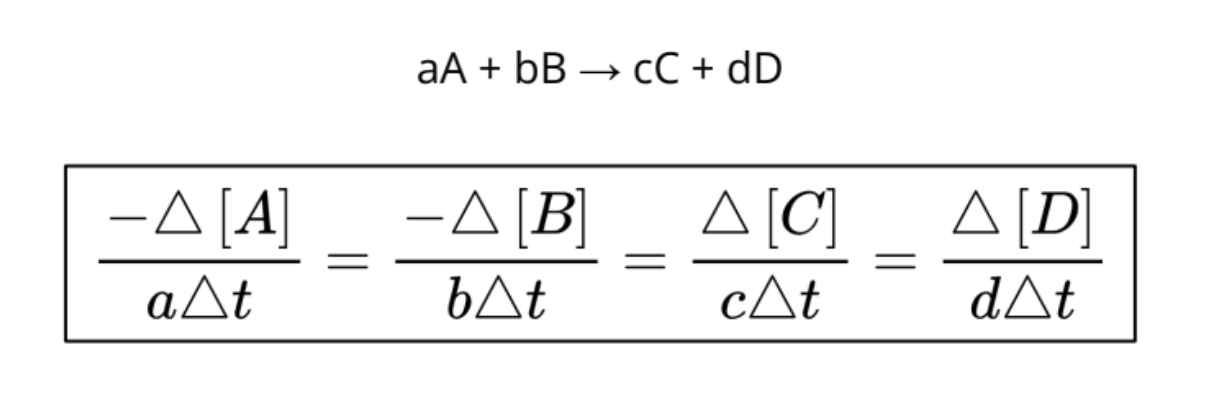
What are all the terms in this called?
Equivalent rate expressions
Where is the negative sign used for the crate expressions?
Used for the reactants ONLY because it is being taken from and decreasing over time
Species with large coefficients do what to concentrations?
They change concentrations more quickly in the reaction
What do relative rate expressions do?
Show how fast reactants and products disappear relative to one another
What are rate laws used for?
To show how changing the concentration of reactants impacts the rate of reaction

How would a rate law look like from this reaction?
Products are EXCLUDED from rate law expressions
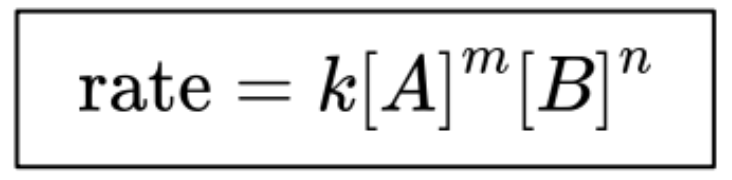
Why are products excluded from rate law expressions?
Because product concentrations do NOT influence the reaction rate
What is k?
The rate constant
The rate constant, k, is ______________ and unique to each reaction/
Temperature-dependent
Reaction order is equal to….
m + n
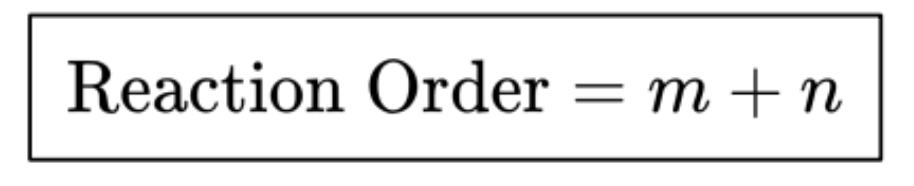
What does the reaction order do?
Determine how the concentration of a species affects the rate of reation
What does it mean for a reaction to be zero-order?
The rate is constant and does not depend on the concentration of the reactant
What does it mean for a reaction to be first-order?
The rate is directly proportional to the reactant concentration
What does it mean for a reaction to be second order?
The rate is proportional to the square of the reactant concentration
What is the rate reaction for a zero order reaction?
rate = k[A]0
![<p>rate = k[A]<sup>0</sup></p>](https://assets.knowt.com/user-attachments/7cc218b1-11e3-4d01-9cad-3c2b806ecc76.png)
What is the rate reaction for a first order reaction?
rate = k[A]1
![<p>rate = k[A]<sup>1</sup></p>](https://assets.knowt.com/user-attachments/3dfc8c7e-26eb-4e85-82fa-3acaede41888.png)
What is the rate reaction for a second order reaction?
rate = k[A]2
![<p>rate = k[A]<sup>2</sup></p>](https://assets.knowt.com/user-attachments/93946f0f-a3aa-4412-a51c-c74f96378533.png)
What is the purpose of integrated rate laws?
They show how concentration changes over time
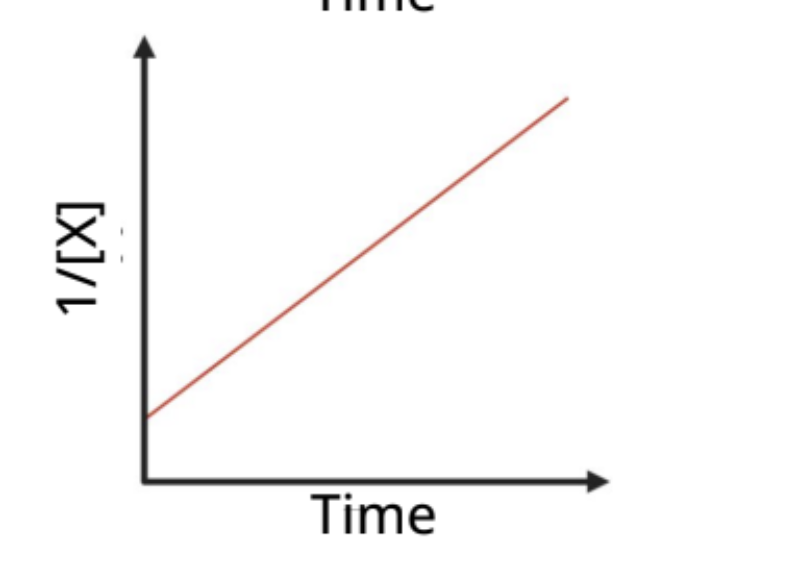
Which graph is this?
Second order
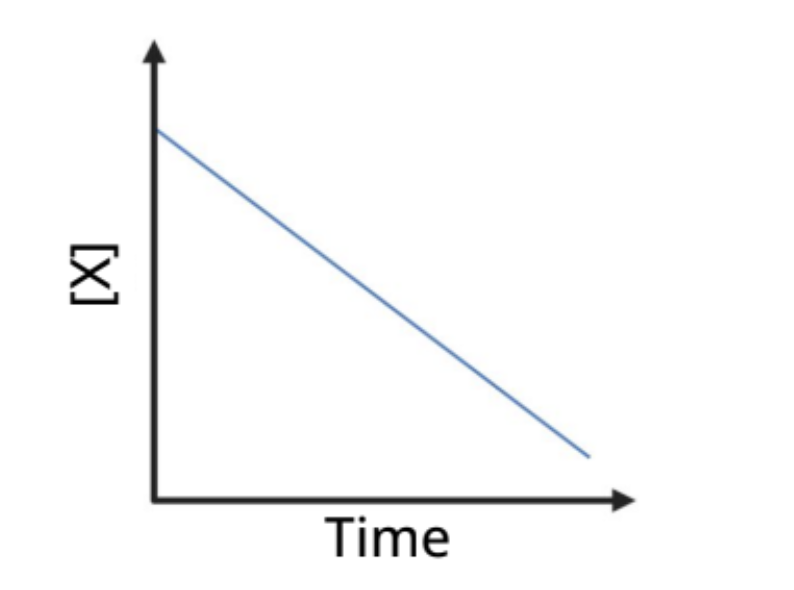
What graph is this?
Zero order
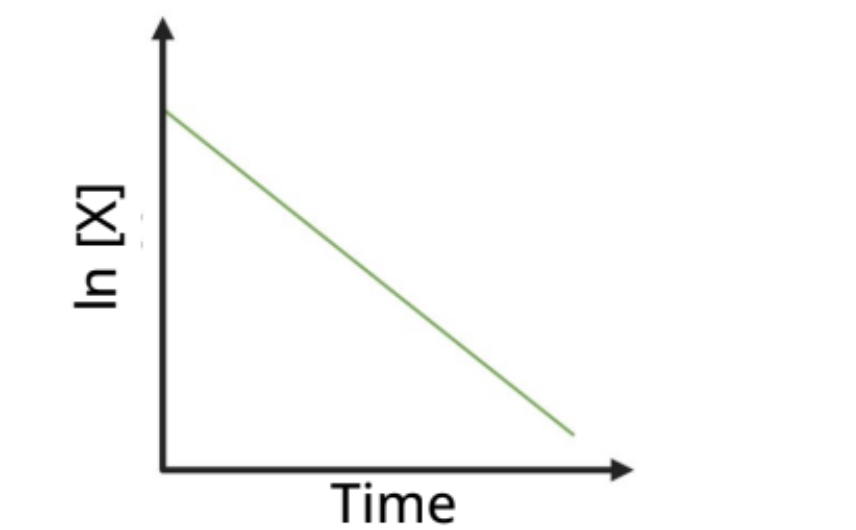
What graph is this?
First order
What is the slope of a straight line graph equal to?
k
When is half life concentration be determined?
When all the reaction orders are plotted with the same axes
What is the half life of a reaction measuring?
The time it takes for half the remaining ractants to be depleted
What does a half life zero-order reaction graph look like?
Linear with downward slope
Reaction will keep going at the same rate no matter what the reactant concentration is
Half life decreases as reactant concentration decreases
What is the half life equation for a zero order graph?
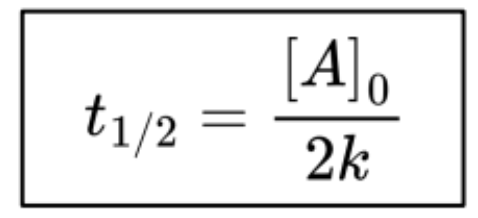
What does a half life first-order reaction graph look like?
Graph is downward sloping with a cruved line
As reaction progresses, same length of time is required to deplete half od the reactant concentration
Half life does NOT change as the reaction goes on
What is the half life equation for a first order graph?
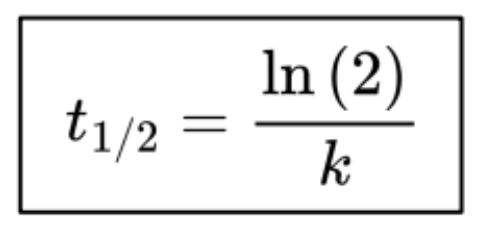
What does a second order graph look like?
Graph is downward slope with a cruved line
The reaction slows down more and more as reactant concnetration is depleted
The half life increases as the reaction progresses
What is the half life equation for a second order graph?
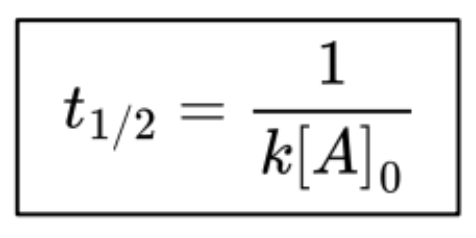
How does the equation of a line y=mx+b correlate here?
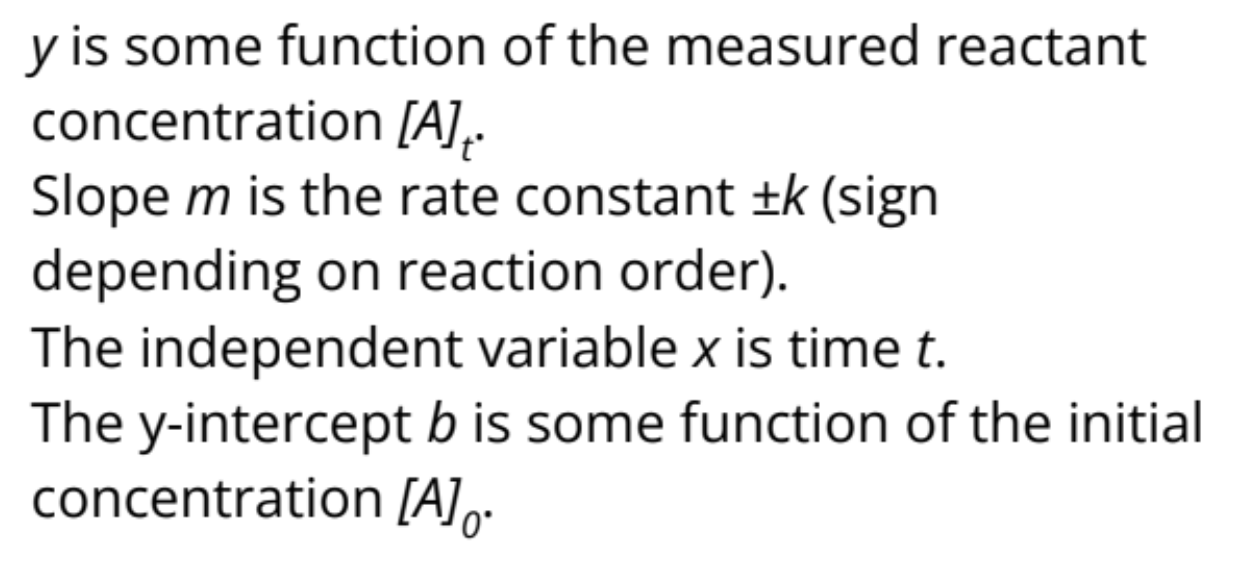
What is the change of enthalpy?
The difference in energy between reactants and products
Exothermic reactions have what kind of ΔH? And what does it mean?
Exothermic reactions release energy and have a negative ΔH meaning that there is more energy in the products than the reactants
So if theres more energy in the reactants than the products, which is more stable?
The products
Endothermic reactions have what kind of ΔH? And what does it mean?
Endothermic reactions have a positive ΔH. This means that the productsd are higher energy than the reactants
If the products and reactants have the same energy, what does this mean?
ΔH = 0 and the reaction is isenthalpic

What does this sign mean?
Denotes the transition state
What is the transition state also known as?
The activated complex
What point on a reaction coordinate diagram has the highest energy?
The transition state
What does it mean that the transition state has the highest energy?
It is the least stable point in the process
Can transition states be isolated?
NO
What is Ea?
This is the forward activation energy that is the energy difference btween the reactants and the transition state
Amount of energy needed for the reaction to happen
What is the rate--determining step?
The step that occurs the slowest or the step with the highest activation energy
What are intermediates?
Complexes briefly formed in between reactants and products
They’re stable, not like transition states, and so they last longer
Does reaction pathway change/influence the change in enthalpy?
NO
What are the qualities of a catalyst?
Not consumed so they will be on both sides of the equation
Lower activation energy
Don’t speed up reactions by changing energy
Provide alternative reaction pathway
Don’t shift equlibrium
For a chemical reaction is happen, what conditions have to be met?
Molecules must physically collide
Molecules must have enough energy to react
Molecules must collide in the proper 3D orientation
What does increasing temperature do in terms of the Arrhenius equation?
Raises particle kinetic energy which will lead to more collisions and higher probability that each collision has enough energy to reach the activation energy
If the activation energy of a reaction and the temperature are both doubled, what will happen to the rate of reaction?
A. The rate will double
B. The rate will quadruple
C. The rate will be cut in half
D. The rate will be cut by three quarters
E. The rate will not change
The rate will not change
How would you find the overall rate law of a reaction coordinate diagram?
What is the hallmark of an intermediate species?
You must find it on BOTH sides of the reaction in equal quantities.
What is the rate constant for a zero order reaction?
M1s-1
What is the rate constant for a first order reaction?
s-1
What is the rate constant for a second order reaction?
M-1s-1
What happens to the rate os a reaction over time?
It decreases because the rate of a chemical reaction depends on the concentration of the REACTANTS
If the reactants are decreasing as a reaction proceeds then so will the rate
What is radioactive decay?
Spontaneous reaction where unstable nuclei transform into more stable ones by emitting radiation
Each atom decays on its own
Radioactive decay follows which type of reaction kinetics?
First order kinetics
How do you calculate the average rate of disappearance?