Environmental and Epigenetic factors
 Call Kai
 Learn
Learn Practice Test
 Spaced Repetition
 Match
Match Flashcards
 Knowt Play
1/14

There's no tags or description
Looks like no tags are added yet.
Name | Mastery | Learn | Test | Matching | Spaced | Call with Kai | Chat |
|---|
No analytics yet
Send a link to your students to track their progress
15 Terms
How is the phenotype determined?
Phenotype: The observable characteristics of an organism, determined by genotype and environmental factors
Genotype has the biggest influence on the phenotype but environmental factors also affect the phenotype

What are some types of environmental factors that affect phenotype?
UV radiation
Chemicals and toxins
Predators
Pathogens
Competition for resources
Physical environment
Harmful radiation
Temperature
Altitude
Nutrition/diet
Exercise
Social changes
What are 2 key examples of how environmental factors act on the phenotype to produce the phenotype?
Flower colour in hydrangeas
Environmental factor: Soil pH (acidity of soil)
PKU - Phenylketonuria
Environmental factor: Diet/nutrition
How does the environmental factor soil pH affect hydrangea’s phenotype?
Flower colour affected by pH of the soil (environmental factor)
Acidic soil = blue flowers and Alkaline soil = pink flowers
The more acidic the soil, the more pigment is made which produces pink flowers
How does the environmental factor diet influence having Phenylketonuria?
Possessing the disease is affected by your diet (environmental factor)
Individuals with PKU have a mutation in a gene which produces an enzyme that breaks down phenylalanine, therefore they cannot break it down
Leads to build up in toxic levels which causes problems with brain development
Recessive trait that newborn babies (in Australia) are tested for
Symptoms can be prevented by modifying the diet to remove food containing phenylalanine
Enzymes can be medically taken after eating high phenylalanine foods
What is the diseases Phenylketonuria?
An inherited disease in which phenylalanine (from the diet) builds up to toxic levels, leading to problems with brain development
What is epigenetics? What do these factors alter?
The study of factors that modify gene expression but do not alter the DNA sequence
What is the epigenome? Is it permanent?
Epigenome: The complete set of chemical tags on DNA that control gene expression without changing the DNA sequence
Everyone has a different epigenome and many throughout their lifetime's as it changes overtime
How do epigenetics enable cell specialisation?
All cells have the same genome, but different epigenetic tags meaning different genes get expressed in each cell type
Allows cells to develop distinct structures and functions despite identical DNA
These patterns are kept through cell division, so specialised cells produce daughter cells of the same type
What affects epigenetic modifications? Are these modifications the same between everyone?
Epigenetic modifications are affected by environmental factors such as diet, stress and exposure to chemicals and toxins
Thus epigenetic tags differ between individuals and change with age
Unlike changes to the DNA sequence, epigenetic changes can be reversible
How can epigenetic markers be inherited?
Epigenetic tags are modified and established throughout development
Thus, pregnant woman's environment and diet can influence the epigenome of her developing baby
During gamete formation and after fertilisation, most epigenetic marks are erased and reset — but some can escape this reprogramming
Means some epigenetic information can pass from parents to offspring via gametes (inhertied)
Yet the extent to which environmentally acquired epigenetic changes are inherited in humans remains uncertain
What are the two types of epigenetic modifications?
DNA methylation
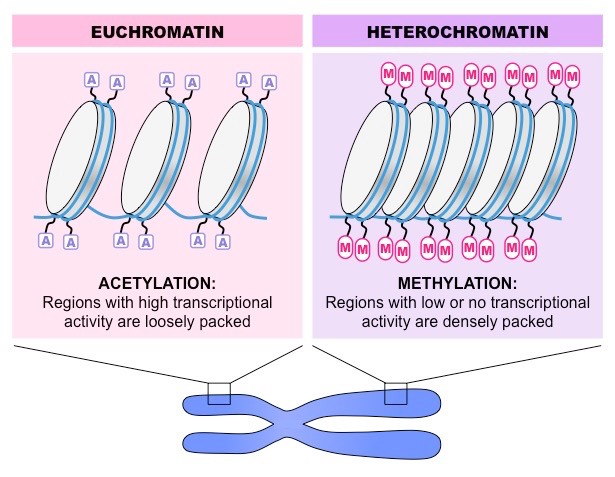
Histone acetylation

What is the most common type of epigenetic tag?
DNA methylation: The addition of a methyl group (CH4) to a cytosine base in DNA
The most common type of epigenetic tag that prevents gene expression
The methyl group causes DNA to coil tighter around histones, which stops proteins from reading the gene

How does histone modification increase gene expression?
Histone acetylation: The addition of an acetyl group to a histone tail which relaxes the chromatin structure and increases the expression of the gene
Increases accessibility for proteins and therefore gene expression

How are histone modifications different to histone acetylation?
Both DNA methylation and acetylation are types of histone modifications
Histone modifications: Chemical changes to histone proteins that control how tightly DNA is wrapped around them
These changes alter chromatin structure, turning genes on or off without changing the DNA sequence itself