Hemostasis and Related Disorders
 Call Kai
 Learn
Learn Practice Test
 Spaced Repetition
 Match
Match Flashcards
 Knowt Play
1/76

There's no tags or description
Looks like no tags are added yet.
Name | Mastery | Learn | Test | Matching | Spaced | Call with Kai | Chat |
|---|
No analytics yet
Send a link to your students to track their progress
77 Terms
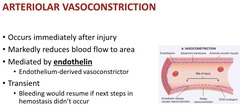
what is arteriolar vasoconstriction mediated by? A.V. is ____ in nature
endothelin, an endothelium-derived vasoconstrictor; transient
How do leukocytes get from the bloodstream to the site of injury?
1. margination
2. rolling- selectins
3. adhesion- integrins
4. transmigration- spacing in endothelium cells
5. chemotaxis- chemokines
what is the goal of hemostasis?
form a clot to prevent/ limit bleeding
what are the 4 general steps of normal hemostasis?
1. arterial vasoconstriction
2. primary hemostasis (platelet/ hemostatic plug)
3. secondary hemostasis (deposition of fibrin- helps platelets become sticky and stabilize)
4. clot stabilization and resporption

why don't we stop at primary hemstasis?
platelet plug isn't long term and can get dislodged
what is arteriolar vasoconstriction mediated by? what triggers the release of this substance?
endothelin- endothelium-derived vasoconstrictor; immediately after injury to a blood vessel
primary hemostasis is responsible for the formation of the ____ ____. It is mediated by ___ ___ ___ and ____, which are exposed when...
platelet plug; Von Willebrand factor' collagen; the endothelium is disrupted
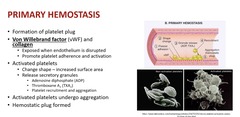
what promotes platelet adherence and activation in primary hemostasis? where is this substance found?
Von Willebrand factor and collagen; under endothelium and exposed when endothelium is disrupted
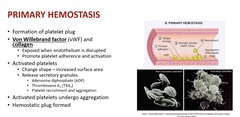
how do activated platelets look different than inactivated platelets?
activated have finger like projections, inactivated do not

what happens to platelets when they are activated and what do the release?
they change shape and secretory granules:
-ADP,
-Thromboxane A are released, promoting platelet recruitment and aggregation
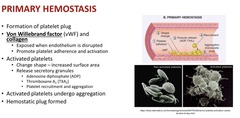
What forms the hemostatic plug?
vWF and collagen, platelets release ADP, Thromboxane A2 which both help w/ platelet recruitment and aggregation
activated platelets undergo _____
aggregation

what factors help with platelet adhesion to the extracellular membrane?
glycoprotein Ib (GpIb attached to the platelet) and vWF (receptor on the collagen)
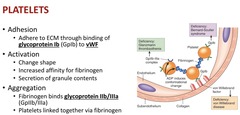
what factors help with platelet aggregation?
-fibrinogen (blue beeds in pic) binds glycoprotein IIb/ IIIa (receptors on platelet in pic)
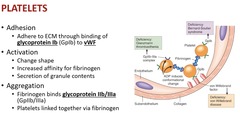
what does fibrinogen bind to to aggregate platelets?
glycoprotein IIb/ IIIa
platelets are linked together via _.
Fibrinogen

what is a membrane-bound procoagulant glycoprotein that is exposed at site of injury during the secondary hemostasis?
tissue factor (TF)

What does TF activate in secondary hemostasis?
Factor VII, which downstream activates thrombin
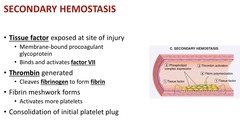
What cleaves fibrinogen and forms fibrin?
thrombin
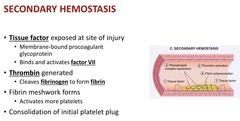
During secondary hemostasis, ____ ____ is exposed at the site of injury. This binds and activates ____ . As a result, _____ is generated and functions by cleaving _____ to _____, allowing the formation of a meshwork
tissue factor; factor VII; thrombin; fibrinogen; fibrin
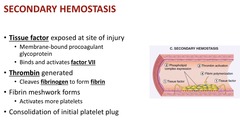
what is the goal of secondary hemostasis?
consolidation of initial platelet plug
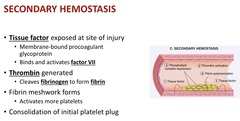
fibrin and platelet aggregates contract to for a __.
permanent plug
what factor limits clotting at site of injury in the clot stabilization and resorption step?
tissue plasminogen activator (t-PA)

what occurs during clot stabilization and resorption? What compound is made at this time and what does it do?
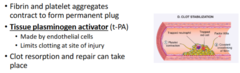
____ cells are regulators of hemostasis
endothelial cells
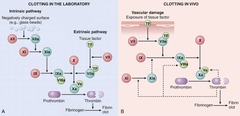
Visualize the coagulation pathway- clotting in vivo; vascular damage
-TF activates VII
-VIIa activates IX
-IXa activates X
-Xa activates prothrombin into thrombin
-thrombin activates fibrinogen to form a clot
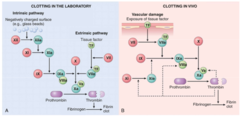
Talk through the intrinsic pathway for clotting in a lab
-negatively charged surface activates XII
-XIIa activates IX
-IXa activates X
-Xa activates prothrombin into thrombin
-thrombin activates fibrinogen to form a clot
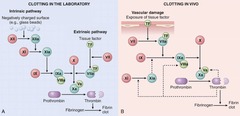
Talk through the extrinsic pathway for clotting in a lab
-TF activates VII
-VII(TF) activates X
-Xa activates prothrombin into thrombin
-thrombin activates fibrinogen to form a clot
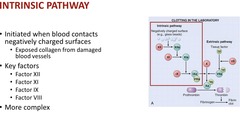
the intrinsic pathway is initiated when...
blood contacts negatively charged surfaces such as exposed collagen from damaged blood vessels
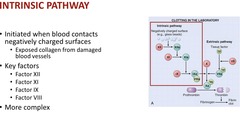
what are the 4 key factors of the intrinsic pathway?
Factor XII, XI, IX, VIII
12, 11, 9, 8 > 10
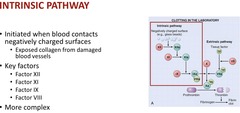
is the intrinsic or extrinsic pathway more complex?
intrinsic
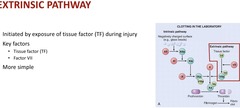
what initiates the extrinsic pathway?
exposure of tissue factor during injury

what are 2 key factors of the extrinsic pathway?
tissue factor (TF) and Factor VII >10
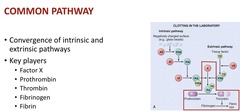
what is the common pathway and what are the key factors?
convergence of intrinsic and extrinsic pathways
Factor X, prothrombin, thrombin, fibrinogen, fibrin
What initiates the extrinsic pathway of the coagulation cascade?
TF

describe the prothrombin time laboratory test. what pathway does it evaluate?
evaluates the extrinsic pathway by adding tissue factor, phospholipids, and calcium to the plasma and measuring the time it takes for fibrin clot formation
What test is used to evaluate the extrinsic pathway?
prothrombin time (PT)
What is added to plasma when testing PT?
Tissue Factor, phospholipids, and calcium are added to plasma
what factors are evaluated for the PT test?
factors VII, X, V, prothrombin and fibrinogen
*factors involved in the extrinisic pathway*
what does PT record?
Time to fibrin clot formation recorded
Describe the internal normalized ratio (INR), what does it test for?
it is a "corrected" prothrombin time. PT results can vary based on the reagents used, INR accounts for this. So results from different places can be comparative to one another.
Describe the partial thromboplastin time (PTT) laboratory test and what is added. what pathway does it evaluate?
assesses intrinsic pathway by adding negative-charged particles (ground glass) and recording the time to form a fibrin clot
What cascade does the PTT assess? what factors are evaluated?
intrinsic pathway; Factors XII, XI, IX, VIII, X, V, prothrombin, and fibrinogen
what does the thrombin time test evaluate?
identifies problem with fibrinogen or thrombin inhibitor issue
Which laboratory test measures the function of the intrinsic pathway?
PTT
What promotes inflammation, angiogenesis, and repair?
thrombin

what pathway does thrombin time test evaluate?
common pathway; identifies problem with fibrinogen or thrombin initiator issue
what is thrombin's function when it touches normal endothelium? Compare this to the function for when it touches damaged endothelium.
becomes an ANTI-coagulant when touches normal endothelium; controls clotting process
*when in the region of damaged endothelium will promote inflammation, angiogenesis and repair*
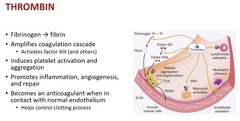
what turns fibrinogen to fibrin? what does this help form?
thrombin; induces platelet activation and aggregation

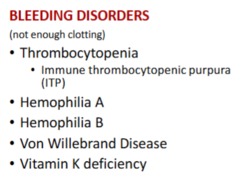
what are 5 bleeding disorders related to hemostasis? is this too much or too little clotting?
1. thrombocytopenia
2. Hemophilia A
3. Hemophilia B
4. Von Willebrand Disease
5. Vitamin K deficiency
***too little clotting**
when we have inflammation and angiogenesis or new blood vessels and some new collagen formation, what do we call this?
granulation tissue; speckled yellow tissue
what are 3 thrombotic disorders? is this too much or too little clotting?
1. thrombosis
2. hypercoagulable state
3. embolism
**too much clotting**
1 -What function does thrombin have?
2 - How does this affect the coagulation cascade and what is the result?
3 - What does thrombin promote?
4 - What does thrombin become when it contacts NORMAL epithelium and why?
1 - cleaves fibrinogen to fibrin
2 - amplifies the coagulation cascade by activating factor XIII, inducing platelet activation and aggregation
3 - inflammation, angiogenesis, repair
4 - anticoagulant to help control the clotting process
what 2 factors that limit coagulation?
dilution (blood stream washes factors away) and fibrinolytic cascade (plasmin is activated by plasminogen
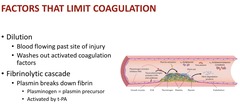
how does the fibrinolytic cascade limit coagulation?
-plasmin breaks down fibrin
-plasminogen = plasmin precursor
-plasminogen is activated by t-PA
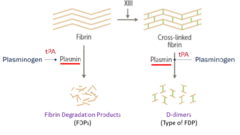
how is plasmin activated to break down fibrin?
tPA activates plasminogen to plasmin, plasmin then breaks down fibrin

what does the phrase she said in class "keep the eyes (II's) in MIND mean?
basic categories of disease acronym:
II- injury & infection
Metabolic
Immune
Neoplastic
Developmental
what is thrombocytopenia (with values)?
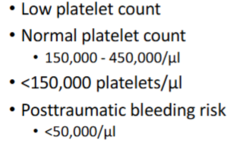
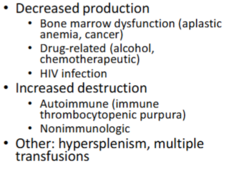
what are causes of thrombocytopenia?
-bone marrow dysfunction
-drugs
-HIV
-autoimmune
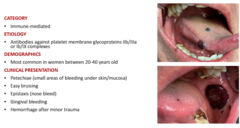
immune thrombocytopenic purpuria (ITP):
-category
-etiology
-demographic
-clinical presentation
-immune-related
-antibodies against platelet membrane glycoproteins IIb/ IIIa or Ib/ IX complexes (II and III glycoproteins connect platelets to platelets)
-demographics- women 20-40
-petechiae, bruising, epistaxis, gingival bleeding, hemorrhage
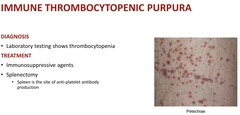
what is the diagnosis and treatment of immune thrombocytopenic purpuria?
lab testing and immunosuppressive agents (steroids) and splenectomy
Hemophilia A:
-category
-etiology
-demographics
-developmental (usually congenital)
-x-linked recessive disorder and deficiency of Factor VIII (8)
-affects males more than females
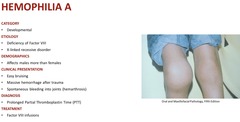
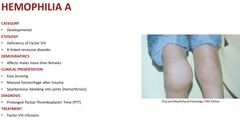
Hemophilia A:
-clinical presentation
-diagnosis
-treatment
-bruising
-hemorrhage after trauma
-spontaneous bleeding into joints (hemarthrosis in the pic)
-dx: PTT
-tx: factor VIII
Hemophilia B:
-catagory
-etiology
-demographics
-developmental
-X linked recessive disorder deficiency of Factor IX (9)
-affects males more than females
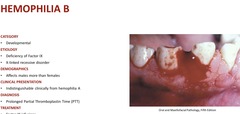
Hemophilia B:
-clinical presentation
-diagnosis
-treatment
-Easy bruising, massive hemorrhage after trauma, spontaneous bleeding into joints (hemarthrosis)
-dx: PTT
-tx: factor IX

von Willebrand disease:
-category
-etiology
-demographics
-developmental
-autosomal dominant or deficiency or dysfunction of vWF
-1% of people in the US/ most common bleeding disorder in US

von willebrand disease:
-clinical presentation
-diagnosis
-treatment
-mucosal bleeding, easy bruising
-dx: prolonged PTT
-tx: desmopressin- increases vWF and factor VIII
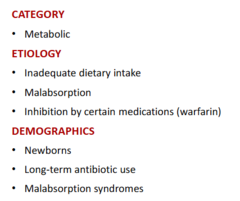
vitamin K deficiency:
-category
-etiology
-demographics
-metabolic
-inadequate dietary, malabsorption, meds (warfarin)
-newborns (given Vit K shots), long-term antibiotics, malabsorption syndromes
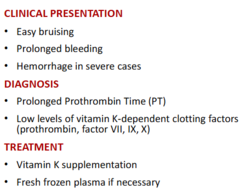
vitamin K deficiency:
-clinical presentation
-diagnosis
-treatment
-easy bruising, prolonged bleeding
-dx: prolonged PT and low levels of vitamin K-dependent clotting factors
-tx: vit K and rfesh frozen plasma if needed
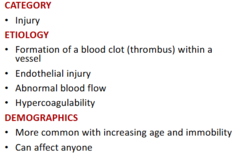
thrombosis:
-category
-etiology
-demographics
-injury
-blood clot in a vessel, endothelial injury, abnormal blood flow, hypercoagulability
-increasing age and immobility
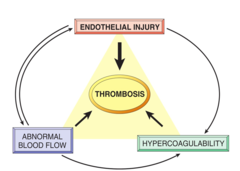
what 3 things can lead to thrombosis?
1. endothelial injury
2. abnormal blood flow
3. hypercoagulability
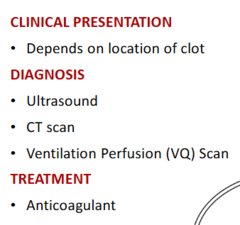
thrombosis:
-clinical presentation
-diagnosis
-treatment
-location dependent
-dx: ultrasound, CT scan, ventilation perfusion (VQ) scan
-tx: anticoagulant
hypercoagulable state:
-category
-etiology
-demographics
-developmental, immune-mediated, or metabolic
-numerous genetic and acquired
-can affect anyone
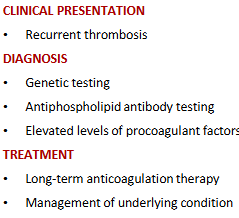
hypercoagulable state:
-clinical presentation
-diagnosis
-treatment
-recurrent thrombosis
-dx: genetic testing, antiphospholipid antibody testing, elevated levels of procoagulant factors
-tx: long-term anticoagulant therapy, management of underlying condition
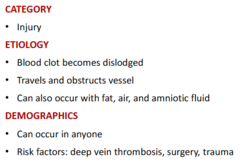
embolism:
-category
-etiology
-demographics
-injury
-blood clot dislodged (broken free from vessel), travels and obstructs vessels and occurs with fat, air, and amniotic fluid
**trouble is when it comes from a LG vessel then breaks free and occludes a smaller vessel**
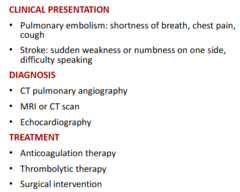
embolism:
-clinical presentation
-diagnosis
-treatment
-pulmonary embolism: shortness off breath, chest pain, cough and stroke: weakness/ numbness on one side and difficulty speaking
-dx: CT pulmonary angiography, MRI/ CT, echocardiography
-tx: anticoagulation therapy, thrombolytic tx (busting the clot), surgical intervention
what can be clinical implications of pt's taking drugs that effect primary vs secondary hemostasis?
-primary hemostasis- formation of platelet plug; pt will have vasoconstriction but will bleed a lot more up front, take a lot longer to make a plug**
-secondary hemostasis- fibrin deposited and matures plug to a clot (more stable/ organized); these pt's have increased bleeding risk after the procedure when they get home due to inability for clot formation
*aspirin and clopidogrel act on primary
*warfarin, heparin effect secondary hemostasis