PHRM 720 Exam 1 questions + inclass questions
 Call Kai
 Learn
Learn Practice Test
 Spaced Repetition
 Match
Match Flashcards
 Knowt Play
1/81

There's no tags or description
Looks like no tags are added yet.
Name | Mastery | Learn | Test | Matching | Spaced | Call with Kai | Chat |
|---|
No analytics yet
Send a link to your students to track their progress
82 Terms
Chlorothiazide Class
A drug belonging to the thiazide diuretic class of antihypertensive medications.
Lisinopril Class
A drug belonging to the ACE (angiotensin-converting enzyme) inhibitor class.
Valsartan Class
A drug belonging to the ARB (angiotensin receptor blocker) class.
Spironolactone Class
A drug belonging to the mineralocorticoid receptor blocker class.
Losartan Imidazole Ring Features
An essential SAR element of losartan containing a 2-alkylated chain (3–4 atoms long), a 4-substitution, and a 3-phenylmethyl substitution.
Peptide Mimetic Concept
A medicinal chemistry strategy designed to mimic amino acid side chains while eliminating hydrolyzable peptide/amide bonds.
Mechanisms Increasing Cardiac Output
Physiological mechanisms that increase blood pressure by elevating cardiac output, including SNS activation, renal Na+ and H2O reabsorption, and increased blood volume.
Chronic Response to SNS Inhibition
A compensatory increase in Na+ and H2O reabsorption from urine by the kidneys following administration of an efficacious SNS inhibitor like an alpha-2 agonist.
Microzide
The brand name for hydrochlorothiazide (HCTZ), a thiazide diuretic used to treat hypertension.
Mechanism of Action of Microzide
Inhibits the Na+/Cl− transporter in the distal tubule, inducing diuresis and natriuresis, and ultimately reducing PVR.
Microzide-Induced Hypokalemia Management
Strategies including potassium supplementation, or co-prescribing spironolactone, triamterene, a Na+ ion channel blocker, or a mineralocorticoid receptor antagonist.
Triamterene Pharmacological Mechanism
Prevents diuretic-induced hypokalemia by blocking sodium ion channels in the distal nephron.
Cozaar Mechanism for PVR Reduction
Reduces peripheral vascular resistance as a competitive antagonist of the AT1 receptor, decreasing arteriolar vasoconstriction and aldosterone secretion.
Trough-to-Peak Ratio > 50%
A pharmacokinetic benchmark indicating that uniform reduction in blood pressure over 24 hours can be achieved with once-daily dosing.
Altace
The brand name for ramipril, an ACE inhibitor used in hypertension management.
Altace Mechanism of Increasing Serum Creatinine
Acts on the efferent glomerular arteriole to reduce intraglomerular pressure, resulting in a decreased GFR.
Altace Mechanism of Hyperkalemia
Decreases aldosterone synthesis in the adrenal cortex, leading to reduced renal potassium excretion.
Indication to Switch Altace to Labetalol
Patient pregnancy, during which ACE inhibitors like Altace are contraindicated.
Procardia
The brand name for nifedipine, a calcium channel blocker.
Procardia Mechanism of Action
Selectively blocks voltage-gated Ca2+ channels in resistance arterioles to lower PVR.
Norvasc Side Effect
A brand name for amlodipine, a calcium channel blocker commonly associated with peripheral edema.
ACE Inhibitor Transition-State Design
Designing inhibitor molecules to mimic the tetrahedral transition state of peptide cleavage, allowing tight and stable binding to the active site.
Zinc (Zn²⁺) Coordination in ACE
An essential active-site interaction where transition-state mimics coordinate with the catalytic Zn2+ ion to block catalytic turnover.
Orally Active AT1 Antagonist Design Strategy
Replacing peptide bonds with nonpeptide structural features that mimic important angiotensin II side chains while resisting GI hydrolysis.
Chlorthalidone Half-Life
Approximately 47 hours.
Hydrochlorothiazide Half-Life
Between 2 and 3 hours.
Indapamide Half-Life
Approximately 14 hours.
Chlorthalidone vs HCTZ Potency
Chlorthalidone is more potent on a mg-to-mg basis and produces greater reductions in office blood pressure than hydrochlorothiazide.
Chlorthalidone CV Outcomes in Stroke/MI
Demonstrates a statistically significant lower risk of cardiovascular events (p=0.02) compared to HCTZ in patients with a history of stroke or MI.
HCTZ Combination Products
Over 25 commercially available single-tablet antihypertensive combination products incorporate HCTZ.
Chlorthalidone Combination Products
Only 2 commercially available single-tablet combination products contain chlorthalidone (Atenolol + chlorthalidone; Azilsartan + chlorthalidone).
Indapamide Combination Products
Only 1 commercially available single-tablet combination product contains indapamide (Telmisartan + amlodipine + indapamide).
Compensatory Response to Reduced Stroke Volume
An increase in heart rate to help maintain cardiac output and blood pressure.
Adherence Strategy for Home BP Monitoring
Initiating daily home blood pressure monitoring to improve medication adherence in patients unmotivated by simple refill reminders.
Furosemide + Metoprolol Synergy
A drug combination providing synergistic BP reduction by targeting different components of the blood pressure equation.
Olmesartan Ang II Side Chain Mimicry
Designed to mimic specific side-chain interactions of Angiotensin II, such as Asp-1, Tyr-4, Ile-5, His-6, or Phe-8.
Efferent Glomerular Arteriole
The primary site of vascular action where ACE inhibitors reduce intraglomerular pressure and GFR.
Distal Tubule Na+/Cl- Transporter
The specific renal transport system targeted and inhibited by Microzide.
2-Alkyl Group of Losartan
A side chain approximately 3–4 atoms long attached to the 2-position of the imidazole ring required for ARB activity.
4-Substituted Imidazole Group
A structural feature in ARBs that can form part of a further cyclic ring structure.
Terminal Tetrazole or Carboxyl Group
An acidic group located on the 4-position of the phenylmethyl ring in ARBs that mimics acidic amino acid features.
Cardizem
The brand name for diltiazem, a non-dihydropyridine calcium channel blocker.
Enalapril
An ACE inhibitor drug used as an antihypertensive agent.
Atenolol + Chlorthalidone
One of the two commercially available single-tablet combination formulations containing chlorthalidone.
Azilsartan + Chlorthalidone
One of the two commercially available single-tablet combination formulations containing chlorthalidone.
Telmisartan + Amlodipine + Indapamide
The single commercially available single-tablet combination product containing indapamide.
Hyperkalemia Mechanism of ACE Inhibitors
Decreased aldosterone synthesis resulting in reduced renal potassium excretion.
Peripheral Edema in CCB Therapy
An adverse effect commonly caused by dihydropyridine calcium channel blockers such as Norvasc (amlodipine).
Management of HTN with Microalbuminuria
Continuing high-dose ACE inhibitor therapy (e.g., Lisinopril 40 mg) when blood pressure goals (130/80 mmHg) are met and microalbuminuria is present.
Stage 1 HTN Management with CVD Risk > 10%
Initiation of antihypertensive monotherapy (e.g., Chlorthalidone) in patients with BP 136/88 mmHg and a 10-year CVD risk of 12.1\text{ %}.
Aldosterone increases BP by which of the following mechanisms? Select the single best answer. (1 pt)
A: Increases constriction of precapillary arterioles which increases PVR
B: Increases SNS outflow from the brainstem which increases C O
C: Increases Ang II expression which increases PVR
D: Increases Na+ and water re absorption from the urine filtrate which increases PVR
E: Increases Na+ and water re absorption from the urine which increases CO
E: Increases Na+ and water re absorption from the urine which increases CO
What is/are the mechanisms by which the SNS increases BP? (select all that apply, no partial credit given; 2 pts)
A: NE stimulates alpha-2 receptors and increases aldosterone which increases CO
B: NE stimulates beta-1 receptors and increases CO
C: NE stimulates alpha-1 receptors and increases PVR
D: NE stimulates beta-2 receptors and increases PVR
E: NE stimulates alpha-2 receptors and increases PVR
B: NE stimulates beta-1 receptors and increases C O
C: NE stimulates alpha-1 receptors and increases PVR
Which of the following would (either directly or indirectly) increase cardiac output? (select all that apply, no partial credit given; 2 pts)
A: Reduction in heart rate
B: Vasoconstriction
C: Increase in blood volume
D: Vasodilation
C: Increase in blood volume
D: Vasodilation
State 2 proven strategies that have not yet been tried may help this patient be more adherent to her antihypertensive regimen.
1. Get an At-Home Blood Pressure Monitor. 2. Switch to Lisinopril/HCTZ, which is an ACEi and thiazide diuretic and can betaken as one pill instead of 2.
While you may or may not agree, the decision was made to begin single-drug antihypertensive drug therapy for this patient. In this situation, which ONE drug would you recommend? (2 pts)
I would put her on a C a2+ Channel blocker such as Amlodipine.
Aldosterone increases BP by which of the following mechanisms? Select the single best answer. (1 pt)
A: Incre ases constriction of precapillary arterioles which incre ases PVR
B: Incre ases SNS outflow from the brainstem which incre ases C O
C: Increases Ang II expression which incre ases PVR
D: Increases Na+ and water re absorption from the urine filtrate which incre ases PVR
E: Increases Na+ and water re absorption from the urine which incre ases C O
E: Increases Na+ and water re absorption from the urine which increases C O
What is/are the mechanisms by which the SNS increases BP? (select all that apply, no partial credit given; 2 pts)
Original Order: 4
A: NE stimulates alpha-2 receptors and incre ases aldosterone which incre ases C O
B: NE stimulates beta-1 receptors and incre ases C O
C: NE stimulates alpha-1 receptors and incre ases PVR
D: NE stimulates beta-2 receptors and incre ases PVR
E: NE stimulates alpha-2 receptors and incre ases PVR
B: NE stimulates beta-1 receptors and incre ases C O
C: NE stimulates alpha-1 receptors and incre ases PVR
Which one of the following drugs would - in theory - hold the most potential as an antihypertensive medication?
(2 pts)
Original Order: 5
A: A drug which blocks endothelin degradation
B: A drug which blocks angiotensin II degradation
C: A drug which stimulates nitric oxide rele ase
D: A drug which stimulates rele ase of aldosterone
C: A drug which stimulates nitric oxide rele ase
Which of the following would (either directly or indirectly) increase cardiac output? (select all that apply, no
partial credit given; 2 pts)
Original Order: 6
A: Reduction in he art rate
B: Vasoconstriction
C: Incre ase in blood volume
D. Vasodilation
C: Incre ase in blood volume
D. Vasodilation
What is the mechanism of action by which Cozaar causes hyperkalemia as a side effect? Select the one best
answer. (1 pt)
Original Order: 9
A: Decre ases aldosterone synthesis
B: Incre ases glomerular filtration rate
C: Decre ases intraglomerular pressure
D: Decre ases blood volume
E: Incre ases dilation at afferent arteriole
A: Decre ases aldosterone synthesis
What is the mechanism of action of nifedipine for treating hypertension? (select all that apply, no partial credit
given; 1 pt)
Original Order: 11
A: Site of action is selective to cardiac SA and AV nodes, and cardiomyocytes
B: Site of action is selective to the resistance arteriole
C: Reduces C O and PVR
D: Blocks voltage-gated Ca2+ channels
E: Reduces C O
B: Site of action is selective to the resistance arteriole
D: Blocks voltage-gated Ca2+ channels
A patient has uncomplicated hypertension and is being treated with Lotensin and Procardia. The patient has
developed swelling in the ankles and feet. Which drug (A or B) is causing this effect and why (C, D, or E)? (select
all that apply, no partial credit given; 2 pts)
Original Order: 12
A: Lotensin
B: Procardia
C: Results from arteriolar dilation and incre ased in capillary pressure
D: Results from non-allergic re action due to incre ases in bradykinin
E: Results from incre ases in blood volume and fluid extravasation from capillaries
B: Procardia
C: Results from arteriolar dilation and incre ased in capillary pressure
Which of the following is part of the mechanism of action of Prinivil that causes dry cough? Select one best
answer. (1 pt)
Original Order: 13
A: It competitively inhibits angiotensinogen binding to renin, decre asing Ang I and Ang II synthesis
B: It decre ases Ang II synthesis and aldosterone secretion
C: It inhibits the degradation of bradykinin
D: It is an antagonist at the AT1 receptors, reducing aldosterone synthesis
E: It is a beta-2 antagonist
C: It inhibits the degradation of bradykinin
What is the mechanism of action by which Thalitone causes the side effect of hypokalemia? (select all that apply,
no partial credit given; 2 pts)
Original Order: 15
A: Inhibits the Na+/Cl- transporter in the distal tubule
B: Inhibits the Na+/K+ ATPase in the distal tubule
C: Delivers more Cl- to the collecting duct
D: Incre ases K+ re absorption from the urine filtrate in the collecting duct
E: Delivers more Na+ to the collecting duct
A: Inhibits the Na+/Cl- transporter in the distal tubule
E: Delivers more Na+ to the collecting duct
What is the pharmacological mechanism of triamterene for preventing hypokalemia? (1 pt)
Original Order: 16
A: Mineralocorticoid receptor antagonist
B: Blocks the Na+ ion channel
C: AT1 receptor antagonist
D: Blocks the K+ ion channel
E: Inhibits Na+/K+ ATPase
B: Blocks the Na+ ion channel
What is the mechanism of action of propranolol for treating hypertension? (select all that apply, no partial credit
given; 1 pt)
Original Order: 18
A: Site of action is resistance arterioles
B: Competitive antagonist of beta-2 receptor
C: C auses vasodilation and reduces PVR
D: Site of action is SA node and cardiac myocytes
E: Reduces HR and C O
F: Competitive antagonist of beta-1 receptor
B: Competitive antagonist of beta-2 receptor
D: Site of action is SA node and cardiac myocytes
E: Reduces HR and C O
F: Competitive antagonist of beta-1 receptor
Which of the following is a possible side effect of terazosin? (1 pt)
Original Order: 20
A: Dry cough
B: Angioedema
C: Postural hypotension
D: Sle ep disturbances
E: Depression
C: Postural hypotension

Which one of the following medications is most appropriate to administer to this patient at this time? (2 pts)
Original Order: 25
A: Oral labetalol
B: Oral chlorthalidone
C: Intravenous carvedilol
D: Intravenous clevidipine
D: Intravenous clevidipine

State 2 proven strategies that have not yet been tried may help this patient be more adherent to her
antihypertensive regimen. (2 pts)
Original Order: 26
A: - Have the patient obtain a blood pressure kit monitor to track her blood pressure regularly. - Give the patient combination drugs
or long acting medication for qd inste ad of bid.

While you may or may not agree, the decision was made to begin single-drug antihypertensive drug therapy for
this patient. In this situation, which ONE drug would you recommend? (2 pts)
Original Order: 28
A: Amlodipine
B: Chlorthalidone
C: Diltia z em
D: Lisinopril
D: Lisinopril

Based on the structures below, which of the following is mineralocorticoid receptor antagonist that can cause hormonal side effects?
A. A
B. B
C. C
D. D
E. Impossible to tell
B. B

based on the structure-activity relationship of beta-blockers, which is expected to be cardioselective
A. A Carvedilol
B. B Pindolol
C. C Timolol
D. D Atenolol
E. E Nadolol
D. it is atenolol
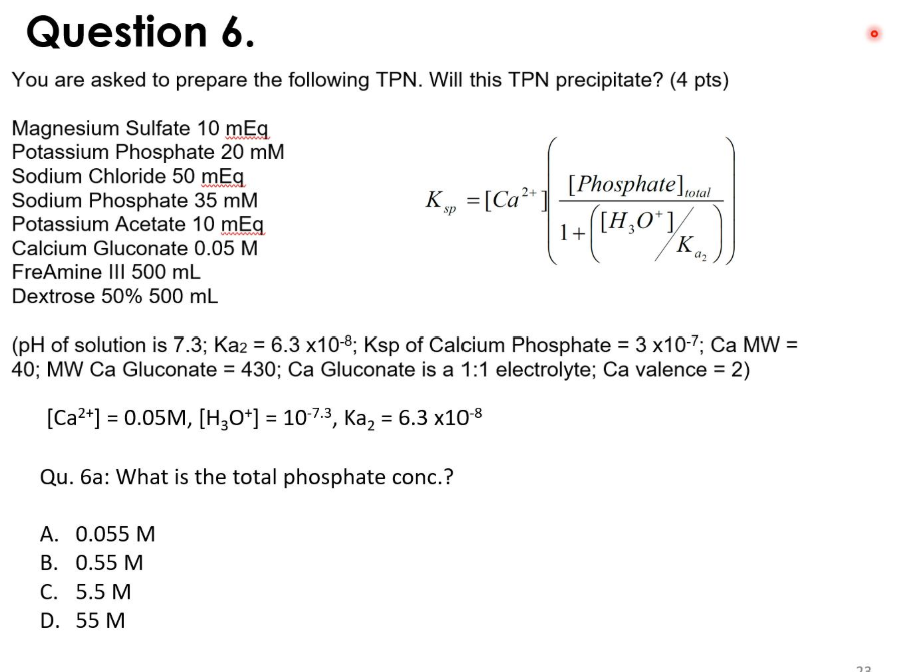
While you may or may not agree, the decision was made to begin single-drug antihypertensive drug therapy for
this patient. In this situation, which ONE drug would you recommend? (2 pts)
You can start the patient on a CCB or a thiazide siuretic
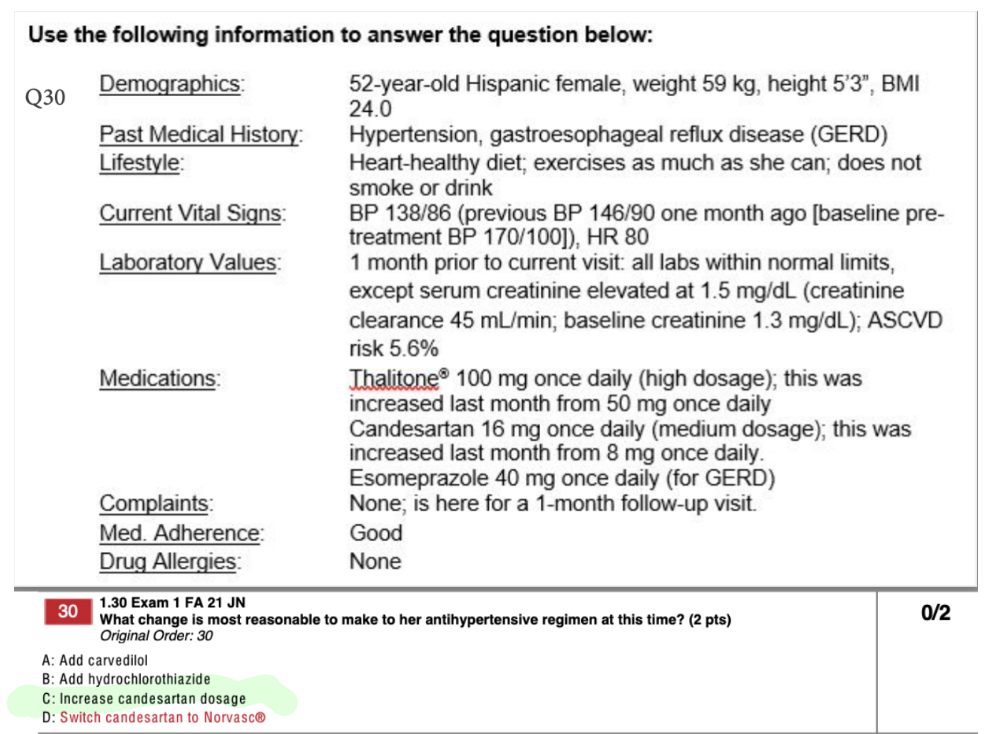
C. Increase Candesartan dosage
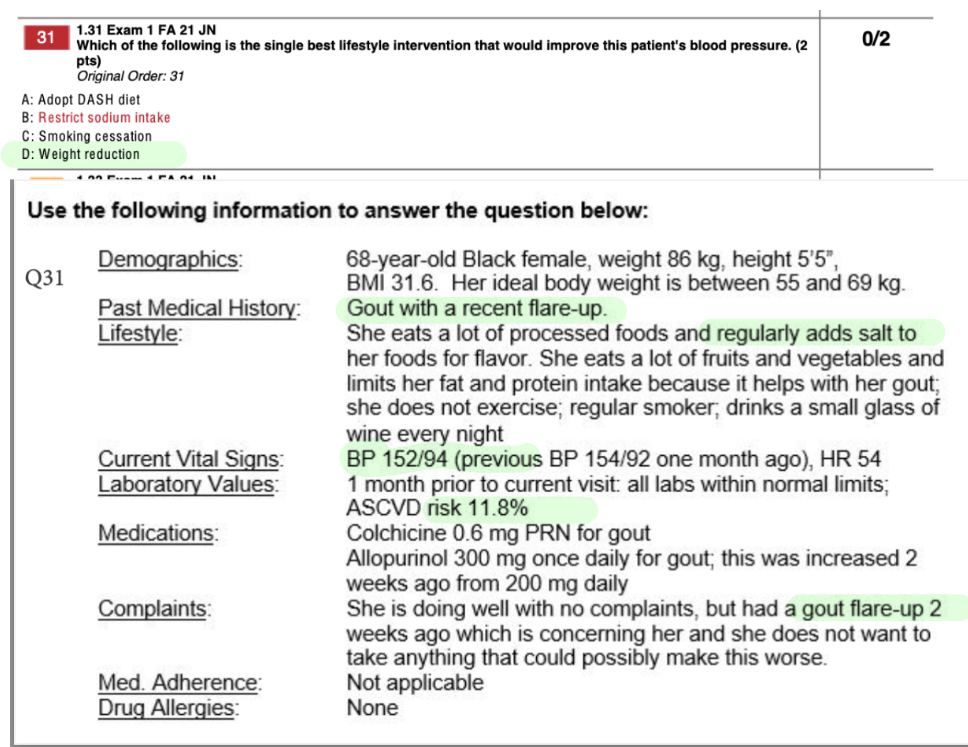
D. weight reduction
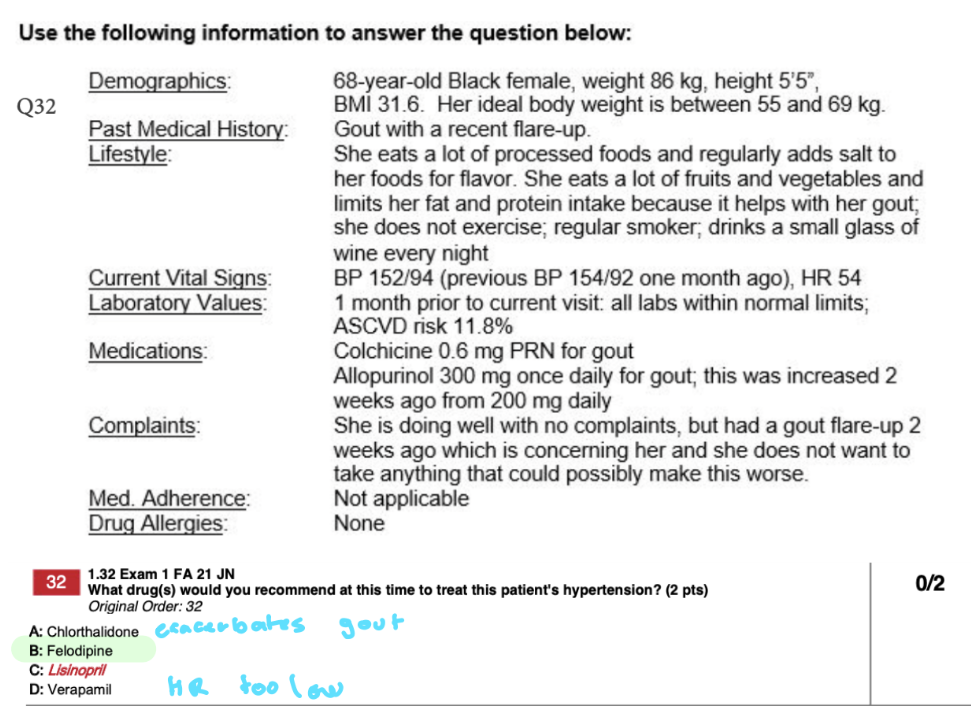
B. Felodipine

Stop Norvasc (amlodipine) 2.5 mg daily: This eliminates the offending agent driving the peripheral edema.
Reduce Microzide (hydrochlorothiazide) to 12.5 mg or 25 mg daily: This lowers the metabolic and electrolyte risks of high-dose thiazide therapy while retaining essential first-line blood pressure coverage.

Add metoprolol and maybe a ACE inhibitor for further blood pressure control, such as lisinopril, checking serum creatinine and potassium
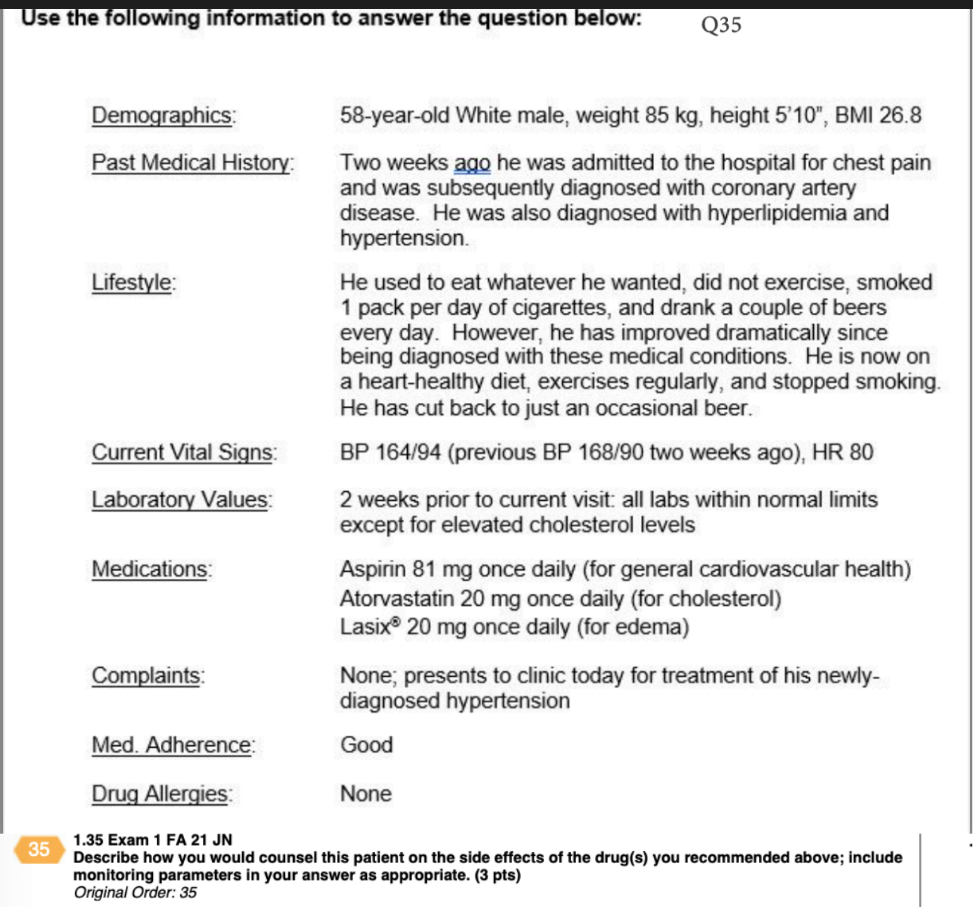
Frequent lab monitoring for potassium and creatinine level. watch for any swelling of the face, discontinue lisinopril immediately and seek medical attention ASAP. monitor bp at home.
What is the highest recommended daily intake of sodium for a patient with hypertension according to the
American Heart Association? (1 pt)
A: 1300 mg
B: 1500 mg
C: 2000 mg
D: 2300 mg
D: 2300 mg
A 62-year-old White male is being seen in the Emergency Department with a chief complaint of fatigue and lack of
energy. Laboratory results show a potassium of 3.9 mEq/L (normal 3.8-5.0 mEq/L) and serum creatinine of 0.8
mg/dL (normal 0.5-1.3 mg/dL). Physical examination is remarkable for right knee tenderness. Two blood pressure
readings are taken which are 204/118 mmHg and 212/108 mmHg with corresponding heart rates of 84 and 88 bpm.
Which one of the following medications is most appropriate to administer to this patient at this time? (2 pts)
A: Oral labetalol
B: Sublingual nitroglycerin
C: Intravenous carvedilol
D: Intravenous clevidipine
A: Oral labetolol