RESPIRATORY SYSTEM
 Call Kai
 Learn
Learn Practice Test
 Spaced Repetition
 Match
Match Flashcards
 Knowt Play
1/55

There's no tags or description
Looks like no tags are added yet.
Name | Mastery | Learn | Test | Matching | Spaced | Call with Kai | Chat |
|---|
No analytics yet
Send a link to your students to track their progress
56 Terms
CONDUCTING ZONE
Nose → pharynx → larynx → trachea → bronchi → bronchioles
move air in/out
traps debris and pathogens in mucus
warms and humidifies air
no gas exchange
RESPIRATORY ZONE
Terminal bronchioles → alveolar ducts → alveolar sacs → alveoli
gas exchange between blood and air
via passive diffusion
across 0.5 um membrane
TERMINAL BRONCHIOLES
The last of the conducting zone
RESPIRATORY BRONCHIOLES
First part of gas-exchanging zone
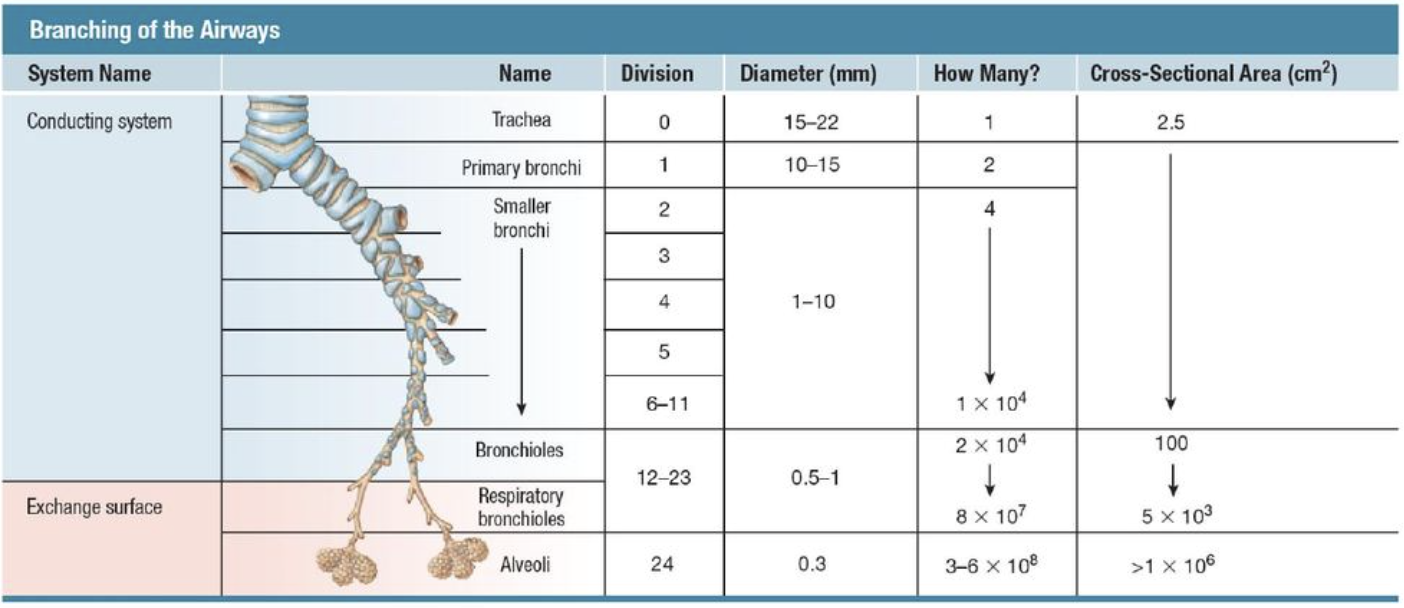
WHY SURFACE AREA MATTERS
As airways branch:
individual airway diameter decreases, then plateaus
airway numbers increase exponentially
cross-sectional area near alveoli increases greatly
This matters because gas exchange is passive diffusion and relies on:
surface area
diffusion distance
RESPIRATORY ENDOTHELIUM
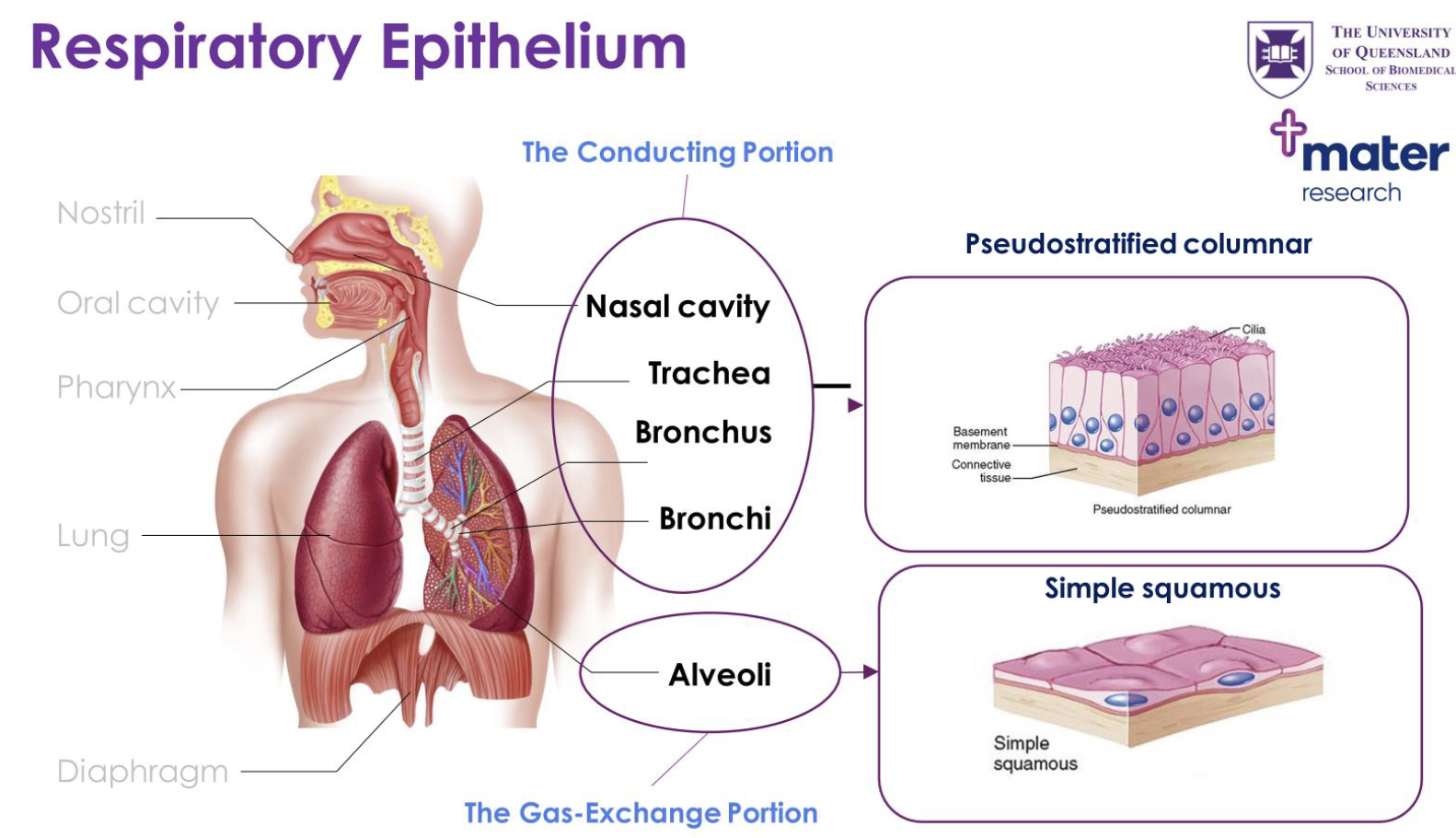
Conducting portion:
nasal cavity + trachea + bronchus + bronchi
pseudostratified columnar epithelial cells
Gas-exchange portion:
alveoli
simple squamous
GAS-EXCHANGE PORTION
Type I alveolar cells
simple squamous epi
thin diffusion barrier
tight junctions
Type II alveolar cells
cuboidal epi
surfactant secreting
replace damaged Type I cells
FLICK’S LAW OF DIFFUSION
Shorter distance = greater rate of diffusion
Greater surface area = greater rate of diffusion
SCARRING AND GAS EXCHANGE
If the alveolar wall is replaced by scar tissue:
diffusion distance becomes greater than the normal 0.5um
scar tissue is stiff so lungs are harder to inflate
This occurs in Idiopathic Pulmonary Fibrosis and once advanced, lifespan is reduced to a few years.
LUNG PLEURA
Each lung is wrapped in a thin, two-layered, fluid-filled membrane containing:
inner visceral pleura (on the lung)
outer parietal pleura (on the chest wall)
pleural cavity filled with pleural fluid
PLEURA FUNCTIONS
Lubrication
reduces friction during breathing
Surface tension
helps position lungs against thoracic wall
Division
Isolates respiratory system from other major organs
PLEURA CRITICAL POINTS
It is a closed system and air should never be inside.
If pleura is compromised, the lung cannot follow the rib cage and you cannot breathe effectively.
BOYLE’S LAW
For a fixed amount of gas at a constant temperature, pressure and volume are inversely related.
P1V1 = P2V2
INSPIRATION STEPS
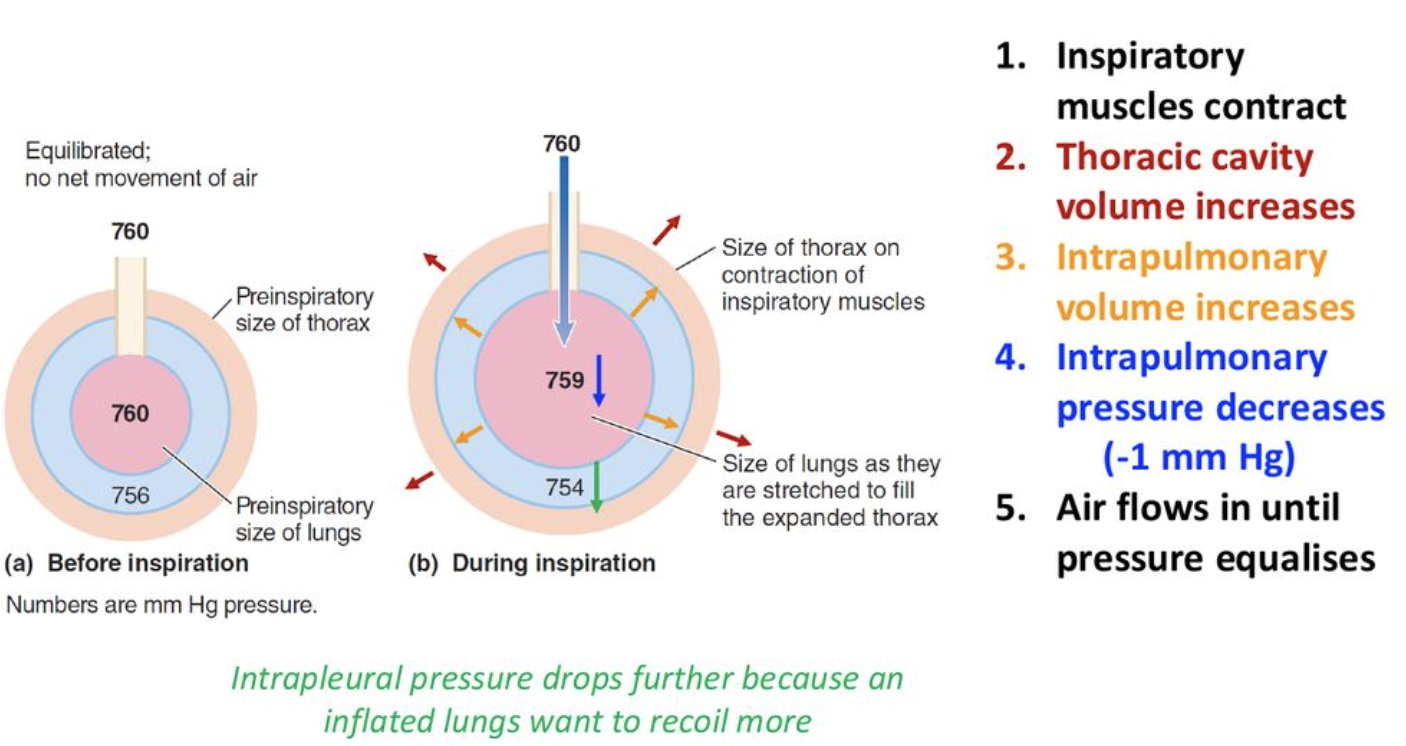
Inspiratory muscles contract (diaphram descends, ribcage raises)
Thoracic cavity volume increases
Lungs are stretched - intrapulmonary volume increases
Intrapulmonary pressure drops (-1mmHg relative to atmosphere)
Air flows down pressure gradient until intrapulmonary pressure returns to zero.
EXPIRATION STEPS
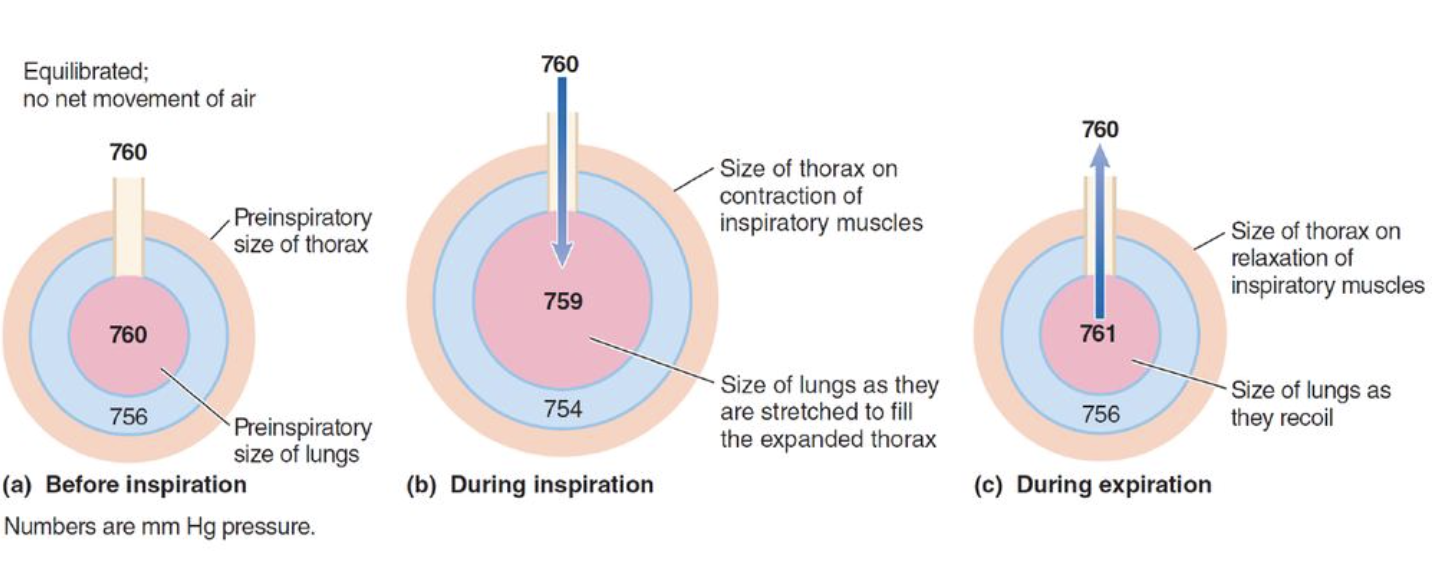
Inspiration muscles relax (elastic recoil of lungs)
Thoracic volume decreases
Intrapulmonary pressure rises to +1mmHg relative to atmosphere
Air flows out down pressure gradient until intrapulmonary pressure equals zero
LUNG VOLUME AND TIME
Rising is slowest at the end of inspiration because the lung is resisting further inflation
Rising is fastest at the start of expiration because recoil is strongest when the lung is most inflated
PRESSURE GRADIENTS
Intra-alveolar pressure:
most negative mid-inspiration
Intrapleural pressure:
keeps falling throughout inspiration and only rises once inspiratory muscles fully relax
never fully equalises with atmosphere because pleural space is sealed

TRANSPULMONARY PRESSURE
the net distending pressure that keeps the lung open
should always be positive
alveolar pressure > intrapleural pressure always
tidal volume approx. 400-500mL per breath
Ptp = Palveolar - Pintrapleural

PNEUMOTHORAX
If pleural seal is breached, air enters pleural space and it is no longer sealed →
Intrapleural pressure rises to equal atmosphere →
Transpulmonary pressure collapses to zero →
Lungs collapse
LUNG PRESSURES
Key factors influencing negative intrapleural pressure:
Surface tension
pleural fluid provides surface tension between pleural layers
Elastic force by lungs
elastic tissue in lungs recoils and pulls lungs inward
Elastic force by thoracic cage
thoracic wall naturally pulls away from lungs
parietal pleura pulled outward
MODES OF BREATHING
Quiet breathing:
At rest without conscious thought
Inspiration = diaphragm or external intercostals
Expiration = passive - relaxation only, no muscle contraction
Forced breathing:
Requires extra muscle contraction both phases
Inspiration = diaphragm, external intercostals + accessory muscles
Expiration = internal intercostal + thoracic transversus compress abdomen and push diaphragm upward.
THE MASTER EQUATION
Airflow rate (F) = Pressure gradient (P) / Airway resistance (R)
Three factors govern how easily air moves and how easily the lung inflates:
Airway resistance
Lung compliance and elastic recoil
Alveolar surface tension
AIRWAY RESISTANCE
Resistance is friction from air moving against airway walls and depends mostly on airway diameter. Increases with:
bronchoconstriction
mucus/secretions
fluid/oedema
Large airways have low resistance because of large diameter.
Small airways have low resistance because of large cross-sectional area.
Therefore, medium airways have the greatest resistance.
ASTHMA
Uncontrolled bronchospasms narrow the airway, raising resistance and work of breathing,
LARGE VS SMALL AIRWAY STRUCTURE
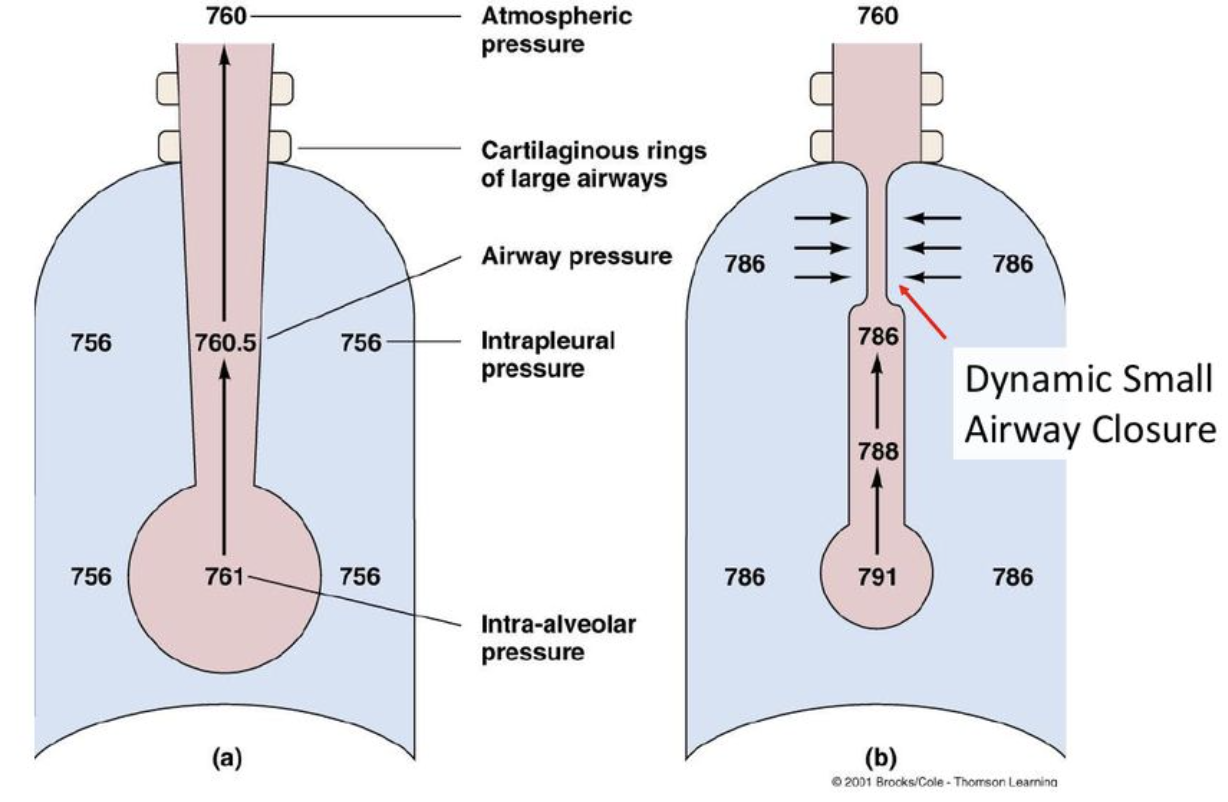
Large airways are held open by cartilage and cannot collapse.
Small airways have no cartilage support, they are floppy and can be squeezed shut from outside.
DYNAMIC AIRWAY CLOSURE
At the point in the small airway where airway pressure drops below the surrounding intrapleural pressure, the higher external pressure physically pinches it shut.
This traps remaining air proximal to the closure point, and that trapped air becomes part of the residual volume.
This is a normal, healthy mechanism
no one can fully empty their lungs
EARLY AIRWAY CLOSURE IN ASTHMA
Overstimulated small airways →
Increased small airway resistance →
Critical closure point reached earlier →
Decreased Forced Vital Capacity (FVC) + increased Residual Volume (RV)
EARLY AIRWAY CLOSURE IN EMPHYSEMA
Loss of lung tissue →
Decreased lung elastic recoil →
Small airways collapse earlier during expiration →
Decreased Forced Vital Capacity (FVC) + increased Residual Volume (RV)
LUNG COMPLIANCE
how easily lung can be stretched
measure of elastic resistance
increased compliance = easy to inflate
C = change in V / change in P
LUNG ELASTIC RECOIL
the tendency of the lung to rebound back
compliance and elastic recoil are inversely related
FIBROSIS COMPLIANCE
decreased compliance
scar tissue is inelastic
harder to inflate, increased breathing work rate
EMPHYSEMA COMPLIANCE
increased compliance
loss of lung tissue = less to stretch and recoil
easier to inflate but fewer functional alveoli for gas exchange
ALVEOLI SURFACE TENSION
Alveolar surface coated in water film
water molecules are charged and attract to each other
creates surface tension that tends to collapse the alveolus and resists inflation
LAW OF LAPLACE
Magnitude of inward-directed pressure in a bubble (alveoli) = 2 x Surface tension / radius of bubble (alveoli)
PULMONARY SURFACTANT
Pulmonary surfactant is produced in roughly equal quantities by the Type II cells of each alveolus, regardless of alveolus size.
In smaller alvelous:
the same amount of surfactant is more concentrated
surface tension lowered more
In larger alveolus:
the same amount of surfactant is more dilate
surface tension lowered less
SURFACTANT EQUILISATION
The different concentrations equilises collapsing pressure across alveoli of different sizes.
Overall, more concentrated surfactant = increased lung compliance + decreased work of breathing
INFANTORY RESPIRATORY DISTRESS SYNDROME
Premature infants (before 28 weeks) or newborns who have inadequate surfactant production
Alveoli collapse during expiration
Treatment:
surfactant spray
mechanical ventilation
ALVEOLI AND FORCES
Keep alveoli OPEN
transpulmonary pressure gradient
pulmonary surfactant
alveolar indpendence
Promote alveoli COLLAPSE
elastic recoil of pulmonary connective tissue
Alveolar surface tension
PRESSURE TERMINOLOGY
P (capital) followed by gas = partial pressure
Ex. PO2 = partial pressure of oxygen
Subscript a = arterial partial pressure
Ex. PaO2 = partial arterial pressure of oxygen
Subscript v = venous partial pressure
Ex. PvO2 = venous partial pressure of oxygen
FiO2 = fraction of inspired oxygen
Ex. %of O2 patient breathes in
VENTILATION - PERFUSION MATCHING
Three factors govern external respiration
V/Q Matching
alveolar ventilation vs pulmonary blood perfusion
Structural characteristics
of respiratory membrane (surface area, distance)
Partial Pressure gradients
And gas solubility
WHY V/Q MATCHING MATTERS
Alveoli are not uniformly inflated therefore, body automatically diverts more blood flow to better ventilated alveoli.
Matching perfusion to ventilation maximises gas exchange efficiency.
Ideal is V/Q = 1.
V/Q < 1 (SHUNTING)
alveolus poorly ventilated but still perfused
blood passes without gas exchange
high CO2, low O2 in mixed blood
= local hypoxia as airway attempts to dilate
V/Q > 1 (DEADSPACE)
alveolus is well ventilated but no blood flow reaches it (no perfusion)
low CO2, high O2 overall
Airway constricts to divert fresh air to alveoli that are perfused
PRONING
Turning someone on their belly for 6+ hours to improve V/Q Matching in unhealthy patients.
RESPIRATORY MEMBRANE
Alveolar walls
thin squamous epi cells
Capillaries
tightly encase external alveolar surface
Type II pneumocytes
secrete pulmonary surfactant
Interstitial fluid
very thin layer (0.5um)
DALTON’S LAW
In a mixture of gases, the partial pressure exerted by any one gas is proportional to its percentage amount in the mixture.

HENRY’S LAW
The amount of gas that dissolves a liquid is directly proportional to the partial pressure of that gas above the liquid.
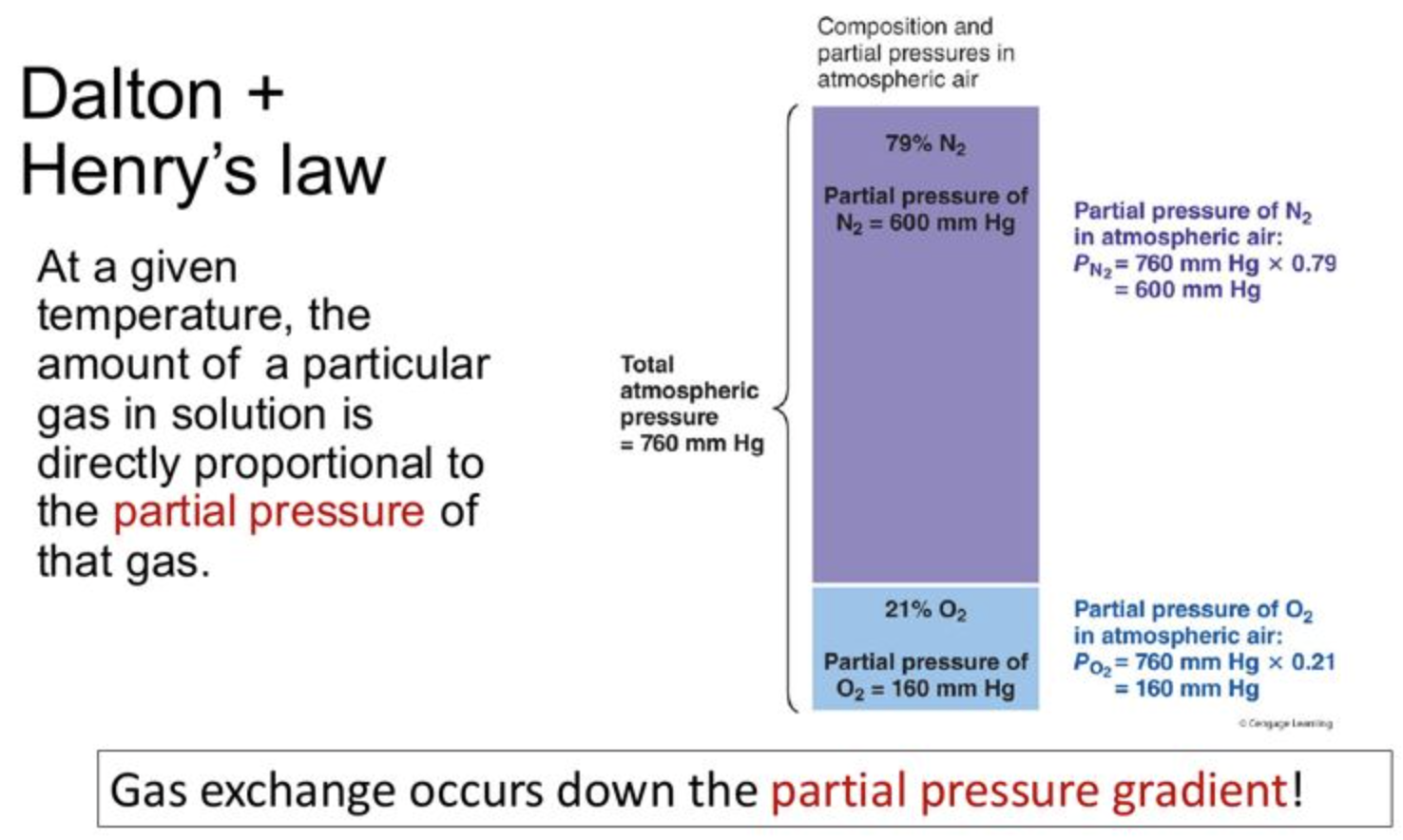
DALTON + HENRY
Partial pressure of a gas can be used a surrogate marker for the amount of that gas dissolved in blood.
FOUR PROCESS OF RESPIRATION
Pulmonary ventilation (breathing)
External respiration
Transport of respiratory gases
Internal respiration
2 + 4 = gas exchange
3 = gas transport
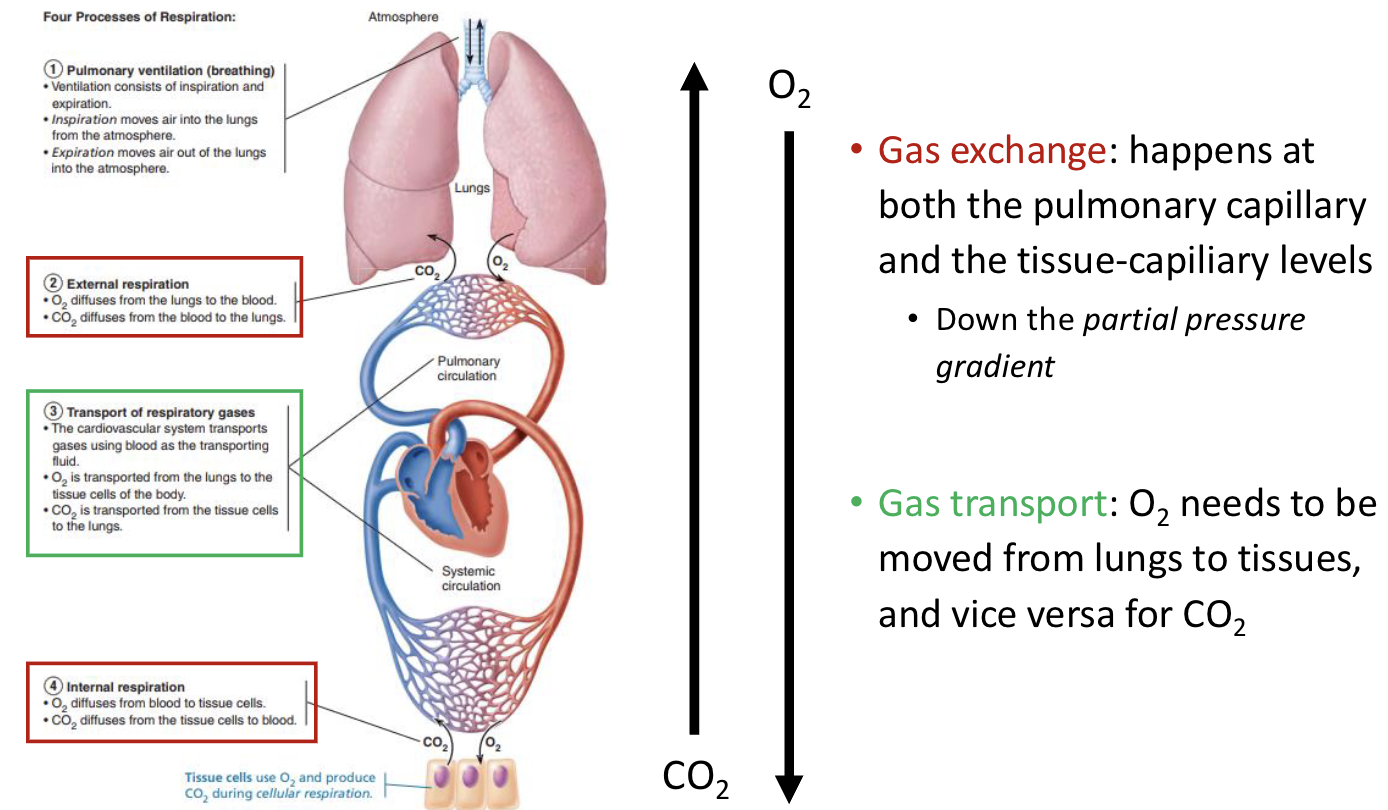
PARTIAL PRESSURE THROUGH SYSTEM
Atmospheric air (dry)
159 PO2
0.3 PCO2
Alveoli air (humidified + mixed)
104 PO2
40 PCO2
Mixed venous blood
40 PO2
46 PCO2
Arterial blood
97 PO2
40 PCO2
FACTORS AFFECTING GAS EXCHANGE
Partial pressure gradient
Surface area of membrane
Thickness of membrane
Diffusion coefficient
V/Q matching
DIFFUSION COEFFICIENT
related to gas solubility and molecular weight
D for CO2 is x20 D for O2 (CO2 diffuses more easily)
BUT O2 has bigger partial pressure gradient than CO2
therefore, CO2 and O2 are exchanged equally despite different solubilities
EMPHYSEMA
Decreased surface area and increased membrane thickness.
Causes:
pulmonary oedema
pneumonia
pulmonary fibrosis
ACUTE RESPIRATORY DISTRESS SYNDROME
Affects 1 in 10 mechanically ventilated ICU patients
30-50% mortality rates
fast onset, <2 weeks
no specific treatment exists
PNEUMONIA
Community acquired
Hospital/ventilator acquired
Inflammation → fluid/oedema → respiratory membrane becomes leaky → membrane thickness increases → diffusion rate decreases → arterial PaO2 drops
PNEUMONIA SEVERITY
Measured using ratio:
P/F ratio = PaO2 / FiO2
P/F ratio > 300 = Good/normal
P/F ratio = 200-300 = 30% mortality
P/F ratio = 100-200 = 40% mortality
P/F ratio <100 = 40-60% mortality