Chapter 16: Electrophilic Aromatic Substitution
 Call Kai
 Learn
Learn Practice Test
 Spaced Repetition
 Match
Match Flashcards
 Knowt Play
1/26

There's no tags or description
Looks like no tags are added yet.
Name | Mastery | Learn | Test | Matching | Spaced | Call with Kai | Chat |
|---|
No analytics yet
Send a link to your students to track their progress
27 Terms
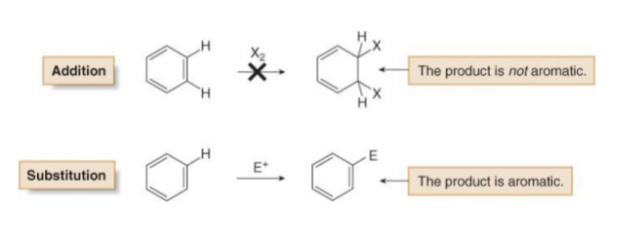
Aromatic compounds usually do substitutions and not additions
If an addition occurred, the product would be nonaromatic and much higher in energy than the aromatic starting material
Benzene is aromatic, meaning it is extremely stable because of its six delocalized π electrons. Instead of electrons staying between two atoms... they are shared around the entire ring. This makes benzene MUCH more stable than normal alkenes.
Losing aromaticity means losing its extra stability. That requires lots of energy. Instead
it replaces one hydrogen. This is called Electrophilic Aromatic Substitution (EAS) Instead of adding something it substitutes. Whenever you see Benzene always think: This molecule wants substitution, NOT addition.
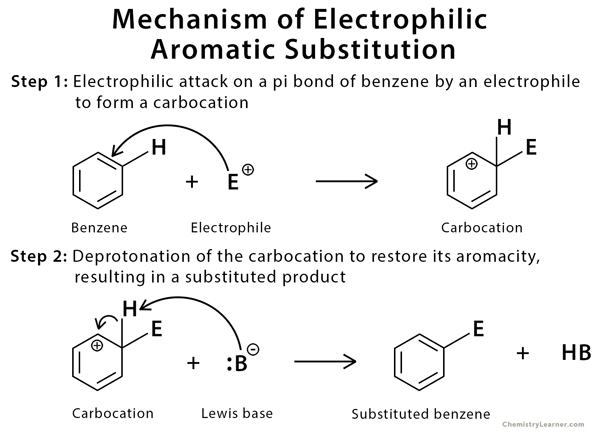
Electrophile
An atom or molecule that wants electrons. Usually positively charged. (In these EAS reactions, the electrophile is just the substituent with a positive charge)
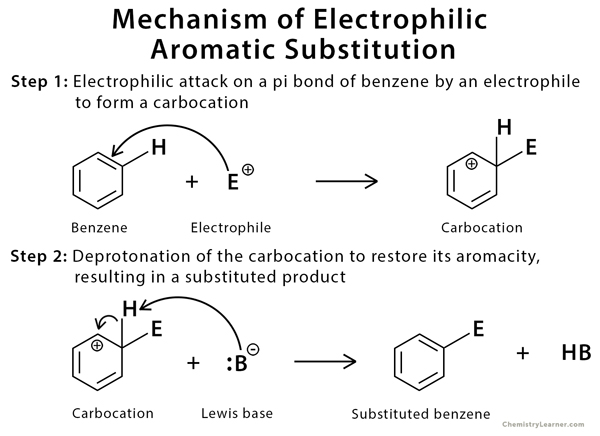
Nucleophile
Electron-rich molecule that attacks electrophiles. In benzene reactions, The benzene ring is the nucleophile. Why? Because the π electrons attack the electrophile. (Nucleophile is a pi bond or lone pair usually)
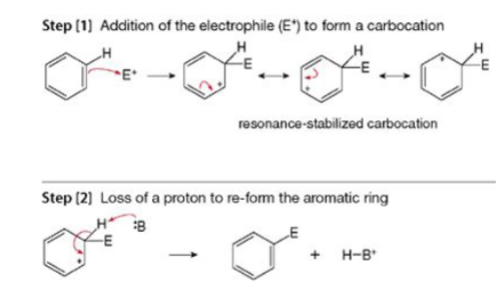
General Electrophilic Aromatic Substitution Mechanism
Every EAS reaction follows the same pattern:
Step 1: Make a strong electrophile.
Step 2: Benzene attacks it.
Step 3: Hydrogen leaves, Aromaticity returns.
The Electrophile will usually be the replacement group (product), but in a positively charged form
Aromatic Ring Products
see image
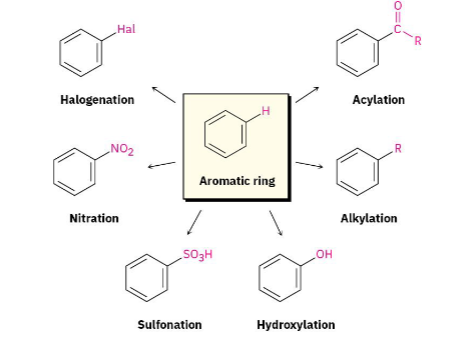
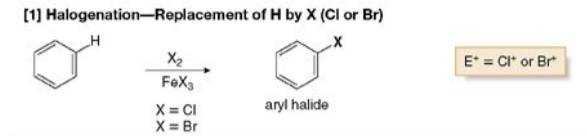
What is Halogenation, reagents, electrophile & what product does it form?
(Replacement of H by X: Cl or Br) Reagents: X2 & FeX3, Product is an aryl halide, electrophile is the +Halogen. (An aryl halide is an organic compound where a halogen atom is bonded directly to an aromatic ring).
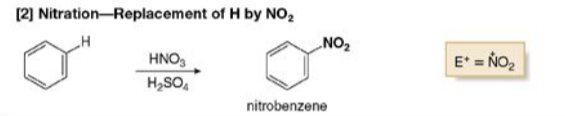
What is Nitration, reagents, electrophile & what product does it form?
(Replacement of H by NO2) Reagents: HNO3 & H2SO4 Product is nitrobenzene, electrophile is the +NO2
What is Sulfonation, what product does it form and what is the electrophile?
(Replacement of H by SO2H) Reagents: SO3 & H2SO4, Product is benzene sulfonic acid (aromatic ring with SO3H attached)
Electrophile is +SO3H

Friedel-Crafts reaction
(Benzene ring reacts with carbocation) a set of organic chemistry reactions used to attach alkyl or acyl groups to an aromatic ring (such as benzene) through electrophilic aromatic substitution.
alkylation
a chemical reaction that transfers an alkyl group (a simple carbon-and-hydrogen chain like a methyl or ethyl group) from one molecule and attaches it to another
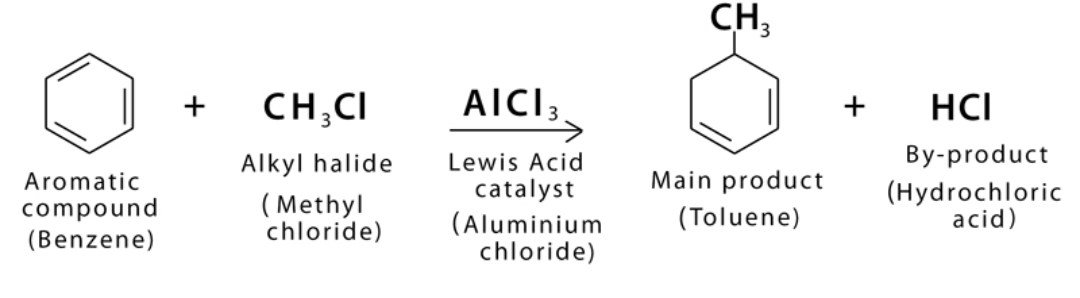
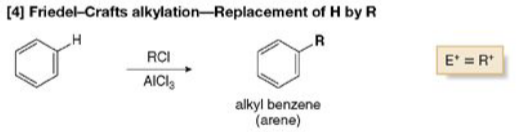
What is Friedel-Crafts Alkylation, what product does it form and what is the electrophile?
(Replacement of H by R) Reagents: RCl & AlCl3, Product is Alkyl Benzene, Electrophile is +R
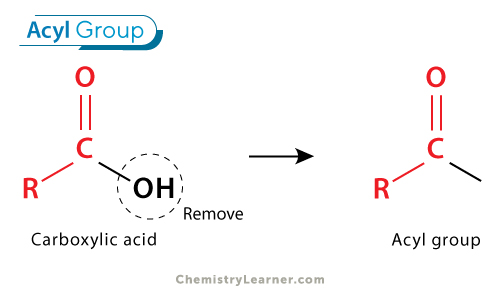
acyl group
a functional group typically derived from a carboxylic acid by removing the hydroxyl group.
The Carbonyl: A carbon double-bonded to an oxygen
The Chain: An alkyl or aryl group attached to that carbonyl carbon.
The Open Bond: A free, single bond on the carbonyl carbon ready to connect to a nucleophile or another molecule.
Because that open bond is attached to a carbonyl carbon, it is highly reactive. The oxygen pulls electron density away from the carbon, making it a prime target for chemical reactions.
acylation
the process of adding an acyl group to a molecule.
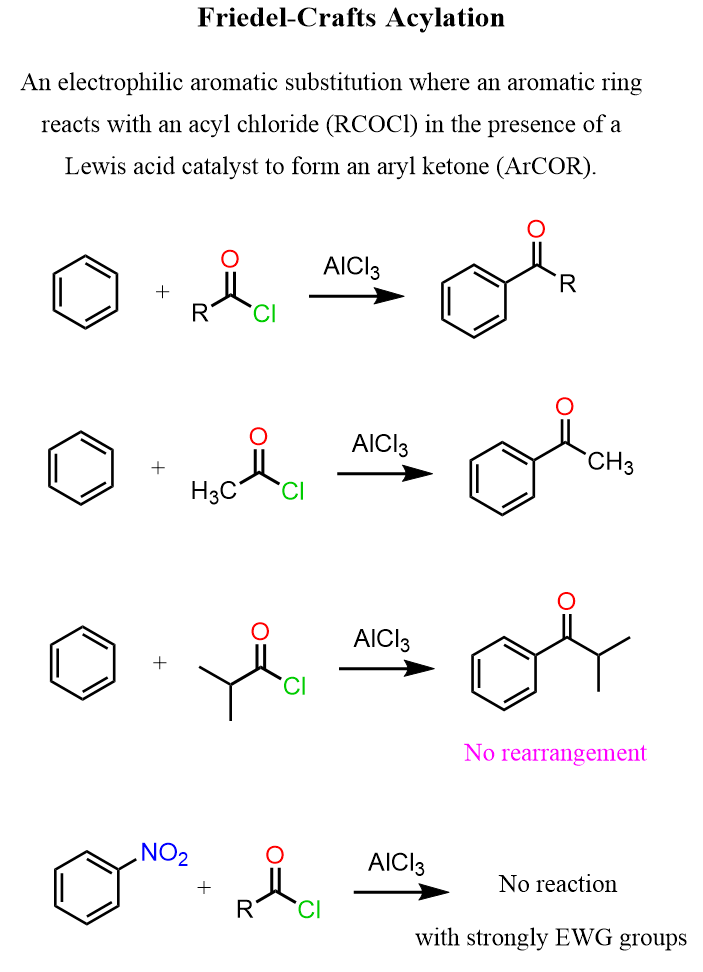
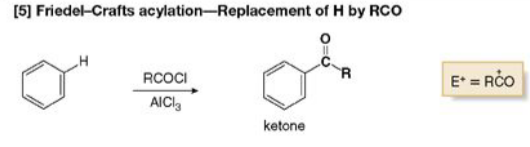
What is Friedel-Crafts Acylation, what product does it form and what is the electrophile?
(Replacement of H by RCO) Reagents: RCOCl & AlCl3 , Product is a ketone attached to an aromatic ring, Electrophile is +RCO
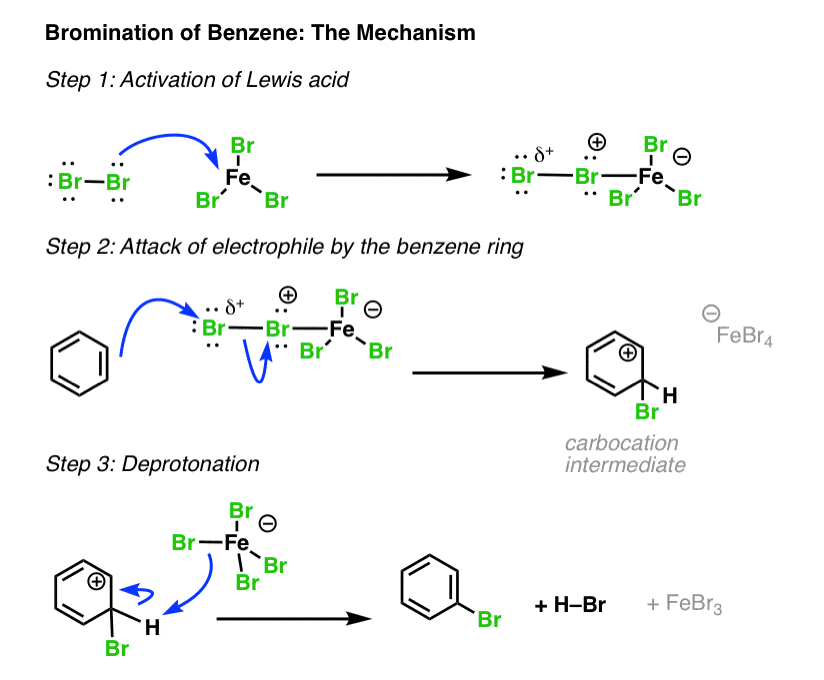
Bromination
Bromination of an aromatic ring is a chemical reaction where a bromine atom swaps places with a hydrogen atom on a benzene ring. Because aromatic rings are highly stable, this reaction requires a catalyst to force the reaction to happen.
1. Form a strong electrophile
Aromatic rings are naturally stable and wealthy in electrons. Normal bromine is not strong enough to attack it alone. A catalyst, usually FeBr3 or AlBr3, pulls a bromine atom away to create a highly reactive, positive bromine ion.
2. Attack the ring
The electron-rich aromatic ring attacks the positive bromine ion. This temporarily breaks the ring's special stability (aromaticity) and forms a carbocation intermediate.
3. Restore ring stability
A base in the mixture plucks away the hydrogen atom from the carbon where the bromine attached. The shared electrons slide back into the ring, instantly restoring its stable aromatic network and forming the final brominated product along with hydrobromic acid HBr
Electron Withdrawing Groups will stop
Friedel Crafts. An electron-withdrawing group stops a Friedel-Crafts reaction by strongly deactivating the benzene ring, which makes the ring a poor nucleophile that cannot attack the weak carbocation electrophile.
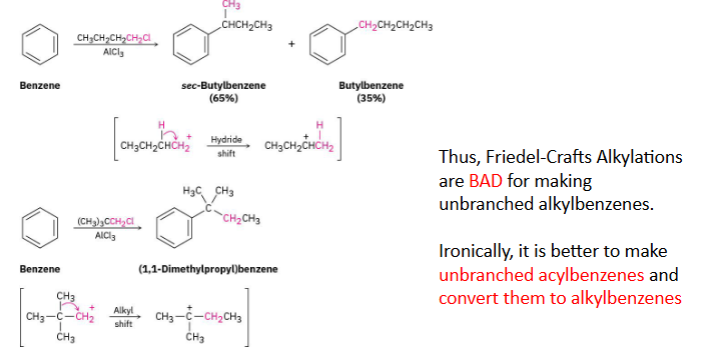
Carbocation Rearrangement
A carbocation rearrangement in a Friedel-Crafts reaction is when a positive carbon atom shifts its structure to become more stable (via a hydride shift or alkyl shift) before attaching to a benzene ring.
Friedel-Crafts Alkylation = Carbocation = Rearrangements possible. Friedel-Crafts Alkylation is BAD for making straight chains. Better method: Friedel-Crafts Acylation
then reduction.
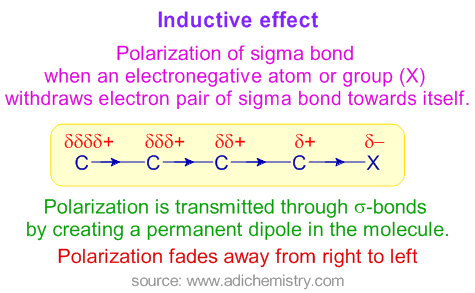
Inductive effect
(an inductive effect is an electron withdrawing or electron donating effect due to ELECTRONEGATIVITY. While it can work through s or p bonds, it is separate from resonance)
The inductive effect is the permanent shifting of electron density through single sigma bonds caused by differences in atom pull (electronegativity). When a highly pulling atom attaches to a carbon chain, it draws the shared bonding electrons closer to itself, creating a tiny charge imbalance down the chain.
Works through single bonds: It travels exclusively via (sigma) bonds, never through double or triple bonds. Fades quickly over distance: The strength of the pull drops fast and becomes almost zero after three carbon atoms. It s a permanent state: Unlike temporary shifts, the polarization stays permanently in the molecule.
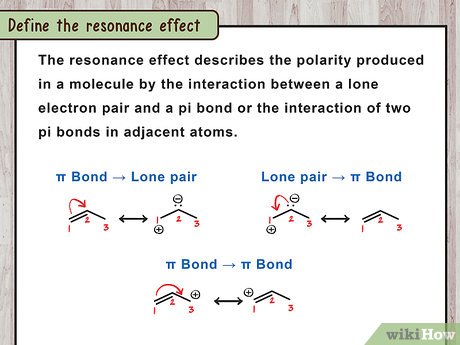
resonance effect
The resonance effect in organic chemistry is the sharing and spreading out of electrons across multiple adjacent atoms, known as electron delocalization. It occurs through pi bonds (double or triple bonds) or lone pairs of electrons.
Substituent effects…
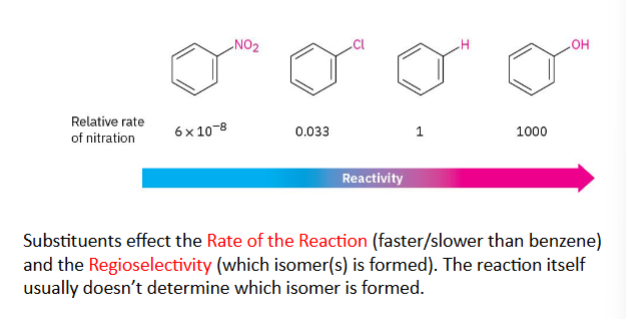
Substituents already attached to benzene affect:
1. Reactivity
How fast the reaction happens.
2. Regioselectivity
Where the new group goes.
The substituent effect in organic chemistry describes how an attached group (substituent) changes a molecule's properties, like reactivity, acidity, and selectivity. It works mainly through two actions: the inductive effect and the resonance effect.
Two kinds of Substituents
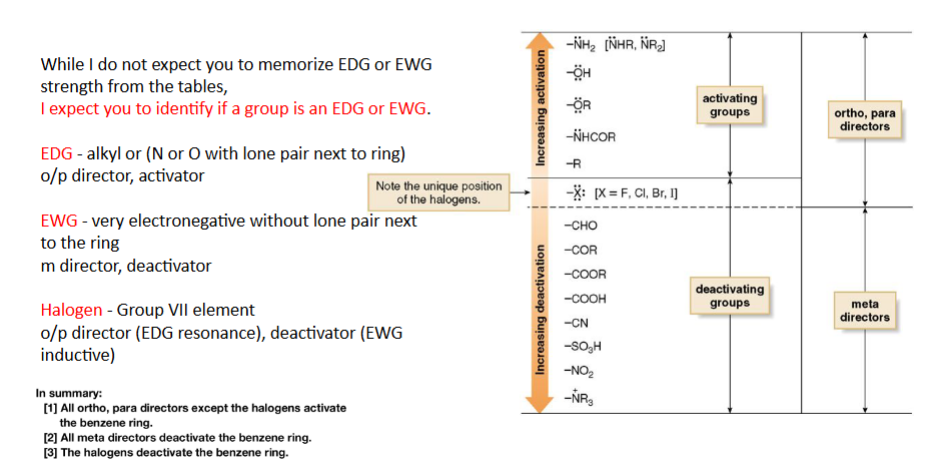
Electron Donating Groups (EDGs): Give electrons. These activate the ring. Ortho/Para directors (PI BOND OR LONE PAIR)
Electron Withdrawing Groups (EWGs): Take electrons. These deactivate the ring. Meta directors (LONE PAIR OR R GROUP, alkyl group)
Halogens are Deactivating BUT Ortho/Para directing.
Activating Group
(Make benzene react faster, Activator always wins) An activating group is a substituent on an aromatic ring that increases the reaction rate of electrophilic aromatic substitution (EAS) compared to bare benzene. Activating group = faster reaction (not the same as a catalyst). Key examples include -OH (phenol), -NH₂ (amine), and alkyl groups like -CH₃. Activating groups make the ring react faster by donating electron density into the aromatic ring. This turns the ring into a stronger nucleophile, allowing it to reach out and grab an electron-poor electrophile much more easily. They achieve this through two main ways
Deactivating group
(Make benzene react slower) A deactivating group is a substituent on an aromatic ring that decreases the rate of electrophilic aromatic substitution (EAS) compared to plain benzene. Key examples include the nitro group (-NO₂), carbonyl groups (-CHO, -COR), and cyano groups (-CN).
Directors
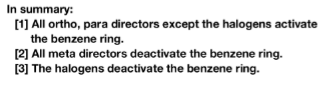
These tell new substituents where to go. In organic chemistry, directors (or directing groups) are groups already attached to a ring (like a benzene ring) that act like a traffic cop, telling a new incoming chemical piece exactly which open spot on the ring it must attach to.
nucleophilic aromatic substitution
TBD
benzyne
TBD
combinatorial chemistry
TBD