Electrolyte and non-electrolyte solutions
 Call Kai
 Learn
Learn Practice Test
 Spaced Repetition
 Match
Match Flashcards
 Knowt Play
1/40

There's no tags or description
Looks like no tags are added yet.
Name | Mastery | Learn | Test | Matching | Spaced | Call with Kai | Chat |
|---|
No analytics yet
Send a link to your students to track their progress
41 Terms
The official definition of solutions: solutions are homogenous mixtures of two or more ingredients that exist
as a
single one homogenous phase.
Solute:
which is the drug to be dissolved; and
Solvent:
which is the liquid used to dissolve the drug, it is the major component of a solution.
To emphasize; some concentration expressions refer to the amount of solute per unit volume of solvent while
others refer to
the amount of solute per unit volume of the final solution.
In addition, some concentration
expressions refer to the amount of solute per unit weight of solvent while others refer to
the amount of solute
unit per unit weight of the final solution.
memorize
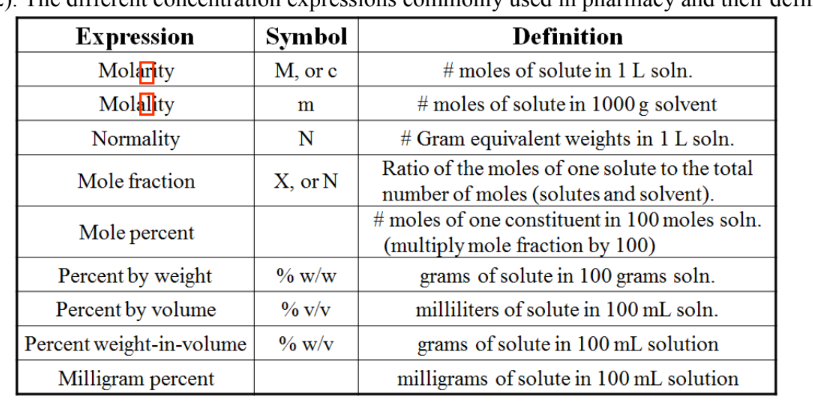
normality is the number of gram equivalent weight (g/Eq) of solute per
1 liter solution.
Raoult’s law states that:
For ideal solutions, the partial vapor pressure of each volatile constituent in the
solution is equal to the vapor pressure of the pure constituent multiplied by its mole fraction in the solution.
Osmosis is the
migration of solvent molecules from dilute solutions
to more concentrated ones across a selective (also described as semipermeable) membrane.
This indicates that solution “a” is more concentrated than the cytoplasm. Solution
“a”, therefore, is described as “hypertonic” to blood because it is
more concentrated than the cytoplasm
as “isotonic” to blood because it has the
same concentration as the
cytoplasm
as “hypotonic” to blood because it is
less concentrated than the cytoplasm
When two solution have the same exact number of solute molecules they are called
isosmotic.
(remember, when
we deal with osmosis, it does not matter if the molecule is positively or negatively charged or if it is
neutral, we add up all species present).
Since this is equal to the 2M we assumed is the molarity of RBCs, solution 2 is isotonic and safe to inject.
For solution 3, calcium chloride is also an electrolyte but it dissociates to 1 mole of calcium and 2 moles
of chloride as follows:
1mole CaCl2 1mole Ca++ + 2mole Cl-
The overall total molarity of this solution therefore, is 3M, which makes it hypertonic and unsafe to
inject.
MEMORIZE: when we say a solution have the same osmolality (or osmolarity) as biological fluids, we mean
that it has the same number of particles as the cytoplasm in human cells and,
therefore, it is isotonic.
Difference between osmolality and osmolarity
The Osmolality of a solution is defined as the number of osmoles of solute per
1kg (which equals 1000 g) of
water.
Osmolarity, on the other hand, is
the number of osmoles of solute per 1L solution.
osmole? An osmole (Osm) is the
amount of a substance that when dissolved in 1kg water
will cause the solution to have the same osmotic pressure as one molal solution of an ideal nonelectrolyte, e.g.
glucose.
For non-electrolytes:
the osmolality of the solution is exactly equal to its molality. The equation to use,
therefore is: Osmolality of non-electrolyte solutions = m
For electrolytes:
the osmolality is equal to the molality multiplied by the number of particles the solute
dissociates to. The equation to use is: Osmolality of electrolytes solutions = m × # ions
1 Osm
= 1000 mOsm.
osmolarity; which is the number of osmoles of solute in
1 liter solution.
For non-electrolytes: osmolarity is
= M of the solution,
For electrolytes: osmolarity is
= M × number of ions
osmolarity of biological fluids is
300 ± 10 mOsm/L).
It is also to be memorized that the osmolality of blood and the other biological fluids is
300 ± 10
mOsm/kg.
Converting regular concentration expressions to osmlality or osmolarity:
If we have the concentration of a solution in “g/L” or “percent by weight”, can we convert this to
osmolarity (mOsm/L) so that we can tell if the solution is isotonic? Yes. We can use the equations below:

For none-electrolytes.
If you are given the concentration in molarity (mole/L), multiply the given
molarity by 1000 to get the osmolarity in mOsm/L.
For electrolytes,
you do exactly the same calculations as for non-electrolytes (steps 1-4 explained above)
but you have to multiply by the number of ions the given electrolyte solute dissociates to.
Lowering of vapor pressure (VP) of solvents
ΔP = pw(pure) Xd..........................equation 1
Elevation in the boiling points (BP) of solvents
Tb= Kbm................................equation 2
Depression in freezing points (FPs) of solvents
Tf= Kf m................................equation 3
The osmotic pressure
osmotic pressure (π) = mRT......................equation 4
where, m is the molality of the solution
R is the gas constant whose value is 0.082 Liter atm deg –1 mole –1
, and
T is the temperature in degrees Kelvin
While it is true that all biological membranes in the human body are semipermeable,
not all
of them have the same degree of permeability, some are more permissive than others. For example RBC
membranes are more permissive than other cell membranes.
IMPORTANT: the difference between isosmotic and isotonic solutions
was NOT found to be isotonic to blood but it
is isotonic to cells in the eye. Why??? Because it can cross RBC membranes but it can not eye membranes.
How did we know 2% boric acid solution is not isotonic? Answer: it caused RBCs to swell and burst (i.e.
hemolyse). This means 2% boric acid in water is actually hypotonic to RBCs but isotonic to the eyes.
Q: you mean to say that having the same colligative properties (or the same number of particles) as biological
fluids is not enough to consider a solution isotonic? Answer: exactly.
the term “isotonic” means an aqueous solution that does not cause cells to change shape. For
this to happen 2 conditions must be met; these are:
1. The number of solute particles in the solution must equal the number of solute particles inside the cell (this
is the colligative property aspect of isotonicity); and
2. The cell membrane of the tissue of interest must not allow any solute molecules to pass through (this is the
membrane permeability aspect of isotonicity).
With respect to #2 above, if the membrane has pores that are large enough to allow the passage of some solute
molecules, then those solute molecules will migrate across the membrane from the region of their high
concentration to the region of their low concentration.
We have learned in biochemistry that membrane permeability is controlled by the type of fatty acids in the
lipid bilayer.
So, the different cell types in our body have different membrane structures with different degrees
of permeability and we just need to know that boric acid solutions, regardless of their osmolarity, should not
be taken internally (by mouth or parenterally) for that reason.
if you a drug molecule can cross biological membranes freely,
never
give it to patients internally (not by mouth, not by injection either).
So, to summarize, this is the difference between isosmotic and isotonic and it is important to memorize:
The term “isosmotic” is used to describe solutions that have the same values of colligative properties (e.g.
osmotic pressure) as biological fluids BUT they cause cells to change their shape.
The term “isotonic”, on the other hand, is reserved only for solutions that has the same colligative
properties as biological fluids AND that do not cause cells to change shape (i.e. do not shrink or swell).
Class 1 methods:
1. The cryoscopic method (also known as the ΔTf
1% method):
o In the ΔTf
1% method, we make the solution isotonic by adding the required amount of NaCl.
o We use equation 10 below to calculate the amount of NaCl needed to make 100 mL of our solution
isotonic using the ΔTf
1% method:
equation 10................Amount (IN GRAMS) of NaCl needed per 100mL soln. = [0.9 (0.52 – ΔTf
1%)] / 0.52
o The ΔTf
1% value in equation 10 is obtained from literature and it will be provided on the test or
whenever needed, there is no need to memorize those numbers.
o What is exactly the delta ΔTf
1% value? It is the lowering in the FP of pure water caused by a final
drug concentration of 1% w/v.
o IMPORTANT NOTE: equation 10 above gives us the grams of NaCl needed for 100 mL final volume
if, and only if, the final concentration is 1%.
o If more (or less) final volume is desired, we will have to correct for the difference accordingly.
o The other thing to pay special attention to here is the ΔTf
1% values listed in the tables are for a final
drug concentration of 1%. What if the solution was more or less concentrated?
o In that case we have to correct for the change in concentration and that is easy to do because the
relationship between percentage concentration and the lowering in the FP of water is a direct
proportional one (i.e. the higher the concentration, the higher the decrease in the FP of the solution).
o Example problem: Calculate how much NaCl is needed to make 100 mL 1% apomorphine HCl
solution isotonic? (ΔTf
1% for apomorphine = 0.08 0C).
o Answer: NaCl needed per 100 mL = [0.9 (0.52 – ΔTf
1%)] / 0.52 = 0.9 (0.52 – 0.08)] / 0.52 = 0.76g
o In this example, what if the prescription calls for a 2% solution of apomorphine?
o If this is the case, we can not use the ΔTf
1% value as provided because it assumes a 1% concentration.
o To calculate for a 2% solution we multiply the provided ΔTf
1% value by 2.
o So, 0.08 × 2 =0.16, which is ΔTf
2%. We would then plug this value into equation 10 above to get the
amount of NaCl in grams needed to make the 2% apomorphine solution isotonic.
o This is the most common mistake that happens when we use the cryoscopic method, so be very careful
with this on the test.
class 1 continued
2. The sodium chloride equivalent method (also called the E value method)
o The sodium chloride equivalent method relies on the “E” value, what is the E value?
o The “E” value (E) of a drug is the weight of NaCl that causes the same depression in the FP of water
as that caused by 1 g of the drug.
o The “E” value has been determined for all known drugs and we can get those from textbooks (will be
provided when needed in exams).
o To calculate the amount in grams of sodium chloride needed to make a solution isotonic using the E
value method we use a set of 3 equations shown below:
14
o Step 1: E amount of drug in solution = quantity X
o Step 2: (0.9g/100mL) volume of solution in mL = quantity Y
o Step 3: quantity Y – quantity X = amount of NaCl needed in grams
o Example problem: A) Calculate the amount of NaCl needed to make 100 mL of 1% ephedrine sulfate
(E = 0.23) isotonic? B) If you decided to use dextrose to adjust the isotonicity of this solution instead
of NaCl, how much dextrose you will need knowing that the E value for dextrose is 0.16?
Answer: Part A)
o Step 1: 0.23 1g = 0.23 quantity X
o Step 2: (0.9/100) 100 = 0.9 quantity Y
o Step 3: NaCl needed in grams = 0.9 – 0.23 = 0.67 g
Part B)
o To use dextrose instead of NaCl, we have to use an amount of dextrose that would produce the same
lowering in the freezing point of pure water as 0.67% NaCl.
o The E value for dextrose is 0.16, which means 0.16 g NaCl are equivalent to 1 g dextrose and we can
set up the calculation as follows:
If 0.16 g NaCl 1 g dextrose
Then, 0.67 g NaCl Z
And Z = 0.67 / 0.16 = 4.2 g dextrose needed
Class 2 method: the White Vincent method:
Using the White-Vincent method, we first calculate the volume of the concentrated isotonic solution of the
drug from the relation:
V = w × E × 111.1 .................equation 11
o Where V is the volume of the initial isotonic but concentrated solution to be prepared,
o w is number of grams of drug in prescription, and
o E is the E value of the drug
After that, we calculate how many mLs of an isotonic solution we need to bring the volume of this
concentrated solution to the prescribed volume thus adjusting the concentration.
Example: Make the following solution isotonic with respect to an ideal membrane:
Phenacaine HCl........................0.06 g
Boric acid................................0.30 g
Sterilized water enough to make 100.0 mL
Here, we have two ingredients in the prescription; phenacaine HCl and boric acid. So, to calculate the mLs of
water needed to prepare the isotonic but concentrated initial solution we set up equation 11 as follows:
V = [(w1 × E1) + (w2 × E2) + (w3 × E3) +.......] × 111.1
The E values for the two ingredients we have here are: for Phenacaine HCl the E value is 0.2 and for boric
acid it is 0.5. Knowing this, we can solve for V
V = [(0.06 × 0.20) + (0.30 × 0.50)] × 111.1 = 18 mL
We then dissolve the grams of active ingredients in 18 mLs of sterilized water to get an isotonic initial solution.
But the prescription calls for 100 mL final volume.
So, we need to add 100 – 18 = 82 mL of sterilized ISOTONIC solution to bring the final volume to 100 mL
as specified in the prescription
Any isotonic solution we have in stock will work; it could be 0.9% NaCl, 5% dextrose, or any other isotonic
solution as long as it is compatible with all the ingredients in the prescription and it is safe for internal use in
humans.