genetics science
 Call Kai
 Learn
Learn Practice Test
 Spaced Repetition
 Match
Match Flashcards
 Knowt Play
1/27

There's no tags or description
Looks like no tags are added yet.
Name | Mastery | Learn | Test | Matching | Spaced | Call with Kai | Chat |
|---|
No analytics yet
Send a link to your students to track their progress
28 Terms
Identify the number of chromosomes in the following human cells: Somatic (body) cell, Sperm, ovum, Zygote
Somatic (body) cell: 46 (23 pairs)
Sperm: 23
Ovum: 23
Zygote: 46 (23 pairs)
What percentage of genetic material do you share with your maternal grandmother (mother's mother)?
You share approximately 25% of your genetic material with your maternal grandmother. Since your mother got 50% of her DNA from her mother, she passes half of that shared DNA down to you.
Identify the human female and male allosomes (sex chromosomes).
XX and XY
Identify the parent whose gametes determine the sex of the offspring in humans.
The father (male parent).
(Because mothers can only pass an X chromosome, while fathers can pass either an X or a Y chromosome).
What is diploid and hiploid
a cell has two complete sets of chromosomes, one inherited from each parent (like normal body cells).
a cell has only one single set of chromosomes (like sperm and egg cells).
What is autosome and sex linked
any chromosome that is not a sex chromosome and carries genes for general body traits.
genes or traits located specifically on sex chromosomes (X or Y), so they are inherited differently by males and females. (specifically one sex)
Identify the nitrogenous bases that pair with:
adenine:
cytosine:
guanine:
thymine:
a. adenine — thymine
b. cytosine — guanine
c. guanine — cytosine
d. thymine — adenine
name all the mutations and what they do
substitution: a DNA base being swapped or replaced by a different base.
deletion: a DNA base being completely removed or deleted from the sequence.
insertion: an extra DNA base is added into the sequence.
Mutagens are factors that cause mutations in DNA. Examples of mutagens can be nuclear radiation, UV radiation, x-rays and certain chemicals. Genes code for proteins that are produced by cells for the organism to function. For example, these proteins can affect how it appears, or how the chemical reactions required for life happen. Suggest what impact a substitution mutation might have on an organism.
A substitution mutation changes one base, which can change the protein made by the cell and change how an organism looks or functions.
Describe a situation where a mutation to the DNA of an organism could be beneficial.
A mutation could give an animal darker fur in a dark forest, helping it hide better from predators and survive longer
Name and describe the difference between homozygous and heterozygous genotypes
Homozygous: The organism has two identical genes (alleles) for a specific trait (such as BB or bb).
Heterozygous: The organism has two different genes (alleles) for a specific trait (such as Bb).
In cabbage butterflies, White wings are dominant to yellow wings. If a Ww butterfly is crossed with a ww butterfly, what are the possible genotypes and phenotypes of the offspring and the percent chance for each? (draw a punnet square and draw a table putting 2 different genotypes, 2 phenotypes, and 2 chances)
W. w
w. Ww. ww
w. Ww. ww
Genotype. Phenotype Chances
Ww White wings. 50%
ww Yellow wings. 50%
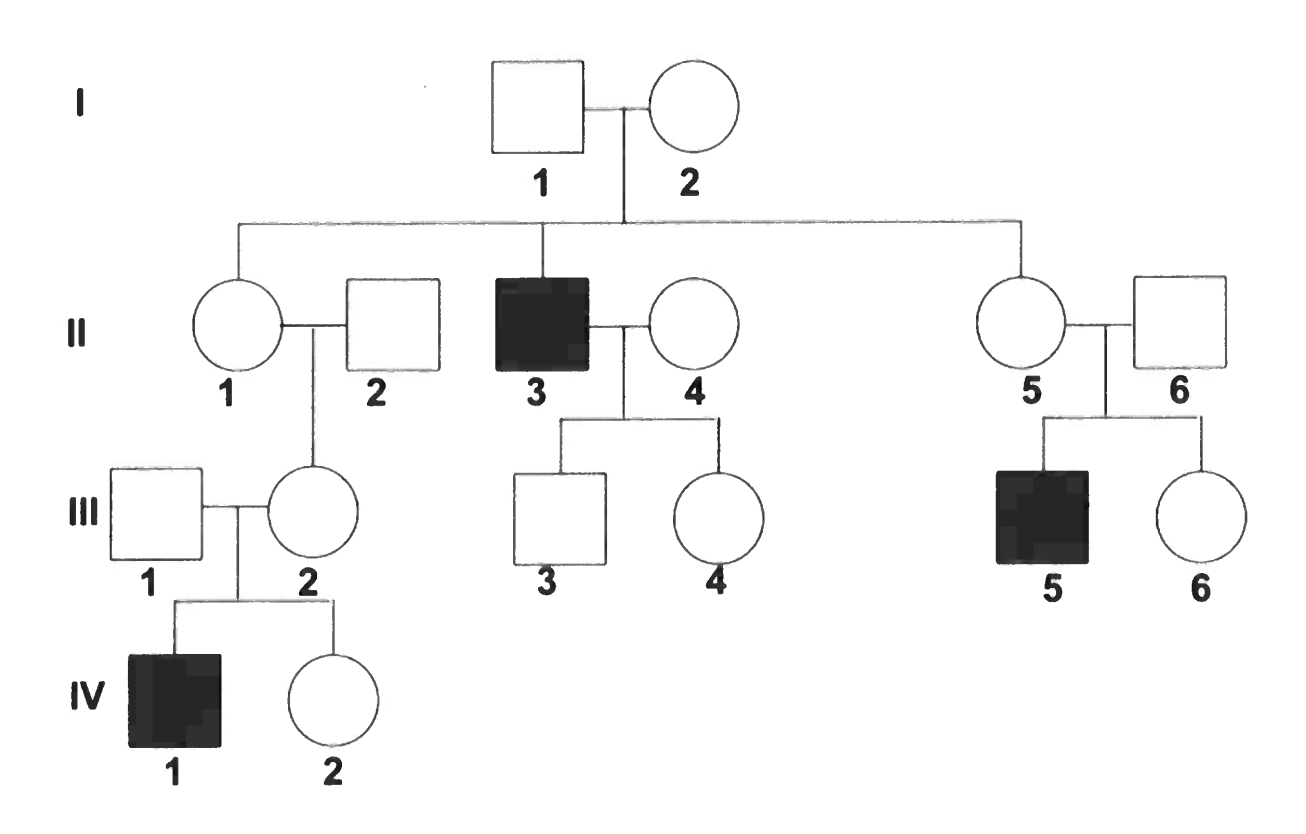
with the following chart, answer:
Is this an autosomal or sex related condition?
Use a punnet square to work out the genotype of individuals in first generation.
Workout of the genotype of all individuals in 2nd generation (may not be possible for some)
It is an sex-linked recessive condition.
Unaffected parents (like I-1 and I-2, or II-5 and II-6) have affected children (like II-3 and III-The trait "skips" generations.
It affects males and unaffected parents (like I-1 & I-2) have affected children (II-3). This pattern of hiding in carriers and popping up in offspring is sex-linked recessive.
An organism's entire set of DNA
genome
The passing of traits from parents to their offspring
heredity
Building block of DNA
Nucleotide
A tightly coiled strand of DNA
Chromosome
An error caused in the DNA at the time of its replication
mutation
A complex cell division that happens in gametes
Meiosis
The name of the structure of a DNA molecule
Double Helix
Compare and contrast mitosis and meiosis. Write at least one similarity and three differences. How many cells are produced in mitosis and meiosis?
Both copy DNA during cell division. Mitosis makes 2 identical body cells in 1 division for growth, while meiosis makes 4 unique sex cells in 2 divisions for reproduction.
What percentage of genetic material does each parent pass to their offspring? Why does the sex cells have only 23 chromosomes unlike other cells?
Each parent passes 50% of their genetic material. Sex cells have 23 chromosomes so when a sperm (23) joins an egg (23), the baby gets the normal set of 46 chromosomes.
What is the difference between gene, DNA and genome.
DNA is the molecule containing genetic instructions, a gene is a single section of DNA for a specific trait, and a genome is the complete set of all DNA in an organism.
Compare phenotype and genotype .
Genotype is the specific genetic code or DNA sequence of an organism, while phenotype is the physical trait or appearance that you can actually see, such as eye color.
What is DNA? What is it made up of?.
DNA is a molecule that carries genetic information in living things. It is made of chemical units called nucleotides, which consist of a sugar, a phosphate group, and a nitrogen base.
What is Karyotyping? How is it helpful?
a test that shows a complete picture of an individual's chromosomes. It helps doctors find genetic conditions by revealing if chromosomes are missing, extra, or abnormal in shape.
What is IVF? How is it different from natural pregnancy?
a treatment where a lab joins an egg and sperm outside the body to make an embryo, which is then placed in the womb. Natural pregnancy is different because the egg and sperm join inside the body.
What are stem cells? What is the difference between adult stem cells and embryonic stem cells?
Stem cells are special cells that can grow into other types of cells in the body. Embryonic stem cells can turn into almost any type of cell, while adult stem cells can only turn into a few specific types.