Chapter 7: Mechanical Properties (Part 2)
 Call Kai
 Learn
Learn Practice Test
 Spaced Repetition
 Match
Match Flashcards
 Knowt Play
1/128

There's no tags or description
Looks like no tags are added yet.
Name | Mastery | Learn | Test | Matching | Spaced | Call with Kai | Chat |
|---|
No analytics yet
Send a link to your students to track their progress
129 Terms
What is fracture toughness?
the ability of a material containing a flaw/crack to resist sudden failure or fracture under applied load
Fracture mechanics
discipline concerned with the behaviour of materials containing cracks and other flaws
ex. microcracks, pores, inclusions
Fracture toughness
measure of the ability of a material with flaws to withstand applied loads
Stress concentration
Introduced by flaws that act as a local stress riser
What effect does a small, rounded flaw have on stress concentration?
causes some stress concentration
stress is spread over a smoother curved surface
local stress increase is relatively limited
What effect does a larger flaw have?
removes more load-bearing area and disturbs the stress field more
local stress near the flaw becomes higher
What effect does a sharp flaw or crack have?
most dangerous because the crack tip has a very small radius of curvature
sharper tip → more stress is concentrated at that point
How does stress concentration increase?
when the flaw becomes larger and sharper
sharper cracks create very high local stresses at the crack tip
rounded defects are less severe
How do you determine fracture toughness?
apply a tensile stress to a specimen prepared with a flaw of known size and geometry
Applied stress is intensified at…
the flaw
Stress intensity factor (K)
measures how severe stress field is near crack tip
K = f*stress*sqrt(PI *a)
When is a material property, Kc, reached?
when a material with flaw breaks into 2 pieces
Plain strain
occurs in thick plates/specimens
through-thickness strain is approximately zero
thickness deformation is restricted
high crack tip constraint → less plastic deformation
provides a lower, more conservative fracture toughness (KIC)
Plane stress
occurs in thin sheets/plates
through thickness stress is approximately 0
material can deform freely through the thickness
lower crack tip constraint → more plastic deformation
usually gives higher apparent fracture toughness
What is KIC?
plane strain fracture toughness
used for safe fracture design
represents the most constrained condition
What happens to measured fracture toughness (Kc) as specimen thickness increases?
It decreases until reaching the constant plane strain value (KIC)
What is the thickness-independent fracture toughness value?
The plane strain fracture toughness KIC
Which stress state occurs in thin sheets?
Plane stress
Which stress state occurs in thick sheets?
Plane strain
In plane stress, what is the out-of-plane stress?
σz = 0
In plane strain, what is the out-of-plane strain?
εz = 0
Why do thin specimens show higher apparent toughness?
They can deform out-of-plane, reducing crack-tip constraint
Why do thick specimens show lower toughness?
Out-of-plane deformation is restricted, increasing crack-tip constraint
What does the plateau in the toughness vs thickness curve represent?
The plane strain fracture toughness KIC
Which condition produces the most constrained crack-tip?
Plane strain
Which condition produces the least constrained crack-tip?
Plane stress
In plane stress, is out-of-plane strain zero?
No, εz ≠ 0
In plane strain, is out-of-plane stress zero?
No, σz becomes tensile
What causes the transition region between plane strain and plane stress?
Intermediate thickness whether neither condition fully dominates
Why is KIC reported for materials rather than the higher Kc (thin materials)?
Because we want the safest and most conservative fracture toughness value
What is the fracture criterion involving K and Kc?
If K > Kc, the crack can grow
What is the formula for the stress intensity factor, K?
K=f*σ*sqrt(πa)
Why does thickness affect the measured fracture toughness?
It changes the crack-tip stress state from plane stress to plane strain
The ability of a material to resist the growth of a crack is dependent on what factors?
Flaw size → smaller flaw is better, larger flaws reduce permitted stress
Ductility → can deform to blunt crack-tip providing higher fracture toughness
Grain size → fracture toughness improves with reducing grain size
Thickness → thinner sections provide higher fracture toughness values
Applied strain rate → higher rates (impact conditions) reduce fracture toughness
Temperature → higher T = higher fracture toughness
Compressive internal stresses → increase required stress for crack propagation
What does increasing the strength of a metal do to its ductility and fracture toughness?
It decreases the ductility and fracture toughness of the metal
What is the overall relationship between Kc and strength?
increased Kc = increased strength
Which material decreases in Kc when strength increases?
Metals because they have a wide range (processing, microstructure)
How do ceramics appear on the Kc vs strength graph?
high strength but low toughness
When does fracture occur?
K >= Kc
What is the goal of Leak-Before-Break?
Ensure a crack leaks through a wall before exploding
What is the formula for hoop stress in a pressurized pipe?
σhoop=Pd/2t
What causes a surface flaw in a pressured vessel to grow?
Hoop stress pulling the crack open
What is the critical crack size, ac?
The critical crack length at which fracture becomes unstable and catastrophic
Why do we want ac >=t ?
It creates a leak that reduces pressure and prevents unstable crack growth
What fracture toughness condition ensures LBB?
KIC ≥ 1.1 σ sqrt(πt)
What does the factor 1.1 represent in the LBB toughness requirement?
A safety margin to prevent unstable fracture.
Why must pressure‑vessel materials have high KIC?
To prevent cracks from reaching ac while still inside the wall.
What type of crack growth is desired in LBB?
Stable crack growth through thickness leading to a leak.
What type of crack growth must be avoided in LBB?
Unstable crack growth once K > KIC.
What happens to internal pressure when a crack leaks?
It decreases, reducing hoop stress.
Why does unstable crack growth cause instant failure?
The crack propagates through the remaining thickness without resistance.
What is the relationship between stress and crack growth in LBB?
Higher stress increases crack opening; reduced stress from leaking slows crack growth.
If ac is reached, what happens to the final propagation?
instantaneous (implosion)
Fractography
What are the two ways to classify fracture in metals?
Ductile fracture (slow)
Brittle fracture (fast)
What is ductile fracture?
slow process with plastic deformation
material absorbs more energy
crack growth is slow and controlled
fracture surface is rough and fibrous
What is brittle fracture?
fast with little to no plastic deformation
crack propagation is fast
low absorbed energy
fracture surface is typically flat and shiny
How is ductile fracture caused?
overloading (large stress) of metals with good ductility and toughness
occurs via transgranular (through the grain) failure
Internal flaws
weak points
higher local stress value
What is the progression of ductile fracture?
necking
microvoids
void growth
fibrous shear
After microvoids combine, they show up as _____________
dimples
Equiaxed
stretched in all directions the same amount
round
usually form near the center of the fracture surface
dominated mainly by tensile opening
voids grow fairly uniformly in all direction
Columnar
one axis is extremely larger than the other
usually form near the shear lip
experiences significant shear deformation/slip during final fracture
voids are pulled and stretched as material shears
A chain used to hoist heavy loads fails. Examination of the failed link indicates considerable deformation and necking prior to failure. What are the possible reasons for the accident?
overloading of the chain (stress > yield strength)
impact/shock/dynamic loading
wrong material/wrong heat treatment
local damage or notch (localizes stress concentration)
How can you tell the loading direction from a brittle fracture surface?
Chevron patterns (V-shaped markings) point to failure point
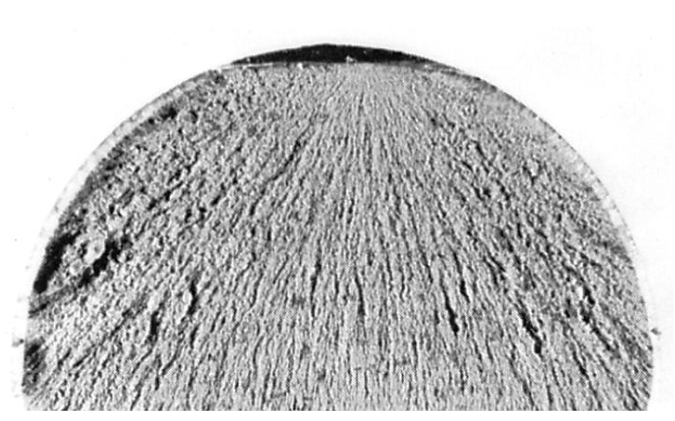
What is the worst type of fracture?
Intergranular Fracture
requires low force and happens fast
indicates the metal broke at the GBs
GBs were weak because of unwanted impurities, incorrect heat treatment, corrosion attack
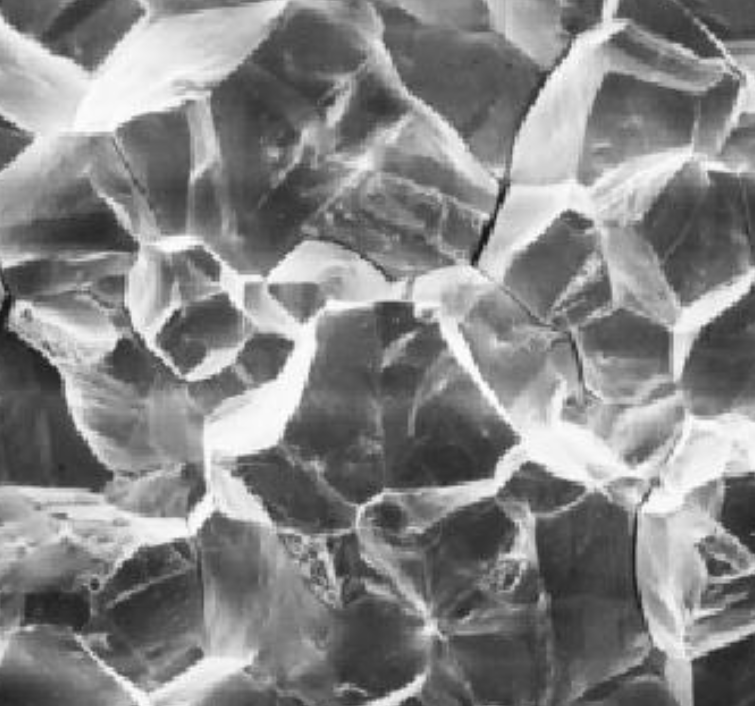
Creep
slow deformation under constant load and high temperature
What are the causes of creep?
diffusion
dislocation glide or climb
grain boundary sliding
Explain diffusion
At high temp, atoms have enough thermal energy to move through crystal lattice
Atomic motion allows for change of shape
Explain grain boundary sliding
boundaries between grains move easier at higher temp
Discuss the process of voids created during creep
creep cavities form along GBs → reduction of effective load bearing area → creep becomes self-accelerating
What happens if there are more voids during creep?
more voids = smaller effective area = higher local stress = faster creep = cracking = final rupture
As the voids form, is creep easier?
Yes
Stress rupture
final fracturing of a material due to creep
True or False: creep facture is the same as final fracture
False
True or False: A material can be considered ‘failed’ by creep even before final fracturing
True
How do you perform creep test on ductile materials?
Use a uniaxial tension test
How do you perform a creep test on brittle materials and why?
Use a uniaxial compression because you don’t want it to break easily
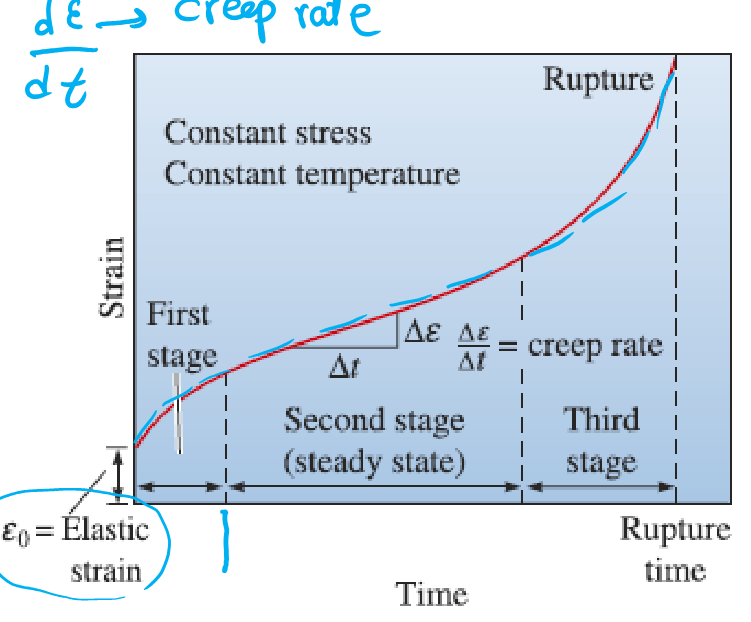
What are the main takeaways from this graph?
stress is constant but strain increases over time at the elevated temperature
strain = deformation
accel/decel rate = slope (creep rate)
Primary creep
strain increases quickly at first
creep rate gradually decreases
material becomes harder to deform due to strain hardening (dislocation-dislocation interaction and multiplication)
creep deformation vs strain hardening → strain hardening winning
Secondary creep
strain increases at an almost constant rate
called steady-state creep
most important stage for design because it often occupies most of creep life
balance between strain hardening and high temp recovery mechanisms
strain hardening vs recovery mechanisms → neither is winning
strain hardening slow deformation → dislocation entanglement → greater resistance to motion → lower creep rate
recover through climb makes deformation easier → fewer effective obstacles → easier continued deformation
Tertiary creep
creep rate increases rapidly
internal damage accumulates: voids, cracks, necking
effective load-bearing area decreases
ends with final fracture, called stress rupture
easier creep deformation (lower load bearing area = more stress)
For dislocation climb, the location of dislocation moves ___________________________________
perpendicular to the slip plane
What is the main mechanism in normal plastic deformation?
Dislocation glide, in the direction of the slip plane with enough shear force
What is creep deformation controlled by?
dislocation glide + dislocation climb + diffusion
Why are high temperatures needed for climb?
At low temperatures, diffusion is too slow for climb, so obstacles strongly restrict motion.
At high temperatures, vacancy diffusion makes climb possible.
Higher stress =
higher creep rate & shorter rupture time
lower temperature =
lower creep rate = longer rupture time
What would you use the secondary creep rate formula for?
chemical rxns
atomic diffusion
vacancy formation
dislocation climb
Stress-Rupture Time
predicts the time to rupture/how long a material survives before final creep fracture
Larsen-Miller Parameter
simplifies creep rupture data
Why do material with high melting temperatures resist creep? (ex. superalloys, ceramics)
creep strongly depends on diffusion
Thomogolous = Tservice / Tm
Tm increases → Thomo decreases
Thomo = slower diffusion = dislocation climb more difficult = GB sliding more difficult = slower steady creep rate
Stress corrosion
phenomenon in which materials react with corrosive chemicals in the environment
leads to formation of cracks and failure
can occur below yield strength
stress + environment is synergistic: affect is greater than expected from either alone
Stress corrosion cracking
formation and growth of cracks by the combination of tensile stress, susceptible materials and corrosive environment
crack propagation is usually slow until cross section is reduced sufficiently for fast fracture
How do you identify stress corrosion cracking in metals an alloys?
deep, fine cracks are formed without any evidence of overall general corrosion
cracks are extensively branched along grain boundaries
Intergranular cracks
the crack travels mainly along GBs
Transgranular cracks
the crack travels through the grains
Fatigue
failure of a material due to repetitive/cyclic stress which may be larger or smaller than yield strength
What does cyclic stress do?
Lowers the strength of a material below its normal yield strength
What must be true for fatigue to occur?
A portion of the stress must be tensile. Loading cannot be purely compressive because tensile force is necessary for cracking