Behaviorism - B.F. Skinner
 Call Kai
 Learn
Learn Practice Test
 Spaced Repetition
 Match
Match Flashcards
 Knowt Play
1/9

There's no tags or description
Looks like no tags are added yet.
Name | Mastery | Learn | Test | Matching | Spaced | Call with Kai | Chat |
|---|
No analytics yet
Send a link to your students to track their progress
10 Terms
The “rules” of Behaviorism
The explanation of observable behavior is the most important aspect of psychology
Psychology should be reductionistic, less “complex”
The most basic explanation of behavior is through the environment
Learning is the most important process to people
Learn via experimentation
Overall disagreement with Personality Psychology
Personality Psychology
Personality is . . .
General
Enduring
Largely functional
Behaviorism
Personality is . . .
Specific (as settings change)
Temporary (again, as settings change arbitrarily)
Largely functional
How do we learn?
Classical Conditioning
US —> UR
CS, US —> UR
CS —> CR
Often used to explain emotional reactions, like fear
Mugged in a dark alley —> fear dark alley
Lots of alleys without mugging —> “extinction”
Instrumental (Operant) Conditioning
The pragmatic side of behaviorism: Do what elicits a positive reaction (Law of Effect: people learn due to their effect on their environment)
Types of Reinforcements
Positive Reinforcement: Increases frequency of behavior
Negative Reinforcement: Increases frequency of behavior by taking away negative stimulus
Punishment: Decreases unwanted behavior
Table
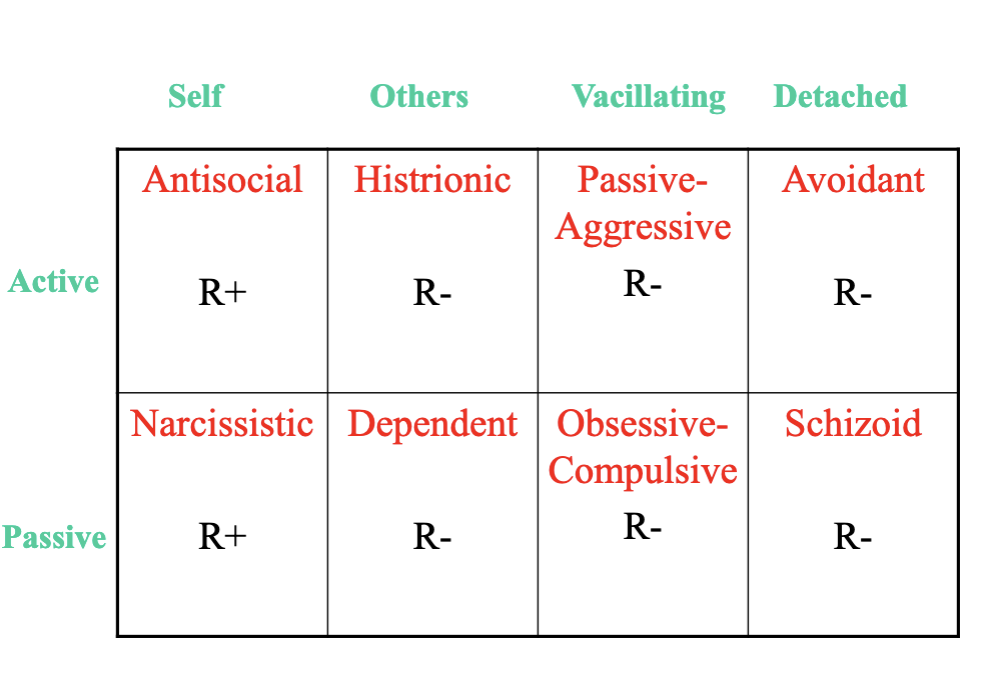
Types of Reinforcers
Primary Reinforcement
Innate reinforcers, like food
Or having pain (e.g., shock) taken away
Secondary Reinforcement
Rewards that are learned to be valued, like money
Please note . . .
In classical conditioning, the environment elicits a response
In instrumental learning, the person acts and the environmental reaction follows . . .
Pleasure is a reinforcer
Pain is punishment
If behaviors must precede reinforcement, how do we learn/teach new things???
Shaping: The use of successive approximations (teaching a dog to roll over)
Generalization: Take learning from one environment and bring it to other similar environments (bringing a pen to class)
Discrimination: Doing a behavior in certain circumstances
Do you drive differently when police are present?
Superstitious Behavior:
Learning from random reinforcement may impact personality
Schedules of Reinforcement
Continuous Reinforcement
Fastest learning
Quickest extinction
Partial Reinforcement – slower learning but more resistant to extinction
Fixed Ratio
Variable Ratio – the most resistant to extinction
Fixed Interval
Variable Interval
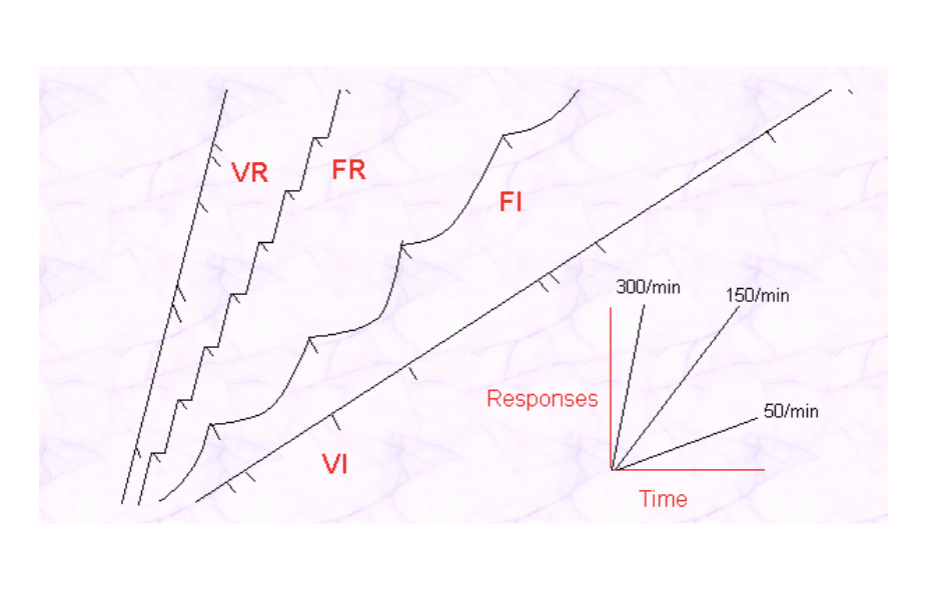
Prepared Learning
Some things are easier to learn than others, perhaps due to phylogenetic reasons
Evidence:
Taste aversion rather than other senses
Fear of spiders/snakes quickly learned
not electrical outlet or doors!
Therapy
Behavior Modification
An approach that systematically applies learning principles to change behavior
Behavior Modification
Functional Analysis
The stimuli and reinforcers which influence behavior are carefully identified
Intervention
Control the situation
Desirable behavior will increase with added reinforcement (catch them being good!)
Undesirable behavior
Withhold reinforcement
Add punishment, if necessary
Token Economies
Learning Modules