BME 474 Exam 1
 Call Kai
 Learn
Learn Practice Test
 Spaced Repetition
 Match
Match Flashcards
 Knowt Play
1/132

There's no tags or description
Looks like no tags are added yet.
Name | Mastery | Learn | Test | Matching | Spaced | Call with Kai | Chat |
|---|
No analytics yet
Send a link to your students to track their progress
133 Terms
Biomaterial
nonviable (nonliving) material that interacts with biological systems (synthetic or natural)
Biocompatibility
ability of a material to perform an appropriate host response for that application
Needs FDA approval if it ______
diagnoses, cures, or treats
FDA medical device classes
low risk (bandaids), medium risk (ear tube), high risk (invasive surgery)
Verification vs validation
verification: verifying/testing if device meets specification (design input & output)
validation: testing if device needs user needs
Commercialization depends on _____
number of patients, risk/benefit, cost, market size
Hydroxyl group
polar (charged) -OH groups, hydrophillic
Carboxyl group
polar, hydrophillic, R-OOH
Amino group
functional group (R), R-NH_2
Stress
F/cross-sectional area, "strength"
Strain
deformation/length
Setup for stress-strain testing
strain on x-axis, stress on y-axis; change in stress w/ material being deformed at constant rate of strain
Engineering vs true stress-strain
engineering/nominal: area & length are constant
true: area & length are variable
Biomedical properties that cannot be found on single stress-strain curve
viscoelasticity, anisotropy, and hardness
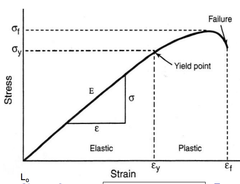
Mechanical properties in stress-strain curve
Young's Modulus (stiffness), yield strength (point of permanent deformation), ultimate tensile strength (maximum load-bearing capacity), and toughness (energy absorption before fracture); distingusihes between ductile and brittle materials
High vs low surface energy
High: spreading adhesive forces
Low: stronger cohesive forces (more bubble shape)
Contact angle analysis pros and cons
pros: simplicity, direct indication of surface wettability and energy
cons: sensitivity to surface roughness and contamination, the need for a large liquid volume, potential contamination of samples
Electron Spectroscopy
interactions with electron beams to determine surface properties
Secondary Ion Mass Spectrometry (SIMS)
vacuum, using positive ions to eject positive/negative ions from surface; tells us more about functional groups
Scanning Electron Microscope (SEM)
high resolution image of surface, in vacuum
Atomic Force Microscopy (AFM)
not a vacuum, sub nanometer resolution that shows surface geometry & molecular interactions
Spectrometry
observing chemical composition
Microscopy
observing surface roughness/geometry
General polymer structure
large number of similar units bounded together, monomers held together by covalent bonds to form polymer
Hydrogel
polymers designed to expand with water, very hydrophillic; gel to solid through cross-linking; useful for drug delivery, wound repair, tissue engineering
Degradable polymers
enzymes, acids, cells in body; PLA, PGA, PLGA
In vivo
in living system
In vitro
on lab bench; mechanical systems
In situ
at the site-with blood
Ex vivo
implanted device, then remove impact & surrounding tissue
In silico
computational modeling
FDA Class I
low risk, does not require premarket notification
FDA Class II
medium risk, requires premarket notification, 510K
FDA Class III
high risk, requires premarket approval (PMA), animal & patient testing, and investigated device exemption
510k
can get approval through a similar different FDA approved device
Title 21 of the Code of Federal Regulations (CFR)
guide to how to get FDA approval
Good Laboratory Practice (GLP)
good lab practices, very documented (FDA->IDE->clinical testing)
Van der waals forces
weak, dispersion forces, polymer chains
Ionic forces
very strong, positive & negative charge atoms, rigid/crystal structure
Hydrogen bonding
water, polarity
Metallic forces
metals, positively charged ions in sea of delocalized electrons
Covalent interactions
shared electron between 2 atoms, very strong
Collagen
structural protein in all tissues of body; hierarchical structure; one chain is weak, adding more chains makes it stronger
Primary structure
amino acids in sequence, polypeptide chain
Secondary structure
alpha helix & beta pleated sheets
Tertiary structure
general 3D structure
Quaternary structure
subunits (eg. hemoglobin), most stable, protein shape is dynamic
Amino acid
building block for proteins, containing both a carboxyl (—COOH) and an amino (—NH2) group.

Polar vs non-polar
polar: charged & hydrophillic
nonpolar: uncharged & hydrophobic
Amino acid side chain
R-group, varies with each amino acid; helps to make 3D shape
Polymers
plastic; molecular structure consisting of large number of similar units bounded together
Metals
positive ions in sea of electrons; high ultimate strength, useful for orthopaedics
Ceramics and glasses
Polycrystalline, nonmetallic w/ oxide, nitride, inert (rigid, high order)
Bulk properties
mechanical properties
Surface properties
properties of a material associated with its surface
Linear vs nonlinear properties
Linear: higher crystallinity, line of monomers
Nonlinear: low crystallinity, more branched
Elastic vs plastic properties
elastic: can go back to original shape, weak forces with van der waals and hydrogen bonding
plastic: deformation permanent
Proportionality limit
where linear relationship between stress and strain ends
Elastic limit
deformation is reversible; maximum stress a material can withstand without permanent (plastic) deformation, even if the stress-strain relationship is no longer linear (slightly past proportionality limit)

Yield strength
yielding (elongation)-occurs w/o changing load, past yield stress will not go back to original shape
Ultimate strength
highest point of strength/stress on graph
Rupture strength
the stress at which a material physically breaks or fractures under load
Elastic/Young's Modulus (E)
slope of linear region, rigidity of material
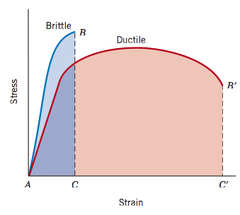
Ductility
brittleness, percent of elongation
Toughness
area under ENTIRE curve

Resilience
area under elastic/linear region; ability of material to absorb energy w/o plastic (permanent) deformation
Homogeneity
material properties vary by location within a material
Isotropic vs anisotropic
isotropic: will deform the same way wherever you apply load
anisotropic: only made for applied load up & down, NOT side-to-side (low ultimate strength axially)
Poisson's ratio
(lateral/axial) strain; measures the Poisson effect—the deformation of a material perpendicular to the direction of applied load
Strain rate
constant, load applied to materials while testing it, variable control in testing
Viscoelasticity
biological, material's behavior is time dependent, strain rate dependent
Hardness
measures a material's resistance to permanent deformation from indentation, scratching, abrasion, or cutting, cannot measure on stress-strain curve
Fracture toughness
crack in material-> how material resists failure/the propagation of crack
Fatigue
multiple loading cycles, can use failure earlier (use smaller loads for testing)
Contact angle analysis
measures wetability, cheapest method, cohesive (rounded droplet) vs. adhesive forces (spreading of droplet); testing multiple liquids w/ known γ_lv (surface tension), tells us about surface tension and how material will interact with body
Surface energy
degree of attraction/repulsion force from a substrate to another material
Critical surface tension
complete wetting, θ=0; compare to known materials
Zisman Plot
γ_lv on x-axis, contact angle θ b/n droplet and material on y-axis; trying to predict γ_sv
Branched polymer
a long polymer chain with shorter chains (branches) attached to a main backbone, creating a tree-like structure; reduce crystallinity
Cross-linking
chemical or physical bonds that connect individual polymer chains, creating a network structure; adding covalent bonds->increase in rigidity, NOT affected by Tg or Tm bc they cannot break covalent bonds
Copolymer
less crystallinity; a polymer formed from two or more different monomers covalently bonded into a single polymer chain
Polymer pendant groups
atoms or smaller chains that "hang off" the main backbone of a polymer; smaller pendant groups = higher crystallinity
Tacticity
stereochemistry of the monomers in polymer chain (3D orientation); orientation of pendant groups, affects how polymers interact & crystallinity
Isotatic
same orientation for repeating unit
Syndiotactic
alternating unit
Atactic
random orientation
Molecular weight
length of polymer chains; calculating avg. molecular weight is important to find PDI
Degree of polymerization (DP)
number of monomers/repeating units
Polydispersity index (PSI)
(weight avg. molecular weight/number avg. molecular weight), molecular mass distribution; is there a lot of variation? closer to 1->wide variation
Amorphous structure
disorganized, random, atactic (rubbery, flexible, lower modulus & Tg)
Crystalline structure
highly organized, rigid (strong), polymer chains are "zipped-up" and align perfectly
Glass transition temperature (Tg)
glassy (brittle) state->rubbery (flexible) state; breaks weak bonds & interactions b/n chains
Melt temperature (Tm)
melt crystalline; add/remove interactions b/n polymer chains; higher Tm=higher crystallinity
Semi-crystalline state
polymers are co-aligned, "zipped-up", organized, isotactic, syndiotech (glassy, more rigid, less change w/Tg, Tm)
Biostable
a material that resists negative changes to its properties when exposed to the biological environment
Biodegradable
breaking down with water; enzymes, acids, cells in body
Hydrolysis
backbone breakdown with water
Addition polymerization
biostable; initial bond(initiation)->second bond(propagation), termination (2 free radicals combine)
316L stainless steel
alloy of Fe, Cr, Ni, Si, C
pros: cheap, easy to shape, fatigue resistant
cons: long term corrosion, Ni & Cr allergies
use: temporary implants
Chromium (Cr)
hard, lustrous, silver-gray metal that is highly resistant to corrosion and tarnishing due to a protective oxide layer it forms in air