Periodic Law and Trends
 Call Kai
 Learn
Learn Practice Test
 Spaced Repetition
 Match
Match Flashcards
1/123

There's no tags or description
Looks like no tags are added yet.
Name | Mastery | Learn | Test | Matching | Spaced | Call with Kai | Chat |
|---|
No analytics yet
Send a link to your students to track their progress
124 Terms
Periodic Law
the physical and chemical properties of the elements are the periodic function of their atomic numbers
group
A column on the periodic table
period
A horizontal row of elements in the periodic table
All elements in group 6 have _____ valence electrons
6
All Alkaline Earth Metals have ____ valence electrons
2
All Noble Gases have ____ valence electrons
8
As you go down a family of metals, the reactivity ________
increases
As you go down a family of nonmetals, the reactivity _________
decreases
All Alkali metals have a ____ oxidation number
+1
All Halogens have a ____ oxidation number
-1
The periodic table is made up mostly of which type of element?
metals
Metals ______ electrons to become stable and become _____.
lose, cations (+)
Nonmetals _____ electrons to become stable and become _____
gain, anions (-)
Explain why radius decreases across a period towards the nonmetals
# of shells is constant but the elements have more protons as you go to the right - this increases the pull on the outside electrons which causes the atoms size to decrease
Explain why radius increases down a family
# of shells increase = electrons are farther from the protons = less pull
Explain why Fluorine has the highest electronegativity
It has the least # of shells with the most protons so it pulls on electrons with the most force
As you go from the left to the right across a period, ioniziation energy
increases
Families, Columns, Groups
Elements that are similar in properties are grouped in __________
Period, row
Elements that have the same # of energy levels will be found in the same ______
malleable
metals are _____ meaning they can be hammered into thin sheets and bent
nonmetallic
luster of minerals that is not shiny like metal and is not considered malleable and Dull in appearance
alkali metals
Group 1, 1 electron in outer level, very reactive, soft, silver, shiny, low density; Lithium, Sodium, Potassium, Rubidium, Cesium, Francium
alkaline earth metals
metallic elements in group 2 of the periodic table which are harder than the alkali metals and are also less reactive
halogens
Contains nonmetals, 7 valence electrons in it's outermost energy level. Very reactive...having highest electronegativities
noble gases
Elements in group 8A of the periodic table. Have no charge and are gases under normal conditions. (Helium, Neon, Argon, Krypton, Xenon, Radon)
transition
the elements most likely to form more than one type of ion and located in the three rows of elements in the middle of the periodic table are known as the ____________ elements
families
elements with similar properties
octet
States that atoms lose, gain or share electrons in order to acquire a full set of eight valence electrons
radius
Half the distance between the centers of 2 of the same atoms OR the distance between the nucleus and valence electrons is known as the atomic _____
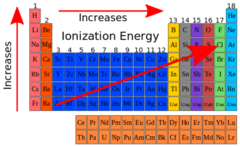
Ionization Energy
The minimum amount of energy required to remove an electron from an atom in the gas phase. This results in an ion.
This is the opposite of electron affinity.
Like electron affinity, it increases left to right across the period.
Na(g) ---> Na+(g) + e-
Shielding
The decrease in attraction between valence electron and the nucleus (due to inner core electrons) in
any atom with more than one electron shell is called...
Addition of protons
Why does the size of an atom decrease as you go right across the periodic table?
Addition of protons
Why does the electronegativity of an atom increase as you go right across the periodic table?
Addition of protons
Why does the ionization energy of an atom increase as you go right across the periodic table?
More energy levels increase the shielding effect.
Why does the size of the atom increase as you go down the column on the periodic table.
More energy levels increase the shielding effect.
Why does the electronegativity decrease as you go down the column on the periodic table.
More energy levels increase the shielding effect.
Why does the ionization energy decrease as you go down the column on the periodic table.
Francium
Which element has the lowest electronegativity?
Chemical process
a process in which the identity of the matter involved changes
Ex: ionization
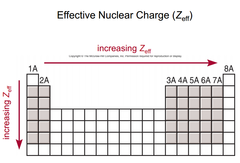
Effective Nuclear Charge
the actual magnitude of positive charge that is "experienced" by an electron in the atom
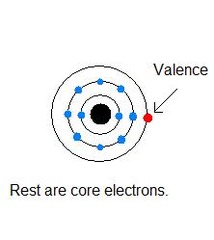
Core electrons
those that are most effective at shielding
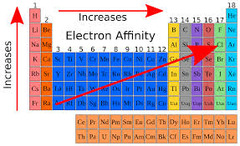
Electron Affinity
The energy released when an atom in the gas phase accepts an electron. This is the opposite of ionization energy.
Like ionization energy it increases left to right across the period.
Cl(g) + e- ---> Cl-(g)
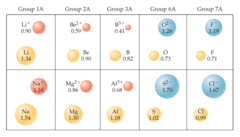
Ionic Radius
the radius of a cation or an anion
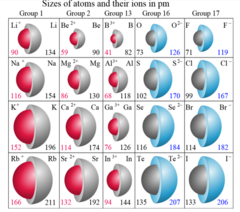
Isoelectronic
Species with identical electron configurations, such as a group 7A atom that has gained one electron and the noble gas immediately to its right in the periodic table.
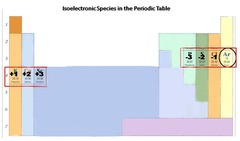
Isoelectronic series
a series of 2 or more species that have identical electron configurations, but different nuclear charges and radii
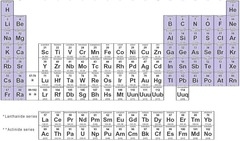
Main group elements
the elements in Groups 1A -7A, plus the noble gases, 8A
Valence Electrons
the outermost electrons of an atom
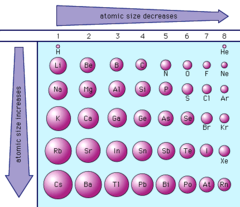
Atomic radius
the distance between the nucleus of an atom and is valence shell. the valence shell is drawn closer to the nucleus making the atomic radius smaller as we go across the period.
Metallic character - metals
shiny, lustrous, malleable, & ductile
good conductor of both heat & electricity
low ionization energy (commonly form cations)
Metallic character - non-metals
vary in color & lack shiny appearance
brittle poor conductor of heat & electricity
high electron affinity (commonly for anions)
Metalloids
elements with properties intermediate between those of metals and nonmetals.
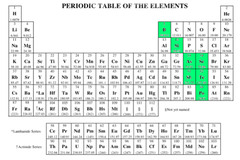
A row on the periodic table is also known as
Period or energy level
A column on the periodic table is called a _______________ or _________________.
group or family
Which group has the highest ionization energy?
noble gases
Which group has the lowest ionization energy?
alkali metals
Which element has the highest electronegativity?
Fluorine (F)
Which element(s) have the largest atomic radius?
Francium (Fr) or Cesium (Cs)
Which element has the smallest atomic radius?
Helium (He)
Which element has the highest ionization energy?
Helium (He)
Which element has the lowest ionization energy?
Cesium (Cs); Francium (Fr) if you follow trend
AR
atomic radius
EN
electronegativity
IE
ionization energy
atomic radius increases
ionization energy decreases
atomic radius decreases
ionization energy increases
ionization energy increases
electronegativity increases
ionization energy decreases
electronegativity decreases
atomic radius
distance between nucleus and valence electrons
Why does atomic radius get larger as you go down?
more energy levels/orbitals and sheilding
Why does it get smaller from left to right?
increased nuclear charge without additional shielding, pulls electrons in closer
ionization energy
the amount of energy needed to remove an electron from an atom
Why does IE increase to the right?
electrons are closer to the charge of the nucleus and thus pulled in harder, making it more difficult to pull off
Explain why Francium has the lowest ionization energy
Francium has 7 shells so its protons are very shielded and thus ineffective at holding onto the electrons. This makes it easy to remove electrons thus the energy is low.
Why do cations have a greater IE?
They have lost electrons and thus are pulled in tighter to the nucleus
Why do anions have a lower IE?
They gain more electrons and are farther from the nucleus and thus easier to pull off
Which IE level is greater?
the one after the next one (2 is greater than 1, 3 is greater than 2, and so on)
What is the trend for electron affinity?
increases up and to the right
Why does electronegativity increase like so?
farther up means it has less orbitals and is thus closer to the nucleus, so it is less willing to share and is higher
Which types of elements like to easily get rid of their electrons?
metals (on left side of table)
Which elements rarely let go of their electrons and want more instead?
nonmetals (right side of table)
isoelectronic
when to elements (or isotopes of elements) have the same number of electrons
Electron configuration
number in configuration must equal atomic number (or number of electrons)
Elements in a group are _____ than in a period.
more similar
Atomic Radius
half the distance between adjacent nuclei or bonded nuclei
*no defined edge of atom because of electron cloud- can't measure from edge
Atomic Radius- Period Trend
-left to right decrease
-increase in number of protons and valence electrons but same energy level; no further shielding so stronger nuclear pull
Atomic Radius- Group Trend
-going down atomic radius increases -there are more energy levels causing more shielding and less nuclear pull
Ion
a charged atom; formed when giving up or taking electrons; form ionic bonds
Cations
-positively charged ion due to electron loss
-usually metal
Anion
-negatively charged ion due to electron gain
-usually nonmetal
Cation- Period Trend
-radius decreases left to right
-losing electrons, nuclear pull greater because there are more protons than electrons
Anion- Period Trend
-radius decreases left to right
-gaining fewer electrons with each element
-electrons don't outnumber protons as much
Transition from Anion to Cation- crossing over stair step line
-radius increases
-gaining electrons, nuclear pull less because electrons outnumber protons
-more electron repulsion
Atomic radius of Anion versus atomic radius of Cation
anionic radius is bigger than cationic radius if they're in the same period
Valence electrons
the electrons that are on the outermost energy level- are involved in a chemical reaction
*group number tells number of valence electrons
Reactivity
a chemical's ability to react- the ability to transfer electrons
Periodic Trends
apply mostly to the main groups/representative groups of elements (s and p blocks)
Reactivity- Period Trend
goes down as you go across a period left to right
Reactivity- Group Trend
-metals: goes up as you go down
-nonmetals: goes down as you go down; harder to gain electrons because of weaker nuclear pull caused by shielding
Electronegativity
-unit: Paulings
-the measure of the ability of an atom in a chemical bond to attract electrons
*atom with higher electronegativity will attract electrons of bond
Four most electronegative elements, greatest to least
-Fluorine
-Oxygen
-Chlorine
-Nitrogen