Lecture 32 - The Jovian Planets
 Studied by 0 people
 Call with Kai
 Learn
Learn Practice Test
 Spaced Repetition
 Match
Match Flashcards
 Knowt Play
1/19

Earn XP
Description and Tags
ASTR 1210 (Exam 3)
Name | Mastery | Learn | Test | Matching | Spaced | Call with Kai |
|---|
No study sessions yet.
20 Terms
Are Jovian Planets All Alike?
Jupiter is next largest sphere in the solar system
10 Earth diameters across Jupiter’s diameter
1000 Earths in Jupiter
1000 Jupiters in the Sun
Jupiter
Alternating red/brown and white bands — white bands are water clouds
Each cloud gives insight into composition of Jupiter
Relatively large moons
Jupiter has over 100 moons
Has 4 LARGE moons
Largest moon slightly bigger than Mercury (Ganymede)
Significant weather features
Great Red Spot — giant hurricane
Other dots are weather patterns
Looks like a dot from the Earth - a wandering star
Next most explored planet, besides the Earth
JWST Image of Jupiter
Looks at infrared
Different bands corresponds to different heights —> different temperatures
See rings and tiny moons and Auroras in infrared wavelengths
Saturn
Dull yellow color - clouds
Hints of bands
Masses of planets alter cloud tops
Has enormous moons - second largest moon that is bigger than Mercury — Titan
Titan has clouds
Rivers, lakes, and oceans made of methane
JWST Image of Saturn
Gap in the rings
Cassini gap - astronomer Cassini
Uranus and Neptune
Smaller than both Jupiter and Saturn but still much larger than the Earth
Significantly more blue in color
Uranus is a light blue
Neptune is a dark blue
Great Dark spot
Weather - not as much as Saturn or Jupiter
Less banded than Jupiter and Saturn but still weather clearly on the outer atmosphere
Jovian Planet Composition
Jupiter and Saturn
Mostly H and He - what the solar nebular is made of
Large planetesimals pulling in H and He from the solar nebula
Uranus and Neptune
Mostly hydrogen compounds: water, methane, ammonia — color
Some H, He, and rock
Density Differences
Uranus and Neptune are denser than Saturn because they have less H/He proportionately
But why is Jupiter more dense on average?
If you added more gas around the current atmosphere of the Earth, how would you expect the density of material at the surface of change?
Density will increase at the surface
Adding mass to a jovian planet compresses the underlying gas layers
Greater densities can change characteristics of gases at each layer
Sizes of Jovian Planets
Jupiter and Saturn are the same size, but Jupiter has more gas, compressing on it, giving it more mass
Greater compression is why Jupiter is NOT MUCH LARGER than Saturn even though it is three times more massive - Jupiter just kinda shrunk
Jovian planets with even more mass can be smaller than Jupiter
Interiors of Jovian Planets
No solid surface
Layers under high pressures and temperatures
Cores (~10 Earth masses) made of hydrogen compounds, metals, and rock
The layers are different for the different planets
H and He under intense pressure and temperature
Inside Jupiter
High pressures inside Jupiter cause phase changes of H w/ depth
Layers include
Gaseous H
Liquid H
Metallic H
Electrons free to move around - share their charges freely and act like iron/nickel
Rocky core of Jupiter are under extreme pressures and temperatures
20,000 K compared to 3,000 K on Earth
What we call rock is different in Jovian world - a fuzzy rock
Cloud top layer creates so much pressure that the gaseous H becomes liquid H
Beneath liquid H, there’s a metallic H (special type of liquid H)
Primary composition of gas giants is liquid, not gas
We see “gas” - but is actually liquid
Phase Changes of Water
Pressure can change composition, shape of matter
Jupiter does not have a large metal core like the Earth. How can it have a magnetic field?
It has metallic hydrogen inside, which circulates and makes a magnetic field
Charges need to move and the planet needs to move
Jupiter’s Magnetosphere - Auroras - strong magnetic field
All jovian planets have substantial magnetospheres, but Jupiter’s is the largest by far
Comparing Jovian Interiors
All Jovian planets have similar compositions - Jupiter and Saturn
Neptune and Uranus don’t have enough mass to create metallic hydrogen core - but they still have a magnetic field
Maybe they have molten rocky core similar to Earth generating that magnetic field
Rotation of the Jovian planets
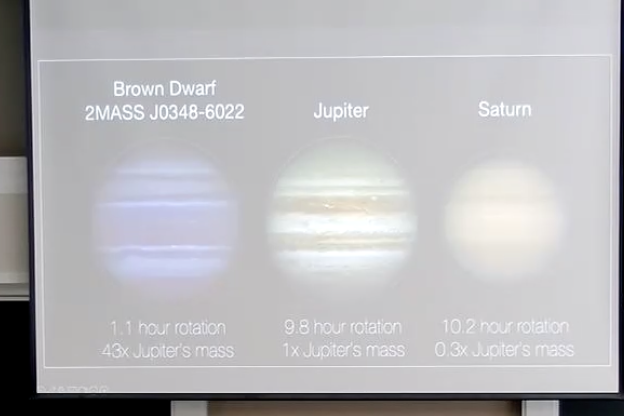
Jupiter is fastest spinning planet - Jupiter spun faster due to angular momentum during collapse of solar nebula
Rotation and Shape
Planets will compress because of fast rotation - not perfect spheres (oblateness)
Jupiter and Saturn
Impact density structure
Bands of Jupiter
Each color corresponds to clouds of different composition - reflect light differently
Hydrogen compounds in Jupiter form clouds
Different cloud layers correspond to freezing points of different H compounds
Jovian Planet Atmospheres
Other Jovian planets have cloud layers similar to Jupiter’s
Different compounds make clouds of different colors
Because red clouds are more distant from yellow, we only see yellow ones in Saturn
Uranus and Neptune is cold enough for methane clouds to form
Jupiter’s Great Red Spot
Great Red Spot is older than UVA
Storm twice as wide as Earth
Existed for at least three hundred centuries
Shrinking in size