Medication Stuff
 Call Kai
 Learn
Learn Practice Test
 Spaced Repetition
 Match
Match Flashcards
 Knowt Play
1/56

There's no tags or description
Looks like no tags are added yet.
Name | Mastery | Learn | Test | Matching | Spaced | Call with Kai | Chat |
|---|
No analytics yet
Send a link to your students to track their progress
57 Terms
Acetaminophen Route
orally
Acetaminophen indications
-mild/moderate discomfort (pain)
-fever (>100.4 °F, 38°C)
Acetaminophen contraindications
Head injury
Allergy/age (have to be over 3 mo)
Liver disease
Swallow (can’t swallow/can’t receive med)
Hypotension (Systolic BP under 90)
Acetaminophen containing products in last 4hrs
Respiratory distress
Persisten vomiting
Acetaminophen Dose
under 3 mo = none
3 mo = 1.25 mL
4-11 mo = 2.5 mL
12-23 mo = 3.75 mL
2-4 yo = 160 mg/5mL (one unit dose)
5-12 yo = 320 mg/10mL (two unit doses)
13 yo+ = 640 mg/20mL (four unt doses)
RPMDDD
acronym to check before administering medication
Route, Patient, Medication, Date, Dosage, Documentation
Activated Charcoal Route
Orally
Activated Charcoal Indications
Poisoning by mouth
Activated Charcoal Contraindications
-altered mental status
-received an emetic (already had activated charcoal)
Activated Charcoal Dose
1 gram/kg Po (bodyweight/2.2)
Albuterol Route
inhaled
Albuterol Indications
-signs & symptoms of respiratory distress
-bronchospasm/wheezing associated with asthma, COPD/emphysema, or allergic reactions (anaphylaxis)
Albuterol Contraindications
known hypersensitivity (allergic)
Albuterol Dose (Inhaler)
Max of 2 doses (4 puffs) over 30 min period
Albuterol Dose (Nebulizer)
2 or older: 2.5mg connected to 6-8 lpm O2
less than 2: 1.25mg connected to 6-8 lpm O2
both max repeat one time
Adverse effects of albuterol
-tachycardia/palpitations
-hypertension
-angina
-nervousness/anxiety
-tremors
-dizziness
-headache
-sweating
-nausea/vomiting
-sore throat
Adverse effects of activated charcoal
may indirectly induce vomiting & cause nausea
Aspirin Route
tablets orally (chewed by patient)
Aspirin Indications
-suspected acute coronary syndrome (heart attack)
-ST Elevation MI (STEMI)
basically chest pain/cardiac problems
Aspirin Contraindications
-known hypersensitivity (allergy)
-received full dose of aspirin before EMS arrival
Aspirin Dose
324 mg or 325 mg (four 81 mg tablets usually)
Adverse effects of aspirin
-heartburn
-nausea & vomiting
-wheezing
Epinephrine Route
intramuscularly in lateral thigh (auto injector or syringe)
Epinephrine Indications
-mod-sev allergic reaction w resp distress
-mild allergic reaction w history of life threatening allergic reaction
-patients w severe asthma
Epinephrine Contraindications
None in presence of anaphylaxis
Must medically consult b4 giving to asthma patients w pregnancy or cardiac history tho
Epinephrine Dose (syringe)
adult: 0.5 mg in 0.5 mL given IM in lateral thigh
pediatric: 0.15 mg in 0.15 mL given IM in lateral thigh
Epinephrine Dose (auto-injector)
adult (5 yo and +): 0.3 mg IM in lateral thigh via epi auto injector
pediatric (less than 5 yo): 0.15 mg IM in lateral thigh via epi auto injector
Adverse effects of epinephrine
-tachycardia/palpitations
-angina
-headache
-nausea/vomiting
-dizziness
-hypertension
-nervousness/anxiety
-tremors
Naloxone (Narcan) Route
intra-nasally
Naloxone Indications
to reverse respiratory depression induced by opioid/narcotic agent
basically help with overdose stuff
Naloxone Contraindications
Patient under 28 days of age
Naloxone adverse effects
opioid withdrawal
Naloxone Dose
Adult: 2mg IN w 1mL per nare
Pediatric (28 days to adult): 2 mg IN w 1mL per nare
repeat as necessary to maintain respiratory activity
Nitroglycerin Indications
Chest pain
Nitroglycerin contraindications
-blood pressure below 90mmHg systolic
-heart rate less than 60 or greater than 150bpm
-medication not prescribed for patient
-ped patient under 13
-took CARLV med in past 48 hours (need medical consult to overrule this contraindication)
CARLV
acronym for meds helping with pulmonary artery hypertension or erectile dysfunc (useful as contraind for nitro)
Cialis- erectile dysfunction
Adcirca - pulmonary artery hypertension
Revatio -pulmonary artery hypertension
Levitra - erectile dysfunction
Viagra - erectile dysfunctio
Nitroglycerin Route
sublingually (one spray or one tablet)
Nitroglycerin Dose
Adult: 0.4mg sublingually (one tablet or one spray)
repeat in 3-5 min if chest pain persists
max 3 doses (add more w/ medical consultation)
ped: contraindicated for under 13
Nitroglycerin Adverse effects
-hypotension
-headache
-dizziness
-tachycardia
Oral Glucose Route
orally
Oral Glucose Indications
-altered mental status w/ known diabetic history
-unconscious for an unknown reason
-measured blood glucose level less than 70mg/dL
Oral Glucose Contraindications
not clinically significant
Oral Glucose Dose
both adult and ped: 10-15g oral glucose btwn gum & cheek (consider single additional dose of oral glucose if not improved after 10min)
ped give with several small administrations
Oxygen Route
inhalation
Oxygen Indications
-evidence of hypoxia (less than 94% SpO2)
-respiratory distress
-cardiopulmonary arrest
-trauma
-suspected CO exposure
-dyspnea (shortness of breath)
Oxygen contraindications
not clinically significant
Oxygen Adverse Effects
high conc of oxygen will reduce respiratory drive in some COPD patients; make sure to carefully monitor
Oxygen Dose
adult & ped: 12-15lpm via NRB (below 90%, Carbon monoxide (CO) exposure) mask or 2-6 lpm via nasal cannula (90-94%)
bvm (below 90% and can’t breathe on own) 15lpm every 5-6 sec adult, 2-3 sec pediatric
Scene Size Up
Scene Safe?
BSI/PPE
number of patients
MOI or NOI
call for additional resources? (ALS
need to take c-spine?
Primary Assessment
ask for general impression
x-exsanguination (massive bleeding)? apply direct pressure, then tourniquet
mental status, introduce yourself & determine via AVPU
airway, open and patent? if not head tilt chin lift/jaw thrust and adjunct/suction as needed
breathing, get rate, rhythm, quality (is BVM needed), and SpO2 reading (provide oxygen if needed)
circulation, get rate, rhythm, quality, and skin assessment (color, temp, condition)
evaluate patient priority (high/low)
Secondary Asses. significant MOI
-request ALS
-determine chief complaint
-get base vitals
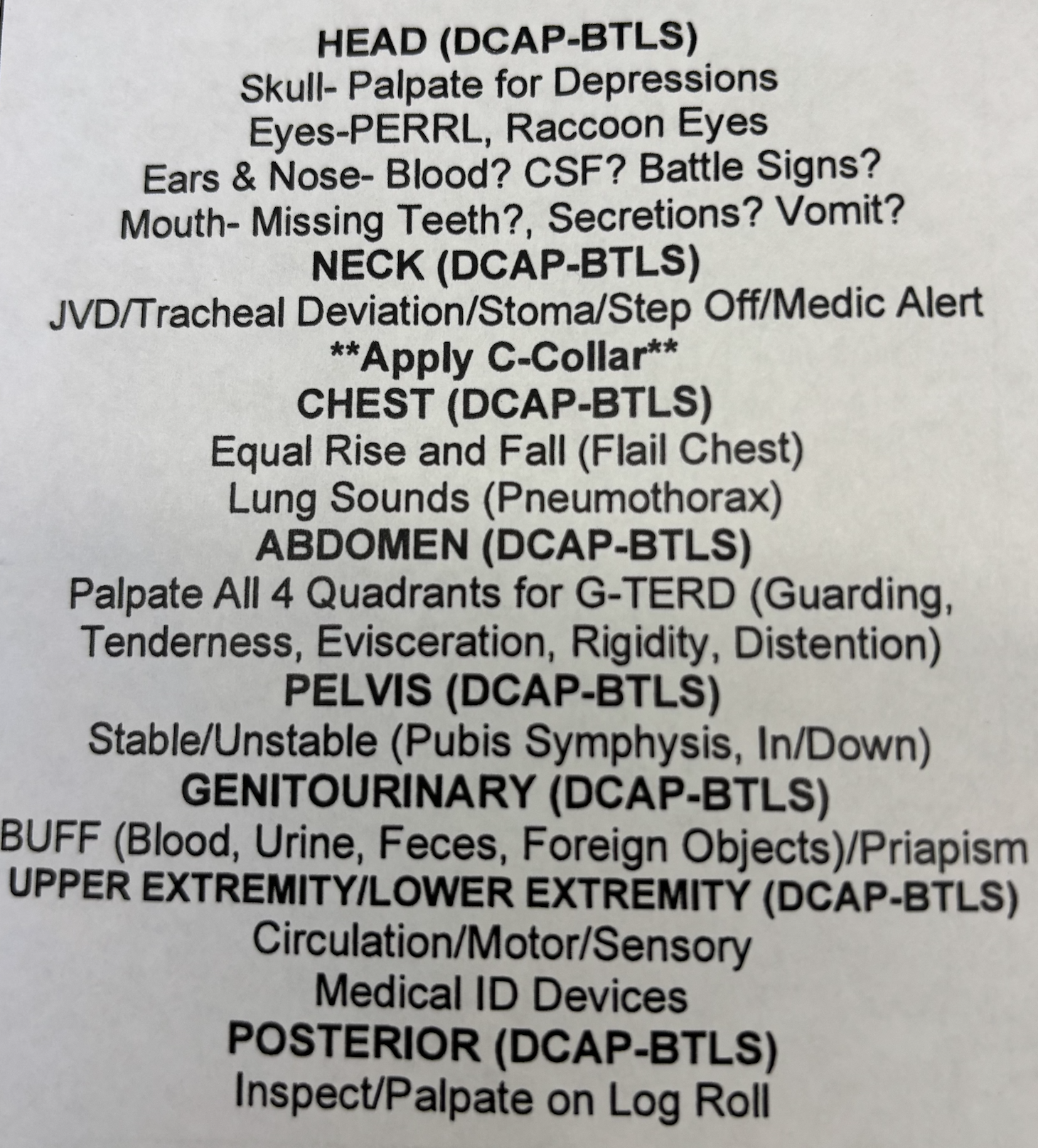
-rapid head to toe exam (DCAP-BTLS)
-SAMPLE/OPQRST
-interventions
-move to ambulance
-transport
-detailed physical exam
-reassessment (VIPS, vital signs, interventions, primary & secondary asses.)
Rapid head to toe exam
Secondary Assessment Non-Sig MOI
-determine chief complaint
-get base vitals
-perform focused physical exam based on chief complaint (check sys above and below too) (DCAP-BTLS)
-SAMPLE
-OPQRST
-interventions
-move to ambulance
-transport
-detailed physical exam
-reassessment (VIPS, vital signs, interventions, primary & secondary asses.)
Secondary Assessment Unresponsive Medical (NOI)
-request ALS
-interview fam/bystanders for info
-get base vitals
-rapid head to toe exam
-SAMPLE/OPQRST
-interventions
-move to ambulance
-transport
-reassesment (VIPS)
Secondary Assessment Responsive Medical (NOI)
-determine chief complaint
-get base vitals
-perform focused exam (above, main, and below body sys)
-SAMPLE
-OPQRST
-interventions
-move to ambulance + transport
-reassesment (VIPS)
how often do you check vitals for high priority
every 5 min
how often do you check vitals for low priority
every 15 min
base vitals
glucose level (blood sugar), HR (heart/pulse rate), SpO2 (oxygen saturation/level), RR (respiratory rate), BP (blood pressure)