Biology Exam 1
 Call Kai
 Learn
Learn Practice Test
 Spaced Repetition
 Match
Match Flashcards
 Knowt Play
1/149

Earn XP
Description and Tags
Chapters 2-6
Name | Mastery | Learn | Test | Matching | Spaced | Call with Kai | Chat |
|---|
No analytics yet
Send a link to your students to track their progress
150 Terms
Compounds
Atoms joined by bonds
number of protons
determines atom identity
electron distribution
determines ability to form bonds
matter
takes up space and has mass, made up of elemets
elements
can’t be broken down to other substances
atom
smallest unit of mater, composed of subatomic particles
neutrons,
neutral, form atomic nucleus
protons
positively charged, form atomic nucleus
electrons
negatively charged, forms “cloud” of negative charge around nucleus
Atomic number
number of protons
mass number
sum of protons and neutrons
atomic mass
total mass
isotopes
two atoms of an element that differ in neutrons, same number of protons but different number of neutrons
valence electrons
in the outermost shell
chemical bonds
atoms with incomplete shells share/transfer VE with other atoms and held by attractionsc
covalent bonds
sharing of a pair with VE by two atoms
molecule
two or more atoms held by covalent bonds
single bond
sharing of one pair of VE
double bond
sharing of two pairs of VE
electronegativity
atom’s attractions for electrons in a covalent bond
fluorine
which element is most electronegative
nonpolar
equal electrons
polar
different electronegativity and don’t share electrons equally
partial positive or partial negative charge
unequal electrons
ionic bonds
attraction between cation and anion
cation
positively charge ion
anion
negatively charged ion
ion
a charged atom
ionic compounds
compounds formed by ionic bonds
hydrogen bond
forms when a hydrogen covalently bonded to one electronegative atom is attracted to another electronegative atom
In ice, water molecules are far apart. In liquid, water molecules slip together. Ice is less dense than liquid.
How does ice float in water?
Cohesive behavior, moderation of temperature, expansion upon freezing, water solvent
What are 4 properties of water?
Cohesion
hydrogen bonds hold water molecules together, help against gravity
adhesion
attraction between different substances
heat absorbed
hydrogen bonds break
heat released
hydrogen bonds form
solution
completely homogeneous mixture of substances
solvent
dissolved agent of solution
solute
substance dissolved
aqueous solution
water is solvent
hydrophillic
affinity for water (ionic, polar)
hydrophobic
no affinity for water (nonpolar)
molecular mass
sum of all masses of all atoms in molecule
1 mol
6.02 × 10²³
Molarity
number of moles per liter of solution
hydrogen ion (H+)
hydrogen leaves electron behind and transferred as proton
hydroxide ion (OH-)
lost the proton
hydronium ion (H3O+)
molecule with extra proton, could also be written as H+
acid
increases H+ concentration of solution
base
reduces H+ concentration of solution
pH
negative log of H+ concentration
neutral solution
pH=7
carbon
can form large, complex, and varied molecules. Can form four bonds
organic chemistry
study of compounds containing carbon
electron configuration
determines the number of bonds an atom will form with other atoms
hydrocarbons
organic molecules consisting of only carbon and hydrogen
isomers
compounds with same molecular formula
structual isomes
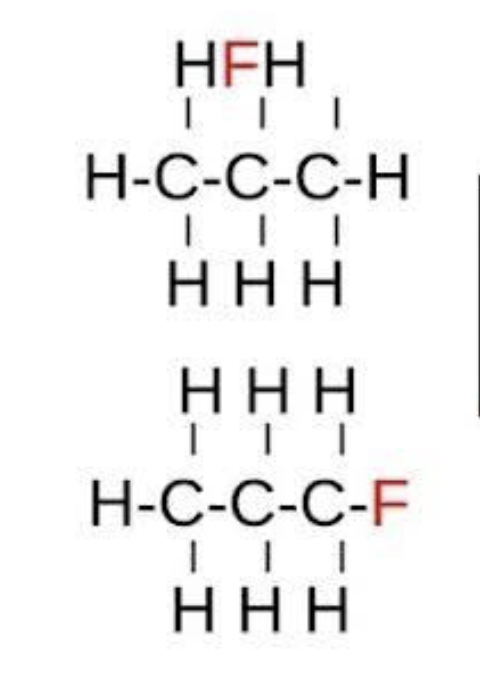
cis-trans isomers

enantiomers

functional groups
components of organic molecules involved in chemical reactions
hydroxyl group
alcohol
carbonyl group
ketone/aldehyde
carboxyl group
acid
amino group
base
sulfhydryl group
stabilize protein, thiol
phosphate group
contributes negative charge
methyl group
affects expression of genes
methyl groups
which function group is nonpolar?
carbohydrates, lipids, proteins, nucleic acid
What are the four large biological molecules?
polymer
long molecule with similar building blocks (made of monomers)
monomer
building blocks
dehydration synthesis
synthesizing polymer, removes water molecule, forming a new bond
hydrolysis
breaking down a polymer, adding water molecule, breaking a bond
carbohydrates
include sugar and polymers of sugars
monosaccharides
simplest unit of building blocks of carbohydrates
disaccharide
two monosaccharide units
polysaccharides
long chain of monosaccharides
chitin
structural polysaccharide, found in exoskeleton of arthropods and cell walls of fungi
lipids
hydrophobic organic compounds made of carbon and hydrogen atoms, and some oxygen
fats
constructed from glycerol and fatty acids, store energy
glycerol
three carbon alcohol with hydroxyl group, energy source
fatty acids
carboxyl group with hydrocarbon skeleton
saturated fats
solid at room temperature
unsaturated fats
liquid at room temperature
phospholipid
two fatty acids and phosphate group attached to glycerol, lipid bilayers of membranes
hydrophobic
Are fatty acid tails hydrophobic or hydrophilic?
hydrophilic
Are phosphate heads hydrophobic or hydrophilic?
steroids
signal molecules traveling through the body, carbon skeleton with four fused rings
cholesterol
type of steroid, in animal cell membranes and precursor from other steroids are synthesized
protein
biologically functional molecule that consists of one or more polypeptides
polypeptides
unbranched polymers built from amino acids
amino acids
molecules with amino and carboxyl groups
peptide bonds
link amino acids
Amino acids make up polypeptides, and polypeptides make up proteins
How are protein, polypeptides, and amino acids related?
enzymatic protein
moves chemical reactions
storage protein
stores amino acids
defensive protein
protects against disease
transport protein
transport substances
hormonal protein
coordination of organism’s activities