CHM2046 Lecture 8/25
 Call Kai
 Learn
Learn Practice Test
 Spaced Repetition
 Match
Match Flashcards
 Knowt Play
1/22

There's no tags or description
Looks like no tags are added yet.
Name | Mastery | Learn | Test | Matching | Spaced | Call with Kai | Chat |
|---|
No analytics yet
Send a link to your students to track their progress
23 Terms
What is K?
The equilibrium constant; a number with no units that depends on the relative amounts of products and reactants at equilibrium
How do we determine K?
From rate constants (k) → Kc = kfwd/krev
Where does Kc = kfwd/krev come from?
{products] / [reactants] review this!!
What does high K mean? Rationalize.
High K means the reaction is product-favored. Equilibrium lies right. This comes from a high [products] compared to [reactants].
What does K ~ 1 mean?
At equilibrium, there is a mixture of products and reactants.
Kc =
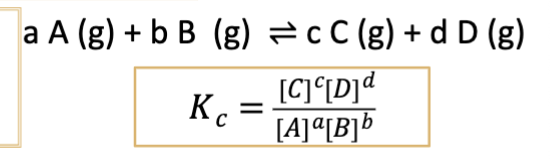
Rule #1 for writing equilibrium constant, K, expressions
Heterogeneous reactions: Pure solids and pure liquids WILL NOT appear in K, so do not include their concentrations in K. Why? Pure solids and liquids have standard-state quantity of 1.
Heterogeneous reactions
K is a defined value for ___ and ___.
A given temperature and specific balanced equation.
Rule #2 for writing K expressions
Rule #3
Koverall =
K1 x K2 x K3…
Rule #4
K refers to a balanced qeuation as written. K changes if multiplied by a common factor.
ex. A→B; 1/2A→1/2B. → Kc → K^1/2
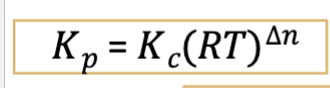
Kp =

Why can we use the same rules for Kc as Kp?
Every concentration can be rewritten as a pressure using a factor of RT. → P=(n/v)RT → M=P/RT
How do we express K in terms of Kp?
delta n = change in moles of gas = moles gas products - moles gas reactants
Always check that units given match ___!
units of K given
Do the rules for K apply to Q?
Yes
Q
The reaction quotient; Q is at any time in the reaction, any set of conditions; Q COULD be at equilibrium
If Q is at equilibrium, ___.
Q = K
K < Q
Reaction proceeds from right to left to reach equilibrium; goes to reactants. This is because we have “too much” product.
K > Q
Reaction proceeds from left to right to reach equilibrium; goes to products. This is because we have “too much” reactant.
K = Q
Reaction at equilibrium. No change in concentrations occurs.