Pharm Kinetics
 Call Kai
 Learn
Learn Practice Test
 Spaced Repetition
 Match
Match Flashcards
 Knowt Play
1/24

There's no tags or description
Looks like no tags are added yet.
Name | Mastery | Learn | Test | Matching | Spaced | Call with Kai | Chat |
|---|
No analytics yet
Send a link to your students to track their progress
25 Terms
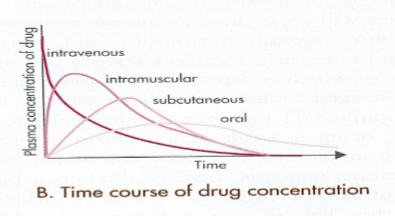
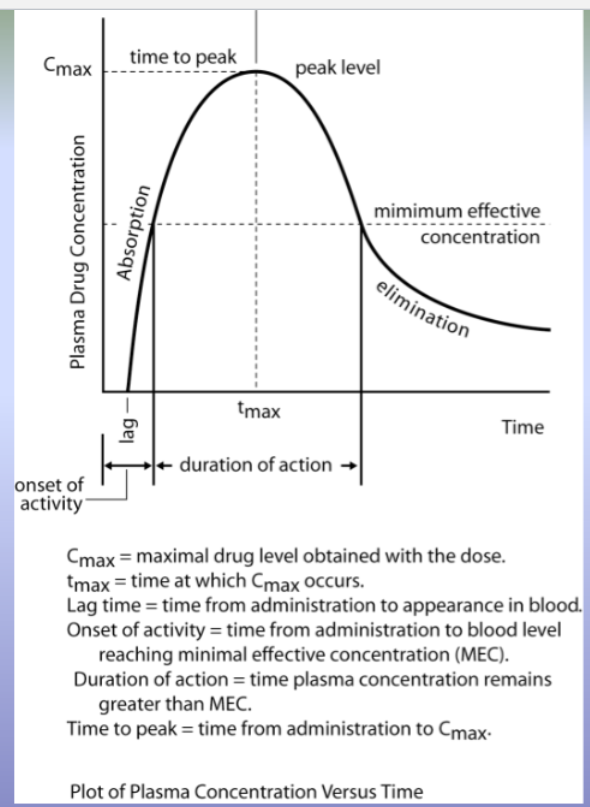
Describe the difference in plasma concentration w/ time for the dif. drug routes
List the advantages and disadvantages of IV admin
Advantages of IV Admin.
immediately enters circulation
rapidly distributed to tissues
Rapid response
Permits instant dosage titration
Useful drug is destroyed by gastric contents or heavily
metabolized by first pass effect
Allows maintenance of constant blood Levels
Large quantities can be administered for a long time
Reduced irritation due to diluting/buffering by blood
Always Available (unconscious patients)
Disadvantages
drug cannot be removed
Too Rapid Injections = serious reactions
too much drug arrives @ Target organs
Not easy self-admin
Must use sterile technique
Pt. Discomfort
Complications (irritation,allergy, etc) difficult management
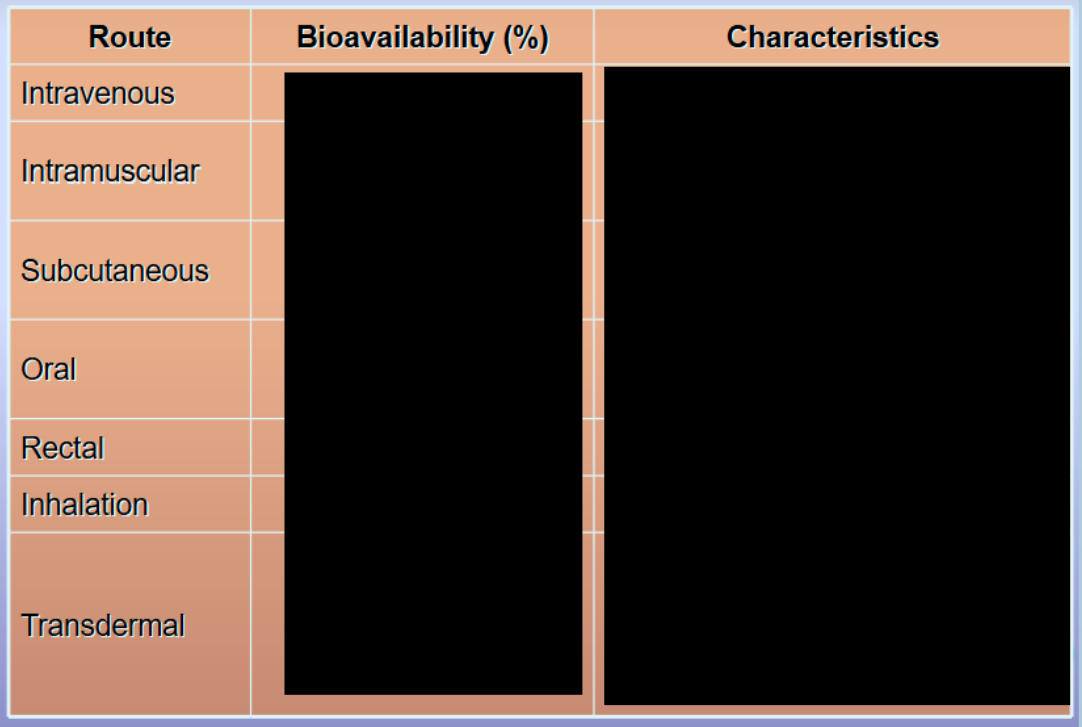
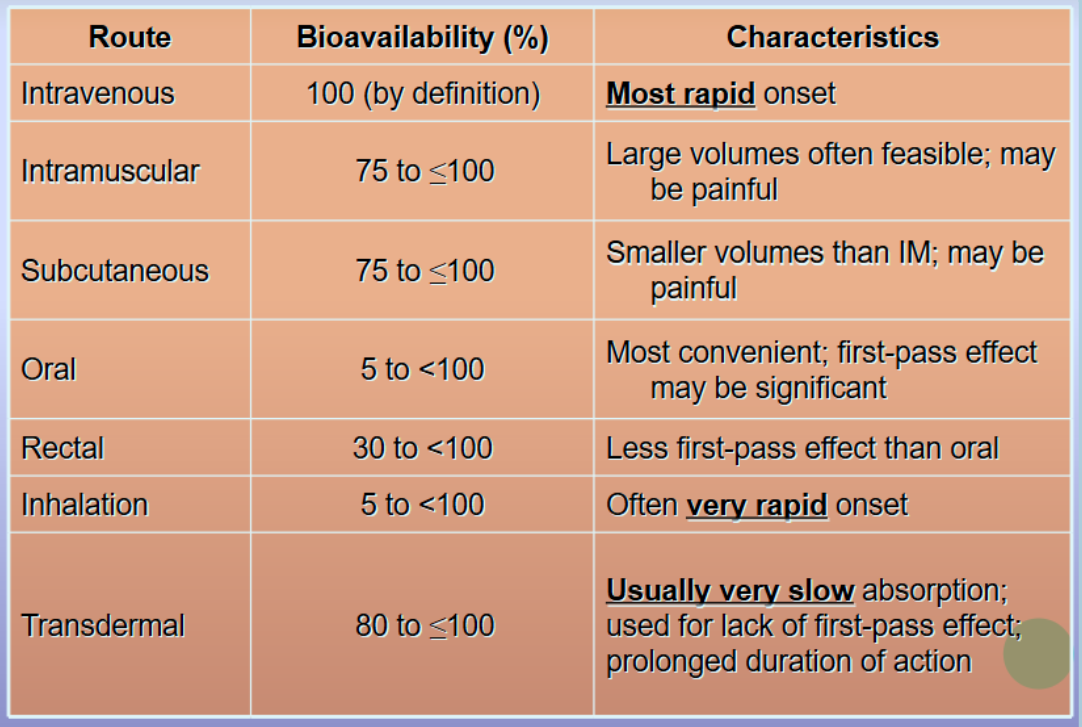
Describe Bioavailability
Define
Affected by?
Definition:
proportion (fraction) of unchanged drug -> systemic circulation.
Affected by
first-pass metabolism,
drug formulation
route of administration.
NOTE: 100% w/ IV admin.
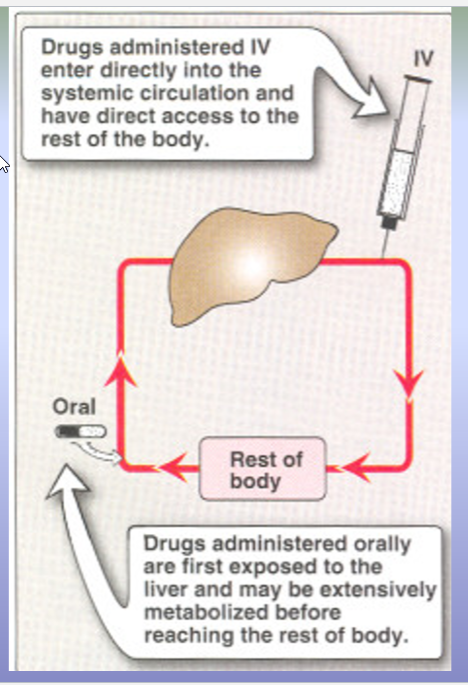
What is first pass hepatic metabolism in regards to drugs
Oral Admin → GI Absorption →Hepatic portal circulation → rapid and extensive metabolism → decrease # of unchanged drug reaching systemic circulation
List and describe the factors that influences bioavailability
Drug solubility:
Lipophilic drugs = more absorbed.
Molecular weight/size
Chemical Instability:
Susceptibility to pH of gastric juice
Drug formulation:
Particle size, salt form etc
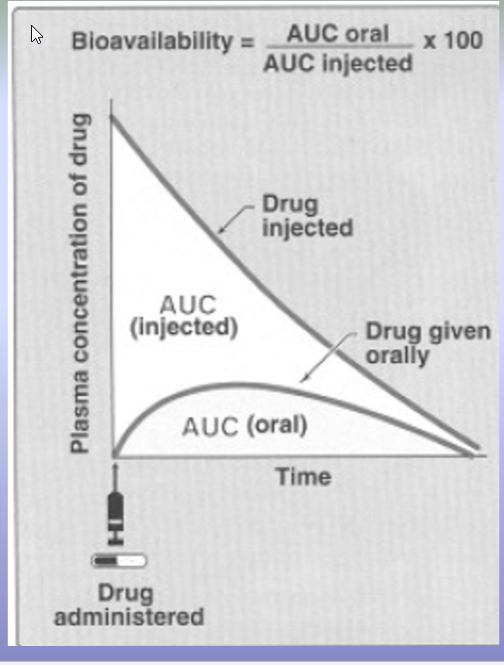
Draw out the graph depicting the difference between injections and oral drugs
What is the formula for Bioavailability
Describe Steady state:
Definition?
Mathematical Formula?
Draw out the graph depicting this
Definition:
Rate of drug elimination balances drug input rate.
[Plasma] = constant.
Mathematically:
4-5 half-lives to reach steady state.
3.33 half life = 90%
![<ul><li><p><span style="background-color: transparent;">Definition:</span></p><ul><li><p><span style="background-color: transparent;">Rate of drug elimination balances drug input rate.</span></p><ul><li><p><span style="background-color: transparent;">[Plasma] = constant.</span></p></li></ul></li></ul></li><li><p><span style="background-color: transparent;">Mathematically:</span></p><ul><li><p><span style="background-color: transparent;">4-5 half-lives to reach steady state.</span></p></li><li><p><span style="background-color: transparent;">3.33 half life = 90%</span></p></li></ul></li></ul><p></p>](https://assets.knowt.com/user-attachments/78d28f8a-26ba-40c0-a220-c3dd07735cbc.png)
What is the THERAPEUTIC WINDOW
What determines this?
What window = toxic?
Definition:
safe “opening” btw minimum therapeutic and toxic concentrations
Determined by:
minimum [effective]
Determines the desired trough level
minimum [toxic]
Determines the permissible peak plasma concentration
Therapeutic index <10 = toxic
![<ul><li><p>Definition:</p><ul><li><p><span style="background-color: transparent;">safe “opening” btw minimum therapeutic and toxic concentrations</span></p></li></ul></li><li><p>Determined by:</p><ul><li><p><span style="background-color: transparent;">minimum [effective]</span></p><ul><li><p><span style="background-color: transparent;">Determines the desired trough level</span></p></li></ul></li><li><p><span style="background-color: transparent;">minimum [toxic]</span></p><ul><li><p><span style="background-color: transparent;">Determines the permissible peak plasma concentration</span></p></li></ul></li></ul></li><li><p><span style="background-color: transparent;">Therapeutic index <10 = toxic</span></p></li></ul><p></p>](https://assets.knowt.com/user-attachments/10db2958-4796-4e56-bd55-a524a7d86378.png)
Describe Drug Absorption:
Definition
Rate + Efficacy
Mechs of Absorption?
Drug Absorption
Definition:
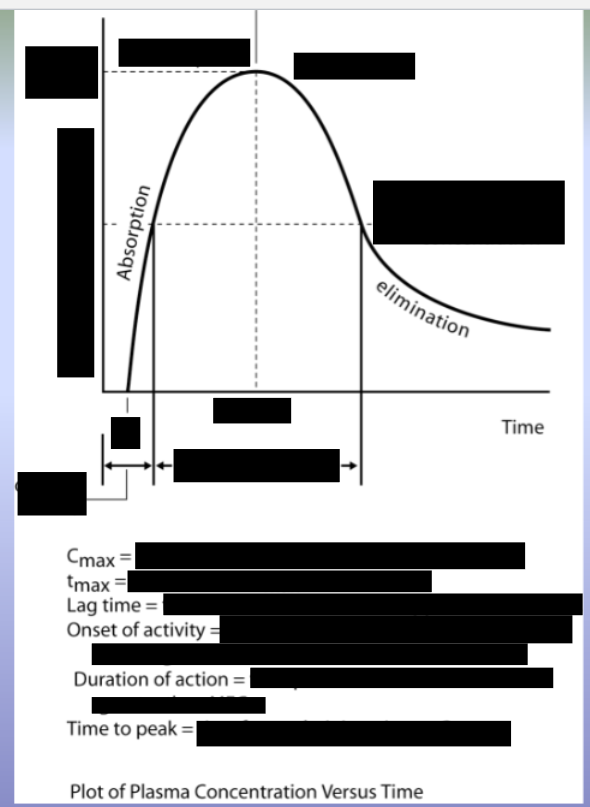
Transfer of drug from site of administration to blood stream
Rate + efficacy:
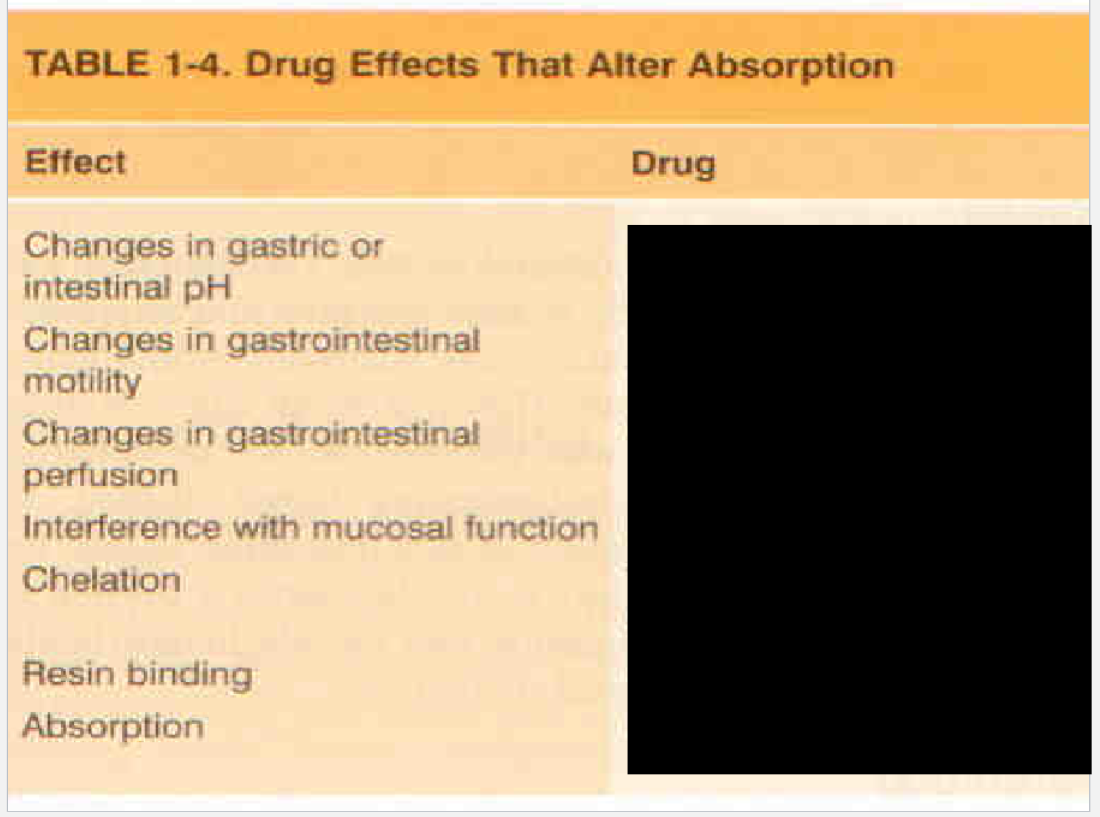
Depends on Route of Admin
Complete absorption after IV administration
Four mechanisms of absorption
Passive diffusion
Active transport
Facilitated diffusion
Pinocytosis
NOTE: REVIEW IF NEEDED
Describe the Non/Ionization of Weak Acids/Bases:
Env of best absorption?
Location in GI?
EX?
Describe how ionization leads to excretion?
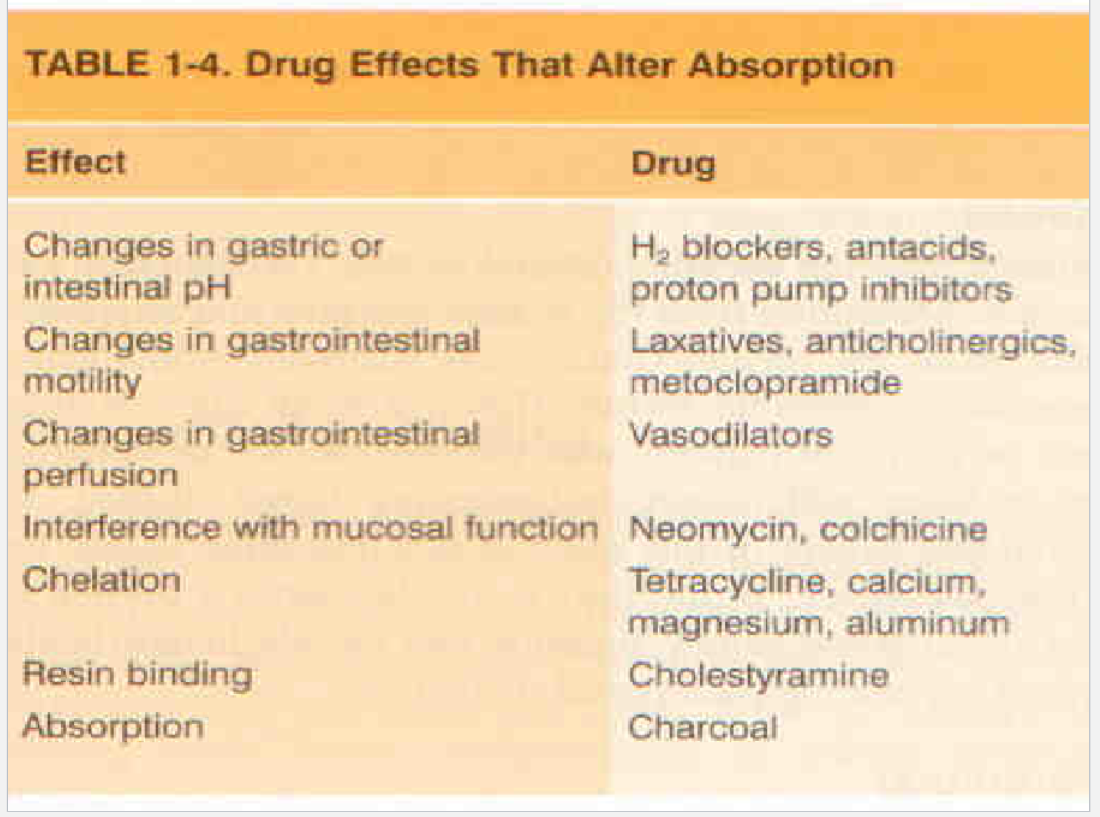
Non/Ionization of Weak Acids/Bases:
Weak acids
Best absorbed in an acidic environment
PROX of Small Int.
Ex: Aspirin, Digoxin, Ketoconazole
Weak bases
Best absorbed in a basic environment
Distal of Small Int.
EX: Quinidine, Morphine, Lidocaine
NOTE:
Non ionized = lipid soluble
Ionized = water soluble -> excreted
Describe Drug Distribution:
Definition
Depends on?
Relationship to Albumin?
Describe the complications of highly bound drugs
%?
Mech
Specific Types of Drugs
clinical Example
Describe Volume of distribution:
Definition
Formula?
Definition:
Process by which drug reversibly leaves blood stream -> interstitium (ECF)
Depends on
blood flow
capillary permeability
drug binding
Relationship to Albumin
Drugs usually bind to albumin-reversible binding
Only free (unbound) drug is available for action
Complications of Highly bound drugs
(> 80%)
Mech: Competes for binding to available sites -> drug displacement into plasma -> toxicity
Specific Types:
NSAID’s
Sulfonamides
Digoxin
Warfarin
Clinical Example:
Sulfonamides contraindicated in neonates -> Bilirubin displacement -> (kernicterus)
Volume of distribution:
Definition:
# of drug in body in relations to [drug] in blood/plasma/water (unbound drug)
Formula:
Vd = Dose/Co (concentration)
Describe Drug Metabolism (Biotransformation):
Effect on drugs
Site?
Affected by?
Consequences?
Effect on drugs:
Terminates pharmacological action (inactivation) -> drug removal
Can activate some drugs (prodrugs)
Site: @ Liver
Affected by:
Prior administration of drug/s
Physiological status (eg. nutritional)
Age
Genetics
Liver Function
Consequences
Produces inactive metabolites
Metabolites w/ increased or decreased potencies
Metabolites w/ different pharmacological actions
Toxic metabolites
Active metabolites
Describe Phase 1 of Biotransformation:
Enzymes used? Clinical Relevance?
Effect of inhibition/inducers of cytochrome P450? List out the substances that can do them
Phase 1 Biotransformation:
Enzymes Used:
Non-microsomal enzyme
Hydrolysis (succinylcholine, amide local anesthetics) + alcohol metabolism
Microsomal enzymes
cytochrome P450 isoenzymes
NOTE: most abundant = 3A4
NOTE: Clinical Relevance:
Genetic polymorphisms may exist
EX: pseudocholinesterases metabolize succinylcholine -> extended muscle paralysis.
Inhibition vs induction:
Inhibition -> reduced meta. -> toxicity
Ex:
grapefruit juice,
Inhibits statin meta -> rhabdomylosis and renal failure!
Cimetidine,
Inhibits 2C9-diazepam toxicity
omeprazole,
macrolide antibiotics (erythromycin) azole antifungals,
acute alcohol.
Induction -> increase meta -> treat. Fail
EX:
barbiturates,
all anticonvulsants (except valproate),
rifampin,
Induces 3A4 -> oral contraceptive fail
chronic alcohol.
may cause acetaminophen toxicity.
Describe phase 2 of Biotransformations:
Enzymes used? Ex of medications for each enzymes?
End result?
Phase II:
Enzymes used:
Glucuronyl transferase (glucoronidation)
EX:
Morphine -> Morphine 6b-glucoronide (6X more potent)
Chloramphenicol contraindicated in neonates (gray baby syndrome)
Sulfotransferase (sulfate conjugation)
EX: acetaminophen, methyldopa
Transacylases (amino acid conjugation)
Glutathione conjugation
Ex: Acetaminophen
Acetylation
EX: Hydralazine, Isoniazid, Procainamide (HIP)
HIP Drugs-SLE syndrome in slow acetylators!!
Result:
Inactivation + increased water solubility = increased excretion
List and describe the impact of different phenotypes on drug metabolism
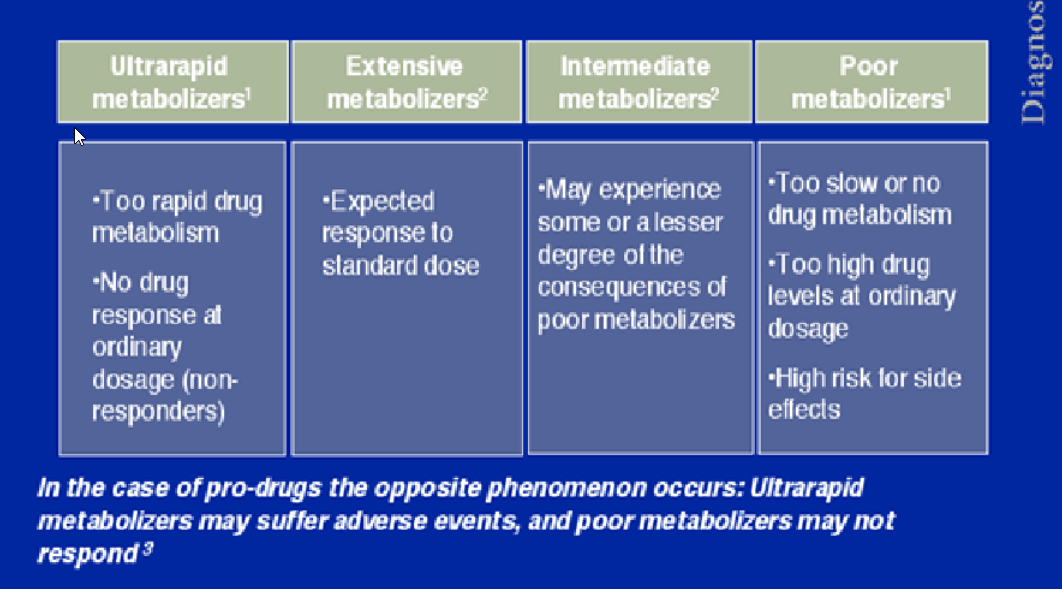
What are the Potential consequences of polymorphic drug metabolism
Increased/decreased effective dose
Extended/shortened therapeutic effect
Adverse drug reactions and drug toxicity
Metabolism by alternative, deleterious pathways
Exacerbated drug-drug interactions
Lack of pro-drug activation
[REVIEW] net renal excretion
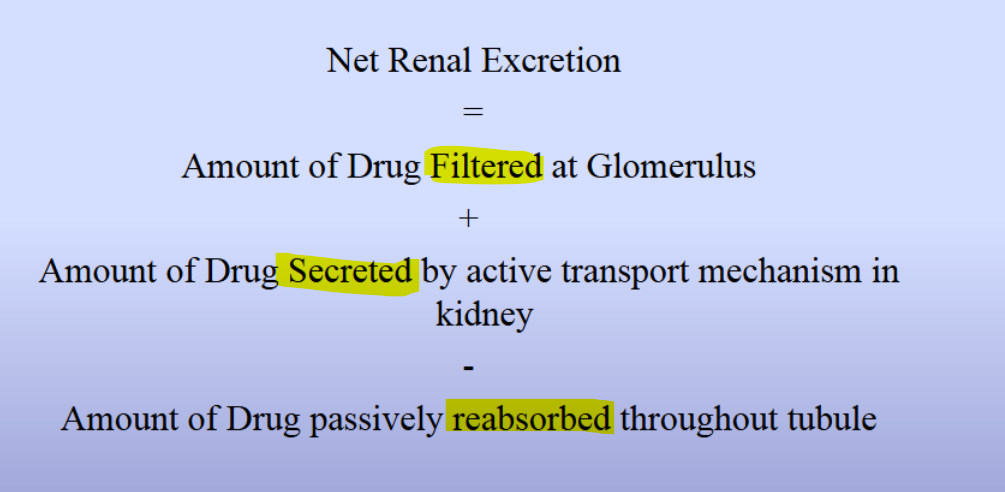
What is the formula for Renal Elimination
Describe Clearance
Define
Formula?
Renal Elimination
Formula:
Rate of elimination = (GFR) + active secretion – reabsorption
GFR = 120 (normally)
Clearance (Cl):
Definition:
volume of blood cleared of drug per unit of time
Formula:
Cl = free fraction × GFR
Cl = GFR if no reabsorption or secretion and no plasma protein binding
Protein-bound drug is not cleared
Cl is constant in first-order kinetics.
Differentiate between First and Zero order elimination rate
What happens?
Formula?
First-Order Elimination Rate
What happens:
constant fraction of the drug is eliminated per unit time
t1/2 is a constant.
Formula:
drug decreases by half every half-life
80 -> 40 -> 20 every four hrs (T1/2)
ZERO -ORDER ELIMINATION RATE
What Happens:
constant amount of drug is eliminated per unit time
Independent of [plasma] or # in body
half-life (t1/2) is a variable
Formula:
Drug decreases by set amount every half life
80 -> 70 -> 60 every 4 hrs (t1/2)
Examples:
Ethanol “except low blood levels”
Phenytoin “high therapeutic doses”
Salicylates (toxic doses)
(T/F) Drug Elimination = drug excretion. Explain?
False:
A drug may be eliminated by metabolism long before the modified molecules are excreted from the body. Excretion is the mode of elimination for drugs that are not metabolized
Describe the Effect of Urine pH on renal Excretion:
Effect of Urine pH on renal Excretion:
Acidification -> ionization of weak bases -> increases excretion of weak bases
EX: NH4Cl, cranberry juice, vitamin C
use NH4Cl last; too potent
Alkalinization -> ionization of weak acids -> increases excretion of weak acids
NaHCO3, acetazolamide.
Differentiate between LD and MD:
Definition
Formula?
LOADING DOSE (LD)
Definition:
First dose of drug treatment
required to achieve target [] rapidly.
Higher loading dose = achieves effective blood levels (Cp)
Formula:
(Vd X Cp)/F
Vd = volume of distribution
Cp= plasma concentration
F = bioavailability
MAINTENANCE DOSE (MD)
Definition:
Dose rate to achieve + maintain target []
@ steady state: dose rate in = rate of elimination
Formula:
(Cl X Css X t)/ F
Cl = clearance
Css = concentration-steady state
F = bioavailability
t – frequency od administration (minutes)