Earth's Layers, Minerals, and Rock Formation: A Comprehensive Geology Review
 Call Kai
 Learn
Learn Practice Test
 Spaced Repetition
 Match
Match Flashcards
 Knowt Play
1/39

There's no tags or description
Looks like no tags are added yet.
Name | Mastery | Learn | Test | Matching | Spaced | Call with Kai | Chat |
|---|
No analytics yet
Send a link to your students to track their progress
40 Terms
What are the four main spheres of the Earth?
Hydrosphere, Geosphere, Atmosphere, Biosphere
What is the Anthroposphere?
The part of the environment that is made or modified by humans.
What is the diameter of the Earth's core?
2500 km
What are the two phases of the Earth's core?
Inner core (solid, composed of pure iron) and outer core (liquid, composed of iron and nickel).

What is the thickness of the Earth's mantle?
2900 km
What are the three layers of the mantle?
Upper mantle, transition mantle, and lower mantle.
What is the composition of the lower mantle?
Formed with MgO, FeO, and SiO2, containing perovskite crystals and H2O.
What is the difference between continental and oceanic crust?
Continental crust is about 40 km thick, while oceanic crust is about 8 km thick.

What is the lithosphere?
The solid outer part of the planet, including the crust and the brittle upper portion of the mantle.
What is the approximate depth of the lithosphere?
Approximately 100 km
What is the main difference between minerals and rocks?
Minerals are naturally occurring inorganic substances with a definite chemical composition, while rocks are solid aggregates of one or more minerals.
What are minerals?
Inorganic solids with a uniform and definite crystalline structure and chemical composition formed by geological processes.
Give examples of minerals.
Calcite, quartz, pyrite.
How are rocks formed?
From the aggregation of one or more minerals due to temperature and pressure changes in the environment.
Provide examples of rocks.
Limestone, granite.
What is the process of mineral formation from magma?
Minerals form through cooling and crystallization of magma.
How does the cooling rate of magma affect crystal size?
Slow cooling results in large crystals; rapid cooling results in small crystals.
What happens when magma comes into contact with air or water?
It cools rapidly, forming small crystals.
What is the process of mineral formation from solutions?
Minerals precipitate when a liquid becomes supersaturated or crystallize through evaporation.
What are the properties of minerals?
Color, streak, hardness, tenacity, crystal structure, cleavage, fracture, luster, density, solubility, and melting point.
What does the hardness of a mineral indicate?
Its resistance to abrasion, measured using Mohs scale.
What is tenacity in minerals?
Resistance to breaking, crushing, or bending.
What is cleavage in minerals?
Breaking along specific planes due to weaker atom bonding.
What is the difference between fracture and cleavage?
Fracture is random breakage with rough edges; cleavage is breaking along specific planes.
What is luster in minerals?
Quality of reflected light on the mineral's surface, independent of color.
What are silicates?
Minerals that contain silicon (Si) and oxygen (O), making up approximately 96% of minerals.
What are carbonates?
Minerals composed of one or more metallic elements and carbonate (CO3), such as calcite and dolomite.
What are oxides?
Compounds of oxygen and a metal, examples include hematite and magnetite.
What are sulfides?
Compounds of sulfur with one or more elements, e.g., pyrite.
What are the three main classifications of rocks?
Igneous, sedimentary, and metamorphic.
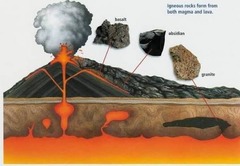
How are igneous rocks formed?
From the solidification or cooling of magma or lava.
What characterizes sedimentary rocks?
Formed from the aggregation of sediment/mineral particles due to erosion and environmental interaction.
How are metamorphic rocks formed?
From physical and chemical changes due to high temperature and pressure on igneous and sedimentary rocks.
What is weathering?
Physical, chemical, and/or biochemical interaction of crust minerals with the environment.

What is physical weathering?
Weathering caused by temperature gradients, abrasion, erosion, and mechanical forces.
What is chemical weathering?
Weathering reactions caused by interactions of water and air with surface compounds.
What is the role of biotic factors in weathering?
Facilitated by autotrophic organisms for oxidation or reduction of minerals.
What is soil?
Loose covering of weathered rock particles and decaying organic matter overlying bedrock.
What factors influence soil formation?
Climate, topography, parent material, biological organisms, and time.
What are the soil horizons?
Layers of soil: O-horizon (organic), A-horizon (weathered rock), B-horizon (zone of accumulation), C-horizon (broken-down bedrock).