NEUS 609 - LTP & LTD
 Call Kai
 Learn
Learn Practice Test
 Spaced Repetition
 Match
Match Flashcards
 Knowt Play
1/39

Earn XP
Description and Tags
Name | Mastery | Learn | Test | Matching | Spaced | Call with Kai | Chat |
|---|
No analytics yet
Send a link to your students to track their progress
40 Terms
Long term potentiation
aka LTP
long-lasting increase in neuronal response, strengthening of the synapse that follows coincident activation of pre- and post-synaptic neurons
cellular mechanism by which info is converted from short to long-term memory
Depends on Ca2+ levels in the POSTSYNAPTIC neuron
different LTP mechanisms at different synapse working at different time points
hippocampus
LYP happens EVERYWHERE but was discovered in the ___ as it is the region of memory formation
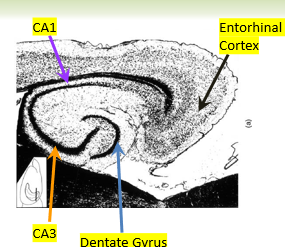
dentate gyrus
inner structure of the hippocampus looking like a little “C”
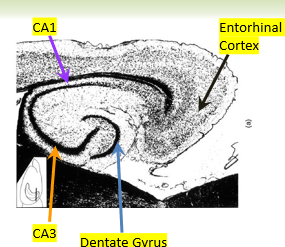
CA3
structure part of the bigger looking “C” closer to the dentate gyrus
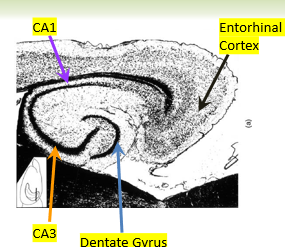
CA1
structure part of the bigger “C”, top of the general hippocampal structure
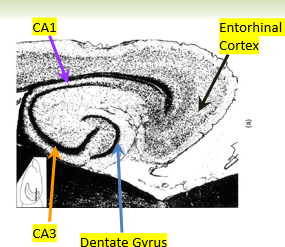
entorhinal cortex
Thicker region at the top end of the “bigger C” aka at the end of CA1
perforant path
pathway through which info ARRIVES at the hippocampus aka the axons of entorhinal cortex
direct pathway
layer III of entorhinal cortex to pyramidal cells of CA1
excitatory input
lesions in this pathway do not prevent initial learning, but prevent consolidation aka long-term storage
trisynaptic pathway
originates form layer III of entorhinal cortex to granule cells of dentate gyrus
excitatory input
aka indirect pathway
lesion in this pathway limit spatial learning tasks but some learning still possible
mossy fiber pathwayway
from granule cells in DG to the pyramidal cells of CA3
excitatory input
Schaffer collateral pathway
CA3 pyramidal cells to CA1 pyramidal cells
become commissural if crossing the midline
excitatory input
ALL
inhibitory interneurons are found in ___ layers of hippocampus
cell nomenclature letters
location—orientation—projection area(s)
25, subtypes
inhibitory cells represent __% of the population, but have many more ___ compared to excitatory cells
high frequency, tetanus
To experimentally generate LTP, you need intense activation of a pathway increasing the subsequent response
done via ___ exposition using ___
Testing done after exposition to stimulus in normal setting. Only the pathway exposed to stimulus increases its response to form LTP.
L-Ca2+
Different mechanisms underly LTP at different synapses and different pathways
usually, postsynaptic ___ channels dependent
Non-associative LTP
Based on following pre-synaptic mechanism:
modulator norepinephrine (NE) acts on postsynaptic receptor activating adenylyl cyclase (ADC)
ADC convert ATP to cAMP
cAMP activates cAMP-dependent kinase A (PKA)
PKA phosphorylates additional proteins ultimately ending in increased NT release
Associative LTP
Based on thinking, Pre and Postsynaptic activity must be COINCIDENT
coincidence detected by NMDA receptor thanks to the Mg2+ blocking the channel until sufficient postsynaptic activity changes the membrane potential enough
activity, NMDA receptors
The 2 factors needed for coincidence to happen are presynaptic ___ (or experimental additional GLU) and postsynaptic ___
induction
transient event that triggers the formation of LTP
NMDA receptor responsible for this phase
amplitude/initial slope
To measure the expression of LTP, you measure the ___ of EPSP
induction mechanism
postsynaptic depolarization
activation of NMDA receptors
postsynaptic influx of Ca2+ (activates protein kinases)
2nd messenger molecules
AMPA
Expression of LTP characterized by:
INCREASED NUMBER or SENSITIVITY of ___ receptors
retrograde messenger nitric oxide (NO)
increased NT release from presynaptic terminal
expression = addition of __ receptors to membrane and/or phosphorylation of the ones already there
maintenance
persisting biochemical signal in a cell that ultimately results in the expression of LTP
consolidation
aka late LTP
phase lasting beyond 1 hour
requires protein synthesis (& more training/high frequency exposure)
blocking protein synthesis only block late LTP, thus preventing ___
growth of new synapses
Protein synthesis is needed in late LTP for the ____
mechanism of late LTP
Normal LTP initiation as NMDA receptors activate, Ca2+ kinases activate, and there in an increase in number/sensitivity of AMPA receptors
Repeated high frequency exposure causes Ca2+ influx which recruits ADC, increasing cAMP levels, activating PKA, which ultimately activates MAP kinase
MAP kinase translocated to the nucleus and phosphorylates CREB-1 TF
CREB-1 activates transcription of targets leading to growth of new synaptic connections
Repeated high frequency exposure also activates translation in dendrites encoding active form of PKC
Long term depression
aka LTD, allows us to forget things
long lasting decrease in magnitude of responses of neurons after afferent cells have been activated with electrical stimuli of relatively LOW frequency
removed, NMDA, Ca2+
LTD ultimately leads to AMPA receptors to be ___ from the membrane
still requires ___ receptors and postsynaptic __ entry just like LTP
LTD mechanism
Low and prolonged internal Ca2+ entry activates phosphatases (calcineurin for ex) that DEPHOSPHORYLATE the AMPA receptor and lead to the internalization of these receptors.
synaptic strength
BOTH LTP and LTD use the NMDA receptors and Ca2+ postsynaptic activity (high and brief for LTP, low and prolonged for LTD) so the ___ will depend on which process prevails/is more active
timing
As presynaptic and postsynaptic activity need to be associated for any synaptic plasticity mechanism, ___ is an important factor
polarity, magnitude
Timing of pre and postsynaptic activity codes for ___ and ___ of plasticity
postsynaptic AP occurs after presynaptic activity = LTP
postsynaptic AP occurs before presynaptic activity = LT
narrow, wider
the window for LTP is quite ___ compared to the __ one of LTD, which is why it is more likely to forget than to remember
Sliding Modification Threshold
aka SMT
phenomenon happening after LTP induction making it easier to produce LTD at the same connection.
threshold frequency slides to the right after LTP induction, meaning you need higher frequency to induce it again
threshold frequency slides to the left after LTD induction, meaning you need lower frequency to induce it again
associativity
association of a normally weak stimulus to a stronger one makes it more likely to be remembered
Like Pavlovian conditioning
cooperativity
2 weak stimuli happening together makes it more likely for each to them to be remembered
A threshold must be overcome -Ensures only events of significance will the memory get stored.
synapse specificity
More likely to remember information linked to a strong stimulus
Information not related to a particular event will not get stored.
spatial memory
demonstration of synaptic plasticity using the water maze assay and blockers and enhancers
preventing autophosphorylation of Ca2+ mediated kinase II = tetanus induced LTD instead of LTP = no learning = no __
blocking NMDA receptors = no __
blocking NMDA receptors after LTP = no effect
blocking active form of PKC in dendrites after LTP = no maintenance = no ___
deletion of NR1 = no LTP = no ___
enhancing NR2B enhances ___