Fundamentals of data representation
 Call Kai
 Learn
Learn Practice Test
 Spaced Repetition
 Match
Match Flashcards
 Knowt Play
1/9

There's no tags or description
Looks like no tags are added yet.
Name | Mastery | Learn | Test | Matching | Spaced | Call with Kai | Chat |
|---|
No analytics yet
Send a link to your students to track their progress
10 Terms
Number bases - decimal, binary, hex - uses - (0 IS A NUMBER)
Dec - base 10, every column are increasing powers of 10, with digits from 0-9 that can be in any column - ideal to represent two states (off/on) - useful for circuits high-low voltage
Bin - base 2, every column is increasing powers of 2 with only 0 and 1, any other number must be represented by a combination of 0 and 1 - familiarity
hex - base 16, 0-9, then A-F where F is 15 - can represent bin more compactly
Analogue vs binary bit patterns
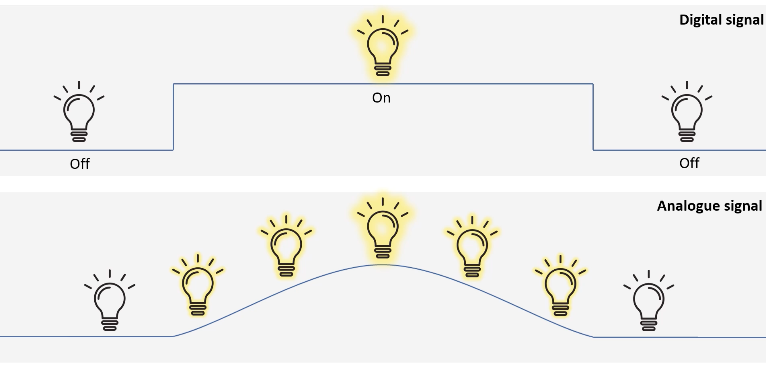
all senses can be measured in a continuous sinuating line e.g. turning a light on and off goes gradually brighter, peak brightness and then gradually goes darker
but in binary (bits) - there are only 2 states that the light can be so it just goes on and off
0 off 1 on makes it simple to build circuits - more states makes it more difficult and prone to error
e.g. data stored in capacitors in RAM as holding charge or no charge (0,1) ,
SSDs hold electrons (1) or dont (0)
N S polarity on HDD representing 1 or 0
point of bit patterns - interpretations
Understand that computers use binary to represent all data and instructions.
you cannot represent anything with bit pattern (0s and 1s) until you know how to interpret it bc e.g. a bit pattern through ASCII can be a letter, an integer if converted, a black and white series of pixels, colour or sound
use of hex and main difference in character usage
as the value of the number increases BIN and DEC use more characters e.g. for up to 15 but HEX uses 1
computers dont really use BIN but bc of the close relationship with binary nibbles they become really useful for representing large, longer sequence binary numbers in a smaller number of digits
and used in CS to represent colours, mem adresses, mac adresses
How to convert DEC to BIN using the divide by 2 method, acknowledge that the number line method is a viable options aswell
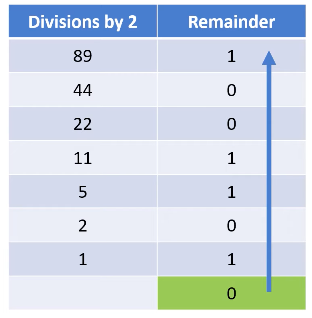
e.g. take 89 into BIN , first divide 89 by two 44r1 keep the 1 in a separate column at the 84 row, and then keep dividing by 2 (if no remainder then 0) until you reach 1 then read the remainder column bottom up
89 → 0101 1001 (best to give answer as 8 bits even if you answer might have less)
to convert BIN to DEC write the columns and write the BIN number underneath and add where 1 is in a column
DEC to HEX
one HEX digit is a binary nibble, so take the DEC number and convert it into binary e.g. 95 which is 0101 1111 now each nibble represents a number, first one being 5 and last being F → so 5F
if given the other way take the two digit number deconstruct it into 2 binary nibbles and convert the 8 bit number into DEC
if for a number that only takes one nibble or under (anything under 15 or F ) best to learn HEX value for it
Units of data capacity
b = bit B = byte
everything is stored in bits and can be used to represent many things, but a byte is a group of 8 bits and a group of 4 is a nibble
kilobyte 210 bytes = 1024 but for science 1 kB = 1000 bytes
using this approximation - 1MB = 1000 kB , 1GB = 1000 MB, 1TB = 1000GB
so to convert between units mult or div by 1000 and then mult or div by 8 for bits and bytes
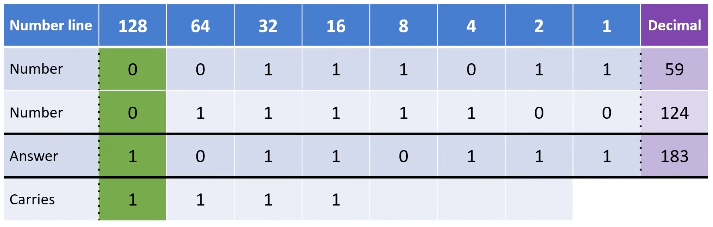
binary rules for addition
0+0 = 0
0 + 1 = 1
1+1 = 0 carry 1
1+1+1 = 1 carry 1
always format table like this and denote overflow if possible
Binary shift
as each column is double the last, if you shift the column leftwards you multiply it by 2 each time and divide by 2 each time you go rightwards
if you shift and odd number right the rule still applies e.g. 0101 (5) becomes 0010 (2) which is 5 DIV 2
whether you shift left or right, the effect of mult or div is given as 2n where n is the number of shifts

given there are 26 letters in the alphabet - we would need 5 bits minimum as 25 gives 32 possible combinations
but practically there is lowercase and many symbols so we need 27 (7 bits) which gives 128 combinations