CHEMISTRY 1 [SEM1Q1] - LESSON 3-4
 Call Kai
 Learn
Learn Practice Test
 Spaced Repetition
 Match
Match Flashcards
 Knowt Play
1/43

There's no tags or description
Looks like no tags are added yet.
Name | Mastery | Learn | Test | Matching | Spaced | Call with Kai | Chat |
|---|
No analytics yet
Send a link to your students to track their progress
44 Terms
Atom
Basic unit of matter that can retain its chemical properties and can enter into chemical reactions.
Neutrons (n0)
Protons (p+)
Electrons (e-)
Sub-Atomic Particles:
Plum Pudding Model
Positively charged pudding with electrons are present
Currently obsolete
Rutherford’s Model
The middle atoms are heavy, thus positively charged particles were discovered.
Although it did not describe the orbital movement of electrons.
Chadwick’s Model
Proved the existence of neutrons
Bohr’s Model
Introduced rings (orbits) which talked about the energy levels
Electrons are traversing designated paths which surround the heavy nucleus
Schrödinger’s Model (Quantum Model)
Has s,p,d,f orbitals which have several possible orientations in the 3d space
Possible orientations tell you where the orbitals are
→ s: 1
→ p: 3
→ d: 5
→ f: 7
Quantum numbers describe orbitals (location of the electron)
Quantum numbers
describe orbitals (location of the electron)
One-dimensional model where electrons orbited around the nucleus in a well-defined path known as “orbits”.
His old theory (Old Quantum Theory) is currently not accepted as it did not describe the electron’s wave-like characteristic.
This is now deemed obsolete except:
The energy of an electron is “quantized” because it has pre-determined levels.
Light is emitted as e- moves from one energy level to a lower energy level
De Broglie (1924) reasoned that e- is both a particle and a wave.
duality nature of electrons
Read about:
Bohr’s Atomic Model
One-dimensional
orbits
Bohr’s Atomic Theory is a ___ model where electrons orbited around the nucleus in a well-defined path known as “___”.
Old Quantum Theory
Bohr’s Theory is also called ___ because it is currently not accepted as it did not describe the electron’s wave-like characteristic.
quantized
Bohr’s Theory is now deemed obsolete except:
The energy of an electron is “___” because it has pre-determined levels.
Light
is emitted as e- moves from one energy level to a lower energy level
De Broglie (1924)
reasoned that e- is both a particle and a wave.
duality nature of electrons
Schrödinger’s Model (1926):
Electrons move in a three-dimensional space and have wave-like properties too.
The location of electrons are based on probability instead of certainty.
Though there is an equation, it is uncertain because the equation is only applicable to the ground state of hydrogen atoms which have 1 electron.
3 Quantum numbers describe the “orbitals” in which electrons can be found:
principal (n) - size
angular (l) - shape
magnetic (ml) - orientation
Banks on the concept of electron density, that gives the probability of finding an electron in a particular region of an atom.
His equation involves both particle behavior (mass) and wave behavior (wave function, psi) of submicroscopic particles, which depends on the location in space of the system.
Read about:
Schrodinger’s Quantum Model
Schrödinger’s Model (1926):
three-dimensional
probability
Electrons move in a ___ space and have wave-like properties too.
The location of electrons are based on __ instead of certainty.
Though there is an equation, it is uncertain because the equation is only applicable to the ground state of hydrogen atoms which have 1 electron.
Why is it that even though we have the Schrodinger’s equation, the location of electrons remain uncertain?
principal (n) - size
angular (l) - shape
magnetic (ml) - orientation
3 Quantum numbers describe the “orbitals” in which electrons can be found:
particle behavior (mass)
wave behavior (wave function, psi)
Schrodinger’s equation involves both ___ and ___ of submicroscopic particles, which depends on the location in space of the system.
Electron Density
The square of the wave function defines the distribution of electron density in a 3-D space around the nucleus.
High ED means a high probability of locating the electron.
Atomic Orbital
It is the wave function of an electron in an atom that has a characteristic energy and distribution of electron density.
These are regions around the nucleus where electrons can probably be found (s, p, d, or f).
Heisenberg Uncertainty Principle
It states that If electrons are traveling at quantum speeds like a wave, then it is impossible to know its exact location and momentum simultaneously with certainty.
Quantum numbers
Describes the orbitals (“address of electrons”)
Spin (ms) - charge
Principal (n) - size and energy
Angular (l) - shape
Magnetic (ml) - orientation
The answer must follow the PAMS format:
n, l, ml, ms
Principal (n)
It is the size and energy of the orbital
Higher n - higher energy of an orbital, larger orbital, further it is from the nucleus
Lower n - low energy of an orbital, smaller orbital, close to nucleus
ex. The 2 electrons in a Helium atom
Angular or Azimuthal (l)
It is the shape of the orbital (integral no. from 0 to n-1)
l is based on the value of “n”.
The possible value of l of an electron may be drawn from the equation (n-1).
Inferences:
s: l = 0
p: l = 1
d: l = 2
f: l = 3
ex. The 2 electrons in a Helium atom
Magnetic (ml)
It is the orientation of the orbital in space
It has integral values between -l and +l including 0.
Number Line Technique - Creating a number line containing the negative and positive l values
ex. 3d subshell
Spin (ms)
It is the spinning motion of an electron when placed in an external magnetic field.
Clockwise (up) - ms = +½
Counter-clockwise (down) - ms = -½
Pauli’s Exclusion Principle:
No 2 electrons in an atom can have the same set of 4 quantum numbers.
The maximum of 2 electrons can occupy an orbital and they must have opposite spins (+½ or -½)
ex. The 2 electrons in a Helium atom
Pauli’s Exclusion Principle
No 2 electrons in an atom can have the same set of 4 quantum numbers.
The maximum of 2 electrons can occupy an orbital and they must have opposite spins (+½ or -½)
ex. The 2 electrons in a Helium atom
Electron Distribution
tells the arrangement of electrons in the energy levels, subshells, and orbitals around an atom’s nucleus.
Electron configuration
Parts:
1s1
1 = energy level/size of orbital/n
s = type of orbital (subshell)
1 = no. Of electrons in this orbital (subshell)
Noble Gas Configuration
For elements with high atomic number
Use of Noble Gas core symbols
Written as an element symbol inside a bracket [ ], followed by the orbital with the highest principal number (n).
Represented by the noble gas that belongs to the row before that of the element questioned.
Orbital Diagram
Boxes and arrows represent the orbitals and the electrons
The up and down orientation represent the magnetic spins of the electrons
Aufbau Principle
Pauli’s Exclusion Principle
Hund’s Rule of Maximum Multiplicity
3 general rules and principles
Aufbau Principle
Electrons should occupy first the orbitals with lower energy before those with higher energy.
Pauli’s Exclusion Principle
No two electrons in an atom can possess the same set of quantum numbers.
Hund’s Rule of Maximum Multiplicity
The most stable arrangement of electrons in subshells is the one with the greatest number of parallel spins.
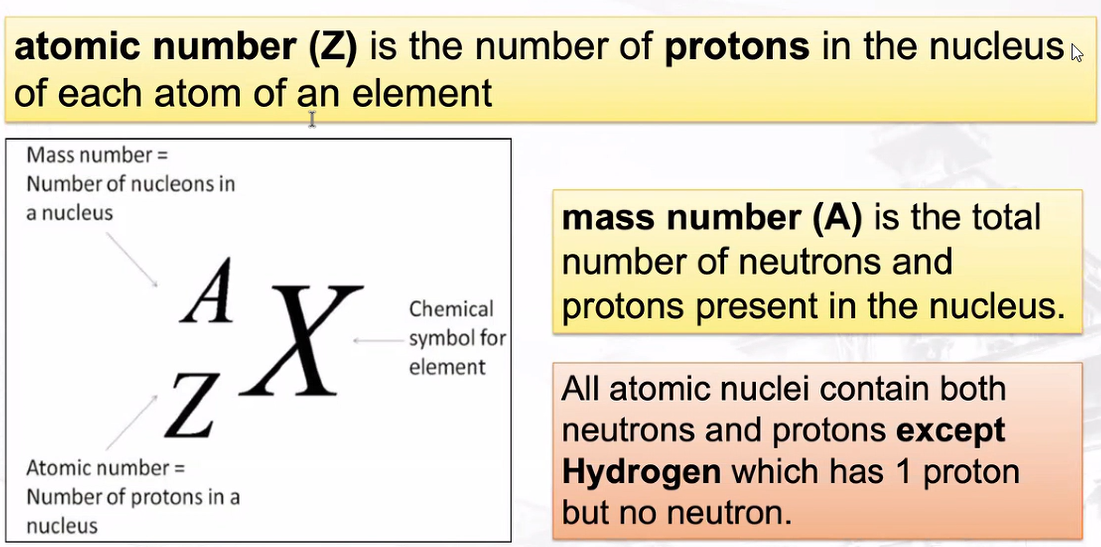
Z | atomic no.
no. of protons in the nucleus of each atom of an element
A | mass no.
total no. of neutrons + protons present in the nucleus (decimals)
Isotopes
are atoms that have the same atomic no. but different mass numbers.
In isotopes, the protons have the same no. while the neutrons have diff no.
In isotopes, the ___ have the same no. while the ___ have diff no.
Read

Read
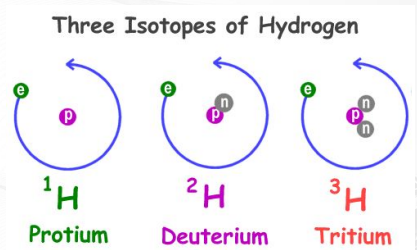
protium
deuterium
tritium
3 isotopes of hydrogen


Read