Anatomy Exam #1 Professor Angela
 Call Kai
 Learn
Learn Practice Test
 Spaced Repetition
 Match
Match Flashcards
 Knowt Play
1/191

There's no tags or description
Looks like no tags are added yet.
Name | Mastery | Learn | Test | Matching | Spaced | Call with Kai | Chat |
|---|
No analytics yet
Send a link to your students to track their progress
192 Terms
What is anatomy?
Study of body structure
What is physiology?
Study of body function
What is gross anatomy?
Visible structures with the naked eye
What is microscopic anatomy?
Study of structures you have to see through a microscope
What is systemic anatomy?
Organ systems
What is regional anatomy?
Specific body regions
What is cytology?
Cells
What is histology?
Tissues
What is a molecule
Two or more atoms combined
What is a tissue?
Two or more cells working together with intercellular matrix
What is an organ?
Two or more tissues working together
What is an organ system?
Two or more organs working together
Main function of skeletal system
Supports, protects soft tissue. Allows movement, stores minerals, formation of blood
Main function of the muscular system
Moves body, helps regulate body temp (shivering)
Main function of the Nervous system
Receives sensory information processes, integrate info then generates responses, fast control.
Main function of the endocrine system
Hormone regulation
Main function of the Cardivoasular system
Transports oxygen, immune cells, nutrients and removes carbon dioide waste.
Main function of the lymphatic system
main site of immune system, removes extracellular fluid, transports fats, fatty acids
Main function of the respiratory system
Gas exchange between outside air and circulating blood
Main function of the digestive system
Digestion, absorb nutrients minerals,vitamins
Main function of the Urinary system
Filters blood, regulates blood elimnates excess water, salts, waste
Main function of the reproductive system
Produces gametes (sperm or ova) and sex hormones
Negative feedback loop
Reverses change to homeostasis
Positive feedback loop
Amplifies change, keeps going same direction
What structures make up the axial region?
Head, neck, trunk (torso)
What structures make up the appendicular region?
Upper lower limbs, girdles , attachment points (arms and legs)
Cranial Cavity location
Skull
Spinal cavity location
Vertebral canal
Thoracic cavity location
Chest, ribs
Abdominal cavity location
Abdomen, below rib cage above pelvis
Pelvic cavity location
Pelvis
What organs are in the cranial cavity?
Brain
What organs are in the spinal cavity?
Spinal cord
What organs are in the thoracic cavity?
Heart and lungs
What organs are in the abdominal cavity?
Digestive organs
What organs are in the pelvic cavity
Reproductive organs and bladder
What serous membrane surrounds the cranial cavity?
Meninges
What serous membrane surrounds the spinal cavity?
Meninges
What serous membrane surrounds the thoracic cavity?
Pleura, pericardium
What serous membrane surrounds the abdominal cavity?
Peritoneum
What serous membrane surrounds the pelvic cavity
Peritoneum
Why does medical terminology matter?
Minimize confusion, concrete terms, precision
What is the anatomical position?
Standard reference position, body standing erect, head facing forward, arms at side of body, palms forward, feet close together, facing forward
What are the anatomical planes?
Sagittal, frontal, transverse
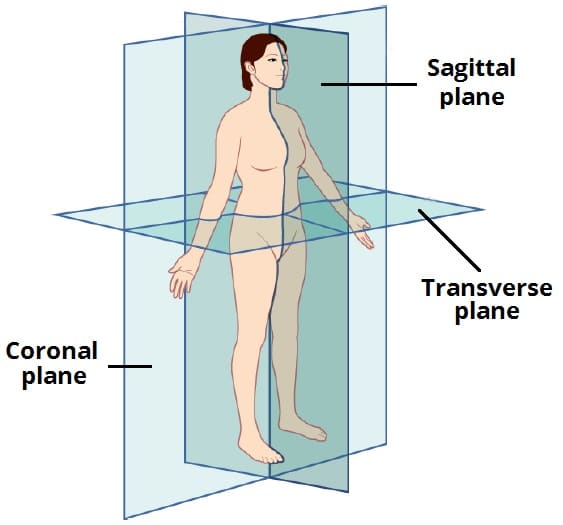
Sagittal plane
Divides body into left and right
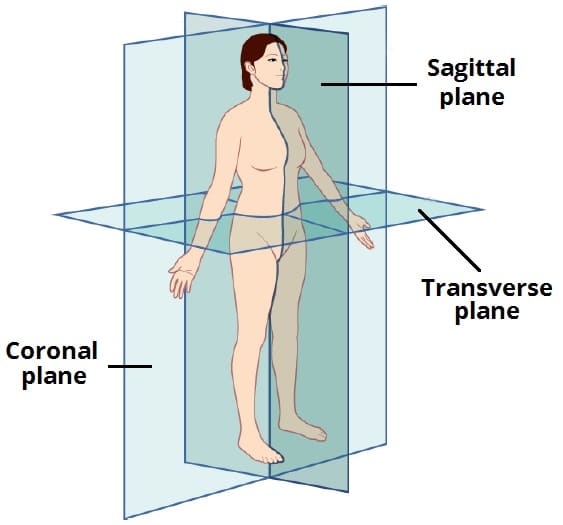
Transverse plane
Divides body into upper, lower
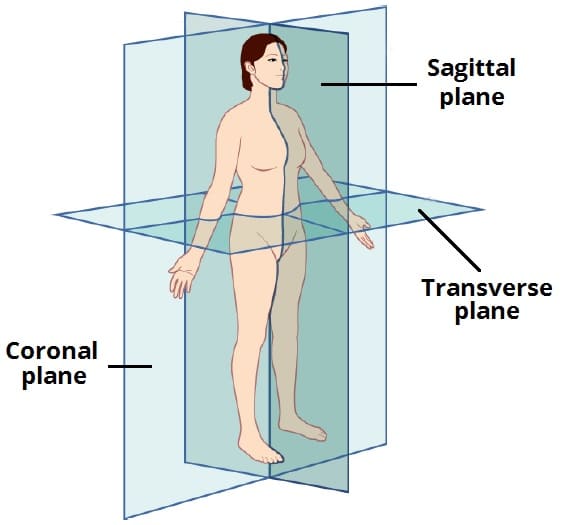
Frontal plane
Divides body into front and back
Anterior
Front forward
Posterior
Back, behind
Medial
Closer to the middle of the body
Lateral
Closer to the side of the body
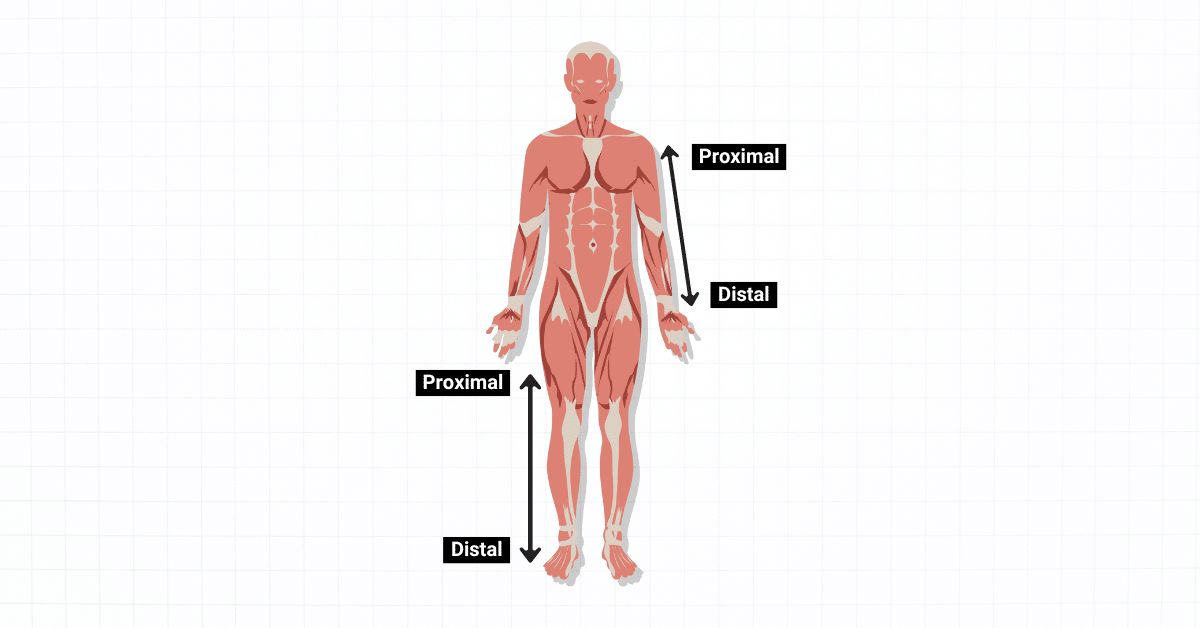
Proximal
Closer to the trunk or origin so the upper legs, upper body (shoulder) The elbow is proximal(higher) to the wrist
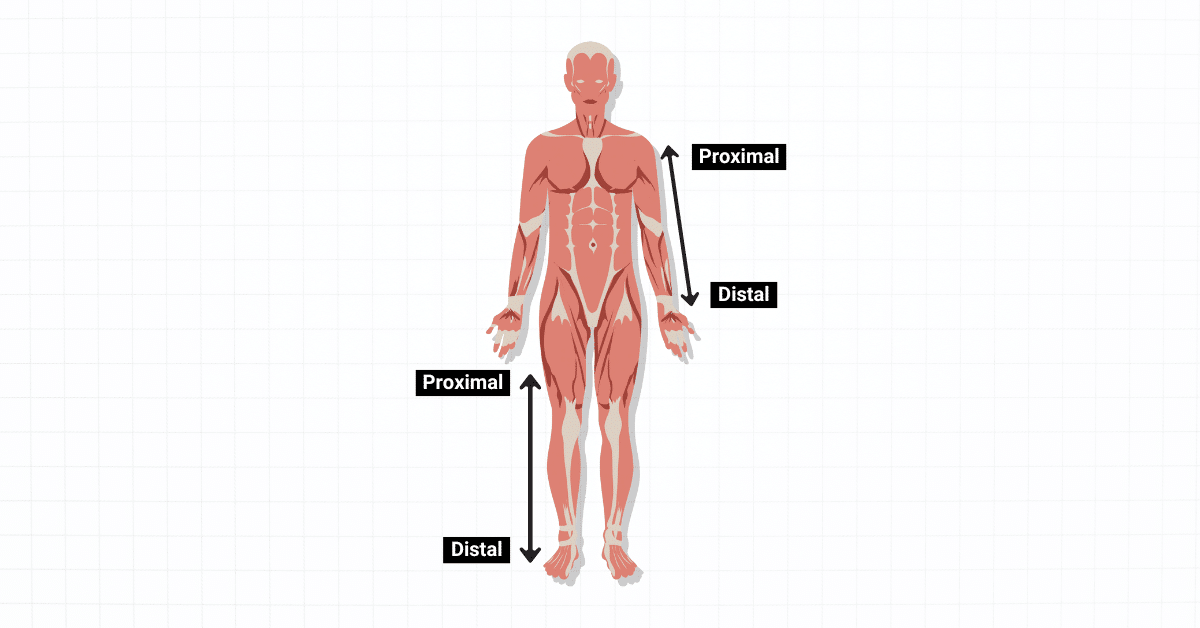
Distal
Farther away, towards the ends of limbs, fingers. The hand is distal(lower) to the elbow
Superficial
Towards the surface
Deep
Away from the surface
Superior
Up Above
Inferior
Down, below
What is the function of the plasma membrane?
Seperate inside from the outside, cell homeostatsis, material exchange communication between cells. Semi-permeable
Why is the plasma membrane semi-permeable?
The phospholipid bilayer
What is the function of phospholipids?
Maintain selective permeability, barrier
Head end phospholipids
Negatively charged, interacts with water
Tail end phospholipid
Positively charged, avoids water
What is the function of the Receptor protein?
Initates cell signaling pathways via ligand
What is the function of the glycoalyx
Cells ID card, cell recognition, how immune system knows if cell is supposed to be there
What does an enzyme do?
Speeds up chemical reactions
Where do you find microvili in the human body?
Small intestine, increases surface area for absorption/secretion
Where do you find cilia in the human body?
Lungs, helps clear airways dust/bacteria
What is passive transport?
Does not require energy(ATP) to move across
What is active transport?
Requires energy (ATP) to cross
Role of Rough endoplasmic reticiulm (Rough ER)
Protein synthesis, (building/modifying proteins)
Role of smooth endoplasmic reticulum
Building lipids(fats) (lipid synthesis), stores calcium
What is the function of lyosomes?
Break down, digest unwanted materials to recycle them
What is the function of mitochondria?
generates energy(ATP) from food
What is the function of the peroxisome?
Break down lipids (fats) neutralize poison
What is autophagy? When does it occur?
“self eating” to recycle an old/not functioning cell/organelle. starvation
What is apoptosis and when does it occur?
Programmed cell death, during failed interphase, or damage.
When do cells form tight junctions?
To prevent materials from passing between, preventing leaks
When do cells form gap junctions?
To allow materials from passing between, communication
When would tyour cells form an anchoring junction?
To provide structural cohesion, mechanical strength
What is mitsosis? How many cells do you end up with at the end?
Cell division, duplicate cell exactly ending up with two identical diploid cells.
G1 phase mitosis
Growth phase, first checkpoint
G2 phase mitosis
Growth phase, second checkpoint
S phase, mitosis
Duplicate the DNA
Which phases make up interphase?
G1, S, G2
What happens during prophase?
DNA condenses becomes chromosomes
What happens during metaphase?
Chromosomes line up at equator, checkpoint #3
What happens during anaphase?
Chromosomes seperate, split in half
What happens during telophase?
2 cells split, making 2 new identical cells
What are the checkpoints during mitosis
G1, G2, metaphase, to ensure cell has enough resources to move on
How do cancer cells behave differently to make them more dangerous?
Rapid cell division, increased rate of genetic mutation, disruption of normal cell cycle, no apopotsis
What is matrix?
Extracellular liquid material. Provides nutrients and other support jobs to the cells
Main function of epithelial tissue
Covers outside layer of organs
Main function of connective tissue
Binds organs together (ligaments) strong structure, support other tissues, transport nutrients
Main function of muscle tissue
Contracts to move body (skeletal, smooth, cardiac muscles)
Main function of nervous tissue
Allows for communication between organs.
Epitheal tissue structure
Mostly cells, little matrix
Connective tissue structure
Tons of matrix, very little cells
Apical surface
Top layer, free surface
Basal lamina
Base layer, Tissue’s attachment site
Simple squamous epithelium function, location
Rapid diffusion, materials pass through, inner lining of blood vessels, lungs