8 Bacterial Genetics
 Call Kai
 Learn
Learn Practice Test
 Spaced Repetition
 Match
Match Flashcards
 Knowt Play
1/23

There's no tags or description
Looks like no tags are added yet.
Name | Mastery | Learn | Test | Matching | Spaced | Call with Kai | Chat |
|---|
No analytics yet
Send a link to your students to track their progress
24 Terms
Natural Selection
Principle that states those with greater fitness (desirable qualities for survival) have higher chance of living and passing them on
Phenotype changes as result
→ influenced by environmental conditions
→ influenced by genotypes that are selectively passed on due to said conditions
Horizontal gene transfer
½ ways genetic change can occur in bacteria.
[__]: acquisition of DNA from other cells and their environment
![<p>½ ways genetic change can occur in bacteria.</p><p><mark data-color="yellow" style="background-color: yellow; color: inherit;">[__]: acquisition of DNA from other cells and their environment</mark></p>](https://assets.knowt.com/user-attachments/ee24cfd3-d31f-4ef8-8904-732c979165fc.png)
transformation
1/3 mechanisms on how genes undergo horizontal gene transfer
[__]: acquisition of naked DNA from the surrounding; uptake by bacteria
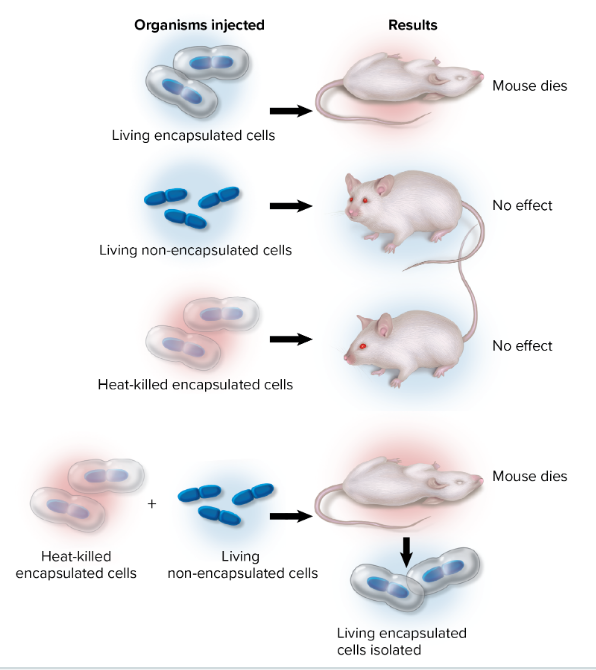
Frederick Griffith
Discovered mechanism of transformation while working with Streptococcus pneumoniae, which existed in (2) forms
smooth in appearance (encapsulated) » virulent form
rough in appearance (nonencapsulated) » avirulent form
Injected varying combinations of the two into mice; found the dead virulent form affected the living avirulent form
living avirulent form —(transformation) → living virulent form
wherein the avirulent form took up the genes of the dead virulent form in their surroundings to learn how to become virulent themselves
transduction
2/3 mechanisms on how genes undergo horizontal gene transfer
[__]: bacterial DNA transfer from donor to recipient via a bacterial virus (bacteriophage)
→ bacteriophage may contain bacterial DNA from its original host cell it was duplicated from by the DNA accidentally entering the phage
→ transfers DNA (and doesn’t infect as it contains only bacterial cell DNA) this way
![<p><mark data-color="blue" style="background-color: blue; color: inherit;">2/3 mechanisms on how genes undergo horizontal gene transfer</mark></p><p><mark data-color="yellow" style="background-color: yellow; color: inherit;">[__]: bacterial DNA transfer from donor to recipient via a bacterial virus (</mark><strong><mark data-color="yellow" style="background-color: yellow; color: inherit;">bacteriophage</mark></strong><mark data-color="yellow" style="background-color: yellow; color: inherit;">)</mark></p><p>→ bacteriophage may contain bacterial DNA from its original host cell it was duplicated from by <u>the DNA accidentally entering</u> the phage</p><p><mark data-color="yellow" style="background-color: yellow; color: inherit;">→ transfers DNA</mark> (and doesn’t infect as it contains only bacterial cell DNA) this way</p>](https://assets.knowt.com/user-attachments/0f5b4077-6a09-4ae5-92f8-12bdcaba2150.png)
bacteriophage
Virus that infects bacteria.
Infects host cell to break down its genetic material, and utilize the rest of its cellular components to duplicate their viral DNA instead (not the bacteria’s) » mass production of [__]
transduction is able to happen when bacterial DNA mistakenly packages the original bacteria’s DNA (from the surroundings) into the [__]
![<p><mark data-color="yellow" style="background-color: yellow; color: inherit;">Virus that infects bacteria.</mark></p><p>Infects host cell to break down its genetic material, and utilize the rest of its cellular components to duplicate <em>their</em> viral DNA instead (not the bacteria’s) » <mark data-color="blue" style="background-color: blue; color: inherit;">mass production of [__]</mark></p><ul><li><p><strong>transduction</strong> is able to happen when bacterial DNA mistakenly packages the original bacteria’s DNA (from the surroundings) into the [__]</p></li></ul><p></p>](https://assets.knowt.com/user-attachments/3186bda1-47a6-404d-8193-c762ad3dd14d.png)
conjugation
3/3 mechanisms on how genes undergo horizontal gene transfer
[__]: DNA transfer between cells via cell-to-cell contact via sex pillus
mediated by a conjugative plasmid F factor: fertility factor
determines if the cell has a sex pillus
makes them “F+”
cells must be of opposite mating types
F+ cells » donor cell
F- cells » recipient cell (does not have F+ plasmid)
mobile gene pool
All the extrachromosomal DNA not part of chromosome
plasmids, transposons, genomic islands, phage DNA
very common
found even in our DNAcontributed to the idea that we’re genetically advance due to larger DNA, but in actuality, don’t code for anything
confers some advantage to bacterium to survive in certain environments
plasmid
Self replicating extrachromosomal DNA (possible due to origin of replication on its DNA)
→ many are R [__]: “resistance” [__] » confer a lot of resistance to antimicrobial medication and heavy metals like mercury and arsenic
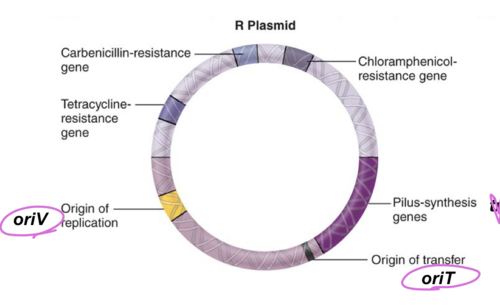
→ other [__] can provide beneficial characteristics such as
nitrogen fixation (Rhizobium sp.)
oil degradation (Pseudomonas sp.)
Mutation
2/2 ways genetic change can occur in bacteria.
[__]: Changes in base sequence of DNA
![<p>2/2 ways genetic change can occur in bacteria. </p><p><mark data-color="yellow" style="background-color: yellow; color: inherit;">[__]: Changes in base sequence of DNA</mark></p>](https://assets.knowt.com/user-attachments/41fecb53-f9c7-44f6-aa07-900c2aecfec4.png)
Spontaneous mutation
Mutation that occurs randomly in the absence of a mutagen
Mutation rate: 10-4 and 10-12 for a given gene
→ DNA polymerase does its job of synthesizing and going back to double-check it, so mutation is very rare
For Bacteria, all and any mutations are passed unto offspring
For Eukaryotes, only mutations in the germ cells are passed on to offspring
amino acid
Note: everything here on forth for mutations are referred in terms of the proteins/[__] that the DNA produces
recall: DNA — mRNA → Protein
when the mRNA has a mutation from any of the following reasons
incorrect (nitrogenous) base substitution
nucleotide deletion/addition
jumping genes
we reference the impact on the [__] synthesized from these mRNA mutations
point mutation
Most common cause of mutation wherein there is a “base substitution” » incorrect nucleotide incorporated during DNA replication
[__]: single base pair is involved in mutation → substituted, inserted, deleted (for insertions/deletions, if it “moves” reading frame, it’s a reading frame mutation!)
silent mutation: same amino acid, no observable change in protein
due to the redudancy of the amino acids
missense mutation: different amino acid, resulting in partially functional (leaky) protein
nonsense mutation: stop codon produced. yields a shorter protein
![<p>Most common cause of mutation wherein there is a <mark data-color="yellow" style="background-color: yellow; color: inherit;">“base substitution”</mark> » incorrect nucleotide incorporated during DNA replication</p><p><strong><mark data-color="yellow" style="background-color: yellow; color: inherit;">[__]</mark></strong><mark data-color="yellow" style="background-color: yellow; color: inherit;">: single base pair is involved in mutation → </mark><u><mark data-color="yellow" style="background-color: yellow; color: inherit;">substituted</mark></u><mark data-color="yellow" style="background-color: yellow; color: inherit;">, inserted, deleted</mark> (for insertions/deletions, if it “moves” reading frame, it’s a <strong><mark data-color="blue" style="background-color: blue; color: inherit;">reading frame mutation</mark></strong><mark data-color="blue" style="background-color: blue; color: inherit;">!</mark>)</p><ul><li><p><strong><mark data-color="purple" style="background-color: purple; color: inherit;">silent mutation</mark></strong>: same amino acid, no observable change in protein</p><ul><li><p>due to the redudancy of the amino acids</p></li></ul></li><li><p><strong><mark data-color="purple" style="background-color: purple; color: inherit;">missense mutation</mark></strong>: different amino acid, resulting in partially functional (leaky) protein</p></li><li><p><strong><mark data-color="purple" style="background-color: purple; color: inherit;">nonsense mutation</mark></strong>: stop codon produced. yields a shorter protein</p></li></ul><p></p>](https://assets.knowt.com/user-attachments/043a00ff-57ea-4505-9e34-f24790c05a3b.png)
frameshift mutation
Most detrimental form of mutation where there is a “deletion or addition of nucleotides”
[__]: mutation that shifts the translational reading frame
affects all amino acids downstream
produces totally different protein or generate stop codons
transposon
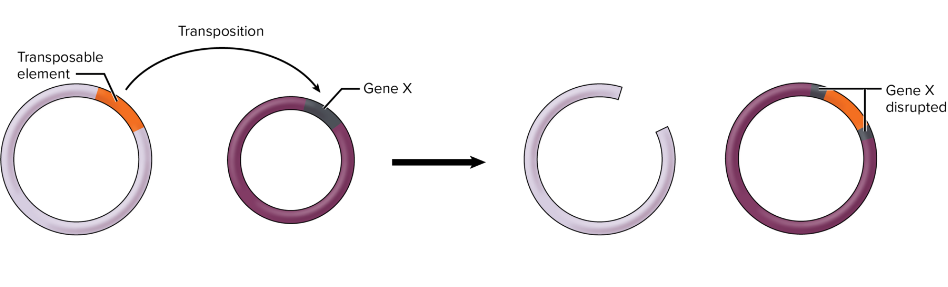
Jumping genes. Lead to knock out mutations as the DNA pieces transposition » move spontaneously from one location to another
→ combining DNA this way is called nonhomologous-recombination
→ usually inactivates the gene it hops into
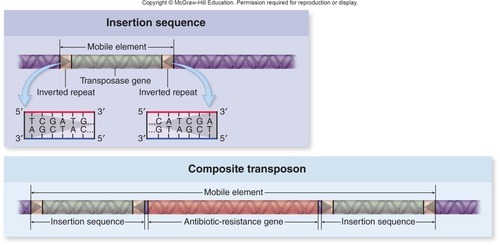
insertion sequence: simplest type of [__]; contains one gene. has inverted repeats on both ends
transposase enzyme → cuts out the IS and inserts it into another gene. recognizes IS by its inversion sequences
composite [__]: include one or more genes; can confer antimicrobial resistance. has IS on ends
Induced mutations
Mutations that result from outside influence
done through mutagens: agent that induces DNA change
chemical
radiation
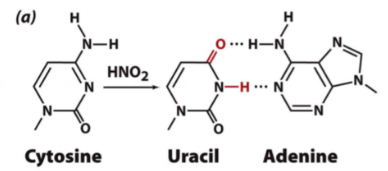
Nitrous acid
Chemical mutagen.
Changes cytosine to uracil
» base-pairs with adenine instead of guanine
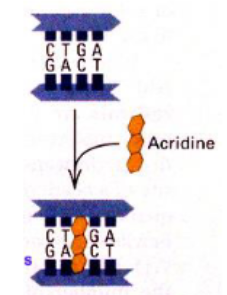
Intercalating agents
Chemical mutagen that works by inserting themselves between adjacent bases
creates space between bases
→ potentially adds an extra base (can cause frame-shift mutation)
ethidium bromide
acridine
chloroquine
(potential pathogen and carcinogen as they can potentially cause this mutation)
Ultraviolet irradiation
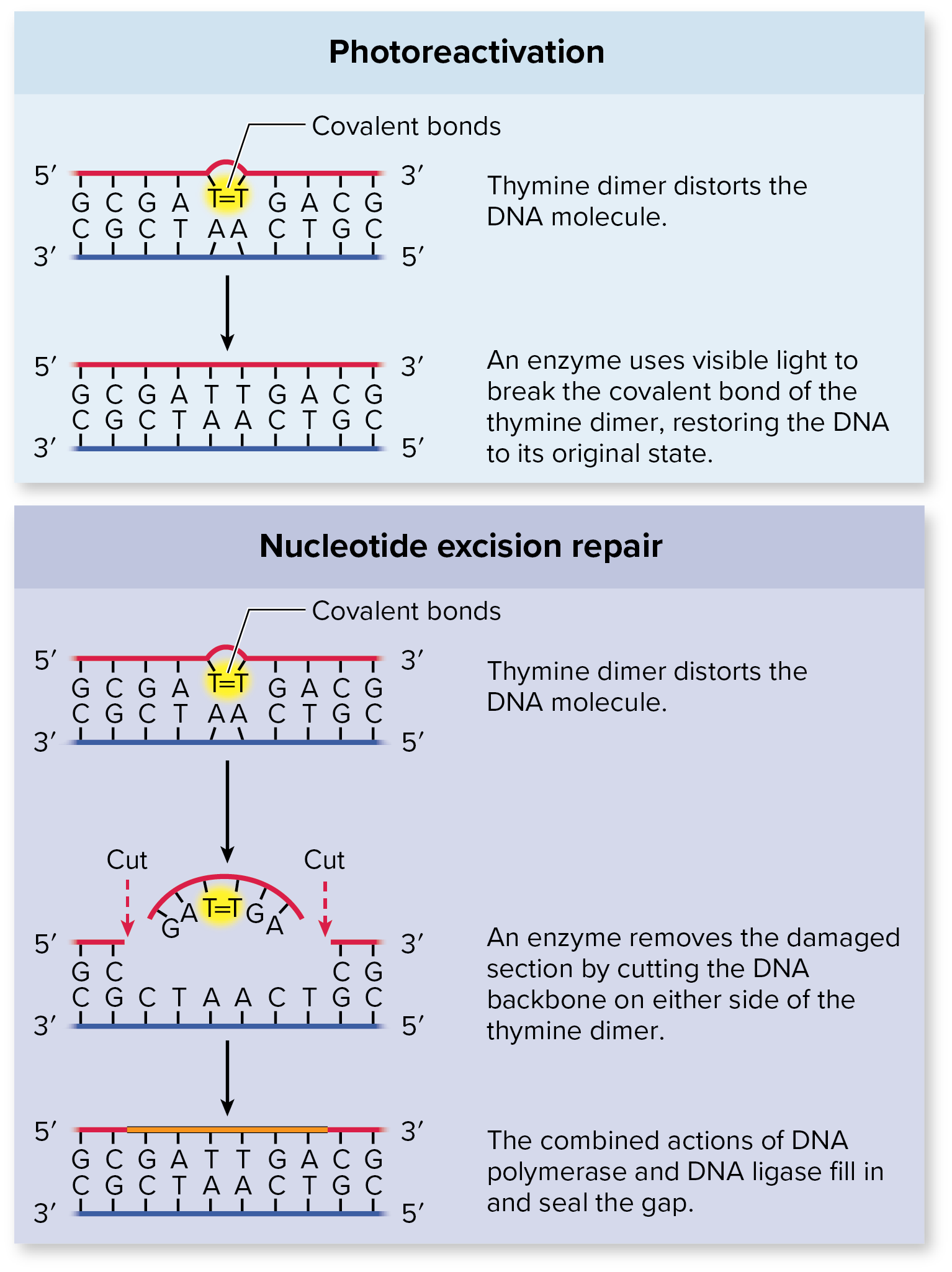
Radiation mutagen. Causes thymine dimers: a pair of adjacent thymine bases bonded together, upon exposure
DNA and RNA polymerase can’t read these during replication and transcription, respectively
stalls processes till something happens
might read thymine dimer as a single base and place a random base → deletion mutation (read 2 bases instead of 1)
X rays
Radiation mutagen. Causes breakages and alterations in DNA that are more detrimental
→ double-strand breaks (lethal)
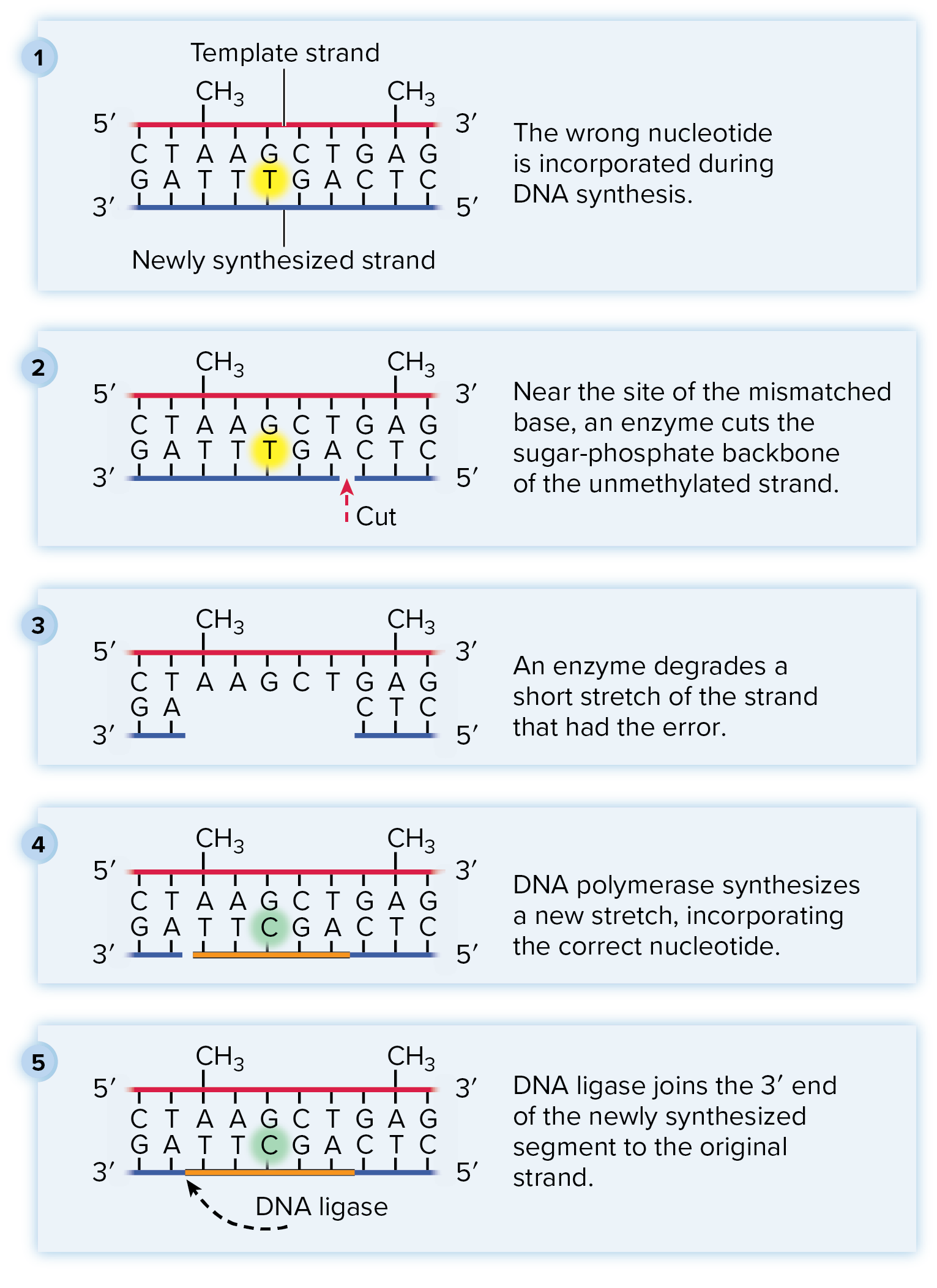
mismatch repair
Repairing of base substitution during DNA replication
DNA polymerase proofreads synthesized DNA
cuts out incorrect base substitution and resynthesizes correct DNA
fixed DNA gets sealed by DNA ligase
Photoreactivation
Repairing of UV light damage
Light repair
photolyase: enzyme that utilizes energy from light to break covalent bond of thymine dimer
restores thymine to their original form!
only found in bacteria
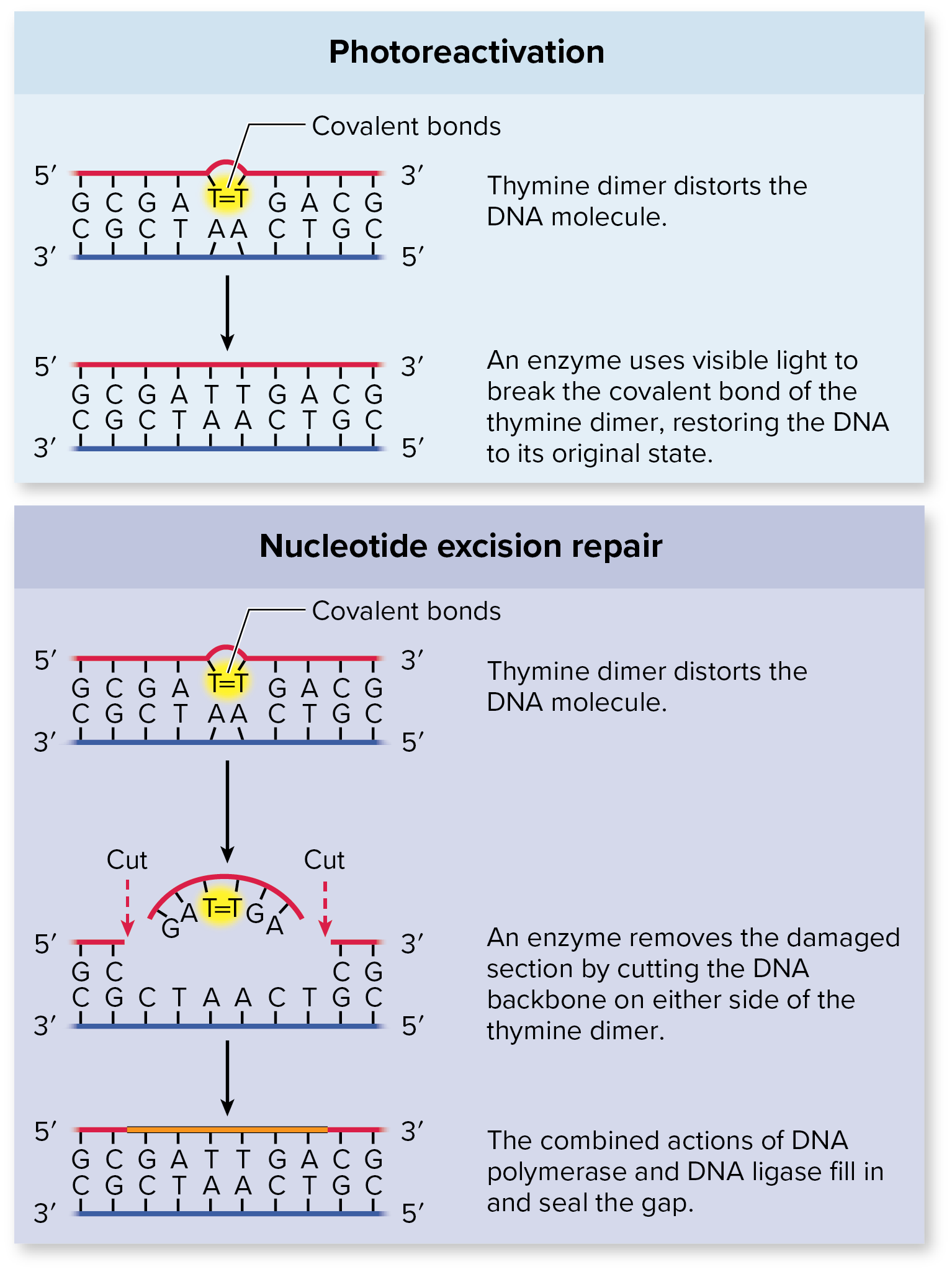
Excision repair
Repairing of UV light damage
Dark repair
enzyme recognizes thymine dimer protrusion from DNA
enzymes remove affected area
DNA polymerase and DNA ligase fill in and repair gap
Xeroderma pigmentosum
Genetic disorder where there are defects in the genes that produce enzymes for excision repair
→ inability to repair DNA damage caused by UV light
→ exposure to sunlight is limited or forbidden
» very vulnerable to skin carcinoma (skin cancer)