Economics Defenitions
 Call Kai
 Learn
Learn Practice Test
 Spaced Repetition
 Match
Match Flashcards
 Knowt Play
1/349

There's no tags or description
Looks like no tags are added yet.
Name | Mastery | Learn | Test | Matching | Spaced | Call with Kai | Chat |
|---|
No analytics yet
Send a link to your students to track their progress
350 Terms
ceterus paribus
the assumption that when studying theories, all other variables remain constant and unchanging
positive statement
a statement about something that was, is or will be true or false
normative statement
a statement about something that ought to be, a subjective opinion or value judgement
rational economic decision making
decision makers behave according to their best self interest, and try to get more rather than less
factors of production
land, labour, entrepreneurship, capital
land
all natural sources that are abotve the ground
capital
machines, tools, equipment, factories, all construction
labour
all human effort or work that goes into producing goods and services
entrepeneurship
the human effort used to organise the other three factors, as well as risk taking, innovation, and management
scarcity
the condition of being limited in relation to the needs and wants of human beings
resource allocation
assigning a particular resource to the production of particular goods and services
reallocation of resources
changing the allocation of resources
underallocation of resources
too few resources are assigned to the production of particular goods and services
overallocation of resources
too many resources are assigned to the production of particular goods and services
misallocation of resources
assigning the wrong amount of resources to the production of particular goods and services resulting in over or underallocation of resources
opportunity cost
the second best option forgone when making a choice
PPC
shows the maximum quantities of two goods that can be produced by an economy with its available resources and technology
competetive market
a market, where the price of a good, service , or factor of production is determined through the interactions of many small buyers and sellers, so no one can influence price
market
any agreement that allows buyers and sellers to come together and make an exchange
demand
the quantity of a good that buyers (and consumers) are willing and able to buy at any given point of time
law of demand
a law stating there is a negative casual relationship between price and quantity of a good demanded
marginal benefits
the additional benefits derived from consuming one more unit of a good
individual demand
demand of a single buyer
market demand
the demands of all the buyers in a market. found by adding up all the individual demands for each price
normal goods
demand for the good increases and consumer income increases
inferior goods
demand for the good decreases as consumer income increases
substitute goods
goods that satisfy a similar need, as the demand of one increases, the other falls
complementary goods
goods that are used together. demand of one increases so does the demand of the other good
supply
the quantity of a good that sellers are willing and able to produce at any given point of time
the law of supply
there is a positive casual relationship between price and quantity of a good
individual supply
the supply of a single seller
market supply
the supplies of all the sellers in a market
indirect tax
tax on spending to buy goods and services paid directly to the government
subsidy
payment by the government to firms in order to lower costs and price, and increase supply
joint supply
when two or more goods are are derived from a single products
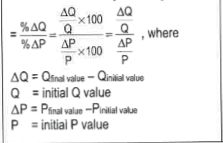
Calculating PED
competitive supply
when two or more goods use the same resources
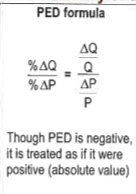
PED
responsiveness of Q demanded to changes in P
price elastic demand
PED > 1, PED is greater than 1
percentage change in Q demanded is greater than the percentage change in P
price inelastic demand
0 < PED < 1
percentage change in Q demanded is smaller than the percentage change in P
prefectly elastic demand
when the percentage change in Q is indefinitely large (horizontal)
perfectly inelastic demand
when the percentage change in Q demanded is 0
unit elastic demand
when the percentage change is equal to the percentage change in P
necessity (contrasted w luxury)
a good that is essential
luxury goods
a good that is not essential
total revenue
a firms total earnings from selling its outputs
primary comodities
goods arising from the factor of production land
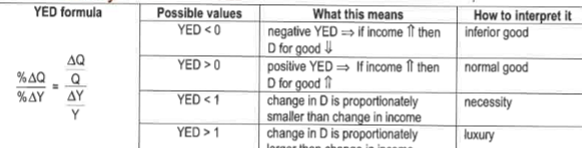
YED
responsiveness of demand for good X to changes in income
primary products
goods arising from the factor of production land
PES
responsiveness of Q supplied to changes in p
PES formula
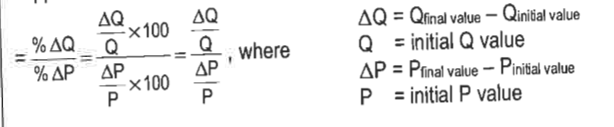
PED formula
YED formula
non price determinants of demand
changes in tastes and preferences, changes in income, changes in # of buyers, changes in the price of related goods
non price determinants of supply
changes in costs of factors of production, the number of firms in the market, indirect tax, expectations
determinants of PED that show if demand is elastic or inelastic
number and closeness of substitutes, degree of necessity and degree of addiction, proportion of income spent on the good, time
determinants of PES that show if supply is elastic or inelastic
mobility of factors of production, unused capacity, ability to store stocks, time
specific tax
a specific amount of money imposed per unit of the good, results in a parallel shift of the supply curve
calculate welfare loss

tax incidence
the particular group bearing the burden of a tax
price controls
government intervention in the market involving the setting of price ceilings or price floors preventing the market from reaching a market-clearing equilibrium price
price ceiling
a maximum price on a good set by the government that is below the equilibrium price of a market resulting in a shortage
price floors
a minimum price set above market equilibrium resulting in a surplus
market failure
the failure of a market to allocate resources efficiently resulting in overallocation, under allocation or no allocation of resources to the production of a good or service relative to what is socially most desirable
externality
the cost or benefit for third parties who are not part of a transaction and whose interests are not taken into account, the market fails to achieve allocative efficiency because MSB does not equal MSC
marginal private benefits
additional benefits from consumers arisingfrom consumption of an additional unit of a good DEMAND
marginal social benefit MSB
additional benefits for society arising from consumption of an additional unit of a good DEMAND
marginal private costs MPC
additional costs to producers arising from production of an additional unit of a good SUPPLY
marginal social costs MSC
additional costs to society arising from the production of an additional unit of the good SUPPLY
4 rules for drawing externalities
production externality S curve splits into two; consumption externality the D curve splits into two
supply reflects costs, demand reflects benefits
negative externality Qe > Qopt Positive externality Qe<Qopt
the point of the welfare loss triangle always looks towards Qopt
Negative production externalities: policy responses
command approaches - legislation, regulations
market based policies - indirect tax on output/emissions
positive production externalities: policy responses
direct government provision ++++
common access resources
a natural resouces without ownership, that are traded in a market, have no price, and are non excludable, yet rivalrous
rivalrous
the use by one person makes them less available for use by someone else
sustainability
the use of natural resources at a rate that allows them to reproduce
minimum wages
A minimum price of labour usually set by the government to protext low skilled workers and ensure they can achieve a minimum standard of consumption RESULTS IN UMEMPLOYED LABOUR
market failure
the failure of a market to allocate resources efficiently, resulting in an overallocation, underallocation, or no allocation of resources to the production of a good or service relative to what is socially most desirable
externality
positive effect (benefit) or negative effect (cost) for third parties who are not part of a transaction and whose interests are not taken into account; the market fails to achieve allocative efficiency
marginal private benefits (MPB)
additional benefits for consumers arising from the consumption of an additional unit of a good
marginal social benefit (MSB)
additional benefits for society arising from the consumption of an additional unit of a good
marginal private costs (MPC)
additional costs to producers arising from the consumption of an additional unit of a good
marginal social cost (MSC)
additional costs to society arising from the consumption of an additional unit of a good
circular flow model
provides an overview of important relationships in the macroeconomy
income flow = expenditure flow = value of output flow
factors of production
land, labour, capital, entrepreneurship
payment by firms = consumer income
rent, wages, interest, profit
leakage
money that leaves the circular flow
injection
money that enters the circular flow
GDP
total value of all final goods and services (output) produced within the boundaries of a country, in a year, regardless of who owns the factors of production
GNI (GNP)
the total income received by the residents of a country in a year, regardless where the factors of production owned by the residents are located
GNI formula
GDP + factor income from abroad - factor income sent abroad = GDP + net income from abroad
nominal GDP/GNI
are measures of output and income in terms of current prices
real GDP/GNI
are measures of output and income in terms of current prices
per capita
divide by population
3 ways to measure economic activity (GDP)
expenditure, income and output approaches
income flow = expenditure flow = value of output flow
expenditure approach (measuring GDP)
C + I + G + (X-M)
income approach (measuring GDP)
Rent + wages + interest + profit = national income
can be used to calculate GDP (after adjustments)
output approach (measuring GDP)
adds up the value of each good and service (PxQ) produced in the economy within a year, thus obtaining the value of all final goods and services = to GDP
the human development index
measures standard of living in three dimensions: per capita income, health and educational attainment
purchasing power parity (PPP) exchange rates
correct for differing price levels in different countries
green GDP
GDP - value of environmental destruction
takes into account environmental destruction