ACT Math
 Call Kai
 Learn
Learn Practice Test
 Spaced Repetition
 Match
Match Flashcards
 Knowt Play
1/104

There's no tags or description
Looks like no tags are added yet.
Name | Mastery | Learn | Test | Matching | Spaced | Call with Kai |
|---|
No analytics yet
Send a link to your students to track their progress
105 Terms
Complementary Angles
Any two angles whose sum equals exactly 90°.
Supplementary Angles
Any two angles whose sum equals exactly 180°.
Adjacent Angles
Any two angles that sit directly next to each other.
Vertical Angles
Any two opposite angles formed when two straight lines intersect; vertical angles are always equal.
Given Two Parallel Lines with a Transversal Line
There are two pairs of 4 vertical angles, and every angle in a pair is equal to each other in degree.
Sum of Interior Angles
This formula finds the total sum of all interior angles in any polygon.
Formula: 180° × (n - 2)
n → Number of sides.
Area of a Triangle
Formula: ½×B×H
b → Base (any side can be the base).
h → Height (the perpendicular distance from the base to the opposite vertex).
Area of a Rectangle
Formula: l×w
l → Length.
w → Width.
Perimeter of a Rectangle
Formula: 2×l + 2×w
l → Length.
w → Width.
Area of a Square
Formula: s²
s → Length of one side.
Perimeter of a Square
Formula: 4×s
s → Length of one side.
Area of a Parallelogram
Formula: B×H
b → Base.
h → Perpendicular height (distance between the parallel bases, not the slanted side).
Area of a Circle
Formula: π×r²
π → Approximately 3.14159.
r → Radius (distance from the center to the edge).
Circumference of a Circle
Formula: 2×π×r
π → Approximately 3.14159.
r → Radius (distance from the center to the edge).
Area of a Trapezoid
Formula: ½×(b1 + b2)×h
b₁ → Length of the first parallel base.
b₂ → Length of the second parallel base.
h → Perpendicular height (distance between the bases).
Area of a Kite
Formula: ½×l×w
l→ Length of the first diagonal.
w → Length of the second diagonal.
Volume of a Rectangular Prism
Formula: l×w×h
l → Length.
w → Width.
h → Height.
Volume of a Cube
Formula: s³
s → Length of one side of the cube.
Volume of a Right Cylinder
Formula: π×r²×h
π → Approximately 3.14159.
r → Radius of the circular base.
h → Height of the cylinder.
Volume of Other Three Dimensional Solids
Formula: B×h
B → Area of the base.
h → Height of the solid.
Pythagorean Theorem
Formula: a2+b2=c2
Pythagorean Triples
A set of three positive integers, a, b, c, that perfectly satisfy the Pythagorean theorem.
(3, 4, 5), (5, 12, 13), (8, 15, 17), (7, 24, 25)
45°- 45°- 90° Triangle
x, x, x√2
30°- 60°- 90° Triangle
x, x√3, 2x
Area of an Equilateral Triangle
s → Length of one side.
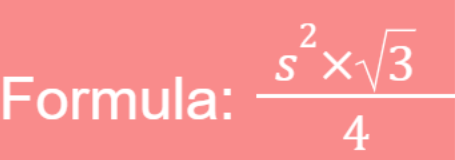
Third Side of a Triangle Rule
The length of the third side of a triangle must be greater than the absolute value difference of the other two sides and less than their sum. This rule is essential in the triangle inequality, determining valid triangle formations. (This rule can be used for any triangle)
Distance
The distance formula finds the straight-line distance between two points on a coordinate plane. It comes directly from the Pythagorean Theorem.

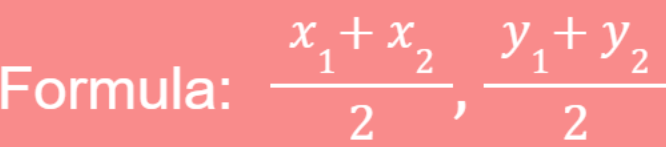
Midpoint
The midpoint is the point exactly halfway between two endpoints on a line segment.
(x₁ + x₂)/2 → Average of the x-coordinates.
(y₁ + y₂)/2 → Average of the y-coordinates.
Linear Equation
A linear equation is an equation whose graph is a straight line. The highest exponent on any variable is 1.
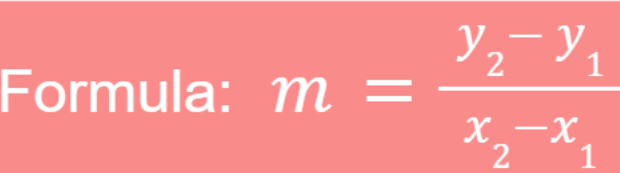
Slope
The slope measures the steepness and direction of a line. It tells you how much the line rises or falls for each unit it moves to the right.
m → Slope.
y₂ − y₁ → Change in y (rise).
x₂ − x₁ → Change in x (run).
Parallel Lines: Have the same slope
Perpendicular Lines: Have the negative reciprocal of the other’s slope.
Point-Slope-Form
Point-slope form is used to write the equation of a line when you know either one point on the line or the slope of the line.
m → Slope of the line.
(x₁, y₁) → A known point on the line.
x, y → Any point on the line.

Slope-Intercept-Form
Slope-intercept form is the easiest way to write the equation of a line. It tells you the line's slope and where it crosses the y-axis.
Formula: y = mx + b
y → Output (dependent variable).
m → Slope (rise/run).
x → Input (independent variable).
b → y-intercept (the y-value where the line crosses the y-axis).
Real Numbers
Any value that can be represented as a point on a continuous, infinite number line.
Irrational Numbers
Any real number that cannot be written as a simple fraction.
Rational Numbers
Any number that can be expressed as a fraction of two integers (a numerator and a non-zero denominator). In decimal form, these numbers either terminate or repeat.
Intergers
A non-fractional number that can be positive, negative, or zero.
Whole Numbers
Any non-negative integer.
Natural Numbers
A positive whole number.
Imaginary Numbers
A number that is expressed in terms of the square root of a negative number, (i).
Complex Numbers
A combination of a real number and an imaginary number.
One Solution (Systems of Linear Equations)
The two lines intersect at exactly one point.
Different slopes = One solution.
No (Zero) Solutions (Systems of Linear Equations)
The two lines never intersect.
They have the same slope but different y-intercepts.
Infinite Solutions (Systems of Linear Equations)
Both equations represent the same line.
Percent Change Formula
The percent change tells you how much a value increased or decreased compared to the original value.
New → The final value.
Original → The starting value.
New − Original → Amount of change.

Percent Greater Than/Less Than Formula-
This formula finds how much greater or less A is than B, expressed as a percentage of B.

Direction Proportions
In a direct proportion, both variables increase or decrease together at the same rate.
y = k×x
y → Dependent variable.
x → Independent variable.
k → Constant of proportionality (constant ratio).
Indirect Proportion
In an indirect proportion, one variable increases while the other decreases so that their product stays constant.
y = k/x
x → First variable.
y → Second variable.
k → Constant of proportionality (constant product).
Average/Mean

Weighted Average
A weighted average is an average where some values count more than others.

Mode
Number that appears most frequently.
Median
Number in the middle of a number set, if numbers break odd choose the odd number, if numbers break even, average the two middle numbers to get a median.
Multiplying/Dividing Exponential Bases
Like Bases may multiple/divide, keep the bases the same and add/subtract the exponents.
Raising an Exponential Base to a Power
Multiplying the exponents, while the base stays the same.
Raising an Exponential Base to an Exponential Fraction
Convert the expression into a root; the numerator becomes the exponent, while the denominator indicates the root power.
Raising a Base to a Negative Exponential Power
To raise a base to a negative exponent, place 1 over the variable and change the exponent to its positive form.
Raising a Base to Zero
Raising a base to zero always equals 1.
Two Variables Inside a Root
When two variables are inside a root, you can split them into two separate roots and multiply them together. If there are two variables divided inside a root, you can perform the same operation but with division instead; combining multiplication and division is dependent entirely on the index being the same. Adding/subtracting radicals, both the index and radicand must be the same.
“Logab = c” =
“ac = b”
Simplifying Logarithms
You can convert logarithms if they have the same base; you may switch between subtracting/dividing, and multiplying/adding, as long as the bases remain the same.

“Logaxy” =
“yLogax”
“lnb=c” =
“ec = b”
Change of Base Rule
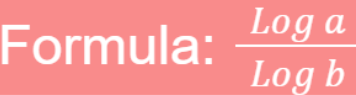
“Loga1 =”
0
Quadratic Equations
A quadratic equation is a second-degree polynomial because the highest exponent of x is 2. Its graph is a parabola.
Formula (Standard Form): ax² + bx + c = 0
a → Coefficient of x² (a ≠ 0).
b → Coefficient of x.
c → Constant term.
x² → Makes the equation quadratic.
Vertex Form
Vertex form is used when you want to quickly find the vertex of a parabola and understand how it is transformed.
Formula: y = a(x - h)² + k
a → Determines the parabola's shape and direction.
a > 0 → Opens upward (∪).
a < 0 → Opens downward (∩).
h → x-coordinate of the vertex.
k → y-coordinate of the vertex.
(h, k) → Vertex of the parabola.
Quadratic Equation
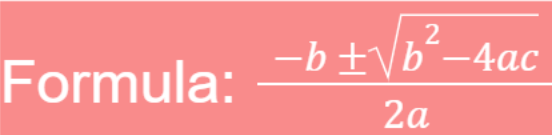
Solving Quadratics
Factoring, Quadratic Formula, Square Root Method
Sine, Cosine, Tangent (Reversals)
SOH-CAH-TOA
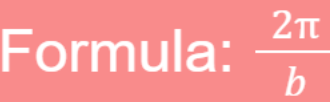
Period for Sine, Cosine, Secant, & Cosecant
B → The coefficient of x inside the trig function. (Absolute Value of b)
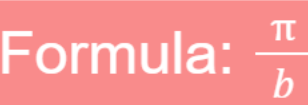
Period for Tangent and Cotangent
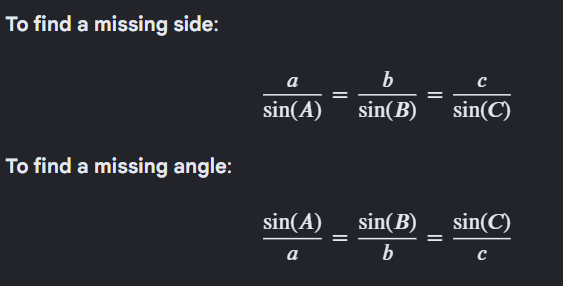
Law of Sines
The Law of Sines relates the lengths of the sides of a triangle to the sines of their opposite angles. It is used to solve non-right triangles.
a → Side opposite angle A.
b → Side opposite angle B.
c → Side opposite angle C.
sin(A) → Sine of angle A.
sin(B) → Sine of angle B.
sin(C) → Sine of angle C.
When to use it:
ASA (Angle-Side-Angle)
AAS (Angle-Angle-Side)
SSA (Side-Side-Angle, may have 0, 1, or 2 solutions)
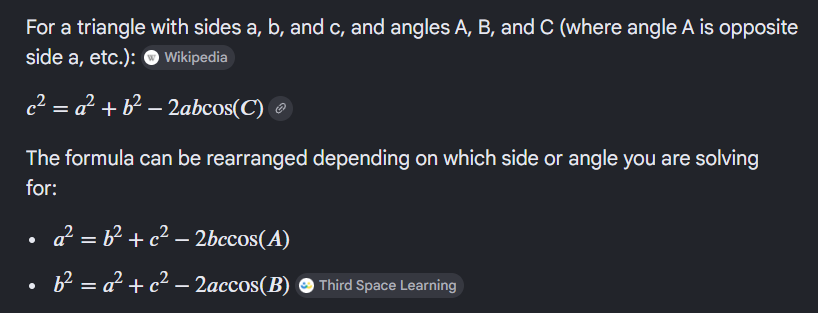
Law of Cosines
The Law of Cosines is used to find a missing side or angle in a non-right triangle. It is an extension of the Pythagorean Theorem.
a, b → Known sides.
c → Side opposite angle C.
C → Angle opposite side c.
cos(C) → Cosine of angle C.
When to use it
SAS (Side-Angle-Side) → Find the third side.
SSS (Side-Side-Side) → Find a missing angle.
Adding/Subtracting 2 By 2 Matrices
Just go by corresponding entries.
Multiplying/Dividing 2 By 2 Matrices
Multiply/Divide each row of the first matrix by each column of the second matrix.
Matrix Determinants
det = ad - bc
Equation of a circle
(x - h)² + (y - k)² = r² [1]
((h, k)): The coordinates of the circle's center. \((x, y)\)
(r): The radius (distance from the center to any point on the edge)
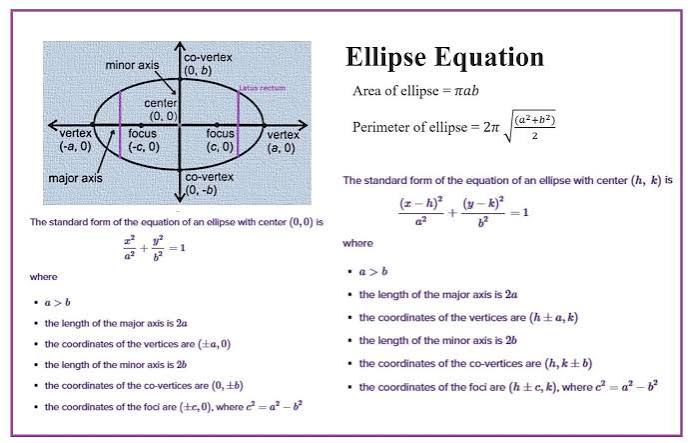
Equation of an Ellipse
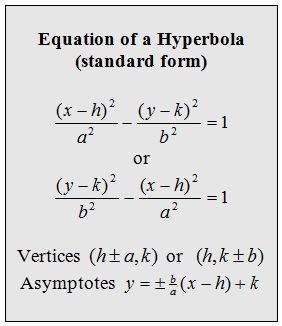
Equation of a Hyperbola
Formula for probability
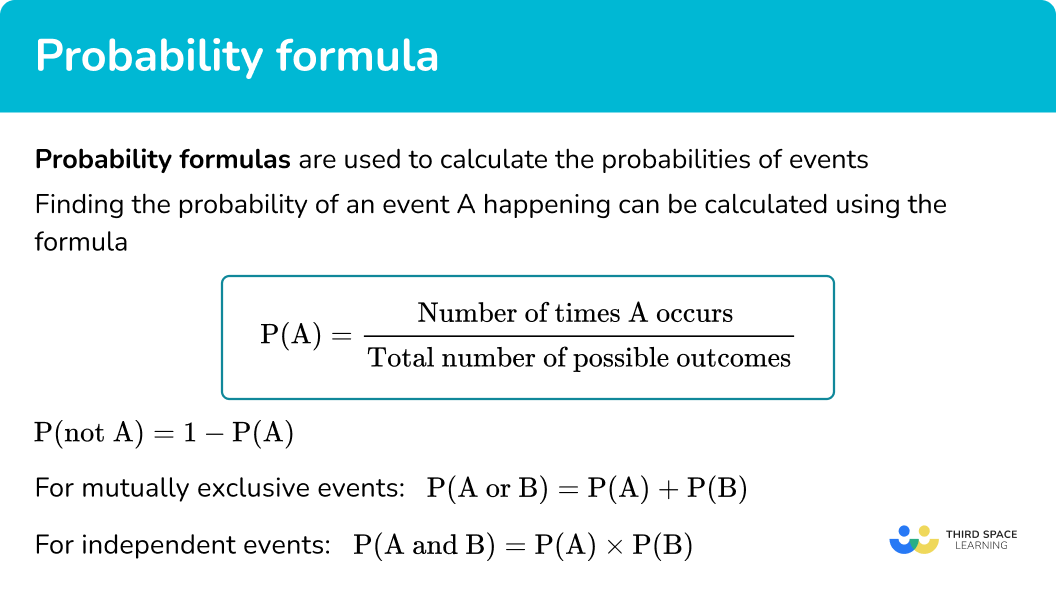
Rule 1 of proability sum of all possible outcomes is equal to
1
rule 2 P(A or B)=
P(A)+P(B)
rule 2 P(A and B)=
P(A) times P(B)
Factorial Equation
A factorial means multiplying a whole number by every positive whole number smaller than it down to 1. Example: 5! = 5 × 4 × 3 × 2 × 1 = 120
Recursive Definition of a Factorial
n! = n(n − 1)(n − 2) … (2)(1) This shows the pattern for a factorial: start with a number and multiply it by each whole number that is 1 less, continuing until you reach 1. Example: 5! = 5(5 − 1)(5 − 2) … (2)(1) = 120
Permutation Formula
A permutation counts the number of ways to arrange r objects chosen from n objects when the order matters.
Formula: nPr = n! / (n - r)!
nPr → Number of permutations.
n → Total number of objects.
r → Number of objects being arranged.
Combination Formula
A combination counts the number of ways to choose r objects from n objects when the order does NOT matter.
Formula: nCr = n! / (r!(n - r)!)
nCr → Number of combinations.
n → Total number of objects.
r → Number of objects being chosen.
Arithmetic Sequence
An arithmetic sequence is a sequence where you add or subtract the same number (common difference) to get from one term to the next.
Geometric Sequence
A geometric sequence is a sequence where you multiply or divide by the same number (common ratio) to get from one term to the next.
Arithmetic Sequence – Find the nth Term
Use this formula to find any term in an arithmetic sequence without listing all the previous terms.
Formula: an = a1 + d(n - 1)
an → The nth term.
a1 → The first term.
d → The common difference (the amount added or subtracted each time).
n → The term number.
(n − 1) → The number of times the common difference is applied.
Geometric Sequence – Find the nth Term
Use this formula to find any term in a geometric sequence without listing all the previous terms.
Formula: an = a1(r)^(n - 1)
an → The nth term.
a1 → The first term.
r → The common ratio (the number each term is multiplied or divided by).
n → The term number.
(n − 1) → The number of times the common ratio is applied.
Simple Growth (Exponential Growth)
Use this formula when a value grows by the same percentage each time period.
Formula: A = P(1 + r)^t
A → Final amount.
P → Initial amount (starting value).
r → Growth rate (written as a decimal).
t → Number of time periods.
(1 + r) → Growth factor.
^t → The growth factor is multiplied by itself t times.
Simple Decay (Exponential Decay)
Use this formula when a value decreases by the same percentage each time period.
Formula: A = P(1 - r)^t
A → Final amount.
P → Initial amount (starting value).
r → Decay rate (written as a decimal).
t → Number of time periods.
(1 − r) → Decay factor.
^t → The decay factor is multiplied by itself t times.
Compound Growth (Compound Interest)
Use this formula when a value grows by a percentage and is compounded multiple times per year.
Formula: A = P(1 + r/n)^(nt)
A → Final amount.
P → Principal (starting amount).
r → Annual interest rate (decimal).
n → Number of compounding periods per year.
t → Time in years.
(1 + r/n) → Growth factor per compounding period.
nt → Total number of compounding periods.
Compound Decay
Use this formula when a value decreases by a percentage and the decrease is applied multiple times per year.
Formula: A = P(1 - r/n)^(nt)
A → Final amount.
P → Principal (starting amount).
r → Annual decay rate (decimal).
n → Number of decay periods per year.
t → Time in years.
(1 − r/n) → Decay factor per period.
nt → Total number of decay periods.
General Exponential Form
This is the general form of an exponential function. The output changes by multiplying by the same factor each time the input increases by 1.
Formula: y = ab^x
y → Output (dependent variable).
a → Initial value (y-intercept).
b → Growth or decay factor (rate of change).
b > 1 → Exponential growth.
0 < b < 1 → Exponential decay.
x → Time interval or input (independent variable).
Arc Length
Arc length is the distance along the curved edge of a circle.
Formula: Arc Length = (θ / 360) × 2πr
Formula: Arc Length = rθ
Arc Length (s) → Length of the arc.
θ → Central angle.
Use degrees in the first formula.
Use radians in the second formula.
360 → Total degrees in a circle.
2πr → Circumference of the circle.
r → Radius of the circle.
Sector Area
A sector is a slice of a circle. The sector area is the fraction of the circle's area determined by the central angle.
Formula: Sector Area = (θ / 360) × πr²
Forumla: Sector Area = (1/2)r²θ
Sector Area → Area of the slice.
θ → Central angle.
Use degrees in the first formula.
Use radians in the second formula.
360 → Total degrees in a circle.
πr² → Area of the entire circle.
r → Radius of the circle.
Vector in Standard Form
Standard form writes a vector using the unit vectors i (horizontal) and j (vertical).
Formula: v = ai + bj
v → The vector.
a → Horizontal (x) component.
i → Unit vector in the x-direction.
b → Vertical (y) component.
j → Unit vector in the y-direction.
Vector in Component Form
Component form lists the vector's horizontal and vertical components as an ordered pair.
Formula: v = ⟨a, b⟩
⟨a, b⟩ → The vector.
a → Horizontal (x) component.
b → Vertical (y) component.
Magnitude of a Vector
The magnitude is the length of the vector.
Formula: |v| = √(a² + b²)
|v| → Magnitude (length) of the vector.
a → Horizontal component.
b → Vertical component.
√(a² + b²) → Uses the Pythagorean Theorem to find the length.