U5
 Call Kai
 Learn
Learn Practice Test
 Spaced Repetition
 Match
Match Flashcards
 Knowt Play
1/49

There's no tags or description
Looks like no tags are added yet.
Name | Mastery | Learn | Test | Matching | Spaced | Call with Kai | Chat |
|---|
No analytics yet
Send a link to your students to track their progress
50 Terms
Which of the following was a widespread social consequence of industrialization in the 1800s?
a. A decline in the social status of women.
b. The general leveling of social hierarchies based on wealth.
c. An increase in the power and prestige of the landowning aristocracy.
d. The creation of a wage-earning working class concentrated in urban areas.
d. The creation of a wage-earning working class concentrated in urban areas.
"Americans . . . who live within the Spanish system occupy a position in society as mere consumers. Yet even this status is surrounded with galling restrictions, such as being forbidden to grow European crops, or to store products that are royal monopolies, or to establish factories of a type the Peninsula itself does not possess. To this, add the exclusive trading privileges, even in articles of prime necessity . . . in short, do you wish to know what our future held?-simply the cultivation of the fields of indigo, grain, coffee, sugarcane, cacao, and cotton; cattle raising on the broad plains; hunting wild game in the jungles; digging in the earth to mine its gold."
- Simon Bolivar, "Jamaica Letter," 1815
Which of the following groups was Bolívar most trying to influence with this letter?
a. Amerindian miners
b. Creole elites
c. Mulatto shopkeepers
d. Plantation slaves
b. Creole elites
"Americans . . . who live within the Spanish system occupy a position in society as mere consumers. Yet even this status is surrounded with galling restrictions, such as being forbidden to grow European crops, or to store products that are royal monopolies, or to establish factories of a type the Peninsula itself does not possess. To this, add the exclusive trading privileges, even in articles of prime necessity . . . in short, do you wish to know what our future held?-simply the cultivation of the fields of indigo, grain, coffee, sugarcane, cacao, and cotton; cattle raising on the broad plains; hunting wild game in the jungles; digging in the earth to mine its gold."
- Simon Bolivar, "Jamaica Letter," 1815
Bolívar was describing the effects of which of the following economic policies?
a. Capitalism
b. Feudalism
c. Mercantilism
d. Socialism
c. Mercantilism
Most world historians would agree that the key to European predominance in the world economy during the nineteenth and early twentieth centuries was
a. the Enlightenment.
b. the Industrial Revolution.
c. European medical technology.
d. Spanish control of New World silver.
b. the Industrial Revolution.
Which of the following best supports the view of some world historians that the eighteenth century marked a major turning point in world history?
a. The beginning of European colonization of Africa.
b. The beginning of the Industrial Revolution in England.
c. The beginning of the Wahhabi movement of Islamic renewal in Arabia.
d .The beginning of European colonization of Australia and New Zealand.
b. The beginning of the Industrial Revolution in England.
One important similarity between the American Revolution and the French Revolution is that they both
a. resulted in the abolition of slavery.
b. challenged monarchical governments.
c. resulted in the abolition of class divisions in society.
d. enabled women to achieve political equality with men.
b. challenged monarchical governments.
"Eight hours' daily labour is enough for any human being, and under proper arrangements sufficient to afford an ample supply of food, raiment and shelter, or the necessaries and comforts of life, and for the remainder of his time, every person is entitled to education, recreation and sleep."
-- Robert Owen, British factory owner and reformer, 1833
The excerpt above emphasizes which of the following solutions to the exploitation of industrial laborers?
a. Abolition of the factory system and industrial wage labor.
b. Radical changes to the socioeconomic structure of Europe.
c. Free food, housing, and other necessities for factory workers.
d. Sufficient wages for factory workers to live full, comfortable lives.
d. Sufficient wages for factory workers to live full, comfortable lives.
"We hold these truths to be self-evident, that all men are created equal, that they are endowed by their Creator with certain unalienable Rights, that among these are Life, Liberty and the Pursuit of Happiness. That to secure these rights, Governments are established among Men, deriving their just powers from the consent of the governed."
--Thomas Jefferson, Declaration of Independence, 1776
Thomas Jefferson was restating the ideas expressed in the Two Treatises on Government by British philosopher
a. Sir Isaac Newton.
b. Thomas Hobbes. c. David Hume.
d. John Locke.
d. John Locke.
"The history of all hitherto existing society is the history of class struggles. Freeman and slave, patrician and plebeian, lord and serf, guildmaster and journeyman, in a word, oppressor and oppressed, stood in constant opposition to one another, carried on an uninterrupted, now hidden, now open fight, that each time ended, either in the revolutionary reconstitution of society at large, or in the common ruin of the contending classes."
― Karl Marx, The Communist Manifesto
Marx's views are best seen as evidence of which of the following?
a. The recognition that economics is the cause of class struggle.
b. Societal harmony between social classes at the time.
c. The widespread use of serfs in Western Europe.
d. The author's optimistic opinion of capitalism
a. The recognition that economics is the cause of class struggle.
"The history of all hitherto existing society is the history of class struggles. Freeman and slave, patrician and plebeian, lord and serf, guildmaster and journeyman, in a word, oppressor and oppressed, stood in constant opposition to one another, carried on an uninterrupted, now hidden, now open fight, that each time ended, either in the revolutionary reconstitution of society at large, or in the common ruin of the contending classes."
― Karl Marx, The Communist Manifesto
The tone of this document best reflects which of the following developments?
a. The Renaissance
b. The Enlightenment
c. The Industrial Revolution
d. Latin American Revolutionary Thought
c. The Industrial Revolution
"We are not European; we are not Indian; we are but a mixed species of aborigines and Spaniards. Americans by birth and Europeans by law, we find ourselves engaged in a dual conflict: we are disputing with the natives for titles of ownership, and at the same time we are struggling to maintain ourselves in the country that gave us birth against the opposition of the invaders."
-- Simon Bolivar, speech to the Council of Angostura, 1819
Bolivar's speech was intended to
a. build an alliance between colonists and indigenous people.
b. persuade Spanish colonists to resist an attack from Brazil.
c. unite creoles in the cause of independence from Spain.
d. justify the need for land reform in Latin America.
c. unite creoles in the cause of independence from Spain.
"We are not European; we are not Indian; we are but a mixed species of aborigines and Spaniards. Americans by birth and Europeans by law, we find ourselves engaged in a dual conflict: we are disputing with the natives for titles of ownership, and at the same time we are struggling to maintain ourselves in the country that gave us birth against the opposition of the invaders."
-- Simon Bolivar, speech to the Council of Angostura, 1819
One long-term impact of Bolivar's actions was to
a. unite all classes into the creation of Gran Colombia.
b. produce land reform in Latin America acceptable to all classes.
c. unite Latin Americans to collectively oppose Catholic influence.
d. create independent countries of Colombia, Venezuela, and Ecuador.
d. create independent countries of Colombia, Venezuela, and Ecuador.
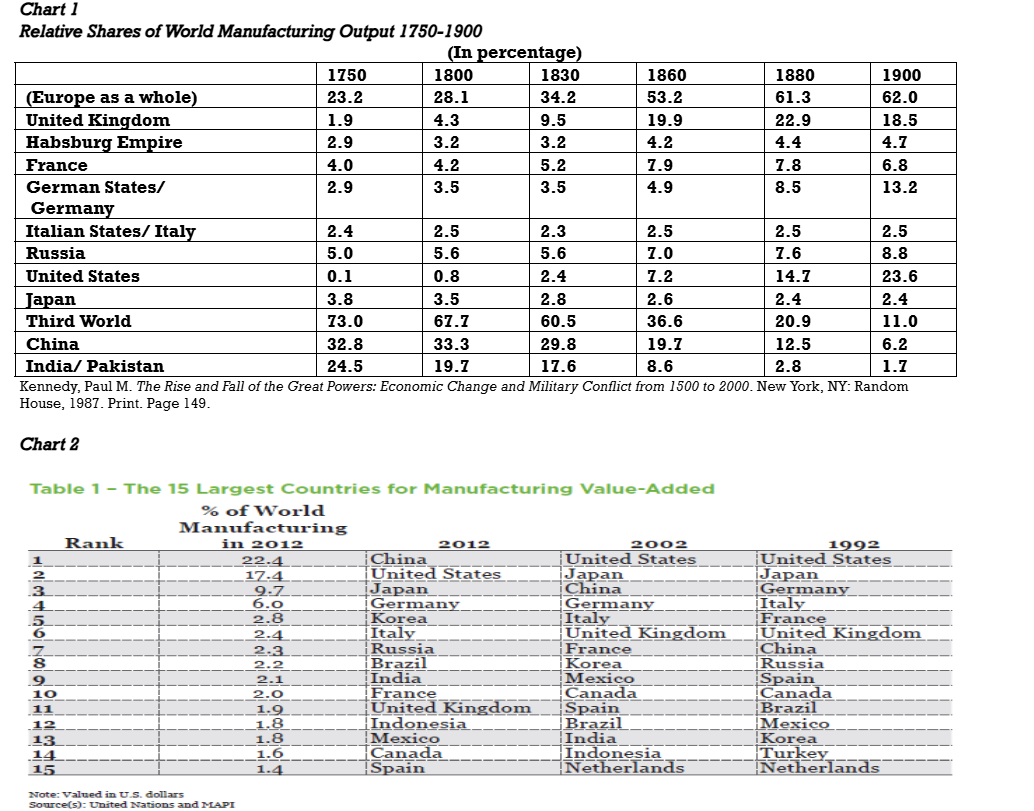
Question includes 2 charts.
Which of the following conclusions is best supported by data in the first chart?
a. The population in the United States grew by approximately 23% between 1750 and 1900.
b. Germany experienced greater economic growth than did the United Kingdom between 1750 and 1900.
c. Russia had a greater share of the world's economy during the 18th century than it did during the 20th century.
d. Between 1750 and 1900 China and India's percentage of the world economy fell whereas the percentage for Europe and the United States grew.
d. Between 1750 and 1900 China and India's percentage of the world economy fell whereas the percentage for Europe and the United States grew.
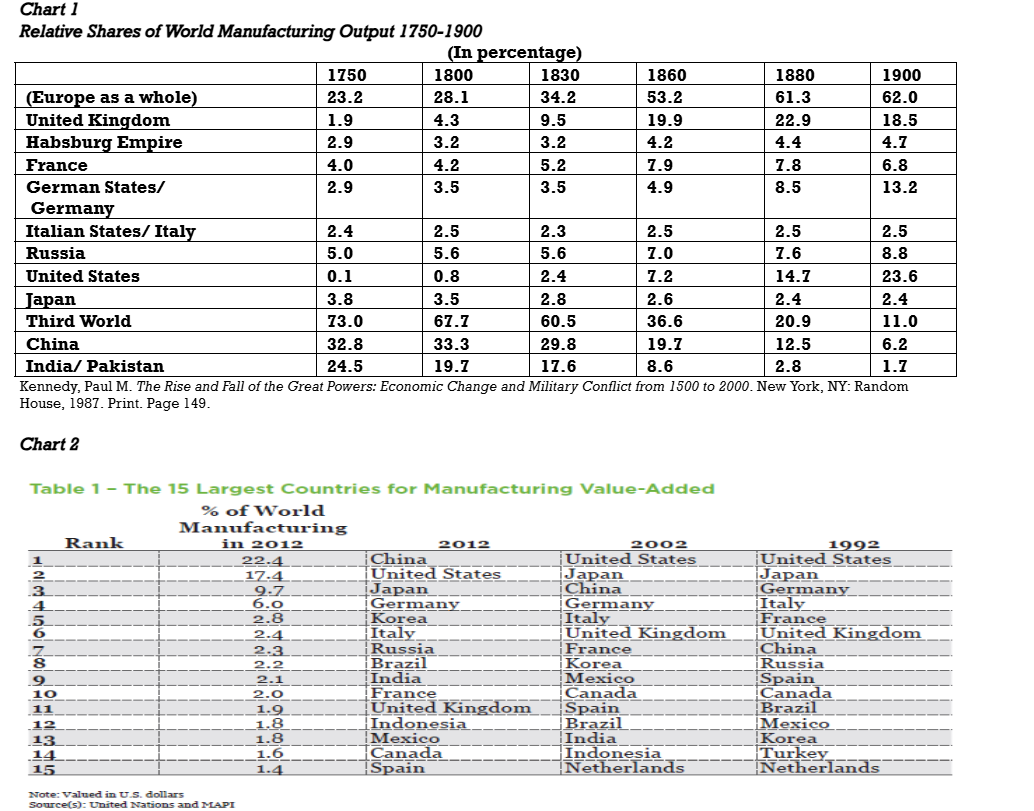
Question includes 2 charts.
The conclusion identified in question 13 is best explained in the context of which of the following?
a. The Industrial Revolution
b. The Columbian Exchange
c. The global circulation of silver
d. The development of communism
a. The Industrial Revolution
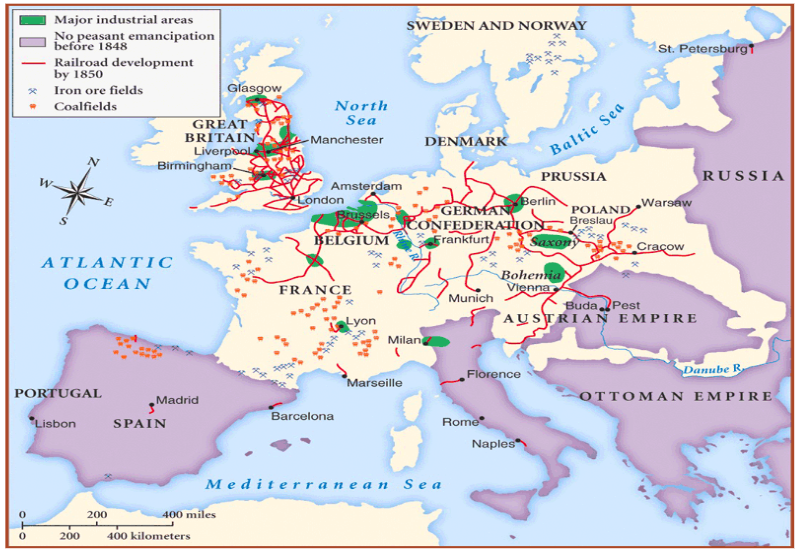
Question features a map.
Which of the following best explains the location of the major industrial areas on the map?
a. Transportations systems were built before industrial areas were built.
b. Major industrial centers tend to be located near coal and iron fields.
c. Europe was unique in the location of major industrial centers.
d. Major industrial centers were mainly built in capital cities
b. Major industrial centers tend to be located near coal and iron fields.
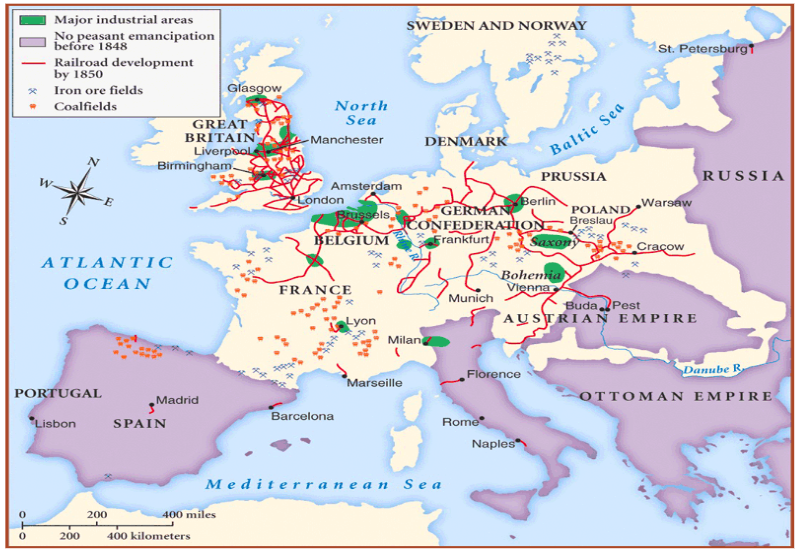
Question features a map.
Which of the following areas was most likely to have a rail line built to it connecting it with an industrial center?
a. Rome
b. Naples
c. Lyon
d. Lisbon
c. Lyon
The revolutionary government is the cause of the fear of the aristocracy, or the pretext for its *calumnies. For the tyrants this government is a scandal, for most people it is a miracle. It must be explained to all, so that at least all good citizens may be rallied around the principles of the general will. The goal of a constitutional government is the protection of the Republic; that of a revolutionary government is the establishment of the Republic…Foreign courts have for some time been spewing out on French soil their well-paid criminals. Their agents still infect our armies. All the bravery of our soldiers, all the devotion of our generals, and all the heroism of the members of this Assembly had to be put forth to defeat treason. These gentlemen still speak in our administrative bodies, in the various sections; they secure admission to the clubs; they sometimes may be found sitting among us; they lead the counter-revolution; they lurk about us, they eavesdrop on our secrets; they flatter our passions and seek even to influence our opinions and to turn our decisions against us…If we spare them, they will conspire publicly; if we threaten them, they will conspire secretly or under the mask of patriotism…Our only possible answer to their pamphlets and lies is to destroy them.
-- Maximilien Robespierre, Report on the Principles of a Revolutionary Government, 1793
*making false statements to destroy someone’s reputation
Based on the source and your knowledge of world history, which of the following best describes the effects of Robespierre's argument?
a. It resulted in Napoleon Bonaparte's coup d'etat.
b. It led to a period of relative peace and stability in France.
c. It led to a year-long period of violence known as the Reign of Terror.
d. It resulted in Austria, Prussia, and England declaring war against France.
c. It led to a year-long period of violence known as the Reign of Terror.
The revolutionary government is the cause of the fear of the aristocracy, or the pretext for its *calumnies. For the tyrants this government is a scandal, for most people it is a miracle. It must be explained to all, so that at least all good citizens may be rallied around the principles of the general will. The goal of a constitutional government is the protection of the Republic; that of a revolutionary government is the establishment of the Republic…Foreign courts have for some time been spewing out on French soil their well-paid criminals. Their agents still infect our armies. All the bravery of our soldiers, all the devotion of our generals, and all the heroism of the members of this Assembly had to be put forth to defeat treason. These gentlemen still speak in our administrative bodies, in the various sections; they secure admission to the clubs; they sometimes may be found sitting among us; they lead the counter-revolution; they lurk about us, they eavesdrop on our secrets; they flatter our passions and seek even to influence our opinions and to turn our decisions against us…If we spare them, they will conspire publicly; if we threaten them, they will conspire secretly or under the mask of patriotism…Our only possible answer to their pamphlets and lies is to destroy them.
-- Maximilien Robespierre, Report on the Principles of a Revolutionary Government, 1793
*making false statements to destroy someone’s reputation
What was most likely Robespierre's purpose for writing this report?
a. To persuade conservatives that Republicanism was superior to Monarchy.
b. To inform French citizens on the current state of the government.
c. To provoke suspicion among the Revolutionaries.
d. To justify the use of a strict curfew in Paris.
c. To provoke suspicion among the Revolutionaries.
“Every individual who employs his capital in the support of domestic industry, necessarily endeavours so to direct that industry that its produce may be of the greatest possible value. . . . He generally, indeed, neither intends to promote the public interest, nor knows how much he is promoting it. By preferring the support of domestic to that of foreign industry, he intends only his own security; and by directing that industry in such a manner as its produce may be of the greatest value, he intends only his own gain, and he is in this, as in many other cases, led by an invisible hand to promote an end which was no part of his intention. . By pursuing his own interest he frequently promotes that of the society more effectually than when he really intends to promote it. I have never known much good done by those who affected to trade for the public good. It is an affectation, indeed, not very common among merchants, and very few words need be employed in dissuading them from it.”
--Adam Smith, Wealth of Nations 1776
Based on the passage above what is the main concept Adam Smith introduces with his Wealth of Nations?
a. He believed that wealth and overall economic activity were fixed.
b. He introduced that attention from the government should be a necessity while trading.
c. He introduced the concept of laissez-faire where all trading was to go through government officials.
d. He believed that the world would benefit most through free trade and little government involvement.
d. He believed that the world would benefit most through free trade and little government involvement.
“Every individual who employs his capital in the support of domestic industry, necessarily endeavours so to direct that industry that its produce may be of the greatest possible value. . . . He generally, indeed, neither intends to promote the public interest, nor knows how much he is promoting it. By preferring the support of domestic to that of foreign industry, he intends only his own security; and by directing that industry in such a manner as its produce may be of the greatest value, he intends only his own gain, and he is in this, as in many other cases, led by an invisible hand to promote an end which was no part of his intention. . By pursuing his own interest he frequently promotes that of the society more effectually than when he really intends to promote it. I have never known much good done by those who affected to trade for the public good. It is an affectation, indeed, not very common among merchants, and very few words need be employed in dissuading them from it.”
--Adam Smith, Wealth of Nations 1776
Adam Smith's economic philosophy most influenced
a. British mercantilist policy leading after the French and Indian War.
b. the rise of capitalism during the Industrial Revolution in Great Britain.
c. the rise of the union movement during the Industrial Revolution in Great Britain.
d. those, like Marx, who believed that the people need to control the means of production.
b. the rise of capitalism during the Industrial Revolution in Great Britain.
"Governments are instituted among Men, deriving their just powers from the consent of the governed. That whenever any Form of Government becomes destructive of these ends, it is the Right of the People to alter or to abolish it, and to institute new Government, laying its foundation on such principles and organizing its powers in such form, as to them shall seem most likely to effect their Safety and Happiness."
--Thomas Jefferson, Declaration of Independence, 1776
The excerpt was written in response to the
a. British government's attempt to assert greater control over their North American colonies.
b. British government's failure to protect colonists from attacks by American Indians.
c. colonial governments' attempts to extend political rights to new groups.
d. colonial governments' failures to implement mercantilist policies.
a. British government's attempt to assert greater control over their North American colonies.
"Governments are instituted among Men, deriving their just powers from the consent of the governed. That whenever any Form of Government becomes destructive of these ends, it is the Right of the People to alter or to abolish it, and to institute new Government, laying its foundation on such principles and organizing its powers in such form, as to them shall seem most likely to effect their Safety and Happiness."
--Thomas Jefferson, Declaration of Independence, 1776
The ideas about government expressed by Jefferson are most consistent with the
a. concept of hereditary rights and privileges of kings.
b. principles of religious freedom.
c. principles of Manifest Destiny.
d. ideas of the Enlightenment.
d. ideas of the Enlightenment.
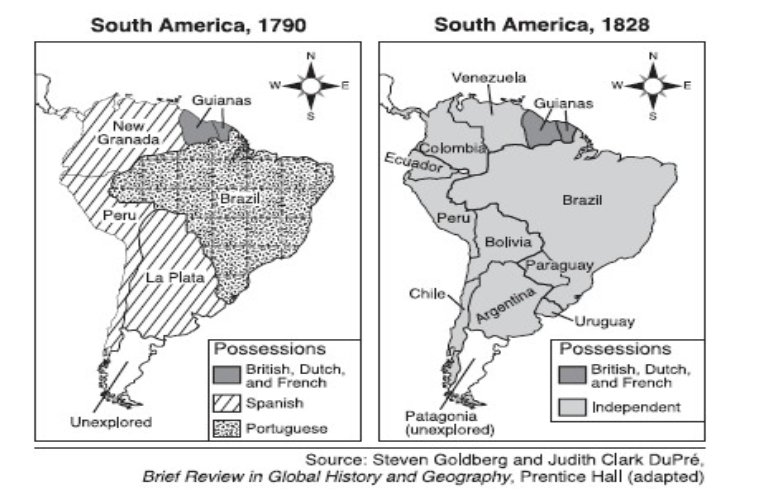
Question features 2 maps.
Which European country controlled the most colonies in 1790?
a. Britain
b. France
c. Portugal
d. Spain
d. Spain
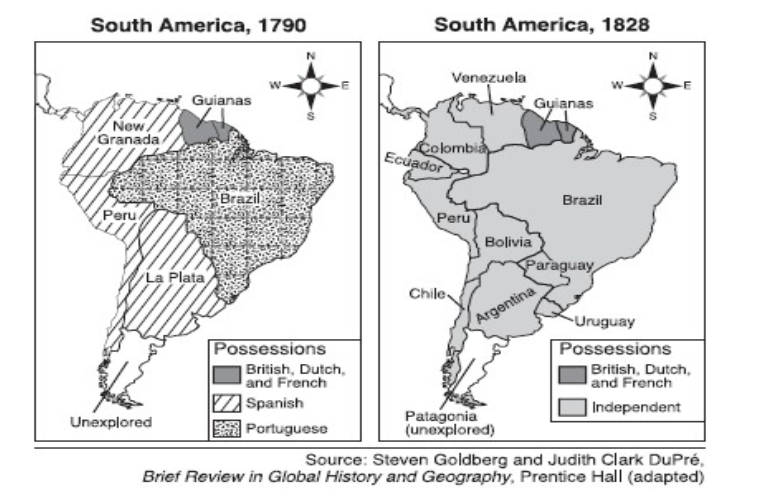
Question features 2 maps.
Between 1790 and 1828, what happened to the continent of South America?
a. The British colonized Patagonia.
b. The United States had to put down rebellions throughout the region.
c. Latin American colonies gained independence from European colonizers.
d. The Spanish gained control of the entire continent, at the expense of the Portuguese.
c. Latin American colonies gained independence from European colonizers.
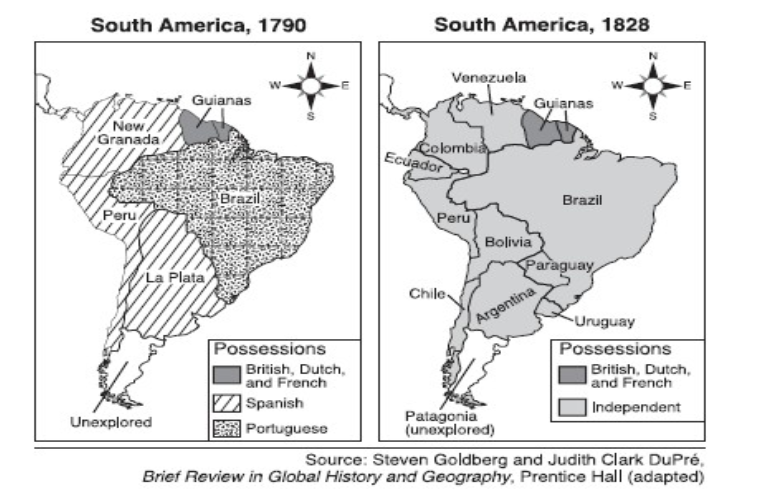
Question features 2 maps.
Between 1790 and 1828, what helped cause the change shown on these two maps of South America?
a. Spain sent conquistadors to Latin America.
b. The Aztecs regained power in the America.
c. The Latin Americans bought their independence from the Spanish.
d. The revolutionary movements led by Simon Bolivar and Jose de San Martin spread throughout South America.
d. The revolutionary movements led by Simon Bolivar and Jose de San Martin spread throughout South America.
Which of the following is a significant result of the late-eighteenth and early-nineteenth century revolutions in both Europe and the Americas?
a. The theory of divine right monarchy dominated intellectual discourse in both Europe and the Americas.
b. People throughout Europe and the Americas reflected the concept of popular sovereignty.
c. Nation-states emerged as the principal form of political organization in both Europe and the Americas.
d. Philosophical liberalism as a force in political life declined throughout Europe and the Americas.
c. Nation-states emerged as the principal form of political organization in both Europe and the Americas.
Which of the following distinguishes the Meiji period from earlier periods in Japanese history?
a. Militarism and feudalism.
b. Reform and industrialization.
c. Isolation and lack of foreign trade.
d. Democratization and manorial privilege.
b. Reform and industrialization.
Which of the following factors contributed most significantly to the contraction of the Ottoman Empire in the nineteenth century?
a. The Opium Wars
b. Adoption of gunpowder weaponry
c. The Berlin Conference of 1884 and 1885
d. Independence movements inspired by ethnic nationalism
d. Independence movements inspired by ethnic nationalism
Which of the following was NOT a reason factories first appeared in England?
a. Socialism first took root in England, spurring more investment in factories.
b. England had large amounts of easy to access coal and iron ore.
c. England had an abundance of rivers and canals to transport raw materials and finished products.
d. England was agriculturally productive, enabling rural populations to work in factories.
a. Socialism first took root in England, spurring more investment in factories.
How did the change from cottage industries to factory production impact the role women played in working class factories?
a. factory production and the resulting urbanization made it too dangerous for women to leave their homes, so most working class women only worked inside the home.
b. The collapse of the urban guilds led ot more equality for working class women.
c. Working class women were more likely to work outside the home, taking jobs in the new factories at a fraction of the pay men received.
d. Migration to cities and factory work mostly only impacted men.
c. Working class women were more likely to work outside the home, taking jobs in the new factories at a fraction of the pay men received.
Which of the following best explains the general increase in the living standards of industrial workers between 1800-1900?
a. Deficit-spending policies by governments in major industrial states
b. The implementation of strong protective tariffs
c. The increased supply of inexpensive consumer goods
d. Implementation of utopian socialist ideas in the organization of factory labor
c. The increased supply of inexpensive consumer goods
Adoption of which of the following power sources has contributed the most to increasing the energy available to humans?
a. Draft animals
b. Wind power
c. Fossil fuels
d. Solar power
c. Fossil fuels
In response to its loss of sovereignty and to the changes in its world economic position reflected in the chart, reformists in Qing China promoted the Self-Strengthening Movement which proposed
a. Adopting European industrial technology while adhering to the Confucian traditions
b. Overthrowing the Manchu government in order to adopt communism
c. Implementing free trading policies associated with Adam Smith and classical liberalism
d. Abandoning Chinese cultural traditions in order to westernize the Chinese economy and military
a. Adopting European industrial technology while adhering to the Confucian traditions
“By the end of the nineteenth century, Germany had advanced beyond Britain in terms of economic output. The prime reason for this development was that Germany developed newer industries, while Britain continued to stress textile production. Formerly an agricultural country, the German Empire has come to be regarded as one of the leading industrial nations of the world and, in the chemical industries, Germany has for some time occupied a leading place.
One of the most successful chemical and pharmaceutical firms in Germany is the Bayer company. Bayer employs 3,500 people alone at its plant in Leverkusen,* and the factory is so gigantic that all of these people are barely noticed when a visitor tours it. The laboratories are arranged very much in the same manner as the university laboratories in Britain. Each workstation receives a supply of electricity, compressed air, steam, and hot and cold water. The research chemists are paid a salary of about 100 British pounds for the first year. If a chemist has shown himself to be useful in his first year, he may receive a longer contract and may receive royalties on any processes that he invented.”
*a city located in west-central Germany near Cologne; until the development of the German chemical industry in the late 19th c., Leverkusen was a small rural community.
-Harold Baron, British historian, 1901
Great Britain's development of the industry referred to in the first paragraph during the late eighteenth and early nineteenth centuries is best explained by the fact that British factories were the first to
a. use steam-powered machines for large-scale economic production.
b. use natural resources from colonies to create finished products.
c. use coerced labor for producing manufactured goods.
d. take advantage of mercantilist economic policies to protect themselves from foreign competition.
a. use steam-powered machines for large-scale economic production.
“By the end of the nineteenth century, Germany had advanced beyond Britain in terms of economic output. The prime reason for this development was that Germany developed newer industries, while Britain continued to stress textile production. Formerly an agricultural country, the German Empire has come to be regarded as one of the leading industrial nations of the world and, in the chemical industries, Germany has for some time occupied a leading place.
One of the most successful chemical and pharmaceutical firms in Germany is the Bayer company. Bayer employs 3,500 people alone at its plant in Leverkusen,* and the factory is so gigantic that all of these people are barely noticed when a visitor tours it. The laboratories are arranged very much in the same manner as the university laboratories in Britain. Each workstation receives a supply of electricity, compressed air, steam, and hot and cold water. The research chemists are paid a salary of about 100 British pounds for the first year. If a chemist has shown himself to be useful in his first year, he may receive a longer contract and may receive royalties on any processes that he invented.”
*a city located in west-central Germany near Cologne; until the development of the German chemical industry in the late 19th c., Leverkusen was a small rural community.
-Harold Baron, British historian, 1901
The emergence of the German industries referred to in the passage is most directly explained by which of the following processes in the nineteenth century?
a. The spread of new industrial technologies such as the internal combustion engine from the United States
b. The development of the production of chemicals during the second industrial revolution
c. The greater diversity of manufactured goods produced by industrial factories
d. The growing importance of using coal as fuel in industrial production
b. The development of the production of chemicals during the second industrial revolution
“By the end of the nineteenth century, Germany had advanced beyond Britain in terms of economic output. The prime reason for this development was that Germany developed newer industries, while Britain continued to stress textile production. Formerly an agricultural country, the German Empire has come to be regarded as one of the leading industrial nations of the world and, in the chemical industries, Germany has for some time occupied a leading place.
One of the most successful chemical and pharmaceutical firms in Germany is the Bayer company. Bayer employs 3,500 people alone at its plant in Leverkusen,* and the factory is so gigantic that all of these people are barely noticed when a visitor tours it. The laboratories are arranged very much in the same manner as the university laboratories in Britain. Each workstation receives a supply of electricity, compressed air, steam, and hot and cold water. The research chemists are paid a salary of about 100 British pounds for the first year. If a chemist has shown himself to be useful in his first year, he may receive a longer contract and may receive royalties on any processes that he invented.”
*a city located in west-central Germany near Cologne; until the development of the German chemical industry in the late 19th c., Leverkusen was a small rural community.
-Harold Baron, British historian, 1901
Which of the following developments in the nineteenth century would most likely help explain the size and composition of the workforce at the Bayer plant as described in the second paragraph?
a. The construction of railroads facilitated the migration of people to interior regions.
b. The invention of steamships facilitated the migration of colonial subjects to imperial metropoles.
c. The invention of the telegraph made it easier for companies to recruit educated workers from across the world.
d. The discovery of electricity made rural communities more attractive places to live for wealthy urbanites.
a. The construction of railroads facilitated the migration of people to interior regions.
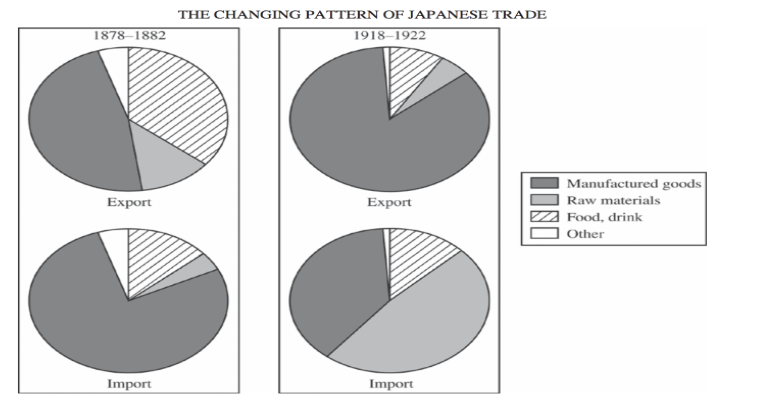
Which of the following developments in the period 1878-1922 best explains the change in Japanese trade patterns shown in the graphs above?
a. Japanese manufacturing output rose as a consequence of industrialization.
b. Japanese manufacturing output decreased because Japanese leaders restricted commercial ties.
c. Japanese imports of raw materials increased as a consequence of extensive immigration to Japan.
d. Export of manufactured goods declined because United States tariffs on Japanese goods increased.
a. Japanese manufacturing output rose as a consequence of industrialization.
“My own sex, I hope, will excuse me, if I treat them like rational creatures, instead of flattering their fascinating graces, and viewing them as if they were in a state of perpetual childhood, unable to stand alone. I earnestly wish to point out in what true dignity and human happiness consists. I wish to persuade women to endeavour to acquire strength, both of mind and body, and to convince them that the soft phrases, susceptibility of heart, delicacy of sentiment, and refinement of taste, are almost synonymous with epithets of weakness, and that those beings who are only the objects of pity, and that kind of love which has been termed its sister, will soon become objects of contempt.”
--Mary Wollstonecraft from A Vindication of the Rights of Women, 1792
Which of the following LEAST influenced Wollstonecraft's views?
a. Emphasis on Reason
b. Enlightenment Philosophies
c. European Imperialism
d. French Revolution
c. European Imperialism
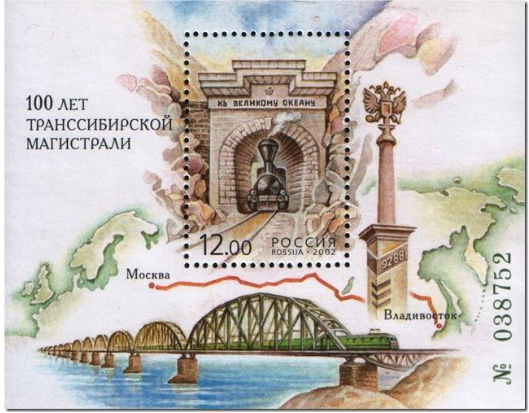
The picture above is an example of
a. The Russian government's sponsorship of industrialization
b. The Russian government's encouragement of entrepreneurship
c. The result of industrial discontent in Russia
d. The rise of merchants in the mid to late 1900s in Russia.
a. The Russian government's sponsorship of industrialization
"The condition of foreign states is not what it once was; they have invented the steamship, and introduced radical changes in the art of navigation. They have also built up their armies to a state of great efficiency and are possessed of war implements of great power and precision, in short have license to be formidable peers. If, therefore, we persistently cling to our antiquated systems, heaven only knows what a mighty calamity may befall our Empire."
-adapted from a letter written by Lord Ii to Lord Tokugawa, 1847
Which event or period in Japan's history best reflects Lord Ii's concerns?
a. The expulsion of Christian missionaries from Japan
b. The adoption of Chinese imperial customs in the Japanese court
c. The annexation of Manchuria by the Japanese
d. Commodore Perry forcing Japan to open its ports to trade
d. Commodore Perry forcing Japan to open its ports to trade
"The condition of foreign states is not what it once was; they have invented the steamship, and introduced radical changes in the art of navigation. They have also built up their armies to a state of great efficiency and are possessed of war implements of great power and precision, in short have license to be formidable peers. If, therefore, we persistently cling to our antiquated systems, heaven only knows what a mighty calamity may befall our Empire."
-adapted from a letter written by Lord Ii to Lord Tokugawa, 1847
The era in Japanese history following this passage is known as the
a. Meiji Era
b. Heian period
c. Tokugawa Shogunate
d. Jomon period
a. Meiji Era
The industrialization of Japan in the nineteenth century most directly led to Japan's adoption of which of the following foreign policies?
a. A policy of isolation that sought to limit foreign cultural, economic, and political influences
b. A policy of mediation that sought to prevent conflict among rival states
c. A policy of promoting regional prosperity through the negotiation of free-trade agreements with Western and Asian states
d. A policy of imperial expansion that sought to take advantage of the political and military weakness of neighboring Asian states
d. A policy of imperial expansion that sought to take advantage of the political and military weakness of neighboring Asian states
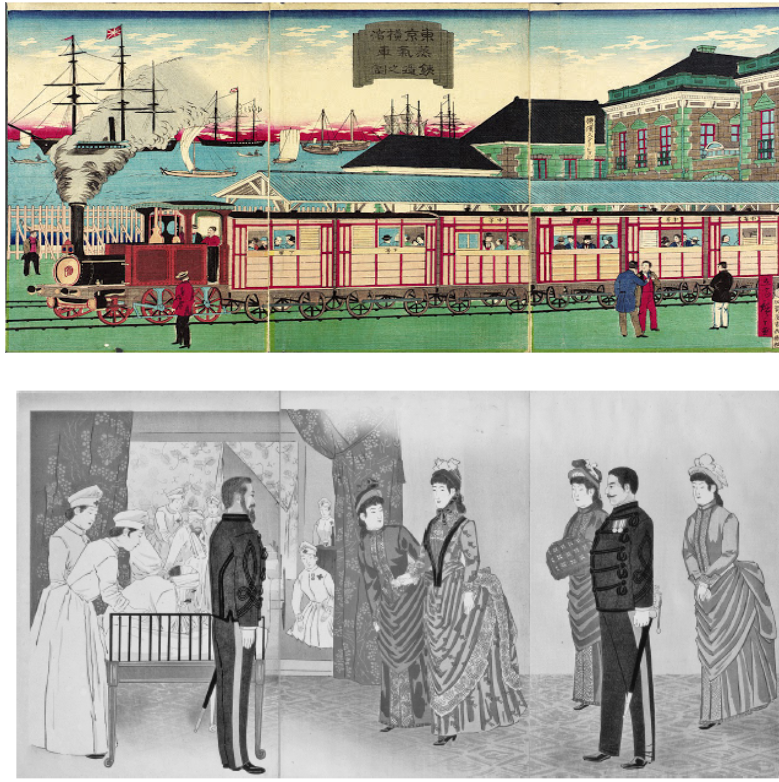
Which statement best describes Japan's industrialization around the time of the illustration shown above?
a. Japan industrialized in the context of a Meiji government-imposed isolation from the West and refused to learn from foreign experts.
b. Japan's Meiji rulers feared the military power of industrializing nations, so they consulted with foreign experts to replicate Western progress.
c. Japan, unlike Britain and the United States, rarely saw abuse and exploitation of its early industrial workers.
d. Japan, like the United States, was the destination for millions of foreign immigrants seeking factory work.
b. Japan's Meiji rulers feared the military power of industrializing nations, so they consulted with foreign experts to replicate Western progress.
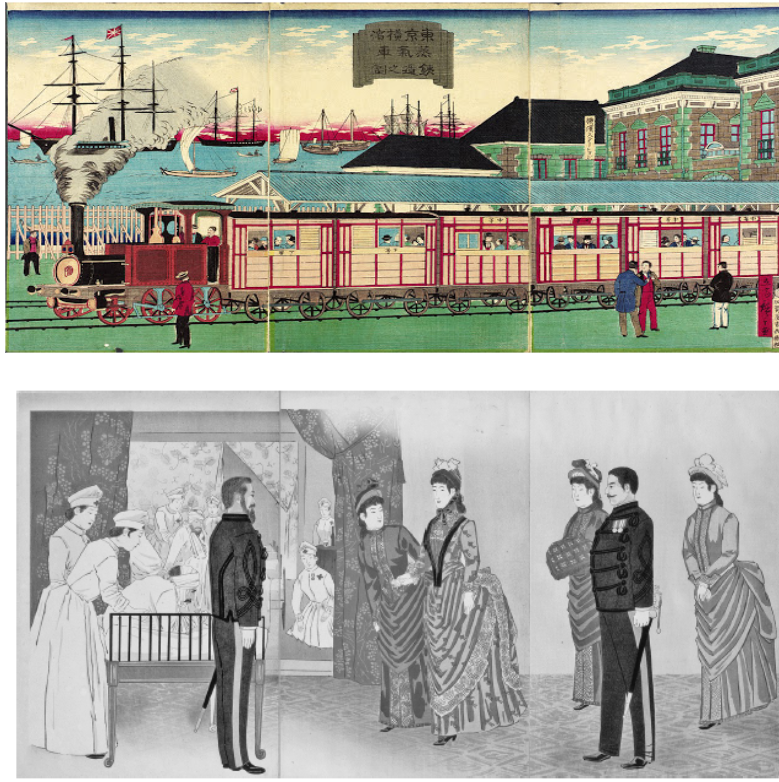
The image from Japan during the Meiji Restoration best exemplifies which of the following processes?
a. Attempts by conservative members of society to maintain indigenous traditions
b. Cultural changes accompanying greater contact with the United States
c. Greater freedom for women resulting from democratization
d. Increased emphasis on international cooperation as a result of the lowering of trade barriers
b. Cultural changes accompanying greater contact with the United States
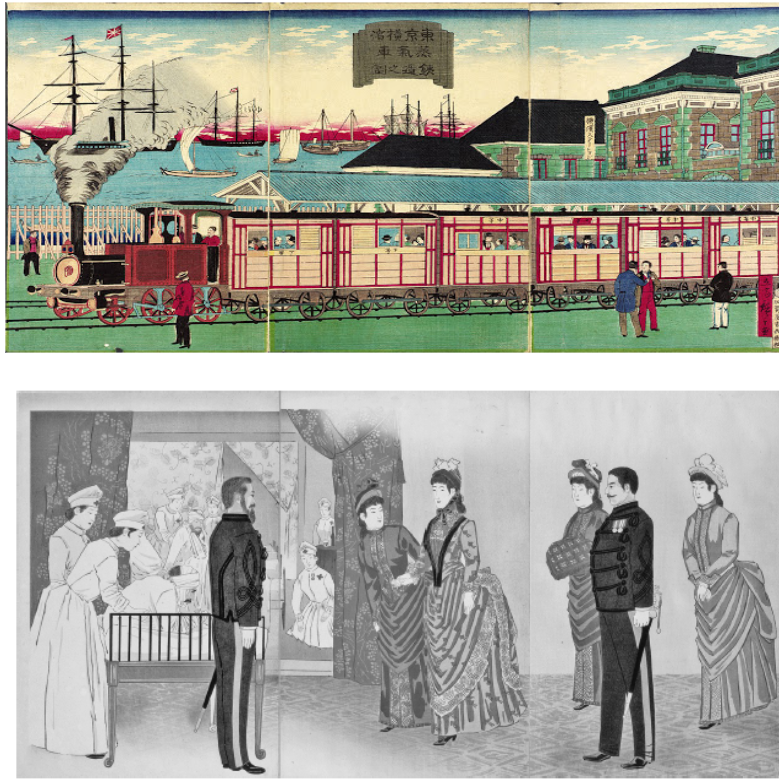
Compared to the changes in Japan shown in the image, by the late nineteenth century China
a. was unable to make significant changes to its society and economy
b. surpassed Japan in reforming its society and economy
c. had still not opened its nation to foreign trade and influence
d. had only reformed its economy but not its politics or society
a. was unable to make significant changes to its society and economy
“We have now received Her Majesty’s decree to devote ourselves fully to China’s revitalization, to suppress vigorously the use of the terms new and old, and to blend together the best of what is Chinese and what is foreign. The root of China’s weakness lies in harmful habits too firmly entrenched, in rules and regulations too minutely drawn, in the overabundance of inept and mediocre officials and in the paucity of truly outstanding ones, in petty bureaucrats who hide behind the written word and in clerks and yamen runners (administrative clerks) who use the written word as talismans (an object that brings good luck) to acquire personal fortunes, in the mountains of correspondence between government offices that have no relationship to reality, and in the seniority system and associated practices that block the way of men of real talent.”
Qing Reform Edict, January 29, 1901
Which segment of Chinese society seems to be the focus of this excerpt from the Reform Edict?
a. the military
b. the emperor
c. civil servants
d. peasants
c. civil servants
“We have now received Her Majesty’s decree to devote ourselves fully to China’s revitalization, to suppress vigorously the use of the terms new and old, and to blend together the best of what is Chinese and what is foreign. The root of China’s weakness lies in harmful habits too firmly entrenched, in rules and regulations too minutely drawn, in the overabundance of inept and mediocre officials and in the paucity of truly outstanding ones, in petty bureaucrats who hide behind the written word and in clerks and yamen runners (administrative clerks) who use the written word as talismans (an object that brings good luck) to acquire personal fortunes, in the mountains of correspondence between government offices that have no relationship to reality, and in the seniority system and associated practices that block the way of men of real talent.”
Qing Reform Edict, January 29, 1901
Which concept best reflects the ideas advocated in the Reform Edict?
a. the concept of concessions
b. the principle of extraterritoriality
c. the Open Door Policy
d. the Self-Strengthening Movement
d. the Self-Strengthening Movement
“We have now received Her Majesty’s decree to devote ourselves fully to China’s revitalization, to suppress vigorously the use of the terms new and old, and to blend together the best of what is Chinese and what is foreign. The root of China’s weakness lies in harmful habits too firmly entrenched, in rules and regulations too minutely drawn, in the overabundance of inept and mediocre officials and in the paucity of truly outstanding ones, in petty bureaucrats who hide behind the written word and in clerks and yamen runners (administrative clerks) who use the written word as talismans (an object that brings good luck) to acquire personal fortunes, in the mountains of correspondence between government offices that have no relationship to reality, and in the seniority system and associated practices that block the way of men of real talent.”
Qing Reform Edict, January 29, 1901
How did the Boxer Rebellion lead to the Reform Edict?
a. The failure of the Boxer Rebellion persuaded many members of the Chinese government to support more extensive reforms.
b. The Boxers were the "inept and mediocre officials" that the edict was trying to remove.
c. The success of the Boxer Rebellion against the Qing opened the way for more significant reforms to be enacted.
d. The Boxers shifted their efforts from trying to drive foreigners out of China to serving as efficient government officials.
a. The failure of the Boxer Rebellion persuaded many members of the Chinese government to support more extensive reforms.
Which generalization applies to all the revolutions discussed in Unit 5?
a. All resulted in newly independent countries.
b. All advocated racial equality.
c. All were reversed within a generation of their completion.
d. All were inspired by Enlightenment ideals.
d. All were inspired by Enlightenment ideals.
Which of the following is an accurate description of relations between European states and the Ottoman Empire in the late 19th century?
a. The Ottomans were expanding at the expense of Russia, England and France
b. Russian, English, and French expansion came at the expense of the Ottomans
c. The Ottomans, in alliance with the Russians, English and French, sought to impede German unification
d. The Ottomans supported nationalism in the Balkans to destabilize Europe
b. Russian, English, and French expansion came at the expense of the Ottomans