chem mock
 Call Kai
 Learn
Learn Practice Test
 Spaced Repetition
 Match
Match Flashcards
 Knowt Play
1/35

There's no tags or description
Looks like no tags are added yet.
Name | Mastery | Learn | Test | Matching | Spaced | Call with Kai |
|---|
No analytics yet
Send a link to your students to track their progress
36 Terms
1.1 Chlorine gas is poisonous. Give one way of reducing the risk of harm
use a fume cupboard (or good ventilation) so chlorine doesnt build up
1.2 plot graph and lobf
DO A SMOOTH CURVE
1.3 a student made the hypothesis “the negative electrode will increase by constant mass every 60s” how do the results show this isnt correct
the incease in mass is not constant each 60s
1.4 25 cm³ of copper chloride solution contains 5.5 g copper chloride. Calculate concentration in g/dm³.
1000 / 25 =40
5.5 × 40= 220g/dm³
1.5 Hydrogen gas was given off at the negative electrode. Why?
Hydrogen forms because potassium is more reactive, so hydrogen is discharged instead.
2.1 What is meant by an exothermic reaction?
a reaction that transfers energy to the surroundings
2.2 Calculate the percentage by mass of oxygen in calcium hydroxide, Ca(OH)₂.
2 × 16 = 32
32 / 74 × 100 = 43.2%
2.3 Plan a method to investigate how changing the mass of calcium oxide affects the temperature change of the reaction mixture.
Measure a fixed volume of water into a polystyrene cup.
Measure and record the starting temperature
Add the calcium oxide to the water.
Stir the mixture.
Record the highest temperature reached.
Calculate the temperature change.
Repeat using different masses of calcium oxide.
Keep the volume of water the same each time.
Keep the starting temperature the same each time.
Repeat each mass and calculate a mean.
3.1 What two conclusions were made from the alpha scattering experiment?
atoms have a charged nucleus
the mass of the atom is concentrated in the nucleus
3.2 Why is particle X not an atom?
It has 36 electrons and 35 protons, so it’s charged, not neutral.
3.3 Which is the correct representation of particle X?
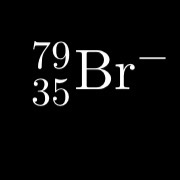
3.4 Explain the increase in boiling points of Group 7 elements going down the group.
The molecules get larger going down the group.
There are more electrons.
this means there is a stronger intermolecular force between molecules.
therefore more energy is needed to overcome these forces, so boiling point increases.
3.5 What is the type of bonding in ClF₃?
covalent
3.6 Complete the word equation:
chlorine + sodium bromide → ? + ?
sodium chloride + bromine
3.7 Explain why Group 7 elements become less reactive going down the group.
atoms become larger and have more electron shells
means there is more shielding between the nucleus and incoming electron
the attraction becomes weaker so the atoms gains the electrons less easily
G7 react by gaining an electron — they become less reactive
4.1 Why can iron be extracted by reduction with carbon?
iron is less reactive than carbon
4.2 Explain why a mixture of aluminium oxide and cryolite is used as the electrolyte instead of only aluminium oxide.
cryolite lowers the melting point if aluminium oxide, so less energy is required
4.3 Write a balanced half equation for oxygen produced at the positive electrode.
2O2− → O2 + 4e−
4.4 In Cr2O3 + 2Al → Al2O3 + 2Cr which substance is reduced
chromuim oxide
4.5 Give one reason for the difference in cost of extracting aluminium and iron.
Aluminium is extracted by electrolysis, which uses a lot of electricity / energy, whereas iron is extracted by reduction with carbon, which is cheaper.
4.6 Give one reason for the difference in cost of extracting aluminium and chromium.
Chromium is much more expensive to extract than aluminium because its extraction process is more difficult
4.7 Explain why alloys are harder than pure metals.
Pure metals have layers of atoms that can slide over each other easily.
Alloys contain different sized atoms.
These distort the layers.
This makes it harder for the layers to slide, so the alloy is harder.
5.1 Give the state symbols for hydrogen chloride, water and hydrochloric acid.
Hydrogen chloride = HCl(g)
Water = H₂O(l)
Hydrochloric acid = HCl(aq)
5.2 hydrochloric acid with pH 2.5 has [H+] = 3.16 x 10⁻³
what if the pH was 3.5
3.16⋅10−4
5.3 Complete the dot-and-cross diagram for HOCl.

5.4 Explain why a weak acid has a higher pH than a strong acid of the same concentration.
A weak acid only partially ionises in water, so it produces fewer H⁺ ions than a strong acid of the same concentration.
Fewer H⁺ ions means a higher pH.
5.5 Calculate the overall energy change
413+243=656
346+432=778
656-778= -122
6.1 Why use a Bunsen burner instead of a water bath?
A Bunsen burner can heat to a much higher temperature.
6.2 Explain the two trends for the first 3 minutes.
magnesium
mass increases because magnesium reacts with oxygen to form magnesium oxide
oxygen is added so mass increases
magnesium carbonate
mass decreases because magnesium carbonate thermally decomposes
escapes — mass decreases
6.3 Why is the final mass the same for both reactions?
Both reactions produce the same amount of magnesium oxide (MgO).
6.4 The student says the difference is caused by solid escaping from the crucible. Give one reason the results show this is not correct.
The final mass is the same as the predicted final mass.
If solid had escaped, the final mass would be lower.
6.5 Iron reacts with steam to produce an oxide of iron and hydrogen gas.
0.120 mol Fe reacts with 0.160 mol H₂O. Determine:
simplest mole ratio Fe : H₂O
formula of iron oxide
balanced equation
ratio:
0.120 : 0.160 = 3 : 4
formula of oxide:
Fe3O4
balanced equation:
3Fe+4H2O→Fe3O4+4H2
7.1 Give two limitations of model A compared with model B for sodium chloride.
Model A does not show the giant ionic lattice structure.
Model A does not show the arrangement of many ions are surrounded by oppositely charged ions.
7.2 What is the formula of aluminium sulfate
Al2(SO4)3
7.3 Suggest one reason why aluminium conducts electricity better than sodium.
Aluminium has more delocalised electrons per atom than sodium
7.4 Compare silicon dioxide with poly(ethene) in terms of structure and bonding.
Silicon dioxide has a giant covalent structure.
Poly(ethene) is made of long-chain polymer molecules.
In both, atoms are joined by strong covalent bonds.
In silicon dioxide, there are strong covalent bonds throughout the whole giant structure.
In poly(ethene), there are strong covalent bonds within each chain, but weak intermolecular forces between chains.