physical & chemical change 2026
 Call Kai
 Learn
Learn Practice Test
 Spaced Repetition
 Match
Match Flashcards
 Knowt Play
1/23

There's no tags or description
Looks like no tags are added yet.
Name | Mastery | Learn | Test | Matching | Spaced | Call with Kai | Chat |
|---|
No analytics yet
Send a link to your students to track their progress
24 Terms
Physical change
Change in shape, state, colour, or electrical conductivity, and no new substances are formed
Exothermic reaction
Reactions which transform chemical potential energy into thermal energy
Endothermic
Reactions which transform thermal energy into chemical potential energy
Heat of reaction (🔼H)
Net change of the chemical potential energy of the system
Activation energy
The minimum energy required to start a chemical reaction
Activated complex
High energy, unstable, transition state between the reactants and the products
Characteristics of physical change (5)
No new substances formed
No change in chemical properties of the substance
Physical dimensions might change
Electrical conductivity may change
Involves small energy changes, energy is either absorbed or released
Catalyst
A substance that increases the rate of the reaction but remains unchanged at the end of the reaction
Decomposition reaction
Compound breaks into simpler substances
Synthesis reaction
Two or more substances combined chemically to form more complex compounds
Displacement reaction
Cations swap places to bond with a different anion
Single displacement / redox reaction
Atom swap places with a cation to bond with an anion
Redox
Transfer of electrons
Law of conservation of energy
The total energy in a system cannot be created nor destroyed, only transformed from one form to another
Negative 🔼H
If heat flows from the system to its surroundings the chemical potential energy of the system decreases
Positive 🔼H
If heat flows from surroundings to the system, the chemical energy increases
Bond breaking (3)
Input energy
Endothermic
Absorb energy
Bond forming (2)
Release energy
Exothermic
Spontaneous reactions
Reactants have enough energy for a reaction to start by itself
Activation energy supplied by reactants themselves
Non-spontaneous
reactants do not have enough energy to start a reaction
Additional energy needed in the form of light or heat energy
Heterogeneous catalyst
Not the sane state as the reactants
The law of constant composition
A specific chemical compound always consists of the same elements in exactly the same ration
The law of conservation of mass
Matter cannot be created nor destroyed in chemical reactions
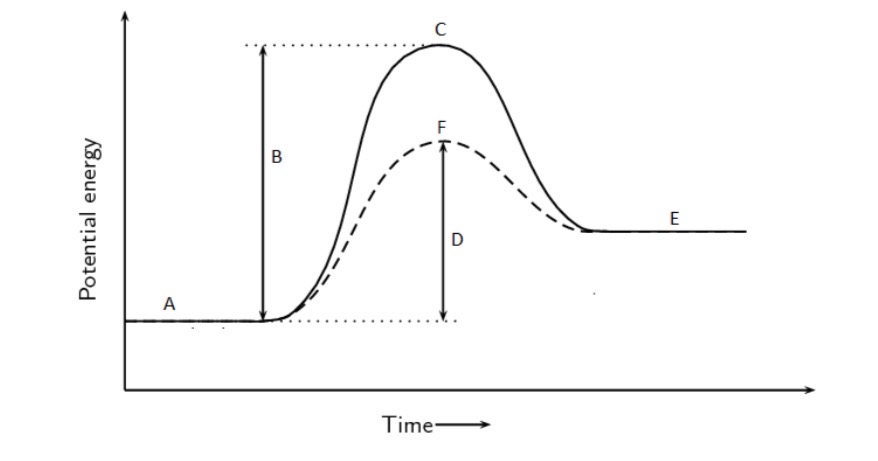
Label parts A to F
A. Energy of reactants
B. Activation energy/ energy absorbed for forward reactions
C. Activated complex, for reaction without catalyst
D. Activation energy for catalysed forward reaction
E. Energy of products
F. Activated complex for reaction with catalyst