Gen MICROBIO LAB PRACTICAL studyguide Cartes
 Call Kai
 Learn
Learn Practice Test
 Spaced Repetition
 Match
Match Flashcards
 Knowt Play
1/143

There's no tags or description
Looks like no tags are added yet.
Name | Mastery | Learn | Test | Matching | Spaced | Call with Kai | Chat |
|---|
No analytics yet
Send a link to your students to track their progress
144 Terms
Steps of the Gram-stain and color of G (+) and (-) along the way
1. smear
- gram (+) control, unknown and gram (-)
- add 1 loop of water to each oval drawn on slide with wax pencil
- use needle to mix a small sample of culture into the appropriate water drop and spread over whole area
2. heat fix sample
3. flood each smeat with CRYSTAL VIOLET (1min) & wash with water
- G(+): purple
G (-): purple
4. flood smears with IODINE (1 min) & wash w/ tap water
- G(+): purple
G (-): purple
5. Decolorize: wash each smear with decolorizer until no purple color in draining liquid
- G(+): purple
G (-): colorless
(USED ALCOHOL-ACETONE)
6. briefly wash smear with tap water
7. counterstain bacteria with SAFRANIN
- G(+): purple
G (-): pink
8. wash with tap water
9. examine slides under bright-field. NO COVER SLIP
WHAT ARE some common methods of visualization for metabolic tets?
- pH indicator ( color change in medium)
- inherently visible reaction product, (can be observed without add indictors or chemicals)
- add chem compound after organism has grown ( chem cpd add to reaction will modify the product or intermediate to form a colored cpd)
what is an enzyme
biological catalysts that lower energy of activation for biochem reactions and permit essential metabolic steps to proceed rapidly
NOT consumed in the reaction
Micrococcus leteus
G (+)
catalase positive
Streptococcus thermophile
G (+)
catalase negative
what is the rate of a enzyme-catalyzed raction depended on
temperature
concentration of enzyme
concentration of substrate
affinity of enzyme for the substrate
why are enzimatic tests good for determining the identity of an organism?
because a microbe's physiological properties are determined by its enzymes capacities
also a microorganism habitat and its interactions with other organisms are a direct reflection of the organism's enzyme complement
What is catalaze? what is its purpose?
catalaze is an enzyme that catalyses the breakdown of hydrogen peroxide (H2O2 - a toxic by-product of aerobic respiration metabolism) to water and gaseous oxygen
purpose of enzymatic test CATALASE? Results
done for GRAM POSITIVE organisms only
to determine if a mciroorganism has catalase
the presence of catalase indicates that the organism MOST LIKELY performes aerobic respiration
add drop of hydrogen peroxide to loopful of bacteria spread on microscope slide. if bubbles of oxygen appear, POSITIVE for catalase
what type of organism can CAtalase enzymatic test be done in?
Gram POSITIVE only
Procedure of CATALASE enzymatic test
add drop of hydrogen peroxide to a loop full of bacteria spread on microscope slide. observe if bubbles or no
what is the purpose of the enzymatic test OXIDASE?
Only done in G (-)
common test to differentiate between families of Pseudomonadaceae (oxidase positive) and Enterobacteriaceae (oxidase negative)
test used to learn if an organism produces certian cytochrome c oxidase.
cytochrome c oxidase is the terminal link in an electron transport chain where oxygen in the terminal electron acceptor.
cytochrome c oxidase is a lipoprotein complex that transfers electrons from cytochrome c to oxygen and pumps protons (H+) across the cytoplasmic membrane
what type of organism can OXIDASE enzymatic test be done in?
G (-) ONLY
Procedure of OXIDASE enzymatic test
1. get amount of culture on a swab
2. use dropper bottle, add drops of 1% tetramethyl-p-phenylenediamine dihydrochloride
3. turn purple ater 10 seconds, oxidase POSITIVE
RESULTS of OXIDASE enzymatic test
turn purple after 10 seconds, oxidase positive
- yes cytochrome oxidase, most likely Pseudomonadaceae family
no purple after 10 seconds, oxidase negative
- no cytochrome oxidase, most likely Enterobacteriaceae family
reagent will turn purple after 20-30 seconds b/c oxidation by the air -> FALSE positive
metabolic test done on G (-) organimss ONLY
CITRATE utilization
MR-VP (Methyl Red & Voges-Proskauer)
SIM (Sulfide Indole Motility)
Nitrate reduction
Eosin-methylene
metabolic tests for G (+) ONLY
Bile Esculine slant
Mannitol salt
6.5% salt broth
Muller Hinton agar and Novobiocin
metabolic tests for G (+) & G (-) Unknowns
carbohydrate utilization
oxygen tolerance
purpose of the CITRATE UTILIZATION metabolic test
G (-) ONLY
to evaluate the microorganisms ability to utilise citrate as its sole source of carbon
negative result: green
positive result: royal blue
Simmons citrate agar (used for CITRATE UTILIZATION metabolic test (G -)) components
sodium citrate - Carbon source
ammonium salts - nitrogen source
bromthymol blue - pH indicator (growth makes pH rise, pH indicator turns green-> blue)
Citrate slant
Original color:
Negative result:
Positive result:
Any chem add to visualize reaction:
G (-)
Original color: GREEN
Negative result: GREEN
Positive result: ROYAL BLUE
Any chem add to visualize reaction:
METHYL RED TEST (MR) metabolic test. purpose
G (-) ONLY
organism's primary fermentation pathway = mixed acid fermentation
(produce - acetic, formic, lactic, and succinic acid + ethanol, molecular H, and carbon dioxide -> accumulation of acids, drop pH. Methyl red bellow pH 4.8 = red )
Methyl Red media
Original color:
Negative result:
Positive result:
Any chem add to visualize reaction:
G(-)
Original color: FAINT YELLOW
Negative result: YELLOW
Positive result: RED
Any chem add to visualize reaction: METHYL RED INDICATOR
Voges-Proskaur (VP) test PURPOSE
G (-)
Microorganisms that do butanediol fermentation pathway
the test detects an intermediary metabolite, Acetoin
VP (Voges-Proskauer)
Original color:
Negative result:
Positive result:
Any chem add to visualize reaction:
G (-)
Original color: FAINT YELLOW
Negative result: BROWN COLOR
Positive result: RED/BURGUNDY
Any chem add to visualize reaction: REAGENT 1: 40% KOH
REAGENT 2: ALPHA-NAPTHOL
SIM metabolic test purpose
G (-)
SIM - Sulfide Indole Motility
produce hydrogen sulfide? (H2S
form indole?
motility?
SIM
Original color:
Negative result:
Positive result:
Any chem add to visualize reaction:
G (-)
Original color: PALE YELLOW
Negative result:
- sulfur: NO COLOR CHANGE
- indole: NO COLOR CHANGE
- motility: GROWTH ONLY ON CENTRAL STAB LINE
Positive result:
- sulfur: BLACK PRECIPITATE
- indole: PINK/DEEP MAGENTA AT TOP OF MEDIUM
- motility: GROWTH RADAITE FROM CENTRAL STAB LINE OUR
Any chem add to visualize reaction: KOVAC'S REAGENT add to detect presence of INDOLE
NITRATE REDUCTION metabolic test purpose
G (-)
microorganism have enzymes nitrate (NO3) reductase and nitrite (NO2) reductase?
Test used to determine if organism reduces nitrate (NO3) to nitrite (NO2)
& if ability of nitrification on both nitrate and nitrite to produce molecular nitrogen
Nitrate reduction
Original color:
Negative result:
Positive result:
Any chem add to visualize reaction:
G (-)
Original color: PALE YELLOW
Negative result:
- NO BUBBLES, NO COLOR CHANGE AFTER ADD REAGENT A& B, RED COLOR AFTER ADD Zn POWDER -> NO NITRATE REDUCTION
Positive result:
- LARGE BUBBLE IN DURHAM TUBE-> NITRATE AND NITRITE REDUCTASES (NITRATES -> NITRITES -> NITROGEN (g))
- NO BUBBLE, RED AFTER ADD REAGEN A & B, POSITIVE NITRATE REDUCTION TO NITRITE
Any chem add to visualize reaction: REAGENT A: SULFURIC ACID
REAGENT B: ALPHA-NAPHTHYLAMINE
If no color change after add reagents, Zn powder add
In a Nitrate reduction metabolic test, what is the purpose of adding Zn powder when there was no color change after adding the reagents A & B?
To confirm a true negative result.
the addition of Zn powder forces the reduction of any remaining NITRATE to nitrITE
If the medium turns red after adding zinc, it confirms that nitrATE was still present in the medium, meaning the bacteria DID NOT reduce nitrate
possible outcomes for Eosin-Methylene Blue (EMB) petri dish
G (-)
Blue-black with GREEN METALLIC SHEEN = POSITIVE (microorganism ferment lactose rapidly)
colorless, mucoid - non-lactose fermenter (NEGATIVE)
Purpose of the Eosin-Methylene Blue EMB metabolic test
G (-)
the medium slighly selecive for G (-), it allows us to differentiate btw organims that can FERMENT LACTOSE and those that cannot
purpose of Bile Esculin slant
G (+)
Selective and differential medium
selects for bile tolerant bacteria and differentiate btw bacteria that can or cannot convert esculin to esculitin
BILE ESCULIN SLANT
Original color:
Negative result:
Positive result:
Any chem add to visualize reaction:
G (+)
Original color: CLEAR, AMBER
Negative result: CLEAR AMBER
Positive result: BLACK
Any chem add to visualize reaction:
Mannitol salt metabolic test
G (+)
Selective and differential medium
selects for halotolerant organisms
differential - organisms can ferment mannitol, which cannot
possible outcomes Mannitol salt slant agar
G (+)
NEGATIVE: No growth, no change in color
POSITIVE:
- POSITIVE mannitol fermentation & halotolerance = Growth and yellow agar
- POSTIVE halotolerance, NEGATIVE mannitol ferment= pink agar
6.5 % salt broth test purpose
G (+)
determine if organisms is halotolerant
6.5 % NaCl TSB
Original color:
Negative result:
Positive result:
Any chem add to visualize reaction:
G (+)
Original color: LIGHT AMBER
Negative result: CLEAR YELLOW
Positive result: TURBID
Any chem add to visualize reaction:
Novobiocin sensitivity test purpose
G (+)
Test for antimicrobial susceptibility testing
medium used: Mueller Hinton Agar (all - purpose)
add Novobiocin disc
Novobiocin is antimicrobial agent target DNA gyrase of bacteria
what is Novobiocin
an antimicrobial agent that targets DNA gyrase of bacteri. interfer with DNA replication
possible outcomes Novobiocin sensitivity test
G (+)
NO ZONE OF INHIBITION (growth througout) - organism is RESISTANT to Novobiocin
ZONE PRESENT, diameter larger than 16mm, organism sensitive to Novobiocin
purpose of carbohydrate utilization (glucose OR lactose)
G (+) & G (-)
to determine if microorganism can ferment
- GLUCOSE by detecting end products (acid or hydrogen gas)
- LACTOSE by detecting acidic end product
Phenol red borth with GLUCOSE
Original color:
Negative result:
Positive result:
Any chem add to visualize reaction:
G (+) & G (-)
Original color: RED
Negative result: NO COLOR CHANGE
Positive result: YELLOW, Bubbles in Durham tube
Any chem add to visualize reaction:
Phenol red browth with LACTOSE
Original color:
Negative result:
Positive result:
Any chem add to visualize reaction:
G (+) & G (-)
Original color: RED
Negative result: NO CHANGE COLOR
Positive result: YELLOW
Any chem add to visualize reaction:
Purpose of the FLUID THIOGLYCOLLATE MEDIUM
to determine the relationship between microorganisms and oxygen concentration
possible outcomes for Fluid Thioglycollate medium metabolic test
OBLIGATE AEROBE: in oxic zone
OBLIGATE ANAEROBE: In bottom of anoxic zone
FACULTATIVE ANAEROBE: Throughtout all tube, high concentration in oxic zone
MICROAEROPHILLIC: Some in oxic zone. Highest concentration in anoxic zone but RIGHT at boarder with oxic zone
AEROTOLERANT: Evenly spread through out all zones
obligate aerobe
organism that requires oxygen in order to live
obligate anaerobe
organism that cannot live in the presence of oxygen
facultative anaerobe
organism that can survive with or without oxygen
if oxygen present, prefers these conditions
microaerophillic
requires only a small amount of oxygen
likes oxygen levels right bellow atmospheric levels
Aerotolerant
do not utilize oxygen but can survive and grow in its presence
in a gram stain, wHAT is the purpose of adding a counterstain? what are the colors of G (+) AND G(-)?
a counterstain is used to recolor cells that have lost the primary stain after alcohol treatment. It contrasts with the primary stain
in lab we used SAFRIN
- G(+): purple
G (-): pink
DURING A GRAM stain what is the purpose of decolorizing agent? And what are the colors of G (+) and G (-) after wash?
it is a solvent, acetone, alcohol or a mix that removes the primary stain from the Gram-negative cell.
The outer membrane dissolves and the G (-) appears colorless.
Also "dehydrates" the G (+) cell wall. the peptidoglycan mesh shrinks and traps crystain violete-iodine complexes.
In both bacterial cells, the plasma membrane is disrupted
in lab we used ALCOHOL-ACETONE
- G(+): purple
G (-): colorless
in a gram stain, what is the purpose of washing the stains with iodine? what are the colors of G (+) and G (-) after the wash?
Iodine is as a mordant so it fixes the crystal violet stain so that it resists washing out.
This step enhanses the color by enhancing a complex formation between the dye and the bacterial cell
- G(+): purple
G (-): purple
During gram stain, waht is the purpose of a primary stain?
what is the color of a gram (+) and gram (-) organims after staining it ?
primary stains stain all cells purple.
in lab we used CRYSTAL VIOLET
G(+): purple
G (-): purple
what type of stain is CRYSTAL VIOLET? what is it used for?
BASIC dye (positive charge)
used for Gram stain
stain cells purple
what other dye could be used as primary stain for gram stain?
basic dyes
ex. methaline blue
gram stain colors = diff
in a gram stain, what is the purpose of heat fixing
to permanently adhere cells into the slide.
when polysaccharides are exposed to heat, they denaturalize so need to make sure not heat up the slide too much or else the gram stain will be unsuccesfull.
In a gram stain, what is the purpose of always smearing a positive and negtive control?
allows us to evaluate our technique and compare the results with the unknown so we cna determine the Gram reaction of it.
Staphylococci
bacteria that grow in clusters that resemble a bunch of grapes.

Streptobacilli
rod-shaped bacteria occurring in chains

streptococci
bacteria that form a chain

diplococci
Spherical bacteria that grow in pairs

tetrads
4 cocci in a square

sarcinal
cuboidal structures of eight or more cells

coccibacilli
very short rods

vibrio
comma shaped
spirilla
spiral, noodle shaped bacteria

Spirochetes
spiral-shaped bacteria that have flexible walls and are capable of movement

what is Negative stain? what is its purpose?
a simple stain that stains the background but leaves the bacteria unstained.
use NIGROSIN (ACIDIC DYE)
use live cells
Purpose: determine an organisms cellular morphology
WHAt is the purpose of gram stain ? what is the significance?
To distinguish between Gram-positive and Gram-negative bacteria.
gram (+) bacteria has a thick peptidoglycan layer in cell wall
gram (-) has a thin peptidoglycan layer. it deos have outer membrane that is composed of lipid bilayer with embeded preoteins and other macromolecules
what type of dye is NIGROSIN and what is it usually used for?
acedic dye
used for negative stain
what is the significance of gram stain procedure in mdeciine?
helps determine what type of drug to utilize to combat the infection by the bacteria
POLYMYXIN for G (-)
isrupt lipid membranes in outer membrane
PENICILLIN for G (+)
interfeer with cell wall construction, prevnt peptidoglycan from being assembled
what are the results of a gram stain?
Gram positive will be purple
Gram negative will be pink
rESTULT of gram stain : G (+) looked pink
what does this mean?
probably over decolorized samples, shrunk cell wall of G + peptidoglycan to a level, inhibiting its ability to retain CRYSTAL violet die
the process for identifying an unknown microbe
from mix culture with unknown ->
unknown isolation via QSP and Slant transfer ->
wet mount so anaylze morphology using miroscopy->
gram stain (determine if gram + or gram - ->
biochemical tests (enzymatic and emtabolic tests) ->
compare to database
In micropipets what does a number in a diffeernt color or under a line mean?
usually it denotes the tenth place
In drawings for microscoscope pciture, What are the things EVERY picture should include?
1. total magnification
( occular lense times 10)
(write as # X)
2. Name of specimen
3. type of microscopy
BF = bright field
PC = phase contrast
4. description of morphology and motility
5. scale bar
( magnification 100x (10 * 10) = 10
400x = 2.5
1000x = 1.0 )
scale double the size of biggest bacteria
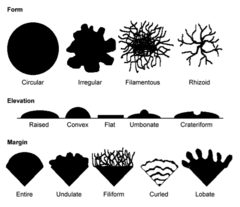
filamentous form

irregular form

punctiform
tiny colonies
bacterial colonies surface is usually...
shiny, smooth
tesxture of bacteria growth can be described as
dry
moist
mucoid
brittle
viscous
butryrous (buttery)
important descriptive terms of the color of bacterial colonies
opawue, cloudy, translucent, iridescent (show lumunois color, change when seen from diff angles)
elevation of colonies we observed in class were usually
flat
Description morphology of bacterail colonies
what is the combination of type of microscopy with correct objective lense (magnification)
BF 0
PC 1 with 10x
PC 2 with 40x
PC 3 100x
How to define the scale bar for a microscopy picture/drawing?
for a magnification of 100x (10 * 10) = 10
400x = 2.5
1000x = 1.0
scale double the size of biggest bacteria
how to determine the total magnification
occular lense times 10
(write as # X)
description of motility
rum & tumble (flagella movement)
swarming ( move across entiere plate as group)
what do microorganisms need to survive?
carbon source, nitrogen, phosphorous and other minerals
Suitable temperature and pH (buffers, weak acids, or bases)
water nutrient transport
and oxygen (or lack of it)
What kind of medium is Trypcase Soy Broth (TSB). What are its ingridients and theri purpose?
pacreatic digest of casein -
enzymatic digest of soybean meal -
NaCl -
Dextrose -
Dipotassium phosphate -
General, all purpose medium
pacreatic digest of casein -
enzymatic digest of soybean meal - nutrients
NaCl - osmotic presure
Dextrose - carbon source
Dipotassium phosphate - buffer
pH 7.3 @ 25C
What kind of medium is Trypcase Soy Agar (TSA). What are its ingridients and theri purpose?
tryptone
soytone
NaCl -
Agar
General all-purpose agar
tryptone (pancreatic digest of casein)
soytone (papaic digest of soybean meal)
NaCl - osmotic pressure
Agar
What kind of medium is Mycophil. What are its ingridients and their purpose?
papaic digest of soybean meal
dextrose -
agar
final pH
selective medium by pH for fungi
papaic digest of soybean meal
dextrose - carbon source
agar
final pH 4.7 at 25C
What kind of medium is MacConkey Agar. What are its ingridients and their purpose?
a selective and differential agar.
Selective for G (-)
selective factor is ampicillin
if microorganism has gene for ampicillin resistant, will grow
differential factor is bacto lactose
if microorganism can digest lactose, agar will be maroon (pH go down)
if cant digest lactose, agar = amber color and colorless colonies (pH go up)
What color do colonies turn in a MacConkey medium if they CANNOT metabolize lactose?
agar turns ambar color and colonies are colorless because to survive, organisms aminate proteins causing the pH go UP
What color do colonies turn in a MacConkey medium if they CAN metabolize lactose?
colonies turn a maroon color because they ferment lactose and produce acid, making the pH go DOWN
what is the purpose of petone, which is found in many agar?
peptone is the principal source of organic nitrogen and may contain carbohydrates or vitamins
% w/v
g/100 mL
what is a medium
sterile base that has all nutrients required for microbial culture of cells to grow