Q1-50
 Call Kai
 Learn
Learn Practice Test
 Spaced Repetition
 Match
Match Flashcards
 Knowt Play
1/49

There's no tags or description
Looks like no tags are added yet.
Name | Mastery | Learn | Test | Matching | Spaced | Call with Kai | Chat |
|---|
No analytics yet
Send a link to your students to track their progress
50 Terms
1. At which of the following layers of the Open Systems Interconnection (OSI) model do the protocols on a typical local area network (LAN) use media access control (MAC) addresses to identify other computers on the network?
A. Physical
B. Data link
C. Network
D. Transport
1. B. The Ethernet (or IEEE 802.3) protocol at the data link layer uses MAC addresses to identify computers on the local network. MAC addresses are coded into the firmware of physical network interface adapters by the manufacturer. The physical layer deals with signals and is not involved in addressing. The IP protocol at the network layer has its own addressing system. The transport layer protocols are not involved in addressing.
2. Which of the following organizations developed the Open Systems Interconnection (OSI) model?
A. International Telecommunication Union (ITU-T)
B. Comité Consultatif International Télégraphique et Téléphonique (CCITT)
C. American National Standards Institute (ANSI)
D. Institute of Electrical and Electronics Engineers (IEEE)
E. International Organization for Standardization (ISO)
2. E. ISO developed and published the OSI model to serve as a conceptual model for software and hardware developers. The ITU-T, formerly known as the CCITT, coordinates the development and advancement of international telecommunication networks and services. ANSI is a private organization that administers and coordinates a United States-based standardization and conformity assessment systein. The IEEE publishes standards that define data link and physical layer standards. These standards are referred to collectively as the 802 series.
3. Which layer of the Open Systems Interconnection (OSI) model is responsible for the logical addressing of end systems and the routing of datagrams on a network?
A. Physical
B. Data link
C. Network
D. Transport
E. Session
F. Presentation
G. Application
3. C. Network layer protocols (such as IP) contain headers that specify logical addresses for end system communication and route datagrams across a network. The physical layer defines standards for physical and mechanical characteristics of a network. The data link layer uses media access control (MAC) or hardware addresses, not logical addresses. The transport layer uses port numbers, not logical addresses. Session layer protocols create and maintain a dialogue between end systems. Presentation layer protocols are responsible for the formatting, translation, and presentation of information. The application layer provides an entry point for applications to access the protocol stack and prepare information for transmission across a network.
4. On a TCP/IP network, which layers of the Open Systems Interconnection (OSI) model contain protocols that are responsible for encapsulating the data generated by an application, creating the payload for a packet that will be transmitted over a network? (Choose all that apply.) A. Physical
B. Data link
C. Network
D. Transport
E. Session
F. Presentation
G. Application
4. B, C, D. Before the payload data generated by an application can be transmitted over a TCP/IP network, the system must encapsulate it by applying protocol headers and footers at three layers of the OSI model. The data link layer applies a header and footer to create an Ethernet fraine. The network layer applies a header to create an IP datagram. The transport layer applies a TCP or UDP header to create a segment or datagram. The other model layers are involved in the payload transmission process, but they do not encapsulate the payload.
5. What layer of the Open Systems Interconnection (OSI) model is responsible for translating and formatting information?
A. Physical
B. Data link
C. Network
D. Transport
E. Session
F. Presentation
G. Application
5. F. The presentation layer implements functions that provide formatting, translation, and presentation of information. No other layers of the OSI model translate and format application data.
6. Which of the following devices typically operates at the network layer of the Open Systems Interconnection (OSI) model?
A. Proxy server
B. Hub
C. Network interface adapter
D. Router
6. D. A router connects networks at the network layer of the OSI model. Proxy servers operate at the application layer. Network interface adapters operate at both the data link and the physical layers. Hubs are physical layer devices.
7. Which layer of the Open Systems Interconnection (OSI) model provides an entrance point to the protocol stack for applications?
A. Physical
B. Data link
C. Network
D. Transport
E. Session
F. Presentation
G. Application
7. G. The application layer provides an entry point for applications to access the protocol stack and prepare information for transmission across a network. All other layers of the OSI model reside below this layer and rely on this entry point.
8. Which layer of the Open Systems Interconnection (OSI) model is responsible for dialogue control between two communicating end systems?
A. Physical
B. Data link
C. Network
D. Transport
E. Session
F. Presentation
G. Application
8. E. The session layer is responsible for creating and maintaining a dialogue between end systems. This dialogue can be a two-way alternate dialogue that requires end systems to take turns transmitting, or it can be a two-way simultaneous dialogue in which either end system can transmit at will. No other layers of the OSI model perform dialogue control between communicating end systems.
9. Some switches can perform functions associated with two layers of the Open Systems Interconnection (OSI) model. Which two of the following layers are often associated with network switching? (Choose all that apply.)
A. Physical
B. Data link
C. Network
D. Transport
E. Session
F. Presentation
G. Application
9. B, C. The primary function of a switch is to process packets based on their media access control (MAC) addresses, which makes it a data link layer device. However, many switches can also perform routing functions based on IP addresses, which operate at the network layer.
10. At which layer of the Open Systems Interconnection (OSI) model are there TCP/IP protocols than
can provide either connectionless or connection-oriented services to applications?
A. Physical
B. Data link
C. Network
D. Transport
E. Session
F. Presentation
G. Application
10. D. There are two types of transport layer protocols: connection-oriented and connectionless. Connection- oriented protocols guarantee the delivery of data from source to destination by creating a connection between the sender and the receiver before any data is transmitted. Connectionless protocols do not require a connection between end systems in order to pass data. The physical layer does not use connectionless or connection-oriented protocols; it defines standards for transmitting and receiving information over a network. The data link layer provides physical addressing and final packaging of data for transmission. The network layer is responsible for logical addressing and routing. The session layer is responsible for creating and maintaining a dialogue between end systems. The presentation layer is responsible for the formatting, translation, and presentation of information. The application layer provides an entry point for applications to access the protocol stack and prepare information for transmission across a network.
11. Which of the following layers of the Open Systems Interconnection (OSI) model typically have dedicated physical hardware devices associated with them? (Choose all that apply.)
A. Physical
B. Data link
C. Network
D. Transport
E. Session
F. Presentation
G. Application
11. A, B, C. The physical layer of the OSI model is associated with hubs, cables, and network interface adapters. The data link layer is associated with bridges and switches. The network layer is associated with routers. The transport, session, presentation, and application layers are typically not associated with dedicated hardware devices.
12. At which layer of the Open Systems Interconnection (OSI) model is there a protocol that adds both a header and footer to the information that is passed down from an upper layer, thus creating a frame?
A. Physical
B. Data link
C. Network
D. Transport
E. Session
F. Presentation
G. Application
12. B. The only layer with a protocol (such as Ethernet) that adds both a header and a footer is the data link layer. The process of adding the headers and footers is known as data encapsulation. All other protocol layers that encapsulate data add just a header.
13. Identify the layer of the Open Systems Interconnection (OSI) model that controls the addressing, transmission, and reception of Ethernet frames, and also identify the media access control method that Ethernet uses.
A. Physical layer; Carrier Sense Multiple Access with Collision Detection (CSMA/CD)
B. Physical layer; Carrier Sense Multiple Access with Collision Avoidance (CSMA/CA)
C. Data link layer; CSMA/CD
D. Data link layer; CSMA/CA
13. C. The Ethernet protocol that handles the addressing, transmission, and reception of frames operates at the data link layer. Each frame includes hardware addresses that identify the sending and receiving systems on the local network. Ethernet uses the CSMA/CD media access control method. Physical layer specifications include the transmission of signals in the form of electrical or light pulses to represent binary code, not frames. CSMA/CA is a data link layer media access control method used by wireless LAN protocols, but not Ethernet.
14. At which layer of the OSI model do you find the protocol responsible for the delivery of data to its ultimate destination on an internetwork?
A. Data link
B. Network
C. Session
D. Application
14. B. On a TCP/IP network, the Internet Protocol (IP) at the network layer is the protocol responsible for the delivery of data to its final destination. Data link layer protocols are only concerned with communication between devices on a Local Area Network (LAN) or between two points connected by a Wide Area Network (WAN) link. The session and application layers are not involved in the actual delivery of data.
15. Which of the following is not a protocol operating at the network layer of the OSI model? A. IP
B. ICMP
C. IGMP
D. IMAP
15. D. Internet Protocol (IP), Internet Control Message Protocol (ICMP), and Internet Group Message Protocol (IGMP) are all network layer protocols. Internet Message Access Protocol (IMAP) is a mail protocol that operates at the application layer.
16. Ed is a software developer who has been given the task of creating an application that requires guaranteed delivery of information between end systems. At which layer of the Open Systems Interconnection (OSI) model does the protocol that provides the guaranteed delivery run, and what type of protocol must Ed use?
A. Data link layer; connectionless
B. Network layer; connection-oriented
C. Transport layer; connection-oriented
D. Application layer; connectionless
16. C. A connection-oriented transport layer protocol, such as Transinission Control Protocol (TCP), provides guaranteed delivery of data for upper layer applications. Connectionless protocols do not guarantee delivery of information and therefore are not a good choice. Guaranteed delivery of information is generally not a function of the data link, network, or application layer.
17. Which of the following devices operates only at the physical layer of the Open Systems Interconnection (OSI) model?
A. Hub
B. Bridge
C. Switch
D. Router
17. A. A hub functions only at the physical layer by forwarding all incoming signals out through all of its ports. Bridges and switches operate at the data link layer by selectively propagating incoming data. Routers operate at the network layer by connecting local area networks (LANs) and propagating only the traffic intended for another network, based on IP addresses.
18. Alice is a network administrator designing a new Local Area Network (LAN). She needs to determine the type of cabling and the network topology to implement. Which layers of the Open Systems Interconnection (OSI) model apply to cabling and topology elements?
A. Physical and data link layers
B. Data link and network layers
C. Network and transport layers
D. Transport and application layers
18. A. The physical layer defines the mechanical and electrical characteristics of the cables used to build a network. The data link layer defines specific network (LAN or WAN) topologies and their characteristics. The physical layer standard that Alice will implement is dependent on the data link layer protocol she selects. The network, transport, and application layers are not concerned with cables and topologies.
19. Which layers of the Open Systems Interconnection (OSI) model do not have protocols in the TCP/IP suite exclusively dedicated to them? (Choose all that apply.)
A. Physical
B. Data link
C. Network D. Transport
E. Session
F. Presentation
G. Application
19. E, F. In the TCP/IP suite, the functions of the session layer are primarily implemented in the transport layer protocols: Transmission Control Protocol (TCP) and User Datagram Protocol (UDP). The presentation layer functions are often implemented in application layer protocols, although some functions, such as encryption, can also be performed by transport or network layer protocols.
20. The protocols at which layer of the Open Systems Interconnection (OSI) model use port numbers to identify the applications that are the source and the destination of the data in the packets?
A. Application
B. Presentation
C. Transport
D. Network
20. C. Transport layer protocols, such as Transmission Control Protocol (TCP) and User Datagrain Protocol (UDP), have header fields that contain the port numbers of the applications that generated the data in the packet and which will receive it. The application, presentation, and network layers do not use port numbers.
21. Which of the following is a correct listing of the Open Systems Interconnection (OSI) model layers, in order, from top to bottom?
A. Physical, data link, transport, network, session presentation, application
B. Application, session, presentation, transport, network, data link, physical
C. Presentation, application, transport, session, network, physical, data link
D. Session, application, presentation, transport, data link, network, physical
E. Application, presentation, session, transport, network, data link, physical
21. E. The correct order of the OSI model layers, from top to bottom, is application, presentation, session, transport, network, data link, physical.
22. At which of the Open Systems Interconnection (OSI) model layers do switches and bridges perform their basic functions?
A. Physical
B. Data link
C. Network
D. Transport
22. B. Switches and bridges are involved in Local Area Network (LAN) communications only and therefore primarily at the data link layer. They are not primarily associated with the physical, network, or transport layers, although some switches include network layer routing capabilities.
23. On a TCP/IP network, flow control is a function implemented in protocols operating at which layer of the Open Systems Interconnection (OSI) model?
A. Presentation
B. Session
C. Transport
D. Network
23. C. Flow control is a process that adjusts the transmission rate of a protocol based on the capability of the receiver. If the receiving system becomes overwhelmed by incoming data, the sender dynamically reduces the transmission rate. In the TCP/IP protocol suite, Transmission Control Protocol (TCP) is responsible for implementing flow control. TCP runs at the transport layer. None of the other layers listed have TCP/IP protocols that provide flow control.
24. Which layer of the Open Systems Interconnection (OSI) model defines the medium, network interfaces, connecting hardware, and signaling methods used on a network?
A. Physical
B. Data link
C. Network
D. Transport
E. Session
F. Presentation
G. Application
24. A. The physical layer of the OSI model defines the standards for the physical and mechanical characteristics of a network, such as cabling (copper and fiber), connecting hardware (hubs and switches), and signaling methods (analog and digital). All of the other layers are not involved in the mechanical characteristics of the network.
25. Which of the OSI model layers is responsible for syntax translation and compression or encryption?
A. Data link
B. Network
C. Session
D. Presentation
E. Application
25. D. The presentation layer provides a syntax translation service that enables two computers to communicate, despite their use of different bit-encoding methods. This translation service also enables systems using compressed or encrypted data to communicate with each other.
26. Which layer of the Open Systems Interconnection (OSI) model is responsible for transmitting signals over the network medium?
A. Physical
B. Data link
C. Network
D. Transport
E. Session
F. Presentation
G. Application
26. A. The physical layer of the OSI model defines the functions specific to the network medium and the transmission and reception of signals. All of the other layers are implemented in software and do not physically send or receive signals.
27. Specify the layer of the Open Systems Interconnection (OSI) model at which the Internet Protocol (IP) operates and whether it is connection-oriented or connectionless.
A. Network; connection-oriented
B. Network; connectionless
C. Transport; connection-oriented
D. Transport; connectionless
27. B. IP is a connectionless protocol that operates at the network layer of the OSI model. There are no connection-oriented protocols at this layer. The protocols at the transport layer include Transmission Control Protocol (TCP), which is connection-oriented, and User Datagram Protocol (UDP), which is connectionless.
28. An Ethernet network interface adapter provides functions that span which two layers of the Open Systems Interconnection (OSI) model?
A. Physical and data link
B. Data link and network
C. Network and transport
D. Transport and application
28. A. An Ethernet network interface adapter functions at the data link layer by encapsulating network layer data for transmission over the network. It provides physical layer functions by providing the connection to the network medium and generating the appropriate signals for transmission. Network interface adapters do not operate at the network, transport, or application layer.
29. Which of the following protocols operate at the application layer of the Open Systems Interconnection (OSI) model? (Choose all that apply.)
А. НТТР
B. SNMP
C. ICMP
D. IGMP
E. UDP
29. A, B. Hypertext Transfer Protocol (HTTP) and Simple Network Management Protocol (SNMP) operate at the application layer. Internet Control Message Protocol (ICMP) and Internet Group Management Protocol (IGMP) both operate at the network layer. User Datagram Protocol (UDP) operates at the transport layer.
30. Which layer of the Open Systems Interconnection (OSI) model would be responsible for converting a text file encoded using EBCDIC on the sending system into ASCII code, when required by the receiving system?
A. Application
B. Presentation
C. Session
B. UDP
C. ARP
D. ICMP
E. TCP
30. B. The presentation layer of the OSI model is responsible for translating different kinds of syntax, including text-encoding systems, such as EBCDIC and ASCII. The application, session, and physical layers do not perform this function.
31. Which of the following protocols operates at the network layer of the OSI model, but does not encapsulate data
generated by an upper layer protocol for transmission over
the network?
A. IP
B. UDP
C. ARP
D. ICMP
E. TCP
31. D. Internet Control Message Protocol (ICMP) operates at the network layer by sending operational and error messages. It does not encapsulate upper layer protocol data. Internet Protocol (IP) operates at the network layer, but it does encapsulate transport layer protocol data. Transmission Control Protocol (TCP) and User Datagram Protocol (UDP) are transport layer protocols that encapsulate upper layer protocol data. Address Resolution Protocol (ARP) does not encapsulate upper layer protocol data, but it is a data link layer protocol.
32. A client on a TCP/IP network is attempting to establish a session with a server. Which of the following correctly lists the order of the TCP flags raised in the Transmission Control Protocol (TCP) session establishment messages?
A. SYN, ACK, SYN, ACK
B. SYN, SYN, ACK, ACK
C. SYN/ACK, SYN/ACK
D. SYN, SYN/ACK, ACK
32. D. The TCP connection establishment exchange is a three-way handshake that uses TCP flags to specify the message type for each frame. The first frame contains a SYN flag from the client; the second frame contains the SYN and ACK flags from the server; and the last frame contains an ACK flag from the client.
33. Which of the following is the Maximum Transmission Unit (MTU) size for an Ethernet frame?
A. 512
B. 1024
C. 1500
D. 1518
33. C. The MTU is the largest amount of data (in bytes) that a protocol operating at a given layer of the OSI model can transmit in one packet. The MTU does not include any header and footer fields supplied by that protocol. For Ethernet, the maximum frame size is 1518 bytes, which includes 18 bytes of header and footer fields. Therefore, the MTU for Ethernet is 1500 bytes. Protocols operating at other OSI model layers can have different MTUs. For example, the typical MTU for an Internet Protocol (IPv4) implementation is smaller than that of Ethernet.
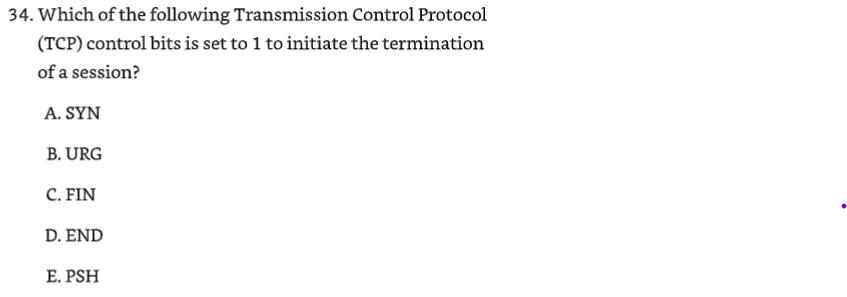
34. Which of the following Transmission Control Protocol (TCP) control bits is set to 1 to initiate the termination
of a session?
A. SYN
B. URG
C. FIN
D. END
E. PSH
34. C. The termination phase of a TCP connection begins when either the client or the server sends a message containing the FIN control bit with a value of 1. The other control bits listed have nothing to do with the connection termination procedure, and there is no END bit.
35. An electrician installing a new light fixture accidentally severs one of the LAN cables running through the dropped ceiling space. With which topology would the severed cable cause the greatest amount of disturbance to the network?
A. Bus
B. Star
C. Logical ring
D. Mesh
35. A. A cable break in a bus topology would split the network into two halves, preventing the nodes on one side of the break from communicating with those on the other. In addition, both halves of the network would be left with one unterminated end, which would prevent the computers on each side of the break from communicating effectively. A cable break in a star or logical ring topology would only interrupt the connection of a single computer to the network. The mesh topology is not often used for LANs, but redundant network connections are a characteristic of mesh networks, which means that a single cable break would have no effect on the network.
36. Which of the following statements about a wired Local Area Network (LAN) is true?
A. Wired LANs support only the star topology.
B. Wired LANs support only the star and bus topologies.
C. Wired LANs support only the star and ring topologies.
D. Wired LANs can support ring, bus, or star topologies.
36. D. A wired LAN is a group of computers within a small area, connected by a cominon network medium. A wired LAN can be configured using a ring, bus, or star topology.
37. Which of the following is an example of a hybrid topology?
A. A workstation with two network interface cards, one of which is connected to a star network and one to a bus network
B. Four Ethernet switches connected using a bus topology
C. Four workstations, each with a separate network connection to each of the other three
D. Four Ethernet switches, each with a separate network connection to each of the other three
37. B. A hybrid topology is a network that uses two or more of the basic topologies, connected together so that each workstation can communicate with all of the other workstations. Connecting four switches to a bus topology combines four-star networks in such a way that the workstations are all interconnected.
Connecting a single workstation to a star and a bus network enables that workstation to access both networks, but it does not enable other workstations to access both topologies. Four workstations, each with a separate connection to the other three, is a mesh network topology, not a hybrid. Four connected switches expands the star topology, but it does not create a hybrid topology.
38. Which type of network is typically confined to a small area, such as a single room, floor, or building?
A. WAN
B. LAN
C. MAN
D. CAN
38. B. A Local Area Network (LAN), as the name implies, is a group of computers contained within a sinall geographic area. WANs (Wide Area Networks) connect LANs that are geographically distant. MANS (Metropolitan Area Networks) are not confined to a small area; they are typically larger than a LAN but smaller than a WAN. A Campus Area Network (CAN) typically includes a group of adjacent buildings, such as those of a corporation or university.
39. Which type of network connects Local Area Networks (LANs) in distant locations?
A. WAN
B. LAN
C. MAN
D. CAN
39. A. WANS (Wide Area Networks) connect LANs that are geographically distant. A LAN (Local Area Network), as the name implies, is a group of computers, not other LANs, and it is contained within a small area. MANS (Metropolitan Area Networks) connect LANs in a single metropolitan area; they are not confined to a small area. A MAN is typically larger than a LAN but smaller than a WAN. A Campus Area Network (CAN) typically includes a group of adjacent buildings, such as those of a corporation or university.
40. Which of the following topologies requires the installation of terminating resistors at two locations?
A. Bus
B. Star
C. Ring
D. Mesh
40. A. A bus topology requires terminating resistors at each end of the bus, to remove signals as they reach the end of the cable and prevent them from reflecting back in the other direction and interfering with newly transmitted signals. Star, ring, and mesh topologies do not require terminating resistors.
41. Which of the following topologies is used by the majority of new Ethernet networks installed today? A. Bus
B. Virtual ring
C. Mesh
D. Hierarchical star
41. D. Virtually all of the new Ethernet networks installed today use the star or the hierarchical star topology, with one or more switches functioning as a cabling nexus.
42. Alice has constructed a five-node failover cluster in which all five servers are connected to a hard disk array using a dedicated Fibre Channel network. Which of the following terms describes this network arrangement?
A. SAN
B. PAN
C. WAN
D. MAN
42. A. A storage area network (SAN) is a network that is dedicated to carrying traffic between servers and storage devices. A Personal Area Network (PAN) provides communication among devices associated with a single person, such as smartphones. A Wide Area Network (WAN) is a network that connects devices or networks at different geographic locations. A Metropolitan Area Network (MAN) is a type of WAN that connects devices within a limited geographic area.
43. Which of the following is not a technology typically used for a personal area network (PAN)?
A. Bluetooth
B. Z-Wave
C. NFC
D. SDWAN
43. D. A Software-Defined Wide Area Network (SDWAN) is a technology that automates the configuration of WAN routers based on the current mix of traffic. It is therefore not suitable for use on a PAN. Bluetooth, Z- Wave, and near-field communication (NFC) are all short-range wireless technologies that are capable of providing communications between PAN devices.
44. Which of the following network topologies are used by Wireless Local Area Networks (WLANs)? (Choose all that apply.)
A. Ad hoc
B. Bus
C. Infrastructure
D. Star
44. A, C. WLANs can use the ad hoc topology, in which devices communicate directly with each other, or the infrastructure topology, in which the wireless devices connect to an access point. The bus and star topologies are used by wired networks only.
45. Which of the following cabling topologies was used by the first Ethernet networks?
A. Bus
B. Ring
C. Star
D. Mesh
45. A. The first Ethernet networks used a physical layer implementation commonly known as Thick Ethernet or 10Base5. The network used coaxial cable in a bus topology. Later Ethernet standards use twisted pair cable in a star topology. Ethernet has never used a ring or mesh topology.
46. On an Ethernet network using the star topology, which of the following devices can function as the cabling nexus that forms the figurative center of the star? (Choose all that apply.)
A. Hub
B. Router
C. Switch
D. Access Point
46. A, C. A hub or a switch can function as the cabling nexus at the center of an Ethernet star topology. Each of the devices on the network is connected by a cable to a hub or switch. Routers are used to connect networks to each other; they cannot function as the center of a star topology.
47. Which of the following cabling topologies provides the greatest number of redundant paths through the network?
A. Star
B. Ring
C. Mesh
D. Bus
47. C. A mesh topology is one in which every node is directly connected to every other node, therefore providing complete redundancy through the network. In a star topology, each node is connected to a central nexus, providing each with a single path to the rest of the network. In a ring topology, each node is connected to two other nodes, providing two possible paths through the network. In a bus topology, nodes are chained together in a line, providing no redundancy.
48. Which of the following Ethernet physical layer options does not use the star topology?
A. 10Base2
B. 10Base-T
C. 100Base-TX
D. 1000Base-T
48. A. 10Base2 is the physical layer specification for Thin Ethernet, which uses coaxial cable in a bus topology. 10Base-T, 100Base-TX, and 1000Base-T all use twisted pair cable in a star topology.
49. Which of the following network types are typically wireless? (Choose all that apply.)
A. WAN
B. PAN
C. SAN
D. WLAN
49. B, D. Personal area networks (PANs) connect devices associated with a single person, such as smartphones, and are nearly always wireless. Wireless Local Area Networks (WLANs) are wireless by definition. Wide Area Networks (WANs) typically span long distances and are typically wired, at least in part. Storage area networks (SANs) require high performance levels and are nearly always wired.
50. Dense Wave Division Multiplexing (DWDM) is a signaling technology that has become a popular choice in the construction of which of the following types of provider links?
A. Digital Subscriber Line (DSL)
B. Metro-optical
C. Satellite
D. Cable
50. B. DWDM has become a popular technology in the construction of metro-optical networks because it addresses some of the scalability and cost restrictions of other optical technologies, such as Synchronous Optical Networks (SONETS). DSL, satellite, and cable providers do not typically use DWDM.