Qualitative and Mixed Methods Research Designs Module
 Call Kai
 Learn
Learn Practice Test
 Spaced Repetition
 Match
Match Flashcards
 Knowt Play
1/24

There's no tags or description
Looks like no tags are added yet.
Name | Mastery | Learn | Test | Matching | Spaced | Call with Kai | Chat |
|---|
No analytics yet
Send a link to your students to track their progress
25 Terms
what is a research paradigm?
a belief system or theory that guides the way we do things and for researchers provides a framework for our rresearch
3 key characteristics of a theoretical framework
ontology - what is reality?
epistemology - how do you know something
methodology - how do you go about finding it out
ontology
what is reality
epistemology
what is knowledge
theoretical persepctive
what approach can we use to get knowledge
methodology
what procedure can we use to acquire knowledge
methods
what tools can we use to acquire knowledge
sources
what data can we collect
4 research paradigms
positivism
interpretivism
critical theory
pragmatism
critical theory paradigm
Critical theory paradigm addresses the need to go beyond simply interpreting what is happening in the world
Researchers using critical approaches concern themselves with issues related to power, oppression, justice, equality and freedom
pragmatism
Pragmatism is a philosophy that focuses on the practical nature of reality, findings truth in the solutions of problems and the consequences of objects & actions
Illustration of an object viewed from different perspectives
table
Worldview | Object definition |
|---|---|
Positivist perspective | A table. (No matter how it is was or is intended to be used) |
Constructionist perspective | A table if she was eating from it, a bench if she was sitting on it and a platform if she was standing on it. |
Pragmatist perspective | A table if she intended eating from it, a bench if she intended sitting on it and a platform if she intended standing on it. |
summary table
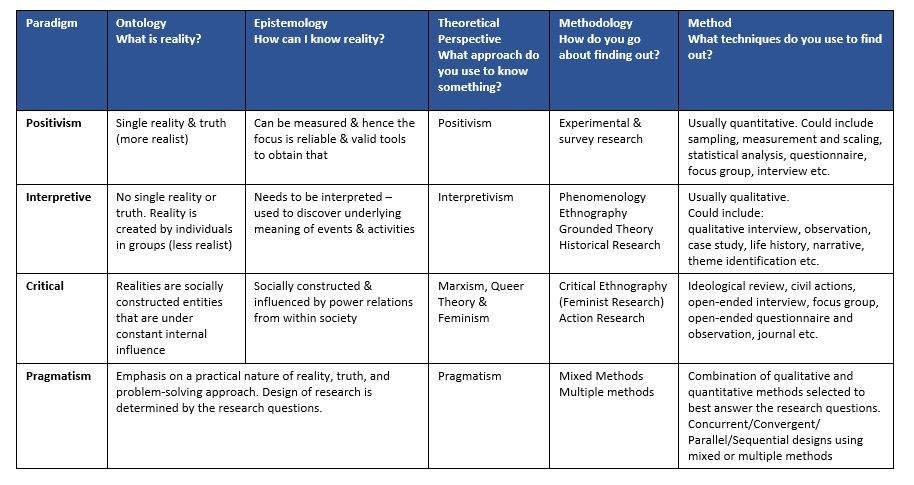
Qualitative research- how/why
uses non-numerical data, and seeks to interpret meaning from these data, to understand and explain specific perspectives of targeted populations or places.
typically explores many aspects of the social world, including personal experiences and expectations, the workings of social processes and relationships, the way institutions work, and the importance of shared meaning.
collecting qualitative data
Qualitative studies often have small sample sizes - deliberately selects participants because of specific characteristics, which are relevant to the research question
analyzing qualitative data
Listen to, read transcripts, and review documents to gain an overall sense of the data
Collect and allocate data into codes that convey similar categories or meaning
Make comparisons between codes within and across transcripts/participants, to clarify common meaning and to identify differences
New codes may be required as analysis progresses, and sub-categories may also emerge within some codes
A level of interpretation usually occurs through the emergence of themes, which represent a deeper level of explanation within and across codes
Present the data to convey meaning, using quotes, tables and diagrams
Quantitative Research
‘Explaining phenomena by collecting numerical data that are analysed using mathematically based methods
a formal, objective, systematic process in which numerical data are utilized to obtain information about the world" and "a research method which is used to describe and test relationships and to examine cause-and-effect relationships"
elements of quantitative research
thee research is curious about a problem or clinical population
the researcher generates a theory or hypothesis
to test the hypothesis the researcher collects data
data is then analysed using statistical tests
the analysis of the data either supports the theory or hypothesis or causes the researcher to generate new theories
mixed methods
Complex situations, where it is important to elaborate, enhance or clarify research findings from one method, to understand both the depth and breadth of a situation
Researchers can use both words and numbers to communicate results and findings from one or more participating groups to convey complexity to a wide audience
Further explanation of results is needed
Data collected using a quantitative data instrument, may be better understood by interviewing a subset of participants who provide more detailed information about some of survey responses
Development of theories and instruments
Exploratory qualitative interviews about how individuals describe or feel about a particular topic can be used to develop quantitative surveys
Multi-phase research projects describe changes over time
How do you start to design a mixed methods study?
degree of interaction
implementation sequence
relative priority of qualitative and quantitative data
timing of integration
4 common mixed methods designs
convergent / concurrent / parallel mixed methods design
explanatory mixed methods design
exploratory mixed methods design
embedded mixed methods design
convergent / concurrent / parallel mixed methods deisgn
In this design, the investigator collects both quantitative and qualitative data simultaneously, often both sets of data are analysed separately, and the results merged in the interpretation. Most often, qualitative and quantitative data are given equal emphasis and together they provide a deeper explanation of the topic
explanatory mixed methods design
In this design, the investigator first gathers and analyses quantitative data, and then uses qualitative data collection and analysis to explain the quantitative results. This type of study is often quantitatively driven and the quantitative phase emphasised. Often, the quantitative results from phase 1 are used to purposefully select participants and focus the interview questions for phase 2 qualitative interviews or focus groups.
exploratory mixed methods design
In this design, the investigator begins with an initial qualitative exploration, designed to explore a construct that is not sufficiently described in the literature, is poorly measured or not aligned to a specific population. After this, the investigator follows up with a quantitative data collection phase to determine if the qualitative findings can be translated to a sample of a population. This design is often qualitatively driven during the first phase. This design is often used to develop new quantitative instruments.
embedded mixed methods design
In this design, the investigator embeds one form of data collection in a larger study designed to collect a different form of data. This is a popular design in clinical trials, where qualitative data are embedded (or nested) within a larger experimental trial. The timing of the smaller embedded study can vary. The investigator may collect qualitative, personal data before the quantitative experimental intervention to help design the intervention, or they may collect qualitative data during the intervention to understand the process experiences of participants and augment the outcome experimental data. Further, the investigator may collect qualitative information at the end of the intervention, as a longer term follow up, to help explain the outcomes. Usually, qualitative data are embedded in a predominantly quantitative study and data can be collected and analysed concurrently or sequentially.