9- included, impacted and retained teeth
 Studied by 0 people
 Call Kai
 Learn
Learn Practice Test
 Spaced Repetition
 Match
Match Flashcards
 Knowt Play
1/19

There's no tags or description
Looks like no tags are added yet.
Name | Mastery | Learn | Test | Matching | Spaced |
|---|
No study sessions yet.
20 Terms
What is an included tooth?
Remains inside bone having reached normal period of eruption
What is an impacted tooth?
Lack of eruption by a physical barrier- either another tooth, bone or soft tissues- or abnormal position of tooth
What is a retained tooth?
No physical obstacle, malposition or abnormal development to explain the interrupted eruption
What are the 2 subtypes of retained teeth?
Primary- tooth located in thickness of bone
Secondary- tooth emerges but eruption stops- fails to reach occlusal plane
What is an ectopic tooth?
Tooth developed outside its normal position
Ectopic inclusion- included in an abnormal position near its normal site
Heterotrophic inclusion- included in an abnormal position far from its normal site
What are the frequency of inclusions?
Lower 3rd molar
Upper canine
Upper 3rd molar
Lower 2nd premolar
Lower canine
What are 9 hereditary prenatal general retention factors?
Facial asymmetries
Micro and macrognathia
Oligodontics and hypodontics
Alteration in shape
Paladar and cleft lip
Diastemas by frenulum
Deep overbite
Crowding and rotating teeth
Upper maxillary retrognathism and mandibular prognathism
What is a congenital prenatal general retention factor?
By maternal pathology in pregnancy
What are 2 postnatal general retention factors and give an example?
Endocrine disturbances- hypothyroidism
Metabolic alterations- rickets
What are 4 rare conditions of general retention factors and their presentations?
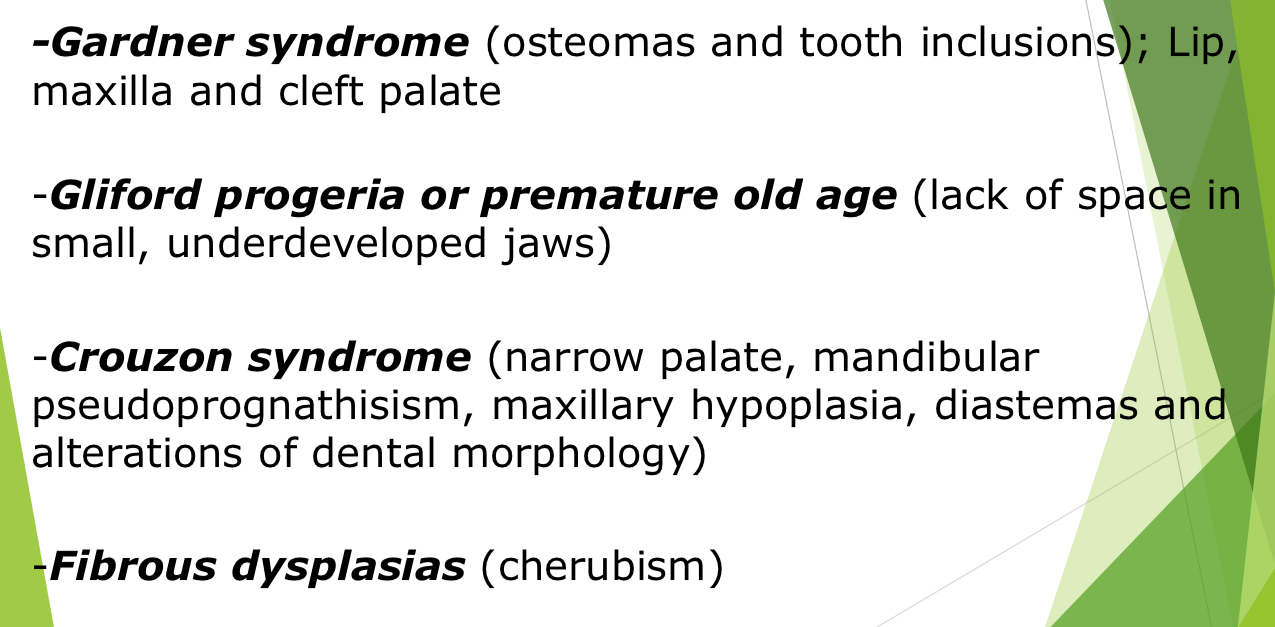
Gardner syndrome
Gliford progeria or premature old age
Crouzon syndrome
Fibrous dysplasias
How do embryological factors cause retention?
Abnormal position of germ
Delayed germ eruption
Common in upper canine or lower third molar
What are 4 DENTAL mechanical obstacles causing included teeth?
Inclined teeth due to premature loss of temp tooth
Retained temp tooth
Supernumeraries
Tumours- odontomas, osteomas- block germ
What 5 SOFT TISSUE mechanical obstacles cause included teeth?
Dental cysts
Congenital gingival fibromatosis
Post traumatic mucous scars
Infectious pathology
Chronic non infectious inflammation
How does lack of space cause included teeth?
Blocked by adjacent structures- 2nd M, bone cortical, mand ascending branch
Dento-maxillary disharmony- large teeth vs small base
No space maintainer
Retrognathia of upper alveolar bone
Excess dental material
Upper lip frenulum with low insertion and diastema
What therapeutic possibilities before a dentarian inclusion?
Abstention
Place tooth in arch
Extract
Why should you abstain from treating included teeth?
Patient has general contraindications
Manipulating tooth causes complications
No associated pathology- regular check up
Why do you treat included teeth by placing tooth in arch and what 3 techniques?
For aesthetics and functional
Conductive alveolotomy- remove bone to guide eruption
Dental transplant- reposition tooth into socket
Orthodontic-surgical methods
Why should you extract an included tooth?
Pathology, can’t place in arch
3rd molar associated with cysts, tumours or destruction of adj bone/tooth
Prophylatic extraction
Operation sequence in exodontia of included teeth (6)
Incision and full thickness flap detachment
Ostectomy- remove enough alveolar bone to move tooth/perform odontosection
Luxation
Odontosection- decreases bone resection, less pain/swelling post op
Extract
Repair area- edge regularisation, replace flap and suture
What instruments are used in each stage of operation sequence in exodontia of included teeth?
Scalpel- blade 15, periosteal elevator, separator/retractor
Handpiece- irrigate, round tungsten or lindemann carbide
Elevators
Fissure bur, handpiece
Elevator and forceps
Regularise with rongeur forceps and bone files, curette granulation tissue