BIOL 265 Exam 1 Preparation
 Call Kai
 Learn
Learn Practice Test
 Spaced Repetition
 Match
Match Flashcards
 Knowt Play
1/84

Earn XP
Description and Tags
Questions relating to key points found in the lecture slides.
Name | Mastery | Learn | Test | Matching | Spaced | Call with Kai | Chat |
|---|
No analytics yet
Send a link to your students to track their progress
85 Terms
Elements are made of _______.
Atoms
The Atomic Number identifies the element and gives the number of ______ an element has.
Protons
The Mass Number is the approximate mass of the atom and is the sum of _______________.
Protons and Neutrons
An Electron has a ____________, and the charge of the atom depends on the difference between the number of protons and electrons.
Negative Charge
Isotopes
Atoms of the same element that have different number of neutrons.
The outermost shell is called _________.
Valence Shell
The number of ______________ determines how likely an atom is to react with other atoms.
Valence Electrons
Atoms typically want their outer shell to be full, and to achieve this they may:
Give away electrons (e-)
Take or accept e-
Share electrons
Valence
An atom’s ability to gain, lose, or share electrons to fill its outer shell. In other words, an atom’s bonding capacity.
Atoms combine to form a __________. Two or more different elements form a ________. (Ex. H2O)
Molecule; Compound
Chemical Bond
An attraction between atoms that enables them to stay close together.
Ionic Bond
One atom gives an electron to another. Electrons are transferred
Ions
Atoms that are electrically charged as a result of gaining or losing electrons.
Atoms with less than half of their outer electron shell:
Cation = loses electrons; becomes positive (+)
Atoms with more than half of their outer electron shell:
Anion = gains electrons; becomes negative (-)
Covalent Bond
Two atoms share one or more pairs of outer shell electrons. Electrons are shared.
Atoms held together by covalent bonds form a ________.
Molecule
Hydrogen Bond
A weak attraction between a slightly positive hydrogen and a slightly negative atom on another molecule.
NOTE: NOT THE SAME as covalent bonds.
To break a bond, ______________ is needed. Energy is released when new bonds are formed.
Activation Energy
Endergonic Reaction
Absorbs more energy than it releases.
Exergonic Reaction
Releases more energy than it absorbs.
The metabolic processes that build complex molecules from simpler ones is called ____________________.
Anabolic Reactions (or Anabolism)
The metabolic processes that break down large, complex molecules into simpler units while releasing energy is called ____________________.
Catabolic Reactions (or Catabolism)
Exchange Reactions are part _____________ and part ______________.
Synthesis; Decomposition
A chemical reaction that is readily reversible is called __________.
Reversible Reaction
Enzymes
Biological catalysts that speed up chemical reactions. They lower a reaction’s activation energy.
Activation Energy
The amount of energy the reactants in the reaction must absorb to start the reaction.
Catalyst
A substance that lowers the activation energy, but is not used up itself.
Active Site
The region of an enzyme where the substrate fits for the reaction to occur.
Substrate
The reactant specific to that enzyme.
Water is ______. Oxygen is slightly negative (-) and Hydrogen is slightly positive (+).
Polar
The FOUR important properties of water:
Water forms hydrogen bonds, giving it a high boiling point.
Ice floats because solid water expands (due to hydrogen bonds) and is less dense than liquid water.
An excellent solvent.
Builds or breaks down molecules.
Acids
A chemical that donates H+ (hydrogen ions) to solutions, therefore increases [H+] and pH decreases.
Bases
A chemical that donates OH- (hydroxyl ions) to solutions, therefore decreases [H+] and pH increases.
Salts
A substance that dissociates in water into cations and anions, neither of which is H+ or OH-.
Buffer
Substances that helps prevent large changes in pH, therefore help maintain pH.
Chains of carbon atoms is called a ________________.
Carbon Skeleton
Functional Groups
Determines many of the molecule’s properties.
Gives characteristic properties.
Participate in chemical reactions.
Classify organic compounds.
Macromolecules
Very large organic molecules. Often made by joining many smaller molecules together.
One small building block makes up a _________. Many monomers joined together make up a _________.
Monomer; Polymer
Dehydration Synthesis
The process of joining two monomers together by removing water (H2O).
Hydrolysis Synthesis
Breakdown of polymers with water into monomers.
Adenosine Triphosphate (ATP)
Building them requires energy. ATP is the cell’s main source of energy.
Carbohydrates
Quick energy for cells.
Mainly made of C, H, and O.
Sugars and Starches.
Ex. Monosaccharides, Disaccharides, Polysaccharides
Chitin
Structural polysaccharides. Found in fungal cell walls. It is also found in the exoskeletons of insects, crabs, etc.
Types of Lipids:
Fats
Phospholipids
Steroids
Triglycerides
Simple lipids that consists of 1 glycerol molecule and 3 fatty acid molecules.
Saturated Fatty Acids
Chains are straight and have the maximum number of hydrogen atoms. There are no double bonds between carbon atoms.
Unsaturated Fatty Acids
Creates kinks/bends and contains one or more double bond(s).
Phospholipids
Made up of 1 glycerol, 2 fatty acids, and 1 phosphate group.
Steroids
Instead of long fatty acid chains, they have 4 interconnected carbon rings.
Ex. Cholesterol and Sex Hormones
Amino Acids
The building blocks of proteins.
Basic Amino Acid Structure:
Amino Group: -NH2
Carboxyl Group: -COOH
Both attatched to an alpha carbon along with an R Group
_________ determines the amino acid. The _________ on the side chain is different in each amino acid.
R Group
Most amino acids found in proteins are ______________.
Alpha-amino Acids
Some amino acids can exist as _____________, a mirror-image form.
Stereoisomers
Proteins are made almost exclusively from L-amino acids. Except: _______.
Glycine
Peptide Bonds
This bond forms between a carboxyl group of one amino acid and an amino group of another amino acid.

Protein Structure: Primary
Exact order of amino acids in the polypeptide chain.
Think: Sequence.
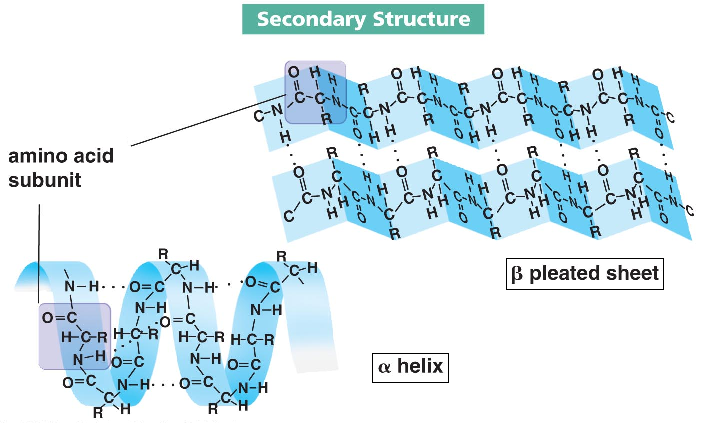
Protein Structure: Secondary
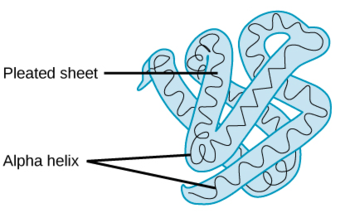
Coiling or folded sheets held together by Hydrogen Bonds between neighboring amino acids.
Think: Helices + Plated Sheets + Hydrogen Bonds
Protein Structure: Tertiary
An Overall 3D shape of ONE polypeptide. Caused by interactions between R Groups (side chains).
Think: 3D shape + R-Group interactions

Protein Structure: Quaternary
Some proteins may be formed by including 2-4 tertiary structures (sub-units) that work together.
What are the monomers of proteins?
Amino Acids
What type of bond holds the secondary structure of a protein together?
Hydrogen Bonds
Which structural level ultimately dictates the overall shape of a protein?
Primary
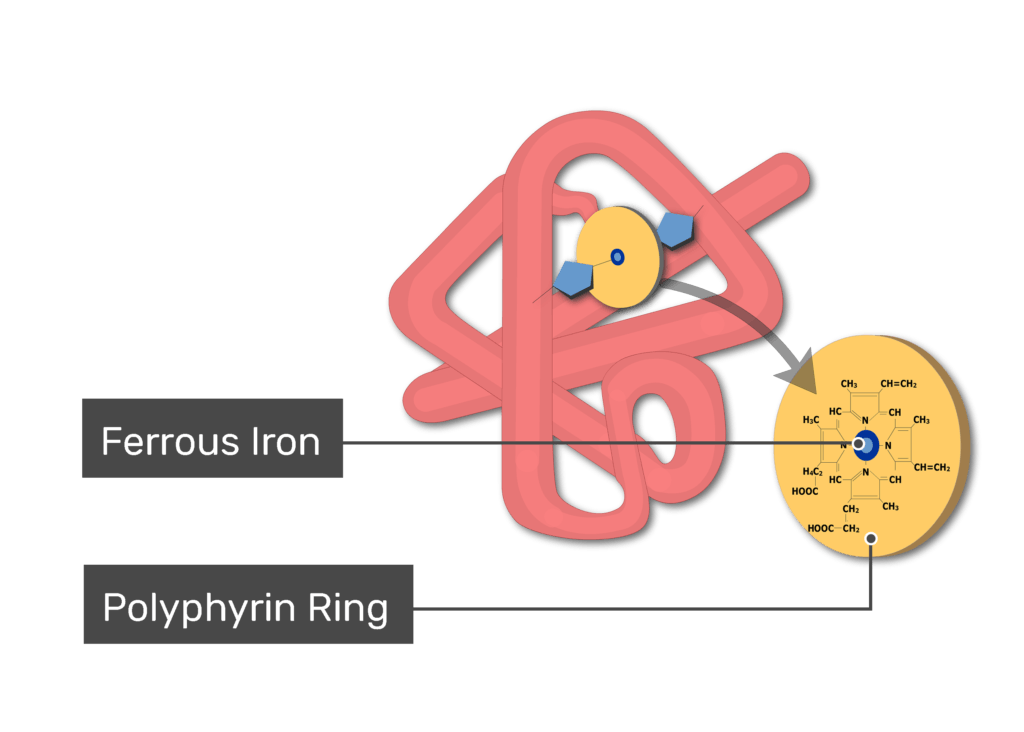
What level of protein structure is exhibited in this protein, known as Myoglobin?
Tertiary
_____________ are the building blocks of nucleic acids.
Nucleotides
Nucleic Acids
Molecules that store, transmit, and help use genetic information.
DNA: Deoxyribonucleic acid
RNA: Ribonucleic acid
Nitrogenous Bases
Adenine, Thymine, Cytosine, Guanine, and Uracil.
Nucleotide = _______________________.
Nucleoside (Base + Sugar) + Phosphate
The sides of the DNA’s double helix is made of _________________. The inside is made of __________________.
Deoxyribose sugar + Phosphate; Nitrogenous Base Pairs
Genes
A segment of DNA that contains information needed to produce a functional product, often a protein. They determine hereditary characteristics and regulate cellular activities.
mRNA (Messenger RNA)
Carries genetic information from DNA for protein synthesis.
rRNA (Ribosomal DNA)
Forms an important part of ribosomes, where proteins are made.
tRNA (Transfer RNA)
Brings amino acids to the ribosome during protein synthesis.
ATP consists of:
Adenine + Ribose + 3 Phosphate Group
ATP can release usable energy when its terminal phosphate is removed:
ATP —> ADP (adenosine diphosphate) —> Pi (lnorganic Phorsphate)—> energy
What type of bond links nucleotides along the sugar-phosphate backbone of DNA?
Covalent Bonds
What type of bond links nucleotides between the nitrogenous bases of the double strand of DNA.
A Hydrogen Bond
What type of bond links nucleotides along the sugar-phosphate backbone of DNA?
A Covalent Bond
Who was it that established scientific nomenclature and published the Systema Naturae?
Carolus Linnaeus
Prokaryotic:
Bacteria and Archaea.
Eukaryotic:
Fungi, Protozoa, and Algae.
Viruses are: __________________________________________.
Acellular and require a living host cell in order to replicate.
Helminths
Parasitic flatworms and round worms.
Who created the Cell Theory?
Rudolf Virchow stated that “all cells arise from preexisting cells.”