BISC208 Exam 3
 View linked note
 Call Kai
 Learn
Learn Practice Test
 Spaced Repetition
 Match
Match Flashcards
 Knowt Play
1/47

There's no tags or description
Looks like no tags are added yet.
Name | Mastery | Learn | Test | Matching | Spaced | Call with Kai | Chat |
|---|
No analytics yet
Send a link to your students to track their progress
48 Terms
Biotic Factors
All of the living organisms in an area that affect an organism's interaction with the environment.
Abiotic Factors
The nonliving components of the environment, including physical and chemical factors.
Habitat
The biotic and abiotic factors present in an organism's surroundings.
Population
A group of individuals of the same species living in a particular geographic area.
Community
All the populations of organisms living close enough together for potential interaction.
Ecosystem
Both the abiotic and biotic components of the environment in an area.
Biosphere
All of Earth that is inhabited by life, extending from the atmosphere to the depths of the oceans.
Primary Succession
Begins in a virtually lifeless area with no soil, such as after a volcanic eruption.
Secondary Succession
Occurs when a disturbance destroys an existing community but leaves the soil intact.
Mutualism
A form of symbiosis where both partners benefit from the relationship, such as corals and dinoflagellates.
Interspecific Competition
Competition that occurs when the niches of two populations overlap and both need a resource that is in short supply.
Altruism
Behavior that benefits others at a cost to oneself, often explained by kin selection.
Population Density
The number of individuals of a species per unit area or volume.
Trophic Structure
The feeding relationships between organisms in a community, defining how energy and nutrients flow.
Carbon Cycle
The cycle of carbon between biotic and abiotic components of the environment, involving processes like photosynthesis and respiration.
Phosphorus Cycle
The cycle of phosphorus through the ecosystem, primarily sourced from the weathering of rocks.
Nitrogen Cycle
The cycle of nitrogen in the ecosystem, which depends on bacterial processes to convert atmospheric nitrogen into usable forms for organisms.
Biomagnification
The process where the concentration of toxins increases in organisms at each successive trophic level.
Greenhouse Gases
Gases that trap heat in the atmosphere, contributing to climate change.
Ecological Niche
The sum of an organism’s use of the biotic and abiotic resources in its environment.
Examples of Abiotic Factors:
Water, sunlight, soil, temperature
Examples of Biotic Factors:
Animals, plants, bacteria
Organism
Individual
Population
Group of individuals living in a particular area
Community
Multiple populations living close enough to interact
Ecosystem
Both abiotic and biotic components of the environment in an area
Landscape
An array of ecosystems usually visible from the air as patches
Biosphere
All of Earth from deep ocean to atmosphere
DDT
Pesticide employed against mosquitoes
DDT Debate
Argues against widespread use of chemicals lingering in food, soil and water and affecting birds of prey
Biomagnification
Small levels of toxin get concentrated as it rises in trophic levels. Since birds of prey are at the top DDT affects them most.
Equatorial regions
Receive sunlight more directly
Higher latitudes
Receive sunlight at more of a slant
Seasons
Caused by Earth’s permanent tilt. Summer tipped toward the sun, winter tipped away.
Gulf Stream
brings warm water from the carribean up the coast of north america then over to north europe
Downstream rivers
wide, slow moving, high nutrients, murky
near river source
narrow, fast, cold, low nutrients, clear
wetlands
reduce flooding, filtration of pollutants
Innate behaviors
do not need to be learned
Clumped dispersion
individuals are grouped in patches due to resources or predators
uniform dispersion
individuals are equally spaced due to territorial interactions
random dispersion
spaced in unpredictable ways like random dispersal of windblown seeds
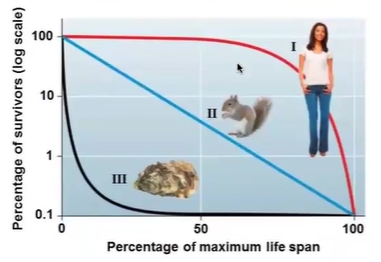
survivorship curves
plot survivorship as the proportion of individuals from an initial population that are alive at each age
type 1 survivor
humans, most live to old age and drop slowly
type 2 survivor
squirrels, uniform death
type 3 survivor
marine organisms, lot of death in younger organisms, some survive to old age
boom and bust cycles
predator cycles closely follow prey cycles, moose go up followed by wolf go up