Homeostasis & Water
 Call Kai
 Learn
Learn Practice Test
 Spaced Repetition
 Match
Match Flashcards
 Knowt Play
1/7

Earn XP
Description and Tags
Name | Mastery | Learn | Test | Matching | Spaced | Call with Kai | Chat |
|---|
No analytics yet
Send a link to your students to track their progress
8 Terms
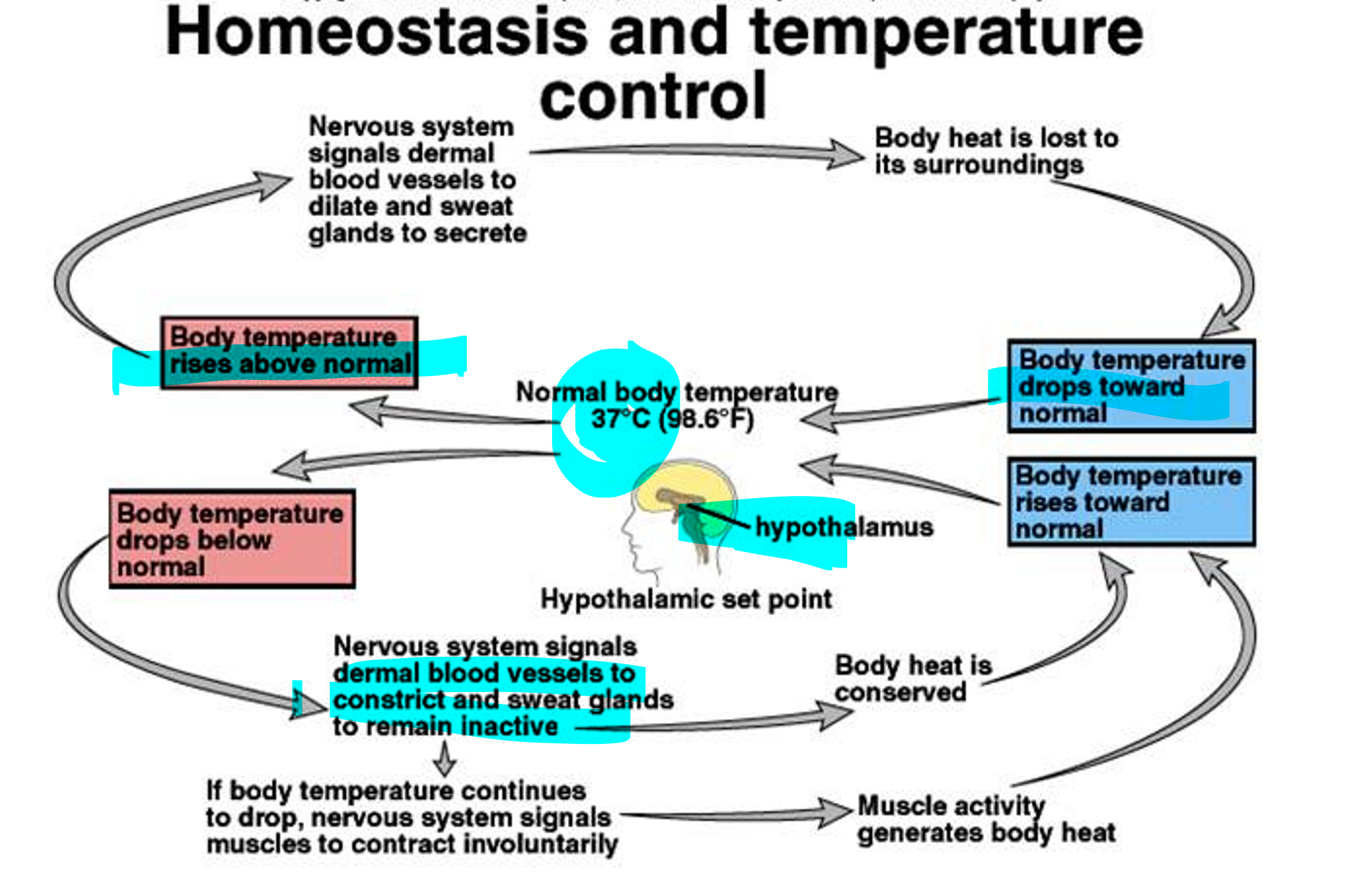
Homeostasis
The ability of the body to keep its internal environment stable.
Thousands of chemical reactions occur in a precise rhythm, even when the environment changes.
→ Ex: constant body temperature, heart rate, O2 levels, water levels, etc.
Importance of Water
Vital for human beings - makes up ~ 60% of our mass.
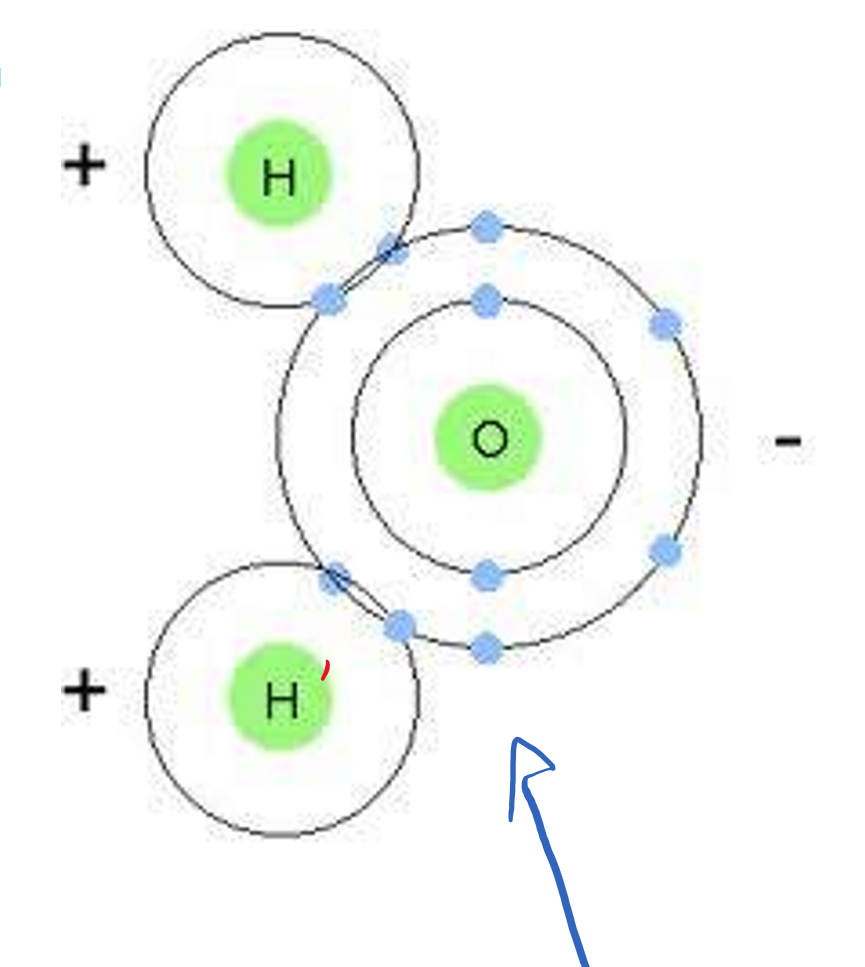
Most important characteristic: polar molecule.
Electrons are shared unequally between the oxygen atom and the hydrogen atoms.
Oxygen is more “electron-greedy”
→ Draw electrons closer to the O-side of the molecule than the H-side.
O-side gains a slightly negative charge
H-end gains a slightly positive charge
→ O-end attracts H-end through a hydrogen bond, which pulls molecules together.
These bonds alter how molecules behave.
Polar → Has several characteristics
High molecular cohesion
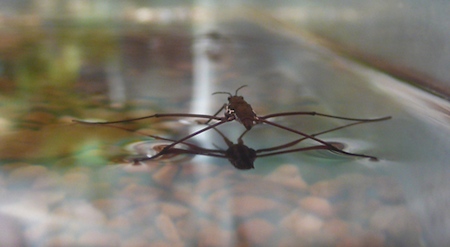
Cohesion: Molecules stick to themselves.
→ Creates surface tension.
Surface tension: a property allowing liquids to resist external force.
Insects can walk on water, and this is why water “beads up”.
H-bonding between water molecules
Solid ice is less dense than liquid water!
Water expands when it freezes and becomes less dense when frozen.
Thus, lakes and rivers don’t freeze from the bottom up but instead have a layer of insulating ice on the top.
Water is a lubricant (= move easily)
H2O molecules cohere under pressure in joints.
Water has polar adhesion to other polar molecules
Adhesion: water molecules stick to other substances.
Can, therefore, spread easily.
H2O molecules move through tiny spaces by adhering to polar surfaces and by cohering to each other.
causes “capillary action”: the ability of a liquid to flow upward in a narrow space without the help of external forces like gravity.
→ Ex: up plant stems and roots
Water has a high specific heat capacity
Specific heat capacity = the amount of energy needed to raise the temperature of something
→ Ex: Water takes more energy to boil as compared to oil, because H-bonds between water molecules have to be broken.
Waters warms (or cools) slowly → Allows for a stable body temperature.
Many reactions occur at a certain rate depending on temperature.
Water is an excellent solvent
Allows chemicals to move within organisms.
Polar molecules help attract positive and negative ions and polar molecules.
Very common on Earth.