Speech Science
 Call Kai
 Learn
Learn Practice Test
 Spaced Repetition
 Match
Match Flashcards
 Knowt Play
1/22

Earn XP
Description and Tags
lec 4 pgs 23-29; COMPLEX TONES/INTERFERENCE/POWER SPECTRUM
Name | Mastery | Learn | Test | Matching | Spaced | Call with Kai | Chat |
|---|
No analytics yet
Send a link to your students to track their progress
23 Terms

frequency + period have a ___ relationship
inverse relationship
the more cycles/frequencies the less the period/duration each cycle will have
the longer the duration/period the less cycles/frequencies will happen
periodicity and frequencies algebraic relationship
f=1/T
f= frequency
1= 1 second
T= duration or the period
if f=1/t then T is T=1/F (bcs of their inverse relationship)
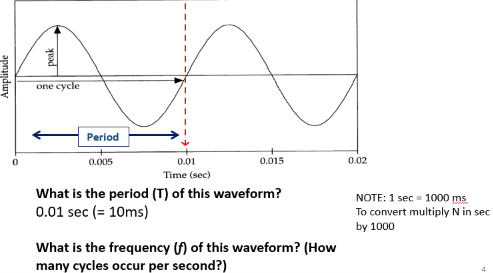
what is the period (T) of this waveform?
0.01 secs 10ms

what is the frequency of this waveform? (how many cycles occur per second)
100Hz
if the frequency of sound is 200Hz then what is the period?
5ms
3 types of interference
constructive interference
destructive interference
complex interference
interference means
multiple waves in a medium at once, simultaneous sounds set up multiple wave patterns, complex sounds transmit multiple frequencies simultaneously, waves bouncing off objects set up reflected waves
what might happen during interference patterns
a sound may be louder in some places and softer in others

in phase
2 waves that align either peak + peak or valey + valey equal 1 wave with larger amplitude making it louder; waves crest and trough at the same time
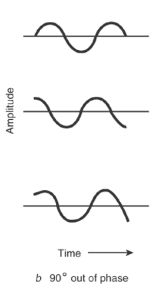
90 degrees out phase
slight minor change, waves crest and trough at different times
little effect on speech sounds the human ear wont notice

180 degrees out of phase
misaligned waves crest and through at different times resulting in slience
phase described how patters relate to each other
in phase: higher amp or higher loudness (constructive interference)
out of phase: mostly cancels each other out (destructive interference)
phase essentially describes
where the sinewave begins; a measure of the position along the sinusoidal vibration important for sound localization
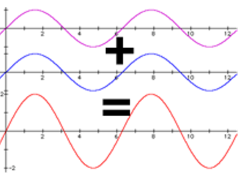
constructive interference
compression meets compression
rarefaction meets rarefaction
leads to reinforcement (wave has greater intensity) of comp and rarefactions

destructive interference
comp meets rarefactions
leads to cancellation of compressions and rarefactions
waves have weaker intensity or slience
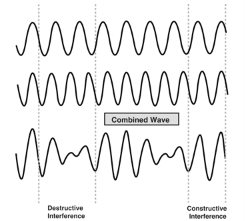
complex interference
most common, not completely constructive or destructive
boundaries
sound meets an obstruction as it travels, interference between 2 mediums
3 boundary behaviors
reflection: bouncing off
diffraction: bending around
transmission: going through
reflection
incident wave: og wave
reflected wave: part of that og wave goes back (reflected waves) in vocal tract
the amount of energy reflected back depends on the similarity between 2 mediums

complex tones
have a periodic wave
2 or more pure tones of different frequency are added
superposition principle
combine amplitude when 2 or more waves meet at a point resultant displacement equals the vector sum of all individual displacements at that point and time
Y= y1+y2
what does our ear do when hearing complex tones?
our ear decomposes complex tone into a set of pure tones (sine waves)
fourier’s theorem
any complex waveform can be decomposed into a set of sine waves