Learn: The Rise of Nationalism in Europe | Quizlet
 Call Kai
 Learn
Learn Practice Test
 Spaced Repetition
 Match
Match Flashcards
 Knowt Play
1/279

There's no tags or description
Looks like no tags are added yet.
Name | Mastery | Learn | Test | Matching | Spaced | Call with Kai | Chat |
|---|
No analytics yet
Send a link to your students to track their progress
280 Terms
Absolutist
Literally, a government or system of rule that has no restraints on the power exercised. In history, the term refers to a form of monarchical government that was centralised, militarised and repressive.
Utopian
A vision of a society that is so ideal that it is unlikely to actually exist.
Nationalism
A force which brought about sweeping changes in the political and mental world of Europe during the nineteenth century.
Nation-state
The emergence of a political entity that replaced the multi-national dynastic empires of Europe, characterized by a centralised power exercising sovereign control over a clearly defined territory.
Ernst Renan
A French philosopher who outlined his understanding of what makes a nation in a lecture delivered at the University of Sorbonne in 1882.
'What is a Nation?'
A famous essay by Ernst Renan that critiques the notion that a nation is formed by a common language, race, religion, or territory.
Plebiscite
A direct vote in which an entire electorate is invited to vote on a particular proposal and can result in the adoption of a new law.
Social capital
The collective value of social networks and the inclinations that arise from these networks to do things for each other.
Fraternity
A sense of brotherhood and solidarity among the nations of the world, symbolized in Sorrieu's print by Christ, saints, and angels.
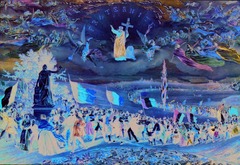
Democratic constitution
A system of governance that is based on the principles of democracy, where the power is vested in the people.
Tricolour
A flag consisting of three colors, notably used to identify the revolutionary spirit in France.
Symbols of absolutist institutions
Representations of the oppressive and centralized power structures that were dismantled during the rise of nationalism.
Liberal hopes of 1848
The aspirations for political freedom and unification among the German-speaking principalities during the revolutionary period.
Common glories
Shared historical achievements that contribute to the identity and unity of a nation.
Great deeds together
Collective actions performed by a group that strengthen their sense of nationhood.
Existence of nations
Considered a necessity for liberty, as it prevents the dominance of a single law or master over diverse peoples.
Culmination of a long past
The idea that a nation is built on historical efforts, sacrifices, and shared experiences.
Social solidarity
The sense of unity and mutual support among members of a nation.
Inhabitants' rights
The principle that the people living in a province should have a say in their governance.
Multi-national dynastic empires
Political structures that encompass multiple nations or ethnic groups under a single ruling dynasty.
Sorrieu's utopian vision
The idealistic representation of a world made up of democratic and social republics as depicted in his prints.
Statue of Liberty
A symbol of freedom and democracy, personified as a female figure in Sorrieu's artwork.

Flags and national costume
Visual identifiers of distinct nations, representing their unique identities and cultures.
Shattered remains
The remnants of absolutist institutions that signify the end of oppressive regimes.
French Revolution
The political and constitutional changes that came in the wake of the French Revolution led to the transfer of sovereignty from the monarchy to a body of French citizens.
La Patrie
The fatherland, a notion emphasised by the French revolutionaries to create a sense of collective identity amongst the French people.
Le Citoyen
The citizen, a concept introduced during the French Revolution to promote the idea of a united community enjoying equal rights under a constitution.
National Assembly
The Estates General was renamed the National Assembly and elected by the body of active citizens.
Centralised Administrative System
A system put in place by the revolutionaries that formulated uniform laws for all citizens within its territory.
Uniform System of Weights and Measures
A system adopted during the French Revolution to standardise measurements across the nation.
Nationalism Abroad
The idea of nationalism was carried abroad by French armies during the revolutionary wars in the 1790s.
Jacobin Clubs
Groups formed by students and educated middle classes in Europe to promote revolutionary ideas following the events in France.
Napoleon's Reforms
Reforms introduced by Napoleon that incorporated revolutionary principles to make the administrative system more rational and efficient.
Despotism
A form of government where a single entity rules with absolute power, which the French revolutionaries sought to liberate other peoples from.
Collective Identity
A sense of belonging to a group that the French revolutionaries aimed to create among the citizens of France.
Cultural Homogeneity
The discouragement of regional dialects and the promotion of a common language (French) as part of nation-building efforts.
Martyrs Commemorated
Individuals remembered and honored for their sacrifices in the name of the nation during the French Revolution.
Internal Customs Duties
Taxes on goods that were abolished during the French Revolution to promote unity and economic integration.
Sovereignty
The authority of a state to govern itself, which was transferred from the monarchy to the citizens during the French Revolution.
Political Changes
The transformations in governance and society that occurred as a result of the French Revolution.
Historical Context of Nationalism
The diverse processes through which nation-states and nationalism emerged in nineteenth-century Europe.
French Armies
Military forces that spread the ideas of nationalism across Europe during the revolutionary wars.
Revolutionary Principles
Ideas and values that emerged from the French Revolution, influencing administrative and political reforms.
Civil Code of 1804
Also known as the Napoleonic Code, it abolished privileges based on birth, established equality before the law, and secured the right to property.
Napoleonic Code
The Civil Code of 1804 that was exported to regions under French control, simplifying administrative divisions and abolishing the feudal system.
Administrative changes
New arrangements made by the French that did not correspond with political freedom, leading to mixed reactions from local populations.
Increased taxation
A consequence of French rule that contributed to the hostility of local populations towards the French.
Censorship
A method used by the French that limited political freedoms in conquered territories.
Forced conscription
The requirement for local populations to join French armies, contributing to resentment against French rule.
Nation-states
Political entities that emerged in Europe, characterized by a collective identity and common culture, which were not present in mid-eighteenth-century Europe.
1797
The year Napoleon invaded Italy, marking the beginning of the Napoleonic wars.
1814-1815
The period marking the fall of Napoleon and the Vienna Peace Settlement.
1821
The year the Greek struggle for independence began.
1848
The year of revolutions in Europe where various groups demanded constitutions and representative governments.
1859-1870
The period during which the unification of Italy occurred.
1866-1871
The period during which the unification of Germany took place.
1905
The year when Slav nationalism began to gather force in the Habsburg and Ottoman Empires.
Habsburg Empire
An empire that ruled over Austria-Hungary, characterized by a diverse population with various languages and ethnic groups.
Tyrol
One of the Alpine regions included in the Habsburg Empire.
Bohemia
A region in the Habsburg Empire where the aristocracy predominantly spoke German.
Lombardy
An Italian-speaking province included in the Habsburg Empire.
Venetia
Another Italian-speaking province that was part of the Habsburg Empire.
Magyar
The language spoken by half of the population in Hungary, with the other half speaking various dialects.
Galicia
A region in the Habsburg Empire where the aristocracy spoke Polish.
Bohemians
One of the subject peasant peoples living within the Habsburg Empire.
Slovaks
Another group of subject peasant peoples in the Habsburg Empire, located to the north.
Slovenes
Peasant peoples living in Carniola within the Habsburg Empire.
Croats
Peasant peoples living to the south within the Habsburg Empire.
Roumans
Peasant peoples living to the east in Transylvania within the Habsburg Empire.
Landed aristocracy
A dominant social class in Europe, characterized by ownership of large estates and a common lifestyle across regional divisions.
Peasantry
The majority population in Europe, primarily consisting of farmers and laborers, often working on land owned by aristocrats.
Industrialisation
The process of developing industries in a country or region, which began in England in the second half of the eighteenth century.
Commercial classes
Social groups that emerged from industrial production and trade, consisting of industrialists, businessmen, and professionals.
Liberalism
A political ideology advocating for individual freedoms, equality before the law, and government by consent.
Suffrage
The right to vote in political elections.
Autocracy
A system of government in which one person possesses unlimited power.
Constitution
A set of fundamental principles or established precedents according to which a state is governed.
Representative government
A system of government in which citizens elect representatives to make decisions on their behalf.
Private property
Legal designation for the ownership of property by non-governmental legal entities.
Economic liberalism
An ideology advocating for free markets and the removal of state-imposed restrictions on the movement of goods and capital.
National economy
The economic activities and policies that are specific to a nation, aimed at fostering national development.
Friedrich List
A German economist who advocated for the development of a national economy in the 19th century.
Confederation of states
A union of sovereign states, often formed for mutual benefit or defense.
Weights and measures
Standards used to quantify physical quantities such as mass and volume in trade and commerce.
Political rights
Rights that allow individuals to participate in the political process, including voting and running for office.
Jacobins
A radical political group during the French Revolution known for their advocacy of democratic reforms.
Opposition movements
Groups organized to challenge and demand changes in political rights and social policies.
Cultural unity
A sense of shared identity and common values among diverse groups within a nation.
Allegiance to the emperor
The loyalty and commitment of diverse groups within an empire to the ruling monarch.
Serfs
Agricultural laborers bound under the feudal system to work on their lord's estate.
Customs Duty
A tax paid on goods when they are transported across international borders, often calculated as a percentage of the value of the goods.
Zollverein
A customs union formed in 1834 at the initiative of Prussia, which abolished tariff barriers and reduced the number of currencies from over thirty to two.
Elle
A unit of measurement for cloth that varied in length by region, such as 54.7 cm in Frankfurt and 65.6 cm in Nuremberg.
Economic Nationalism
A wave of sentiment that emphasized the importance of a unified economic territory for the movement of goods, people, and capital.
Conservatism
A political philosophy that stressed the importance of tradition, established institutions, and customs, preferring gradual development to quick change.
Congress of Vienna
A meeting of representatives from European powers in 1815 to restore order and redraw the map of Europe after the defeat of Napoleon.
Treaty of Vienna
The agreement drawn up at the Congress of Vienna in 1815 aimed at undoing changes made during the Napoleonic wars and restoring monarchies.
Autocratic Regimes
Governments that are led by a single ruler with absolute power, which do not tolerate criticism or dissent.
Modernization
The process of adapting something to modern needs or habits, which conservatives believed could strengthen traditional institutions.
National Sentiment
A feeling of pride and loyalty toward one's nation, which was hoped to be awakened through economic measures and unity.