7.5 | Diagenesis
 Call Kai
 Learn
Learn Practice Test
 Spaced Repetition
 Match
Match Flashcards
 Knowt Play
1/19

There's no tags or description
Looks like no tags are added yet.
Name | Mastery | Learn | Test | Matching | Spaced | Call with Kai | Chat |
|---|
No analytics yet
Send a link to your students to track their progress
20 Terms
Diagenesis
chem, phys, & bio changes taking place after sediments are deposited & buried
Where does diagenesis take place?
upper few km of crust, less than 150-200°C
Why does burial promote diagenesis?
increasing temps & pressures
Recrystallization
diagenetic change, development of more stable minerals from less stable minerals
Provide an example of recrystallization:
aragonite becomes more stable calcite due to burial
Plant material being converted to coal is an example of…
diagenesis
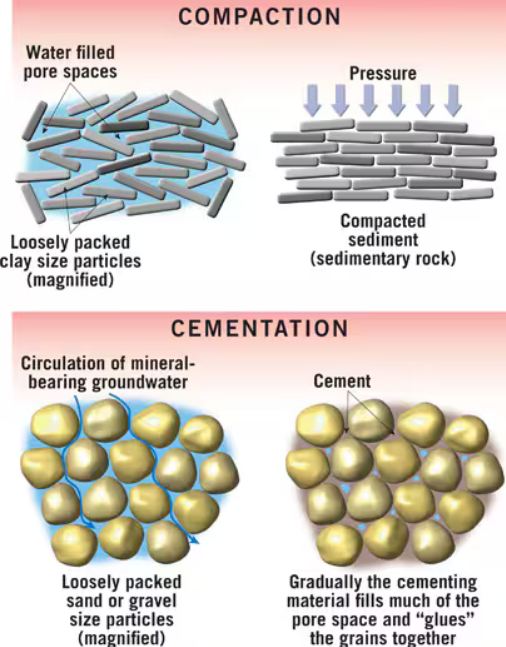
Lithification
unconsolidated sediments transformed into solid sedimentary rocks
What are the 2 lithification processes?
compaction & cementation
What is the most common physical diagenetic change?
compaction
Compaction
weight above buried sediments compresses more deeply buried sediment
What happens to pore space during compaction?
reduction in pore space, water driven out
What rocks are impacted significantly by lithification through compaction?
shale, fine-grained rocks
Cementation
ions in solution crystallize among individual sediment grains
Describe the process of cementation briefly:
material precipitates from water, fills open pores between sediments, reduces porosity, glues grains
What are the most common cements?
calcite, silica, iron oxide
The hardest sedimentary rocks are cemented with…
silica
Sedimentary rocks cemented with calcite will…
effervesce in hcl
Sedimentary rocks cemented with iron oxide display…
red or orange color
Provide an example of a sediment undergoing diagenesis:
caco3 rich skeletal debris recrystallized into limestone
What types of sedimentary rocks are impermeable? Why?
crystalline limestone, evaporites; lack pore spaces due to growing crystals