cell biology exam 1
 Call Kai
 Learn
Learn Practice Test
 Spaced Repetition
 Match
Match Flashcards
 Knowt Play
1/52

There's no tags or description
Looks like no tags are added yet.
Name | Mastery | Learn | Test | Matching | Spaced | Call with Kai | Chat |
|---|
No analytics yet
Send a link to your students to track their progress
53 Terms
cellular membrane
allow the cytoplasm to maintain compartments with distinct environments
n terminus
starting end of a protein or polypeptide chain, defined by a free amine group (-NH2)
c terminus
end of a protein or polypeptide chain that terminates with a free carboxyl group (-COOH)
side chain
r group
polar side chain
side chain that has an -O or -SH
acidic (-) / basic (+) side chain
side chain that has a positive or negative charge
nonpolar side chain
side chain that is neither acidic / basic nor polar
primary structure
order of amino acids (ex. Met Ala Tyr Pro)
secondary structure
alpha helix (tightly coiled) and beta sheets (wavy) throughout protein
tertiary structure
overall shape of protein
quaternary structure
multi-subunit complex
first law of thermodynamics
enthalpy (change in heat / ∆H)
translation (movement through space)
vibration
rotation
second law of thermodynamics
entropy is a measure of disorder or randomness (∆S = change in entropy)
gibbs free energy
∆G = ∆H - T∆S
reaction dynamics

exergonic reaction

endergonic reaction

two ways that cells control reactions
enzymes and concentration
-ase
indicates an enzyme
-omics
studying the entire thing in a cell in opposition to just one (ex. genomics, metabolomics, proteomics)
oxidative phosphorylation
final common pathway converting electron
energy to ATP
krebs cycle
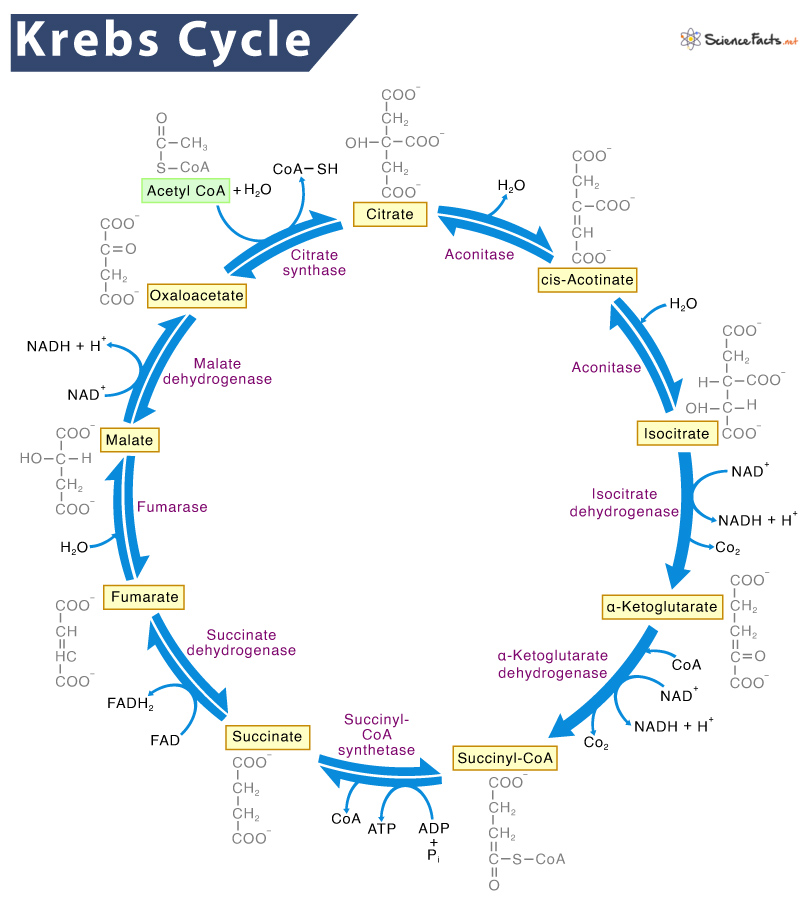
glycolysis

fatty acid oxidaiton
major pathway of aerobic energy production
fatty acids enter krebs cycle as acetyl coa
dna polymerase
synthesize dna strands from 5’ to 3’ (dna replication)
proofreading
dna polymerase

dna polyerase error rate
error rate: 1 per 10,000
w/ proofreading: 1 per 1,000,000
w/ mismatch repair: < 1 per 100,000,000
proteins required for replication
dna polymerase
dna ligase
rna primer
dna primase
okazaki fragment
sliding clamp
helicase
single-strand binding proteins
topoisomerase
primase (rna polymerase)
provide a 3’-OH end to dna polymerase so that it can initiate dna synthesis

clamp loader
use the energy of ATP hydrolysis for assembly of sliding clamps
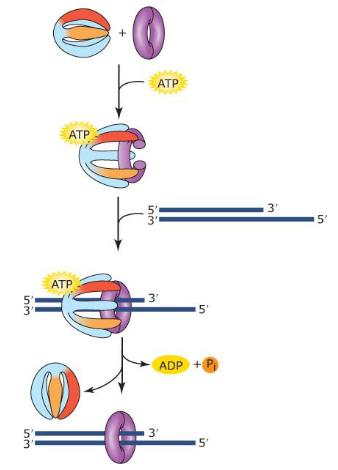
helicase
separates the 2 strands of DNA ahead of the advancing replication fork using energy from ATP hydrolysis
multimeric
multimeric
composed of multiple monomers that are linked together
fixing double-strand breaks
homologous recombination
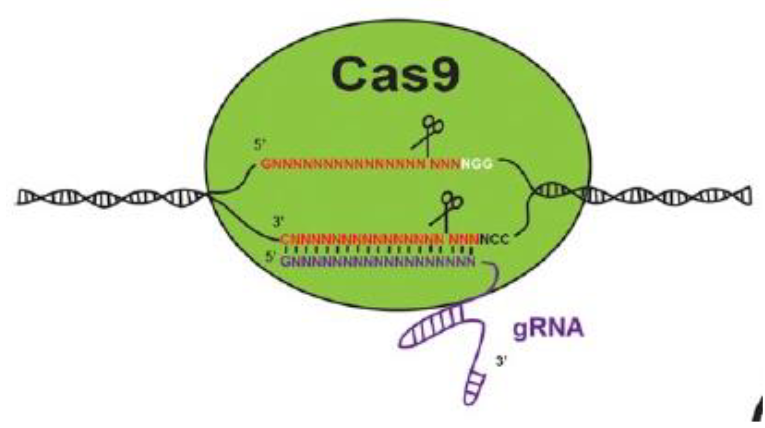
CRISPR
Homologous Recombination to replace areas of the genome with new DNA
replication
origin of recognition (ORC) binds eukaryotic origins
ORC recruits Cdc6, which recruits Cdt1 and the MCM helicase
Cdc6 is degraded or exported after origin firing, which prevents reinitiation
genome
complete set of genetic material carried by an organism
each gene is a sequence of DNA that codes for at least one RNA or protein as its final product
nucleotides
consist of nucleoside and phosphate
nucleosides
5-carbon sugar and purine / pyrimidine (sugar + nitrogenous base)
nucleic acid
nucleotide polymer (connecting together)
nitrogenous bases
cytosine, uracil, thymine, adenine, guanine
hydrogen-bonding
hold the two complementary strands of a DNA double helix together by connecting the nitrogenous bases in the center
van der waahl forces
help stabilize the three-dimensional structure of DNA by acting between the flat, stacked base pairs in the core of the double helix
rna secondary structure

types of dna damage

activators and receptors
regulate transcription initiation by binding to DNA sequences proximal or distal to the basal initiation complex at the core promoter region
5’ cap
protects the 5’ end from enzymatic degradation and it a binding site for both proteins involved in mRNA export from the nucleus to the cytoplasm and translation initiation factors in the cytoplasm
poly-a tail
protects the 3’ end from degradation and modulates the efficiency of translation initiation
intron
spliced out of pre-mRNA