Week 2: Symbolic Thought in Early Childhood
 Call Kai
 Learn
Learn Practice Test
 Spaced Repetition
 Match
Match Flashcards
 Knowt Play
1/13

There's no tags or description
Looks like no tags are added yet.
Name | Mastery | Learn | Test | Matching | Spaced | Call with Kai | Chat |
|---|
No analytics yet
Send a link to your students to track their progress
14 Terms
What's a symbol?
Representation of one entity by a qualitatively different kind of entity
What are some systems of symbolic ability?
Spoken and written language → words
Body language + spatial gestures
Numbers - mathematics
Pictures.
Why are symbols important?
Symbols support reasoning and problem solving Tools present in every human culture Unique to humans (and a limited number of primate species).
What is representational insight?
The understanding that an entity can stand for something other itself A symbol of a countries’ flag can also have ‘referent’ to the country, the country's power and values.
What is the dual representation hypothesis?
States that a symbol both represents concrete aspects of the symbol and represents relation to the referent. (e.g. a map to where an object could be, or a model generally)
To use such objects effectively, one must achieve dual representation, that is, one must mentally represent the concrete object itself and its abstract relation to what it stands for. Supposes that understanding of dual representation develops at different rates for different symbol systems (but follows same pattern)
What are the types of errors that could occur if the dual representation hypothesis is true?
Confusing a symbol with referent - e.g. if a kid interacts with a picture of an object as if it is the object. The symbol and referent is treated as independent → especially with the symbol is highly salient/interesting.
Testing the Dual Representation Hypothesis
PICTURES
Describe how pictures can be used to test the hypothesis?
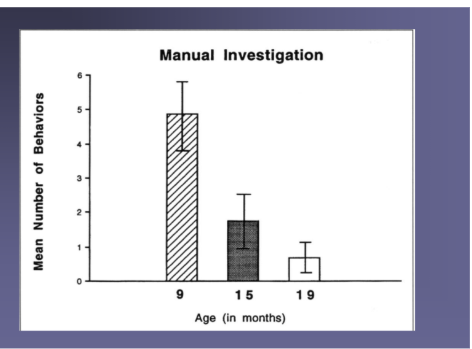
18 month olds - treats the picture of an object as a symbol and knows that they understand that the symbol and the referent are NOT EQUAL
9 months - treats the picture of an object as the object
Basically you can test the hypothesis by asking children to point out a picture – and measure the amount of manual investigations (that is, if the child interacts with the picture as if it is a real thing) Find that this understanding develops gradually →
What is the role of similarity between objects and symbols demonstrating dual representation → experiment ?
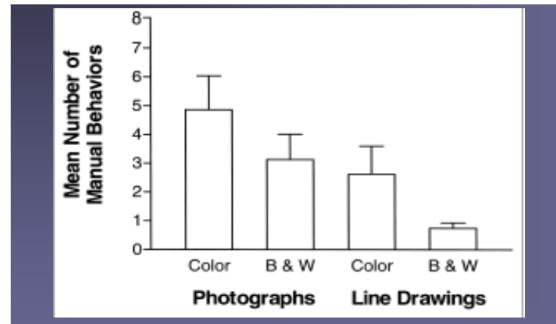
Tested more realistic vs. line drawings in colour or B & W → measuring manual behaviour as a function of dual representation understanding Found that line drawings = less realistic depictions = better dual understanding
MODELS
Describe how models can be used to test children’s understanding of dual representation?
Tests if children can use models to find objects → the Big Snoopy/Little Snoopy procedure.
In the procedure, children are shown a model of the room they are in. Children are told that there is a miniature toy hidden in the model. They are asked to find a big Snoopy in the actual room.
DV - children's success in finding Big Snoopy.
There is normally a control → a memory test, wherein the child is simply told to remember where little snoopy is.
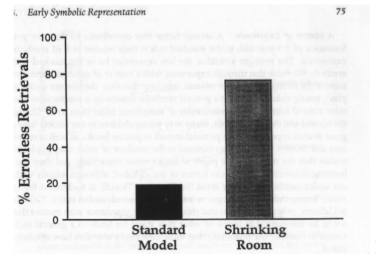
Finds that there is a developmental difference in performance → 3 year olds have 75-90% errorless retrievals, whereas 2 ½ have a 20% errorless retrieval rate.
Why is there an age difference in the ‘Big Snoopy/little Snoopy’?
It seems that is NOT due to inadequate or inaccessible memory representation, and it is NOT that they don’t understand the task. Seems to suggests that the 2 ½ year olds seemed to treat the model and the referent as independent.
What are and explain manipulations of the ‘Big Snoopy/Little Snoopy’ task?
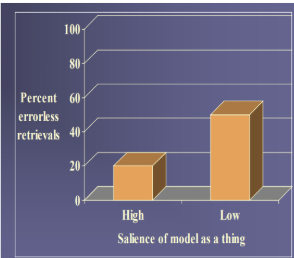
Salience! In 3 year olds - Increasing the salience of the model by letting kids play with the model before the task - decreases performance on the task - suggests that the model is NOT being treated as a model anymore
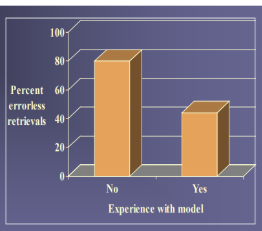
In the 2 ½ year olds - Decreasing the salience of the model by putting the model behind a window in a puppet theater – increases task performance, suggest that the model is being treated as a model
Making the Symbol-referent relationship transparent In the 2 ½ year olds - convincing the kids that a shrinking machine has shrunk the room into the scale model - creating a highly iconic model (Terry’s Troll and Terry’s room) → increases performance
Teaching Model Behaviour
How do you teach children how to use the model?
escalation from an easy model, to a more complex model That is (1) first, make it easy for the child to make correspondences between the model and situation, (2) second, train the child in a more complex model.
Describe Deloache’s experiment?
: Examined if different model progressions allows for children to learn better or worse
IV - had 2 x conditions -
EXPERIMENTAL (TRANSFER) → Attempted Easy model; Then Hard Model.
CONTROL → Attempted Hard model; Then Hard Model
DV = errorless retrievals
Found that in session 2 - the experimental transfer group did best well above the expected practice effect for the attempted Hard Model, and then Hard model.;
2 ½ kids can also make the opposite error - that is, symbol = the referent, rather than just a symbol - e.g large car to a small car.
What is the application of the dual presentation?
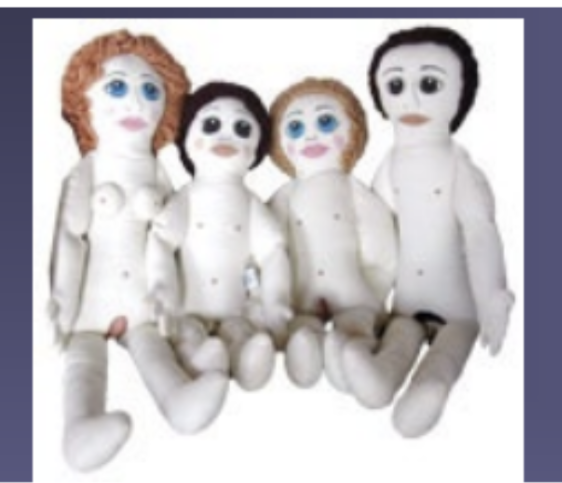
: Use of “anatomically correct” dolls in forensic investigations – assumes that the symbols-referent relations that are transparent to adults are equally obvious to children, when this could not be the case.