Part 4: Burns, Rule of Nines, Frostbite, Pressure Injuries (Stages 1–4), Unstageable Injuries, Wound Healing, Debridement, Dressings, and Wound Therapies
 Call Kai
 Learn
Learn Practice Test
 Spaced Repetition
 Match
Match Flashcards
 Knowt Play
1/127

There's no tags or description
Looks like no tags are added yet.
Name | Mastery | Learn | Test | Matching | Spaced | Call with Kai | Chat |
|---|
No analytics yet
Send a link to your students to track their progress
128 Terms
What is a burn?
A traumatic injury to skin and underlying tissues caused by thermal, chemical, electrical, or radiation exposure.
How are burns classified?
By depth of tissue destruction and total body surface area (TBSA) affected.
What are the two major burn classifications discussed in this lecture?
Partial-thickness burns and full-thickness burns.
What is a superficial partial-thickness burn?
superficial epidermal damage with hyperemia
tactile and pain sensation remain intact.
What are the clinical manifestations of a superficial partial-thickness burn?
Erythema
blanching with pressure
pain
mild swelling
Possible blistering after 24 hours.
What are common causes of superficial partial-thickness burns?
Sunburn and quick heat flashes.
ex. stove
Why are superficial partial-thickness burns painful?
Nerve endings remain intact.
What is a deeper partial-thickness burn?
A burn involving the epidermis and dermis to varying depths while retaining viable regenerative skin elements.
What are the manifestations of deeper partial-thickness burns?
Red
shiny
wet skin with ruptured or intact vesicles
severe pain
mild-to-moderate edema.
Why are deeper partial-thickness burns extremely sensitive to touch?
Nerve injury and exposed dermal structures increase sensitivity.
What are common causes of partial-thickness burns?
Flame
flash burns
scalds
contact burns
chemicals
tar
electrical current
What structures remain viable in partial-thickness burns?
Skin elements responsible for epithelial regeneration.
What is a full-thickness burn?
A burn that destroys all skin elements and local nerve endings.
What are the clinical manifestations of full-thickness burns?
Dry
waxy-white
leathery
hard skin with visible thrombosed vessels
loss of pain sensation
Why are full-thickness burns often painless?
Nerve endings are destroyed.
What is coagulation necrosis?
Tissue death caused by protein denaturation following severe injury.
Why is surgical intervention often required in full-thickness burns?
The skin cannot regenerate adequately because all regenerative elements are destroyed.
What structures may be affected in severe full-thickness burns?
Muscles, tendons, ligaments, cartilage, and bone.
What are common causes of full-thickness burns?
Flame, scalds, chemicals, tar, and electrical injuries.
wound sensation of full thickness burns
insensate
pinprick sensation
loss of sensation
What is the Rule of Nines?
A method used to estimate the percentage of total body surface area (TBSA) affected by burns.
How much TBSA does one entire arm represent in the Rule of Nines?
9%.
4.5 on each side for a total of 9%
How much TBSA does the anterior chest represent?
9%.
How much TBSA does the abdomen represent?
9%.
How much TBSA does the upper back represent?
9%.
How much TBSA does the lower back represent?
9%.
Why is estimating TBSA important?
It helps determine burn severity, fluid resuscitation requirements, and treatment priorities.
When is a burn considered severe in children under 10 years?
Greater than 10% TBSA.
When is a burn considered severe in adults?
Greater than 20% TBSA.
When is a burn considered severe in adults over age 50?
Greater than 10% TBSA.
What percentage of full-thickness burns constitutes a severe burn injury?
Greater than 5% TBSA.
adult vs PEADS TBSA
adult = head 9% each side, legs = 18%
PEADS = head 18%, legs 14%
how much does the hand count?
1%
used to measure when burns are on multiple areas of the skin
What are the major systemic effects of burns?
Fluid shifts (intravascular to interstitial)
hypovolemic shock
electrolyte imbalances
hyperK+
infection risk
respiratory injury
organ dysfunction.
myoglobinuria + acute tubular necrosis (AKI)
rapid muscle breakdown
What fluid shift occurs after major burns?
Fluid moves from the intravascular space into the interstitial space.
Why do burn patients develop edema?
Capillary permeability increases, allowing fluid to leak into tissues.
What is hypovolemic shock?
A life-threatening condition resulting from severe fluid loss and reduced circulating blood volume.
Why are burn patients at risk for hypovolemic shock?
Massive capillary leak causes significant intravascular fluid loss.
What electrolyte imbalance commonly occurs early after burns?
Hyperkalemia.
Why does hyperkalemia occur after burns?
Damaged cells release intracellular potassium into the bloodstream.
What is myoglobinuria? - burns
The presence of myoglobin in urine following muscle injury.
Why is myoglobinuria dangerous? - burns
It can cause acute tubular necrosis and acute kidney injury.
What is acute tubular necrosis (ATN)? - burns
Kidney injury caused by ischemia or nephrotoxic substances such as myoglobin.
What is acute kidney injury (AKI)? - burns
A sudden decline in kidney function.
What are contractures? - burns
Permanent shortening and tightening of muscles, tendons, or skin after healing
b/c scar tissue is less flexible
Why do burn contractures develop?
Scar tissue formation restricts normal movement.
What is the stress response associated with burns?
A hypermetabolic state characterized by increased energy expenditure and catabolism.
Why are burn patients highly susceptible to infection?
Loss of skin integrity removes a major protective barrier.
What is sepsis? - burns
A life-threatening systemic response to infection causing organ dysfunction.
Why are severe burn patients at risk for sepsis?
Open wounds provide portals of entry for microorganisms.
How can burns affect the respiratory system?
Through smoke inhalation and airway injury.
pt could be AO x 4 then intubated next minute
swelling of airway
What is smoke inhalation injury?
Damage to respiratory tissues caused by inhaling heat, smoke, and toxic combustion products (CO)
Describe the pathophysiologic sequence of severe burn injury.
Burn injury → capillary leak → edema → hypovolemia → tissue ischemia → anaerobic metabolism → acidosis → decreased cardiac output → multiorgan dysfunction.
What is tissue ischemia? - burns
Insufficient blood flow resulting in inadequate oxygen delivery.
What is anaerobic metabolism? - burns
Energy production without oxygen, leading to lactic acid accumulation.
What is acidosis? - burns
An excessive accumulation of acid in the body causing decreased pH.
What is frostbite?
Localized tissue injury caused by freezing temperatures.
What is first-degree frostbite?
Frostbite affecting only the epidermis.
What is second-degree frostbite?
epidermis and part of the dermis.
What is third-degree frostbite?
epidermis, dermis, and subcutaneous fat.
What is fourth-degree frostbite?
full-thickness tissue destruction extending into muscle, tendon, and bone.
What is a pressure injury?
Localized damage to skin and underlying tissue caused by prolonged pressure or pressure combined with shear.
What causes pressure injuries?
Pressure
shear
friction
moisture
impaired perfusion
poor nutrition
comorbidities.
How does pressure cause tissue damage?
Pressure compresses blood vessels, reducing blood flow and causing ischemia.
What is shear?
A force that occurs when skin remains stationary while deeper tissues move.
How does shear contribute to pressure injuries?
It bends and stretches blood vessels, reducing circulation.
What is friction?
Mechanical rubbing that damages the epidermis.
Where do pressure injuries commonly occur?
Over bony prominences.
What is a medical device-related pressure injury?
A pressure injury caused by medical equipment pressing against the skin.
What factors influence pressure injury development?
Moisture, nutrition, perfusion, mobility, and comorbidities.
What is capillary closing pressure?
The minimum pressure required to collapse a capillary and obstruct blood flow.
Why is capillary closing pressure important?
Pressure exceeding this level causes tissue ischemia.
What is hyperemia?
Redness caused by increased blood flow after pressure is relieved.
What is blanching?
Temporary whitening of skin when pressure is applied.
What is non-blanching erythema?
Redness that does not turn white when pressure is applied.
Why is non-blanching erythema significant?
It is a hallmark sign of Stage 1 pressure injury.
How does pressure duration affect tissue damage?
Both low pressure over a long period and high pressure over a short period can cause injury.
What is tissue tolerance?
The ability of tissue to withstand pressure without injury.
What factors affect tissue tolerance?
Tissue integrity, supporting structures, nutrition, moisture, perfusion, and overall health.
Why are older adults at increased risk for skin breakdown?
Age-related skin changes reduce tissue resilience and healing capacity.
How does aging affect skin elasticity?
Elasticity decreases with age.
How does aging affect collagen production?
Collagen decreases, making skin more fragile.
How does aging affect underlying tissues?
Muscle and adipose tissue become thinner.
Why is elderly skin more susceptible to injury?
It tears easily and heals more slowly.
How can polypharmacy contribute to pressure injuries?
Some medications (polypharmacy) impair circulation, mobility, or wound healing.
What is a Stage 1 pressure injury?
Intact skin with localized non-blanchable erythema + darker/red
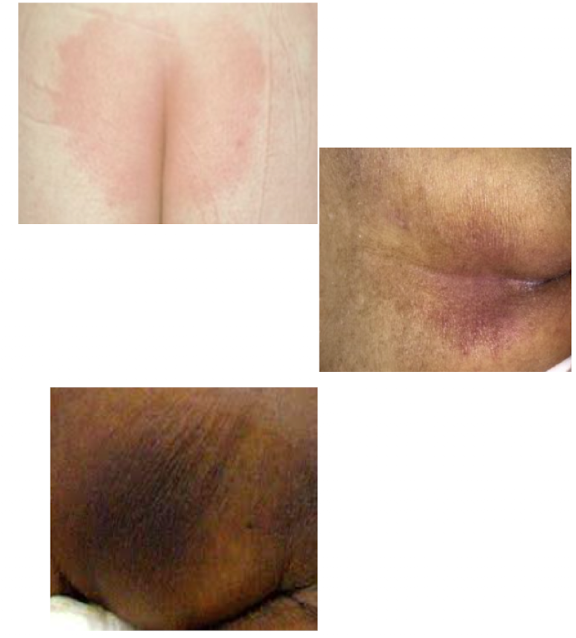
What are manifestations of Stage 1 pressure injury?
Persistent redness, changes in temperature, firmness, or sensation.
Can Stage 1 injuries appear differently in dark skin tones?
Yes.
What is a Stage 2 pressure injury?
Partial-thickness skin loss with exposed dermis.
What does the wound bed look like in Stage 2 pressure injuries?
Pink, red, viable, and moist.
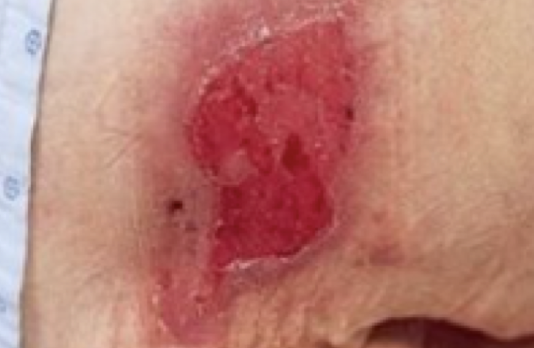
How may Stage 2 pressure injuries present?
As an intact or ruptured serum-filled blister.
Are adipose tissue and deeper structures visible in Stage 2 pressure injuries?
No.
Are slough or eschar present in Stage 2 injuries?
No.
What is a Stage 3 pressure injury?
Full-thickness skin loss extending into subcutaneous tissue.
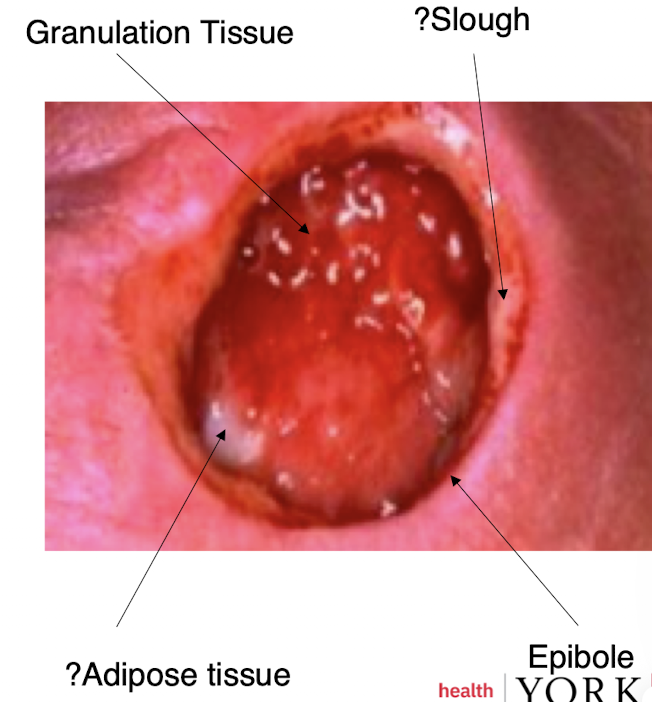
What tissue becomes visible in Stage 3 pressure injuries?
Adipose (fat) tissue.
What is granulation tissue? - stage 3 pressure injury
New vascular connective tissue formed during healing.
What is epibole? - stage 3 pressure injury
Rolled wound edges that impair wound closure.
What is slough? - stage 3 pressure injury
Yellow, tan, or gray devitalized tissue produced during inflammation.
What is eschar? - stage 3 pressure injury
Dry, black or brown necrotic tissue.
Can slough and eschar be present in Stage 3 pressure injuries?
Yes.