Nader Thermo Final Review
 Call Kai
 Learn
Learn Practice Test
 Spaced Repetition
 Match
Match Flashcards
 Knowt Play
1/108

There's no tags or description
Looks like no tags are added yet.
Name | Mastery | Learn | Test | Matching | Spaced | Call with Kai | Chat |
|---|
No analytics yet
Send a link to your students to track their progress
109 Terms
[T/F] A real gas behaves like an ideal gas at low pressure.
T
[T/F] A real gas behaves like an ideal gas at high temperatures.
T
[T/F] A real gas behaves like an ideal gas as its specific volume increases.
T
[T/F] A real gas behaves like an ideal gas as its specific volume decreases.
F
[T/F] A real gas has a continuum at low specific volume
T
[T/F] A real gas has a continuum at high specific volume.
F
[T/F] A real gas can be considered more of a continuum at higher temperatures.
F
[T/F] If a system is in thermal equilibrium, the temperature can change.
F
[T/F] If a system is closed, energy can flow throughout it.
T
[T/F] Energy cannot cross a boundary in a closed system.
F
[T/F] Specific volume is an intensive property.
T
[T/F] The three mechanisms of heat transfer are conduction, convection and radiation.
T
[T/F] A non-rigid tank has constant volume.
F
[T/F] Quality(x) is m(vapor) over m(total).
T
[T/F] Real gases are in continuum at low temperature.
T
[T/F] This course is a microscopic view of thermodynamics.
F
[T/F] A closed system always contains the same matter, there is no transfer of matter across the boundary
T
[T/F] Two systems are in thermal equilibrium if there is no heat transfer between them.
T
[T/F] Heat transfer needs a medium.
F
If Bob leaves the refrigerator open in a house with good insulation, what happens with the temperature? [increase, decrease, nothing]
Increase
What is an adiabatic process?
A thermodynamic process where no heat is transferred between a system and its surroundings (there is no heat loss or gain, regardless of whether the temp goes up or down)
What is convection?
The transfer of energy between a solid surface and the adjacent fluid that is in motion, and it involves the combined effects of conduction and fluid motion.
What is a Polytropic process?
When PV^n = Constant. ‘n’ can be used to determine what specific process it is [n=0; isobaric], [n=1; isothermal].
If you are sitting next to a radiator, what type of energy is transmitted? [radiation, conduction, convection]
Convection
What is the 0th Law of Thermodynamics?
If 2 systems are in thermal equilibrium with a third system, then the third system is also in thermal equilibrium.
What is the 1st Law of Thermodynamics?
Energy cannot be created nor destroyed, just transferred. Total energy in an isolated system remains constant.
What is the 2nd Law of Thermodynamics?
The total entropy of an isolated system can only increase or remain constant in a reversible process; it’ll never decrease
What do Heat (Q) and Work (W) have in common, and why are they different from properties like temperature or pressure?
They are both boundary phenomena (and path functions). They are not properties of the fluid; they only exist as energy crossing the system boundary.
What is the definition of a Control Mass in terms of what can cross its boundary?
Mass cannot enter or exit, but energy (Heat and Work) can enter and exit.
[T/F] Entropy always increases at isolated processes, but remains constant at reversible processes.
T
[T/F] A process can be reversible without releasing heat or energy to the surrounding environment.
T
[T/F] The Carnot cycle is reversible.
T
[T/F] An engineering student calculates the thermal efficiency of a heat engine and realizes there is a higher thermal efficiency than the equivalent reversible cycle. That is impossible.
T
[T/F] Uncontrolled expansion of gas is irreversible.
T
What is needed to be isentropic?
Adiabatic and reversible
Which of the following is true about heat loss?
Heat loss from a system is tied to irreversibilities and hence decreased efficiency.
[T/F] The principle of conservation of entropy exists in a real car engine.
F
[T/F] One of the remarks about entropy is that the process of entropy increase is in a certain direction and not any direction.
T
[MC] Entropy can be transferred by
Heat transfer and mass flow only.
Change in entropy for different processes:
(Adiabatic -> ΔS ≥ 0)(Isentropic -> ΔS = 0)(Isobaric w/ heat removed -> ΔS < 0)
[T/F] Does a throttle function like a valve?
T
[T/F] If a nozzle increases velocity, the pressure decreases.
T
[T/F] A nozzle increases the velocity of a fluid.
T
[T/F] A heat pump is the same as a fridge, going from a low reservoir to a high reservoir.
T
[T/F] A heat pump works the opposite way of a fridge, it transfers heat from a low energy environment to a high energy one.
T
[T/F] The total energy in an isentropic process is equal to the total energy out in a steady state.
T
[T/F] Mass flow rate is AV, where A is cross-sectional area and V is velocity
F
[T/F] In a refrigeration cycle, heat is transferred via compression to increase the heat in the pipes in a refrigeration compartment.
F
[T/F] A diffuser is described by a decrease in pressure and an increase in volume.
F
[T/F] Valves have a constant specific entropy
F
[T/F] Volume flow rate for an incompressible fluid is AV, where A is cross-sectional area normal to the directional flow and V is the volume of the fluid.
F
[T/F] A thermal energy reservoir can supply or absorb finite amounts of heat without undergoing any changes in temperature.
T
[T/F] Qh/Ql = Th/Tl, work done = Ql(Th/Tl-1).
T
[T/F] COP is the efficiency of a heat pump.
T
[T/F] A heat engine connects all absorbed heat into work.
F
[T/F] Fluid flowing through a pipe has the same mass entering as leaving during a steady state.
T
[T/F] Energy entering equals energy leaving a mixing chamber during a steady state.
T
[T/F] A compressor compresses gas to very high pressure.
T
[T/F] According to the principle of continuity, the volume of an incompressible liquid with a steady flow entering a container is equal to the volume exiting the container.
T
[T/F] A turbine increases the velocity of a fluid
F
[T/F] The diffuser decreases the pressure of a fluid with an increase in velocity
F
[T/F] Heat naturally flows from high to low temperature. This is reflected in the Kelvin-Planck statement.
F
[T/F] For isentropic processes, entropy is constant. s1=s2.
T
If the valve of N=0, PV^n = C, the process is.
Isobaric
If the valve of N=1, PV^n = C, the process is.
Isothermal
Calculate the isentropic efficiency of a compressor
The sum of the differences in enthalpies by 2s and 1 is divided by the differences of enthalpies of 2a and 1.
[T/F] What do the lines of this compressor work represent? [Right to left is isentropic, polytropic, isothermal] The right side is least work.
F
Which of the following is correct about turbines.
Adding heat to the turbine increases efficiency.
What happens to working fluid through a turbine?
Temperature decreases
Why is a two-stage compress with intercooling used?
More efficient, saves energy
Which of the following about throttle is true?
Enthalpy remains constant.
What is the equation for thermal efficiency of a turbine?
(h1-h2a)/(h1-h2s)
An ideal gas expands from state 1 and state 2 under constant temperature, work is given by?
nRTln(V2/V1) or nRTln(P1/P2)
Given F(force), A(area) and P(pressure): what is the equation?
F = PA
Given L(length), V(volume), A(area) and P(pressure): what is the right equation for W(flow work)?
W = PAL = PV
What happens to pressure, velocity and specific volume in a turbine?
Velocity and specific volume increase while pressure decreases.
In a compressor, P1 enters and P2 exits, what can be inferred about P3.
Closer to P1
Arithmetically what is the pressure of a cooling cycle of a compressor compared to the initial and final pressure.
Just below the arithmetic mean.
For a refrigeration cycle, what must be true?
Qout = Qin + Win
[T/F] The conversion of entropy applies to a car engine.
F
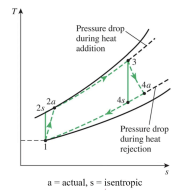
Given the graph of an actual gas turbine cycle, when does compressor work happen?
1-2a
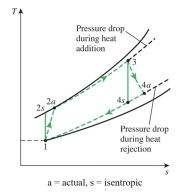
Given the graph of an actual gas turbine cycle, when does turbine work happen?
3-4a
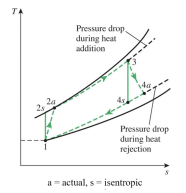
Given the graph of an actual gas turbine cycle, how do you find Qout?
h4a-h1
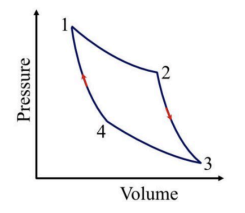
What is the process of 4-1 in the Carnot Cycle?
Adiabatic Compression
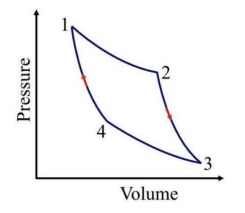
What is the process of 2-3 in the Carnot Cycle?
Adiabatic Expansion
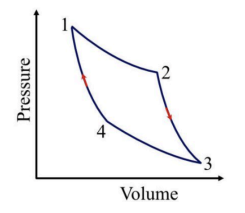
What is happening in 2-3 in the Carnot Cycle?
ΔS = 0
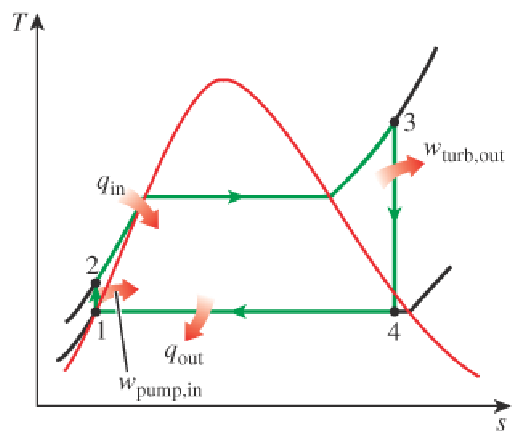
How do you find h2 on the Rankine Cycle
h2= h1+ vf_1@10kPa(P2-P1)
[T/F] COP of heat pump is 2.5 so the COP of refrigerator is 3.5
F
[T/F] The Stirling cycle, like the Carnot cycle, has regeneration.
F
What happens during throttling?
Internal energy decreases as specific volume increases.
Pressure ratio calculates which of the following?
P2/P1 for the Brayton cycle
[T/F] The actual power cycle is more efficient than the ideal power cycle due to more irreversibilities in the actual power cycle.
F
What is the purpose of regeneration?
Increases the temperature of heat addition and decreases the temperature of heat rejection.
[T/F] For an isentropic cycle the thermal efficiency increases as the area under the curve increases on a T-s diagram?
T
[T/F] During the Rankine cycle reheat, the pressure at 4-5 is the same as 2-3.
F
[T/F] Higher back ratio means higher new work output in the cycle and higher efficiency in the cycle.
F
[T/F] The actual Steam cycle has higher efficiency than the simple Rankine cycle.
F
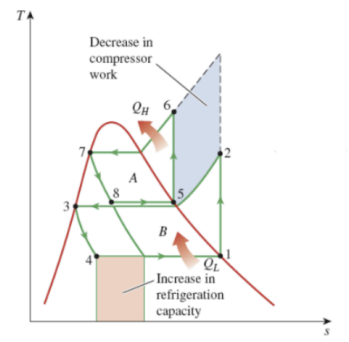
What is the energy balance for a cascade refrigeration cycle?
mA(h5-h8) = mB(h2-h3)
Why is the Carnot cycle not practical in refrigeration?
Compressor cannot handle liquid-vapor mixture
The purpose of refrigeration is
To lower and maintain its temperature below the ambient level.