ASI 601 Exam 1 Terminology
 Call Kai
 Learn
Learn Practice Test
 Spaced Repetition
 Match
Match Flashcards
 Knowt Play
1/151

There's no tags or description
Looks like no tags are added yet.
Name | Mastery | Learn | Test | Matching | Spaced | Call with Kai | Chat |
|---|
No analytics yet
Send a link to your students to track their progress
152 Terms
Homeostasis
The condition of certain variables being held within a constant range and also the regulation of those variables back into their normal range when they have deviated.
Regulated variable, sensor, regulatory system, physiological response
What four things make up homeostasis?
Controlled variable
What type of variable is the heart? This type of variable is considered to be physiological responses that regulate regulated variables.
Negative feedback
Initiated by the deviation of a regulated variable, and then ends with the opposite of whatever stimulus triggered the reaction. Results in the movement of a regulated variable in the opposite direction from its original change, and is caused by the activation of a physiological response
Anticipatory Feedback
This type of feedback occurs when a physiological response occurs even before the regulated variable has deviated.
Permissive Feedback
In this type of feedback, physiological responses don’t directly affect the regulated variable, but instead make it easier to ultimately correct the deviation in the regulated variable. It is thus used to stop physiological responses that would make it harder to correct the deviation in a regulated variable.
Positive Feedback
Occurs when the stimulus triggers a physiological reaction that furthers the condition or stimulus that started the whole thing.
Pathological Feedback
Sometimes, positive feedback occurs for reasons that are not deliberate and result from a disease state. Usually, this ends up causing harm even though it was initiated to try and correct some problem.
Positive Feedforward
This type of feedback is almost always done deliberately. In this case, there is no feedback at any point. The process just continues from one point to the next, with the results of each step having no influence on any previous steps.
Negative
Positive feedback and positive feedforward are usually ended by _______ feedback.
Negative Feedback
What type of feedback responds to increased body temperature by resulting in a decreased body temperature in order to return the regulated variable to its safe physiological range?
Anticipatory Feedback
What type of feedback causes an increase in insulin secretion in response to food smells or food entering the digestive tract?
Permissive Feedback
What type of feedback causes the body to save water during dehydration? HINT: This doesn’t directly increase water in the blood; it just makes it easier to correct the deviation in the body by saving water.
Positive Feedback
What type of feedback is associated with childbirth?
Pathological Positive Feedback
What type of feedback is associated with arthritis? The inflammation in the joint causes pain, which is generally a good thing because it lets the animal know there is a problem and thus can avoid further damage. However, the pain caused by arthritis results in reduced movement.
The Nervous System
Responds quickly by sending action potentials through nerve cells that travel through extended axons to various organs and tissues. Although it acts quickly, it has the limitation of needing to send a physical nerve cell axon to the location where the response is needed.
Hypothalamus
Monitors circulating nutrients such as glucose, amino acids, and fatty acids. If there are reduced amounts of circulating nutrients because food is not available, it is not a good time to become pregnant and support a developing fetus. Thus, the hypothalamus can reduce the secretion of hormones that cause growth and development of follicles on the ovary and shut down reproduction if nutrients are limiting.
Endocrine Glands
Glands that secrete hormones into the extracellular fluid where they are then picked up by capillaries and transported throughout the body by travelling through the blood.
Autocrine
This endocrine response occurs when a cell releases a hormone that binds to receptors on that very same cell or on nearby cells of the same type and causes a physiological response
Paracrine
This endocrine response occurs when a cell releases a hormone that binds to receptors on nearby cells of a different type and causes a physiological response.
Exocrine
There are a very large number of glands that make secretory products that then get secreted directly into a duct. These products then move through the duct and eventually travel through the opening of the duct and out of the body. This is known as _______ secretion. Exampels of this include milk, sweat, and sebum.
Autocrine
What response is this?
A pituitary cell called a lactotroph produces and releases two hormones: 1. Prolactin and 2: VIP. The VIP that is released stimulates lactotroph cells to produce more prolactin.
Endocrine
What response is this?
A pituitary cell called a gonadotroph produces and releases two hormones: 1. Luteinizing hormone and 2. Follicle stimulating hormone. Both of these stimulate reproductive activity within the gonads.
Exocrine
What response is this?
Certain types of sweat glands associated with hair follicles produce specific proteins, fatty acids and other materials collected from the blood serum, then secrete these products into a duct that leads to the opening of the hair follicle. The product is called apocrine sweat and ultimately ends up on the surface of the epithelium of the skin.
Paracrine
What response is this?
A pituitary cell called a gonadotroph produces a hormone called activin. Activin stimulates nearby cells called folliculostellate cells to produce a hormone called follistatin. Follistatin then binds to activin receptors on gonadotrophs and prevents further activin activity.
Autocrine
What response is this?
A pituitary cell called a gonadotroph produces a hormone called activin. Activin binds to receptors on gonadotrophs and causes the production of follicle stimulating hormone subunits.
Allostasis
Occurs when an animal has a physiological need to change an optimal set point of a regulated variable. An example of this is lactation.
Hypothalamus, Pituitary, Thyroid, Parathyroid, Pancreas, Adrenal, Gonads
What are the seven endocrine glands?
Pituitary Gland
What endocrine gland sends hormones through the bloodstream to their target tissues?
Diencephalon
The hypothalamus is a part of the _______ in the brain.
Capillary beds
Where are hormones first secreted into? HINT: Located at the base of the hypothalamus (median eminence)
Pituitary Portal Vessel
This vessel in the anterior pituitary serves as a vessel between two capillary beds.
Hypothalamus
A part of the diencephalon of the brain and has many different functions that primarily involve behavioral responses to internal or external stimuli. It contains nerve cells that release hormones into the blood, and thus could be termed a neuroendocrine gland rather than an endocrine gland.
Superior Hypophyseal Artery
Hormones from the hypothalamus that want to travel to the anterior pituitary will be secreted into the capillary beds of what artery?
Extracellular fluid
Neuroendocrine hormones from the hypothalamus can now leave the pituitary portal vessel and enter the _______ _____ of the anterior pituitary where they can bind to their specific cells.
Nuclei
Clusters of cell bodies located in the hypothalamus are known as ______.
Neurohormones
Produced within the hypothalamus and released into the pituitary portal system. Termed releasing factors or release-inhibiting factors because they ultimately stimulate or inhibit the synthesis and release of hormones from the anterior pituitary.
Ernst and Berta Scharrer
What two married scientists worked on vertebrates and invertebrates and were able to discover that neurons are capable of producing and secreting hormones and that this feature is highly conserved across all species of animals.
Anterior Pituitary
Comes from oral ectodermal tissue that forms in the roof of the mouth during embryonic development. A portion of this tissue begins to grow and form a kind of loop or invagination called Rathke’s Pouch. What part of the pituitary gland is this?
Sella Turica (Turkish Saddle)
The pituitary sits inside a pocket of the sphenoid bone called a _____ _____.
Somatotroph
Which anterior pituitary cell secretes growth hormone (somatotropin)?
Thyrotroph
Which anterior pituitary cell secretes TSH (Thyroid Stimulating Hormone)?
Corticotroph
Which anterior pituitary cell secretes ACTH (Adrenocorticotropic Hormone)?
Gonadotroph
Which anterior pituitary cell secretes LH and FSH (Luteinizing Hormone and Follicle Stimulating Hormone)?
Melanotroph
Which anterior pituitary cell secretes MSH (Melanocyte Stimulating Hormone)?
TRH
What is the releasing factor for TSH?
CRH
What is the releasing factor for ACTH?
GnRH
What is the releasing factor for LH and FSH?
MRH
What is the releasing factor for MSH?
PRH
What is the hypothalamic releasing factor for Prolactin?
GHRIH (Somatostatin)
What is the hypothalamic release inhibiting factor for GH (ST)?
Somatostatin
What is the hypothalamic release inhibiting factor for TSH?
PRIH (Dopamine)
What is the hypothalamic release inhibitng factor for prolactin?
Growth Hormone (Somatotropin)
Which hormone impacts skeletal muscle cell hyperplasia (enlargement of tissue) and reduced adipose storage?
Thyroid Stimulating Hormone (TSH)
What hormone results in increased secretion of thyroid hormones; ultimately increased heat production and metabolic rate?
Adrenocorticotropic Hormone (ACTH)
What hormone results in increased secretion of adrenal cortical hormones; ultimately increased breakdown of glycogen and increased circulating glucose
LH, FSH
What two hormones result in the development of follicles on the ovary, development of sperm within the testis?
Melanocyte Stimulating Hormone (MSH)
What hormone results in the increased distribution of melanin within the epidermis?
Prolactin
What hormone results in increased water uptake from large intestine, increased sweat production, increased conservation of sodium and water by kidneys, increased milk production?
Posterior Pituitary (Neurohypophysis)
A part of the gland derives from neural tissue during embryonic development rather than from oral ectoderm. What part of the pituitary gland is this?
Inferior Hypophyseal Artery
What artery feeds into the posterior pituitary?
Circulation
In contrast to the anterior pituitary, the hormones released by the posterior pituitary are picked up by capillary beds and enter the general _______. They travel throughout the body.
Goiter
This condition occurs when the thyroid gland enlarges due to the pituitary releasing more TSH than normal.
Lipid
Thyroid hormones are classified as _____ hormones and contain iodide.
T4
Does the thyroid gland secrete more T4 or T3?
T4, T3
In target tissues the thyroid hormone ___ is typically converted into ___, which is the more active form.
Deiodinase
What enzyme converts T4 into T3?
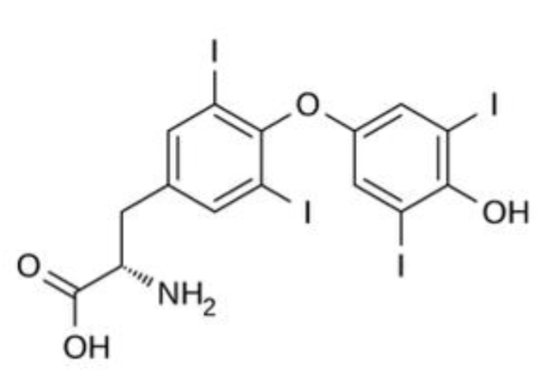
Thyroxine (T4)
What thyroid hormone is this?
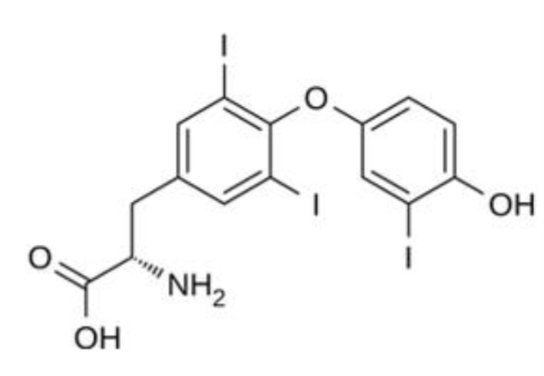
Triiodothyronine (T3)
What thyroid hormone is this?
Anterior
Gonadotropins (LH and FSH) are secreted from the ______ pituitary.
Posterior
Oxytocin is secreted in the ______ pituitary.
Parathyroid
PTH is secreted from the _________ gland.
Thyroid
Calcitonin, T4, and T3 are secreted from the _______.
Anterior
TSH is secreted from the _______ pituitary.
Cortex
Cortisol is secreted from the adrenal ______.
Kidneys
Erythropoietin (EPO) is secreted from the _______.
Skeletal muscles
Irisin is secreted from the _______ ________.
Anterior
Growth hormone (ST) is secreted from the _______ pituitary.
Posterior
Arginine vasopressin (AVP) also known as (ADH) is secreted from the ________ pituitary.
Anterior
Prolactin is secreted from the ________ pituitary.
Medulla
Norepinephrine and Epinephrine are secreted from the adrenal ________.
Hypothalamic neurons
Prolactin release inhibiting hormone (PRIH), also known as dopamine is secreted from _______ ________ in the hypothalamus.
Hypothalamic neurons
GnRH is secreted from _______ ________ in the hypothalamus.
Posterior
Neurophysin is secreted in the _______ pituitary.
Bone tissue
Undercarboxylated osteocalcin is secreted from what type of tissue?
Right atrium
Atrial natriuretic peptide is secreted from the ______ ______ of the heart.
Hypothalamic neurons
Corticotropin releasing hormone (CRH) is released from ________ _______ in the hypothalamus.
Hypothalamic neurons
Prolactin releasing hormone (PRH) is released from the _______ _______ in the hypothalamus
White adipose
Leptin is released from ______ _______ tissue.
Cortex
Aldosterone is released from the adrenal _______.
Anterior
ACTH is released from the _______ pituitary.
Calcitonin, T3, T4
What are the three hormones secreted from the thyroid gland?