A. CATION ANALYSIS
 Call Kai
 Learn
Learn Practice Test
 Spaced Repetition
 Match
Match Flashcards
 Knowt Play
1/21

There's no tags or description
Looks like no tags are added yet.
Name | Mastery | Learn | Test | Matching | Spaced | Call with Kai | Chat |
|---|
No analytics yet
Send a link to your students to track their progress
22 Terms
a. Group I
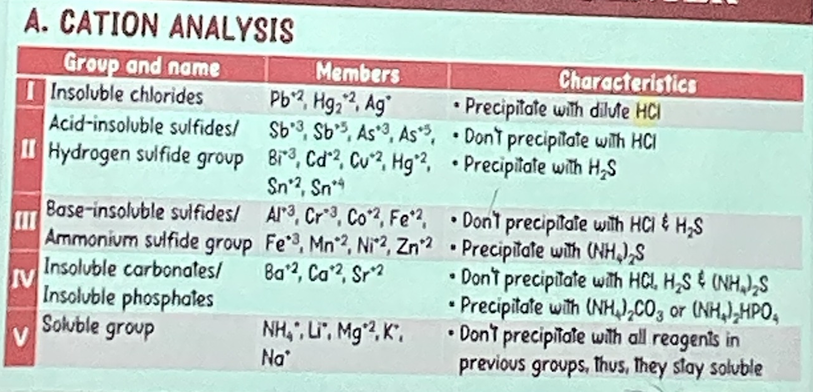
The cation group that precipitates with dilute HCl
a. Group I
b. Group II
c. Group IV
d. Group III
d. Insoluble chlorides
The name of Cation Group I
a. Acid-insoluble sulfides
b. Insoluble carbonates
c. Soluble group
d. Insoluble chlorides
c. Pb²⁺, Hg₂²⁺, Ag⁺
The members of Cation Group I
a. Sb³⁺, Sn²⁺, As³⁻
b. Al³⁺, Fe³⁺, Mn²⁺
c. Pb²⁺, Hg₂²⁺, Ag⁺
d. Ba²⁺, Ca²⁺, Sr²⁺
Pb²⁺, Hg₂²⁺, Ag⁺
The members of Cation Group I
b. Group II
The cation group that precipitates with H2S
a. Group IV
b. Group II
c. Group III
d. Group I
b. Group II
The cation group that doesn’t precipitate with HCl
a. Group IV
b. Group II
c. Group III
d. Group I
b. Hydrogen sulfide group
d. Acid-insoluble sulfides
The name of Cation Group II
(multiple answers)
a. Insoluble chlorides
b. Hydrogen sulfide group
c. Insoluble carbonates
d. Acid-insoluble sulfides
Sb³⁺, Sb5⁺, As³+, As5⁺, Bi³⁺, Cd²⁺, Cu²⁺, Hg²⁺, Sn²⁺, Sn4⁺
The members of Cation Group II
d. Group III
The cation group that does not precipitate with HCl or H2S but precipitates with (NH4)2S
a. Group I
b. Group IV
c. Group II
d. Group III
a. Ammonium sulfide group
d. Base-insoluble sulfides
The name of Cation Group III
(Multiple Answers)
a. Ammonium sulfide group
b. Insoluble carbonates and phosphates
c. Acid-insoluble sulfides
d. Base-insoluble sulfides
Al³⁺, Co³⁺, Cr³⁺, Fe²⁺, Fe3+, Mn²⁺, Ni²⁺, Zn²⁺
The members of Cation Group III
d. Group IV
The cation group that precipitates with (NH4)2CO3 or (NH4)2HPO4
a. Group II
b. Group V
c. Group III
d. Group IV
d. Group IV
The cation group that doesn’t precipitate with HCl, H2S & (NH4)2S
a. Group II
b. Group V
c. Group III
d. Group IV
b. Insoluble phosphates
d. Insoluble carbonates
The name of Cation Group IV
(Multiple answers)
a. Acid-insoluble sulfides
b. Insoluble phosphates
c. Base-insoluble sulfides
d. Insoluble carbonates
a. Ba²⁺, Ca²⁺, Sr²⁺
The members of Cation Group IV
a. Ba²⁺, Ca²⁺, Sr²⁺
b. NH4⁺, Li⁺, Mg²⁺, K⁺, Na⁺
c. Pb²⁺, Hg₂²⁺, Ag⁺
d. Al³⁺, Fe³⁺, Mn²⁺
d. Group V
The cation group that does not precipitate with any reagent in the previous groups and stays soluble
a. Group II
b. Group IV
c. Group III
d. Group V
a. Soluble group
The name of Cation Group V
a. Soluble group
b. Acid-insoluble sulfides
c. Insoluble carbonates
d. Insoluble chlorides
d. NH4⁺, Li⁺, Mg²⁺, K⁺, Na⁺
The members of Cation Group V
a. Ba²⁺, Ca²⁺, Sr²⁺
b. Al³⁺, Fe³⁺, Mn²⁺
c. Pb²⁺, Hg₂²⁺, Ag⁺
d. NH4⁺, Li⁺, Mg²⁺, K⁺, Na⁺
d. HCl
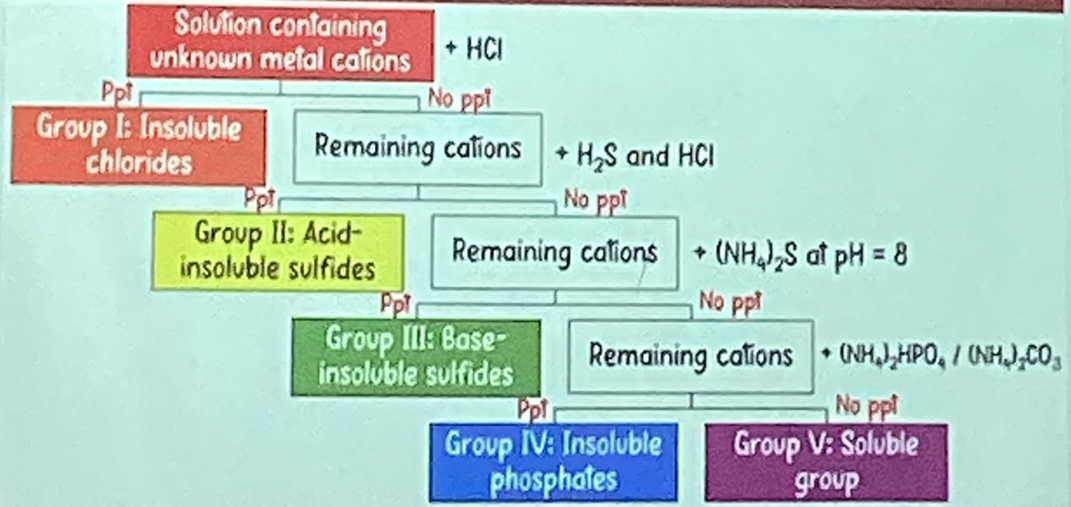
The reagent added first in systematic Cation Analysis to precipitate Group I cations
a. H2S and HCl
b. (NH4)2S at pH 8
c. (NH4)2HPO4 or (NH4)2CO3
d. HCl
b. H2S and HCl
The reagent added to remaining cations after Group I separation to precipitate Group II cations
a. (NH4)2S at pH 8
b. H2S and HCl
c. HCl
d. (NH4)2CO3
d. (NH4)2S at pH 8
The reagent added to remaining cations after Group II separation to precipitate Group III cations
a. H2S and HCl
b. HCl
c. (NH4)2HPO4 or (NH4)2CO3
d. (NH4)2S at pH 8
a. (NH4)2CO3
b. (NH4)2HPO4
The reagents added to remaining cations after Group III separation to precipitate Group IV cations
(multiple answers)
a. NH4)2CO3
b. (NH4)2HPO4
c. (NH4)2S at pH 8
d. H2S