Male reproductive system
 Call Kai
 Learn
Learn Practice Test
 Spaced Repetition
 Match
Match Flashcards
 Knowt Play
1/101

There's no tags or description
Looks like no tags are added yet.
Name | Mastery | Learn | Test | Matching | Spaced | Call with Kai | Chat |
|---|
No analytics yet
Send a link to your students to track their progress
102 Terms
What type of organ is the male reproductive tract?
Endocrine
What are the functions of the male reproductive tract
1 - produce sperm
2 - deliver sperm
3 - produce testosterone, estrogen, dihydrotestosterone (DHT) and inhibin
What do you call hanging balls or outside of the abdominal cavity
pendular

What type of animals have a sigmoid flexure and what is it
All small ruminants have one. it is penis of certain male mammals that keeps the organ retracted inside the body until sexual arousal.

What makes the stallion testicles different
they are non pendular, the prostate is onebody, no sigmoid flexure, nonexpandable shaft.
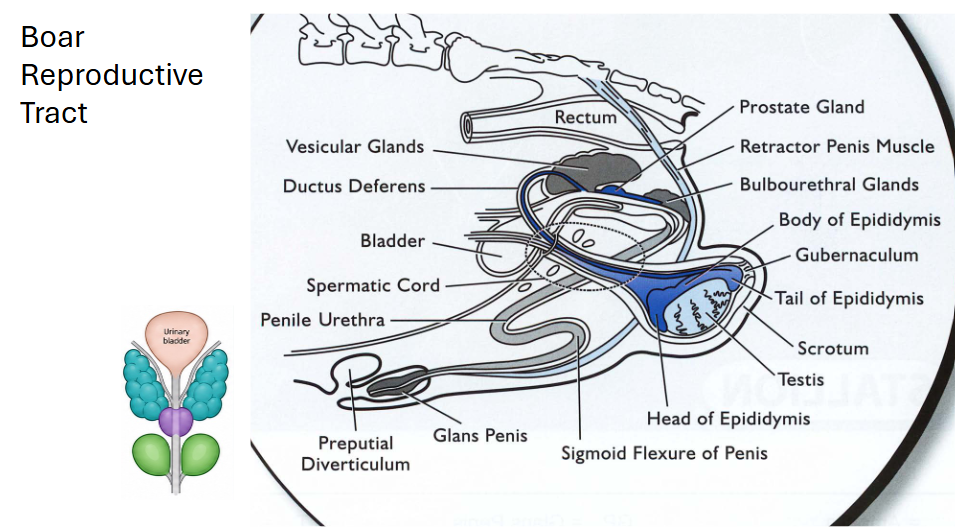
Differences in the boar
fibroelastic penis, makes a lot of sperm, huge vesticular glands, produce a lot of seminal fluid, nonpendular, has a pouch called preputial diverticulum that makes phermonones.

Differences in the dog
one accessory gland - prostate (good model for prostate cancer), nonpendullar, glands penis has two parts
bulbus glandis - produces the lock during mating
pars longa glands
most prominent bone in the dog penis.

Differences in cats
penis is pointing back wards, no vesicular glands only prostate, glands penis has spines.
What is the functions of the testicle
produce sperm
synthesize hormones and proteins (cytokines to keep system healthy)
secrete fluids
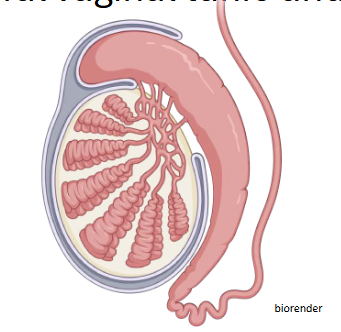
What are the testicle structures
Testicular capsule (visceral vaginal tunic and tunica albuginea) (closest to the testicle).
Parenchyma - start producing sperm
Mediastinum

Describe the testicular capsule
Visceral vaginal tunic surrounds the testicle
Tunica albuginea is very hard and protects the testicle and it makes projections inside the testicle, keeps strucuture, helps move sperm

Describe the testicle parenchyma
They contain the seminiferous tubes where spermiogenesis is taking place. All the tubes connects and end up in one little vas deferences

Describe the interstitial compartment
leydig cells cells outside the seminiferous tubes. Leydig cells produce testosterone and estrogens in reponse to luteinizing hormone LH.
Sertoli cells on the walls of seminiferous tubes.
Spermatagonia cells - sperm cells of the testicle
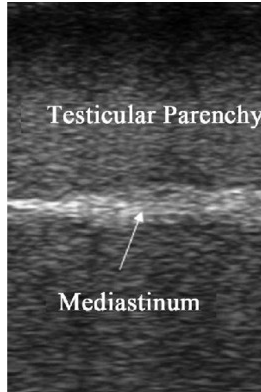
Mediastinum
dense structure in the middle on an ultrasound. protects testicle from collapsing.

Spermatic cord
cord that connects the inguinal to dorsal pole of the testis. Contains everything it needs to survive like arteries, veins and lymphatic vessels. Cremaster muscle. pampiniform plexus.
Functions: provide basic physiology needs of the testicle, heat exchanger device, recirculate testosterone.

Pampiniform plexus
structure that is right on the spermatic cord closer to the testicle. finger like viens bring blood from the testicle to the body. all around the artery. heat exhnage acts like a cooler. provides consent blood pressure.
Pulse pressure elimination in the spermatic cord
there is no pulse pressure to move blood because it will cause death of sperm due to tunica no tbeing ablle to move
Cremaster muscle
Structures:
1 - striatum muscle
2 - part of the internal abdominal oblique muscle
Functions:
support testis, facilitates the return of blood protects testicle
retracts when threatended and during sexual activity
Scrotum
-two lobed sac
four layers
skin
tunica dartos (smooth muscle)
scrotal fascia
parietal vaginal tunic
Pendular (bull, ram) and non-pendular (stallion)
Scrotum function
temperature regulation
physical protection of the testicle
List the ducts in the male reproductive system starting from the testicle
Seminiferous tubes (tubulus contortus and rectus)
rete testis
efferent ducts
epididymis
duct deferens
pelvic urethra
penile urethra
Seminiferous tubules structures
contractile peritubular cells
basement membrane
seminiferous or germinal epithelium
Seminiferous epithelium
1 - basal compartment with sertoli cells (somatic) and spermatogonia (germ cell)
2 - adluminal compartment with sertoli cells sperm at different stages of development
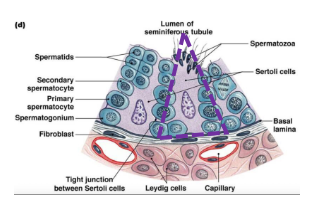
Sertoli cell
analogous to granulosa cells in the ovary
“host” for developing sperm cells
the number of sertoli cells positively correlates with the number of sperm produced.
receptors for FSH and testosterone
they are connected to each other via tight junctions
In response to FSH, Sertoli cells produce
estrogen (attraction)
DHT: dihydrotestosterone (secondary sex characteristics)
inhibin (feedback)
Sertoli cells and blood-testis barrier
Tight junctions separating the basal compartment from the adluminal compartment of the seminiferous epithelium form the “blood-testis barrier” blocking access of immune cells and molecules such as antibodies into the adluminal compartment
Excurrent Duct system - outside testicle
efferent ducts - connect rete testis to the epididymis, reabsorbs rete testis fluid
epididymis
duct deferns

epididymis structure
head
body
tail: it is a convoluted duct (30 to 60 meters) surrounded by smooth muscle.

Epididymis functions
reservoir of sperm
transport of sperm
maturation of sperm
reabsorption of fluid (so much fluid needs to be reabsorbed)
protein secretion
Seminal plasma (fluid) is produced in
epididymis
ampulla
vesicular glands
prostate gland
bulbourethral glands
Seminal fluid function
transport of sperm during ejaculation
retention of sperm in the female reproductive tract

Ampulla
enlargement of the mucosa in the last portion of the duct deferens, it opens into the pelvic urethra

vesicular glands (seminal vesicles)
secretions delivered into the pelvic urethra: there is great variation in size between species
very active

prostate gland
located between the bladder and pelvic urethra
two parts: corpus and disseminate
The disseminated part is also called the urethral gland
the prostate is the only accessory gland in the dog
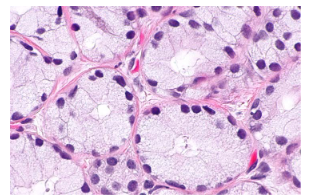
Bulbourethral glands
paired glands on either side of the pelvic urethra. they provide mucus secretion composing the pre-sperm, neutralizing the pH of the urethra
Penis structure and function
Base crus penis attached to the ischial arhc
shaft
glans
Function is to deliver sperm to the female
Glans penis
Homologous to the female clitoris
cat glans has spines
alpaca stiff cartilaginous process
boar corkscrew shape
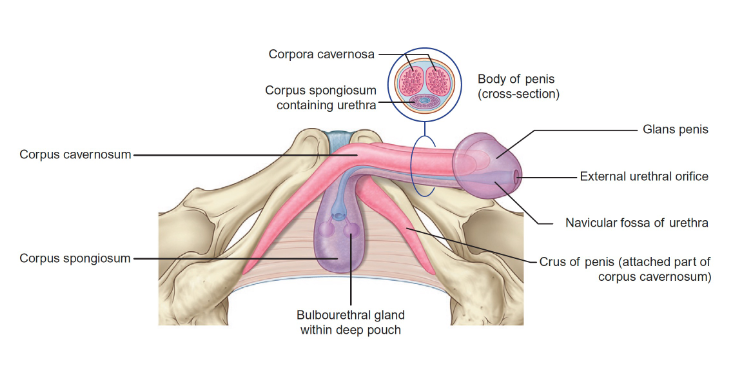
Erectile tissues
Corpus cavernosum most of the penis, houses the corporal sinusoids
Corpus spongiosum surrounding the penile urethra and gland penis
Erectile tissue in the dog
Glands: bulbus glandis and pars longa glandis
Penis muscles
Urethralis: striated muscle around the urethra that moves seminal plasma and sperm into the penile urethra (help move sperm along and secretions of accesory glands)
ischiocavernosus: striated muscle, short paired muscles in the root of the penis and lateral surface (helps the penis become erect)
Bulbospongiosus: striated muscle from the root of the penis down to the caudal and ventral surfaces, covers the bulbourethral glands and empties secretions into the penile urethra (help move sperm along and secretions of accesory glands)
4. retractor penis: smooth muscle paired along the ventral penis (contracts after)
What are the two types of penile shafts
expandable
non-expandable/fibroelastic
Which species have an expandable penile shaft
dog
human
stallion
Expandable shafts have large corporal sinusoids.
Which species have a non-expandable/fibroelastic penile shaft?
bull
boar
ram
fibroelastic shaft, sigmoid flexure (ruminants) and two retractor penis smooth muscles inserted into the coccygeal vertebrae
What is the major erectile tissue making up most of the penis?
Corpus cavernosum, which houses the corporal sinusoids
What is the corpus spongiosum?
erectile tissue that surrounds the penile urethra and glans penis
What is unique about the alpaca penis?
It has a stiff cartilaginous process.
What is unique about the boar's penis?
The glans has a corkscrew shape.
What are the seven ducts sperm pass through, in order?
Seminiferous tubes → rete testis → efferent ducts → epididymis → duct deferens → pelvic urethra → penile urethra
What are the two portions of the seminiferous tubes?
tubulus contortus = convoluted portion where spermatogenesis takes place
tubulus rectus = straight portion that connects with the rete testis
What do the efferent ducts connect? What additional function do the efferent ducts perform?
they connect the rete testis to the head of the epididymis. They reabsorb rete testis fluid.
What are the three major structures of the testicle?
A. Testicular capsule
B. Parenchyma
C. Mediastinum
What are the two parts of the testicular capsule?
Visceral vaginal tunic
Tunica albuginea
What is the visceral vaginal tunic?
A continuation of the visceral peritoneum and is a serosa.
What is the tunica albuginea?
A strong capsule made of connective tissue and smooth muscle. It sends projections into the testicle and connects with the mediastinum.
What are the two compartments of the testicular parenchyma?
Tubular compartment
Interstitial compartment
What is found in the tubular compartment of the testicle?
The seminiferous tubes, including:
Tubulus contortus
Tubulus rectus
Where does spermatogenesis take place?
In the convoluted portion of the seminiferous tubes called the tubulus contortus.
What is found in the interstitial compartment?
Connective tissue
Vessels
Nerves
Leydig cells
What is the mediastinum of the testicle?
Central connective tissue that protects the rete testis from collapsing.
What are the three structures of the seminiferous tubules?
Contractile peritubular cells
Basement membrane
Seminiferous/germinal epithelium
What are the two compartments of the seminiferous epithelium?
Basal compartment: Sertoli cells + spermatogonia
Adluminal compartment: Sertoli cells + sperm at different stages of development
What is the function of Sertoli cells in sperm development?
Sertoli cells act as the "host" for developing sperm cells.
Q: What is the relationship between the number of Sertoli cells and sperm production?
A: The number of Sertoli cells positively correlates with the number of sperm produced.
What forms the blood-testis barrier?
Tight junctions between Sertoli cells.
What does the blood-testis barrier do?
It separates the basal compartment from the adluminal compartment and blocks access of immune cells and large molecules such as antibodies into the adluminal compartment.
What are the two important endocrine cell types in the testicle?
Leydig cells
Sertoli cells
Q: Where are Leydig cells located?
A: In the interstitial compartment of the testicular parenchyma.
Q: What hormones do Leydig cells produce?
testosterone
estrogens
Where are Sertoli cells located?
In the seminiferous epithelium of the seminiferous tubules.
What hormones do Sertoli cells produce in response to FSH?
estrogen
DHT (dihydrotestosterone)
inhibin
Which cells respond to LH
Leydig cells
What happens when LH stimulates leydig cells
Leydig cells produce testosterone and estrogen
Which cells respond to FSH
Sertoli cells
What do Sertoli cells produce in response to FSH
Estrogen, DHT, inhibin
Compare the roles of LH and FSH in the testicle.
LH → Leydig cells → testosterone + estrogens
FSH → Sertoli cells → estrogen + DHT + inhibin
Where does the spermatic cord extend?
From the inguinal ring to the dorsal pole of the testis.
What structures are contained in the spermatic cord?
Artery, veins and lymphatic vessels
cremaster muscle
pampiniform plexus
What are the three major functions of the spermatic cord
provide basical physiological needs of the testis
act as a heat exchanger device
recirculate testosterone
What type of muscle is the cremaster muscle
Striated muscle that is part of the internal abdominal oblique muscle.
What are the functions of the cremaster muscle
support the testis, facilities return of blood, protects the testicle, retracts during threats and sexual activity
What is the basic structure of the pampiniform plexus
a finger like wrapping that surrounds the testicular artery
What happens to the pampiniform plexus veins as they leave the area
They connect with a single testicular vein that runs into the caudal vena cava
What are the three functions of the pampiniform plexus
decrease testicular temperature by up to 6 degree Celsius
provide constant blood pressure
recirculate testosterone back to the testicle
How does the pampiniform plexus help regulate testicular temperature?
It functions as a heat exchanger, allowing blood traveling toward the testis to be cooled.
How does the pampiniform plexus affect blood pressure entering the testicle?
It reduces blood-pressure variability and provides pressure around the median between systolic and diastolic pressure.
How much does blood-pressure variability change across the pampiniform plexus?
Above pampiniform plexus: about 40 mmHg variability
Below pampiniform plexus: about 10 mmHg variability
What are the four layers of the scrotum from superficial inward?
Skin
Tunica dartos — smooth muscle
Scrotal fascia
Parietal vaginal tunic
What type of muscle is the tunica dartos?
Smooth muscle
Which species have pendular scrotums according to the lecture? Which species have non-pendular scrotums according to the lecture?
Pendular - bull and ram
non-pendular - stallion boar
Does having non-pendular testicles mean testicular temperature cannot be decreased?
No. The lecture's iClicker statement that temperature cannot be decreased in animals with non-pendular testicles is false.
Where is seminal plasma/fluid produced?
Epididymis
Ampulla
Vesicular glands/seminal vesicles
Prostate gland
Bulbourethral/Cowper's glands
Which structures that produce seminal fluid are accessory glands?
Ampulla
Vesicular glands
Prostate gland
Bulbourethral glands
What are the two functions of seminal fluid listed in the lecture?
Transport sperm during ejaculation
Retention of sperm in the female reproductive tract
Q: Is seminal fluid required for fertility when assisted reproductive techniques are used?
No. The lecture states that it is not required for fertility if assisted reproductive techniques are used.
What is the ampulla
An enlargement of the mucosa in the last portion of the duct deferens that opens into the pelvic urethra.
Where do the vesicular glands deliver their secretions?
Into the pelvic urethra.
What is important about vesicular gland size among species?
There is great variation in size between species.
Where is the prostate gland located?
Between the bladder and pelvic urethra.
What are the two parts of the prostate gland?
Corpus
Disseminate
The disseminated portion is also called the urethral gland.
What is unique about the dog's accessory sex glands?
The prostate is the dog's only accessory gland.