Terrestrial Biodiversity and Ecosystem: Study Guide
0.0(0)
Studied by 7 people0%Exam Mastery
Build your Mastery score
 AP Practice
Supplemental Materials Call Kai
Call KaiCard Sorting
1/45

Earn XP
Description and Tags
Last updated 4:37 AM on 1/20/23
Name | Mastery | Learn | Test | Matching | Spaced | Call with Kai | Chat |
|---|
No analytics yet
Send a link to your students to track their progress
46 Terms
1
New cards
Ecosystem Diversity
Measures the quantity of different types of ecosystems around the planet.
2
New cards
***Functional diversity***
Measures the diversity of their niche or energy acquisition.
3
New cards
***Species diversity***
Measures to the diversity of species in a region or ecosystem
4
New cards
***Genetic diversity***
Measures diversity of genes within a species.
5
New cards
HIPPCO
H - Habitat Loss
I - Invasive Species
P - Population
P - Pollution
C - Climate Change
O - Overharvesting
I - Invasive Species
P - Population
P - Pollution
C - Climate Change
O - Overharvesting
6
New cards
Some ways in which humans use the land:
* Wood & wood derivative products
* Agriculture/animal husbandry
* Mining
* Recreation
* National/state parks & reserves
* Urbanization
* Agriculture/animal husbandry
* Mining
* Recreation
* National/state parks & reserves
* Urbanization
7
New cards
**Land Usage & Biodiversity**
humans use land to make materials/services to maintain population and economy.
8
New cards
**Habitat Fragmentation**
How roads, farms, logging, etc. can cause ecosystems to be **fragmented. (break). L**arge and contiguous habitats get divided into smaller, isolated habitats.
* Increases amount of “**edge.**” (places where two cover types come together)
* this causes a movement of animals called **isolation** that causes animals to move to the isolated “islands”
* Increases amount of “**edge.**” (places where two cover types come together)
* this causes a movement of animals called **isolation** that causes animals to move to the isolated “islands”
9
New cards
Habitat Fragmentation causes..
disruption of organisms within an ecosystem: due to the movement/migration of habitat fragmentation, himpacts organisms’ reproduction.
\
animals and plants requiring the habitat will disappear from one edge to another.
\
ecosystems/communities’ changes fundamentally
so, it changes new species coming into an ecosystem.
\
animals and plants requiring the habitat will disappear from one edge to another.
\
ecosystems/communities’ changes fundamentally
so, it changes new species coming into an ecosystem.
10
New cards
**Ecosys / Econom Services of Forest**
* Removal of CO2 & other air pollutants
* Removal of pollutants from water
* Reduction of erosion
* Provide habitat for species (80% of all terrestrial species in US)
* Provide medicines & pharmaceuticals
* Provide fuels & wood used as raw material
* Removal of pollutants from water
* Reduction of erosion
* Provide habitat for species (80% of all terrestrial species in US)
* Provide medicines & pharmaceuticals
* Provide fuels & wood used as raw material
11
New cards
Invasive Species (Intrusion)
Formation of an island leading to the isolation of communities
This leads to loss of biodiversity.
leading to 4 different gene pools within the habitat
WHICH leads to a reduction in genetic diversity
WHICH leads to a loss of species.
\
fragmentation = more edge = more effects
This leads to loss of biodiversity.
leading to 4 different gene pools within the habitat
WHICH leads to a reduction in genetic diversity
WHICH leads to a loss of species.
\
fragmentation = more edge = more effects
12
New cards
Forest Conservation (Deforestation)
The alteration of a forest ecosystem turning into a highly disturbed area
13
New cards
Causes of Deforestation
agriculture (conversion to farms)
mining
urbanization (conversion to cities, roads, etc.)
logging
mining
urbanization (conversion to cities, roads, etc.)
logging
14
New cards
Deforestation: Climate Change
Deforestation can be caused by climate change since climate change is associated with:
\
increased frequency of forest fires
changes in precipitation
heat stress in trees
\
increased frequency of forest fires
changes in precipitation
heat stress in trees
15
New cards
Which biome is the MOST in danger to deforestation?
Tropical Rainforests b/c they have the HIGHEST biodiversity
16
New cards
Old Growth/ Primary Forest
Forests are 1,000’s of years old or older.
human disturbance is LOW.
human disturbance is LOW.
17
New cards
**New growth / secondary forest**
Clear-cut forests that have grown back.
18
New cards
Terms for Old and New Growth
Age - younger
vertical structure
presence of invasive/exotic species (new)
biodiversity - more limited (new)
vertical structure
presence of invasive/exotic species (new)
biodiversity - more limited (new)
19
New cards
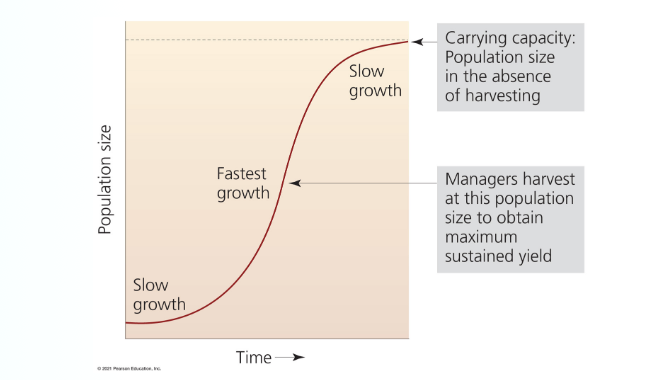
Maximum Sustainable Yield
how much a resource can be extracted in a sustainable manner.
\
BALANCE between harvest rate and GR OPTIMIZE sustainability and resource extraction.
\
Refers to the cut-rate that optimizes extraction & growth.
* Does not refer to the ecological impact of logging.
* Intermediate-aged trees are abundant in these forests.
\
BALANCE between harvest rate and GR OPTIMIZE sustainability and resource extraction.
\
Refers to the cut-rate that optimizes extraction & growth.
* Does not refer to the ecological impact of logging.
* Intermediate-aged trees are abundant in these forests.
20
New cards
Maximum Sustainable Yield Graph
carrying capacity: population size in the absence of harvesting
\
managers harvest at this population size to obtain maximum sustainable yield.
\
managers harvest at this population size to obtain maximum sustainable yield.
21
New cards
Logging Techniques
**Clear Cutting - cut all trees.**
**Strip Cutting - cut some trees.**
**Selective Cutting - cut some trees.**
**Strip Cutting - cut some trees.**
**Selective Cutting - cut some trees.**
22
New cards
Clear Cutting
* all trees are cleared from a site and a new, even-age stand of timber is grown.
* Clear cut soils prone to high rates of erosion.
* As root systems are destroyed, water & wind can cause erosion.
* This can cause long term degradation, since topsoil requires a lot of time to develop.
* **Yields high rate of resources extraction.**
\
clear cutting is when all trees are cleared from a site and are grown evenly. The soil is now prone to high rates of erosion which causes long term degradation.
* Clear cut soils prone to high rates of erosion.
* As root systems are destroyed, water & wind can cause erosion.
* This can cause long term degradation, since topsoil requires a lot of time to develop.
* **Yields high rate of resources extraction.**
\
clear cutting is when all trees are cleared from a site and are grown evenly. The soil is now prone to high rates of erosion which causes long term degradation.
23
New cards
Scheduled Cutting
* where all trees are harvested on a timeline.
* *Plantations are not ecosystems.*
* *Clearcut occurs on a “rotation time”*
* Designed to produce “maximum sustainable yield”.
* Does not account for the ecological impact of clear-cutting.
* **This practice still greatly decreases species biodiversity.**
\
all trees are harvested on a timeline. The cutting occurs in a rotation time and produces maximum sustainable yield. However the practice decreases species biodiversity
* *Plantations are not ecosystems.*
* *Clearcut occurs on a “rotation time”*
* Designed to produce “maximum sustainable yield”.
* Does not account for the ecological impact of clear-cutting.
* **This practice still greatly decreases species biodiversity.**
\
all trees are harvested on a timeline. The cutting occurs in a rotation time and produces maximum sustainable yield. However the practice decreases species biodiversity
24
New cards
Selective Cutting
* Certain tree species within a forest are targeted for cutting.
* All other species are left undisturbed.
* Root networks are able to remain intact.
* **Erosion is limited**
* **Water impacts are limited.**
* This is the most ecologically sustainable way of managing a forest ecosystem.
* May impact species that depend on trees that are being harvested.
* All other species are left undisturbed.
* Root networks are able to remain intact.
* **Erosion is limited**
* **Water impacts are limited.**
* This is the most ecologically sustainable way of managing a forest ecosystem.
* May impact species that depend on trees that are being harvested.
25
New cards
Strip Cutting
* Clear cutting is limited to strips
* Cut on “rotation time”
* Strips of clearcut areas extend away from central road.
* High impact the ecological structure of the forest.
* Significant increase in fragmentation / “edge”
* Root networks are able to remain intact.
* **Erosion is limited**
* **Water impacts are limited.**
* Cut on “rotation time”
* Strips of clearcut areas extend away from central road.
* High impact the ecological structure of the forest.
* Significant increase in fragmentation / “edge”
* Root networks are able to remain intact.
* **Erosion is limited**
* **Water impacts are limited.**
26
New cards
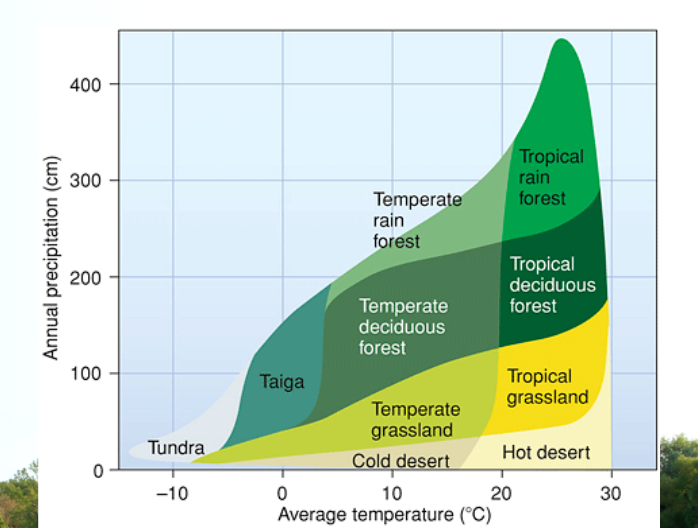
Climate and Biome
* Major contributors to climate also help to determine biome:
* **Temp**
* **Precipitation**
* Hours of sunlight / Angle of Incidence
* Wind currents
* Altitude
* **Interplay of these factors can determine the types of biotic factors in a region.**
* **Temp**
* **Precipitation**
* Hours of sunlight / Angle of Incidence
* Wind currents
* Altitude
* **Interplay of these factors can determine the types of biotic factors in a region.**
27
New cards
Whittaker Biome Graph
28
New cards
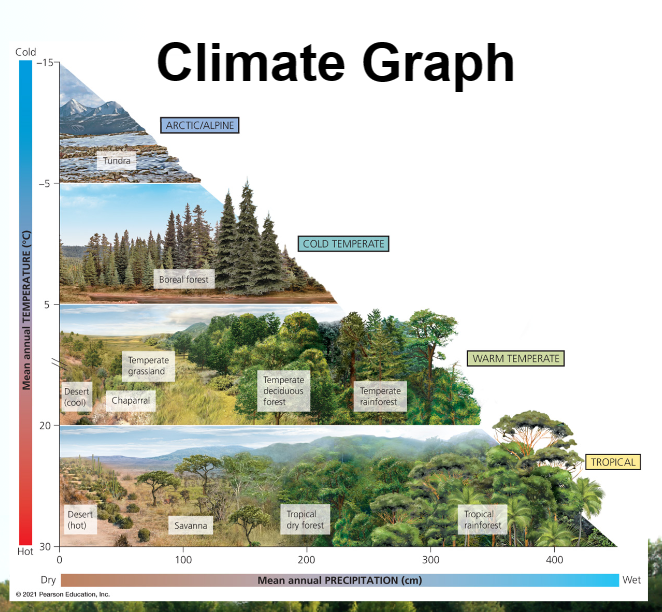
Climate Graph
29
New cards
**Climate Defintion**
**Long-term atmospheric conditions - or the average of weather.**
\
NOT WEATHER!!
\
NOT WEATHER!!
30
New cards
Climate is affected by different factors..
Atmospheric circulation patterns
ocean currents
elevation
radiant energy (sun)
biological factors (e.g. plants)
ocean currents
elevation
radiant energy (sun)
biological factors (e.g. plants)
31
New cards
Factors Affecting Regional Climate
* Convection cells
* Latitude / insolation
* Tilt of the earth’s axis
* Wobble of the earth’s axis.
* Oceanic currents
* Altitude of region
* Latitude / insolation
* Tilt of the earth’s axis
* Wobble of the earth’s axis.
* Oceanic currents
* Altitude of region
32
New cards
Climate Graphs
* Show annual precipitation and temperature, along with moths of the year.
* Can be used as a model for understanding common patterns in biomes.
* Should be able to identify the biome just by looking at the climate graph.
* In addition to this, you should also know the dominant vegetation and a couple examples of animals in each major biome.
* Can be used as a model for understanding common patterns in biomes.
* Should be able to identify the biome just by looking at the climate graph.
* In addition to this, you should also know the dominant vegetation and a couple examples of animals in each major biome.
33
New cards
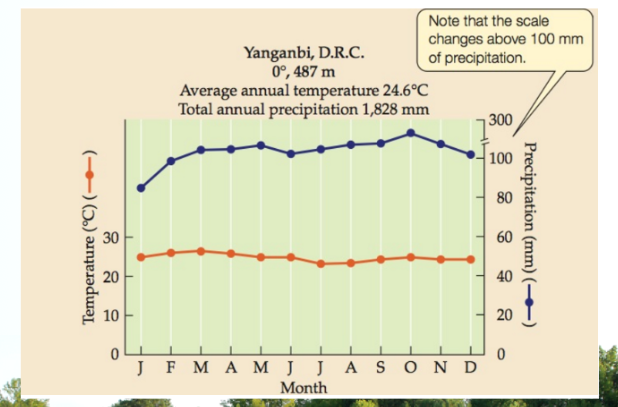
What is this Biome #1
tropical rainforest
34
New cards
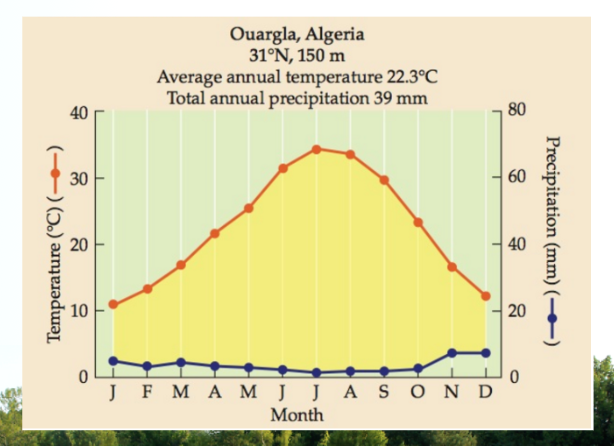
What is this Biome #2
Tropical Grassland
35
New cards
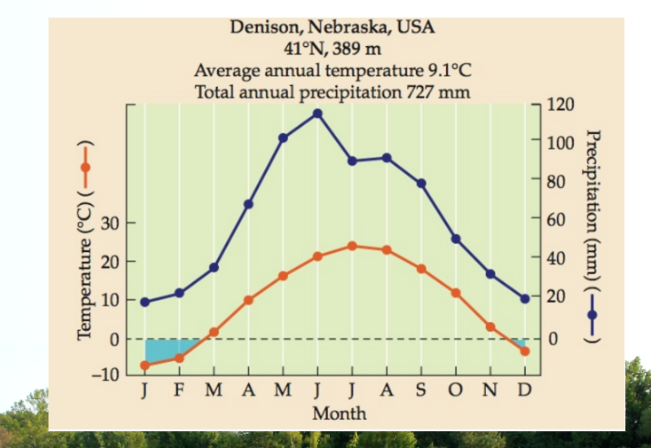
What is this Biome #3
Temperate Forest
36
New cards
Atmospheric Currents
Warming in the earth’s atmosphere is uniform b/c it is a spheroid.
\
air moves from areas of HIGH PRESSURE to LOW PRESSURE (air rising in the atmos = low pressure)
\
WARM AIR has LOW PRESSURE (b/c of LOW density) and RISES in COOLER air. (air increases in atmos = air is COLD)
\
air LOSES moisture as it RISES (precipitation occurs) (tropical rain forest biomes occur after)
\
the Coriolis effect causes the DEFLECTION OF AIR
\
air moves from areas of HIGH PRESSURE to LOW PRESSURE (air rising in the atmos = low pressure)
\
WARM AIR has LOW PRESSURE (b/c of LOW density) and RISES in COOLER air. (air increases in atmos = air is COLD)
\
air LOSES moisture as it RISES (precipitation occurs) (tropical rain forest biomes occur after)
\
the Coriolis effect causes the DEFLECTION OF AIR
37
New cards
Hadley Cells (TRF)
The amount of heat in the atmosphere @ the equator triggers TRF.
That warm air has LOW PRESSURE b/c the density is so low so that air RISES into COOLER air.
\
That air LOSES moisture as it RISES.
\
This causes precipitation to occur.
\
TFR occurs when the amount of heat @ the equator triggers it. due to the low density in the air, the warm air has low pressure so when it rises, the air cools. As it rises, the air loses moisture causing perciptation to occur
That warm air has LOW PRESSURE b/c the density is so low so that air RISES into COOLER air.
\
That air LOSES moisture as it RISES.
\
This causes precipitation to occur.
\
TFR occurs when the amount of heat @ the equator triggers it. due to the low density in the air, the warm air has low pressure so when it rises, the air cools. As it rises, the air loses moisture causing perciptation to occur
38
New cards
Ferrel Cells/ Deserts
Deserts occur at 30 degrees N and S b/c when the air moves N and S it has LOW MOISTURE because it loses that moisture at the TRF.
\
So cooler air will begin to SINK to the TROPOSPHERE.
\
That results in high pressure due to the lack of water in the sinking cool air.
\
So cooler air will begin to SINK to the TROPOSPHERE.
\
That results in high pressure due to the lack of water in the sinking cool air.
39
New cards
Coriolis Effect
a deflection of air currents at the right angles and moves air masses east and west.
40
New cards
Identify three leading causes of anthropogenic habitat fragmentation.
Urbanization
Agriculture
Land Development
Mining
Agriculture
Land Development
Mining
41
New cards
Identify the four categories in which biodiversity can be measured.
Genetic
Species
Functional
Ecosystem Biodiversity
Species
Functional
Ecosystem Biodiversity
42
New cards
Contrasts species richness and evenness
richness: the number of species in a population.
evenness: the relative abundance of species in a population
evenness: the relative abundance of species in a population
43
New cards
describe the concept of maximum sustainable yield and why it matters.
Definition: The extraction of resources in a sustainable manner
Why it matters: If your yield is sustainable, a population remains balanced and you are able to use that resource regularly and over the long term.
Why it matters: If your yield is sustainable, a population remains balanced and you are able to use that resource regularly and over the long term.
44
New cards
Identify the two main approaches to conserving the planet’s biodiversity.
Species Conservation
Ecosystem Biodiversity
Ecosystem Biodiversity
45
New cards
Convection Cells
a self-contained zone in which warmer air in the center is pushed upward and is balanced by the downward motion of cooler air
46
New cards
Hot Spot
A small area or region with a relatively hot temperature in comparison to its surroundings.